How to Write Resume Bullet Points: A Simple Formula That Stops You From Sounding Generic
How To Write Resume Bullet Points

A strong bullet is not “a better verb”. It is a complete mini-story: action, context, method, outcome, and a proof noun. If you do not have numbers, you can still show impact with directional outcomes, scope, constraints, and what changed because of your work. Use the checklist at the end to catch vague claims, inflated … Read more
Where to Put a Resume Summary: Placement Rules That Make Recruiters Read It

Where To Put Resume Summary

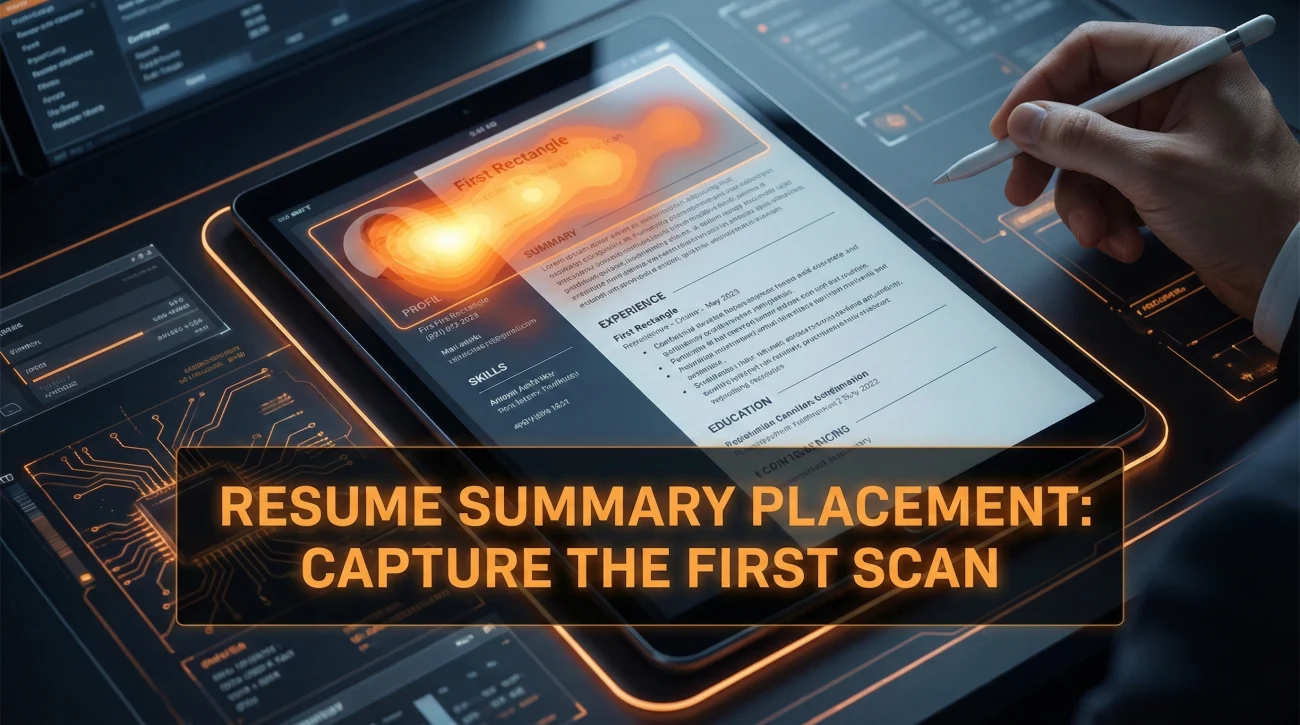
Your summary only works if it sits inside the first scan path: Contact, headline, summary, proof. Use one of three safe placements: Standard one-column, headline-first, or full-width above a two-column body. If you cannot make it specific in 3 to 5 lines, remove it and let your first bullets do the talking. The Simple Truth: … Read more

Resume Summary Mistakes: 15 Red Flags That Kill Credibility

Resume Summary Mistakes

A weak summary does not just waste space: It makes your direction and seniority feel unclear. Recruiters react to predictable lines fast: Generic openers, self-rating adjectives, and vague “seeking” language. This guide covers 15 resume summary mistakes recruiters notice quickly, plus a one-line fix for each and a 10-minute self-audit. Why Your Summary Gets Judged … Read more

Resume Summary Length: How Many Lines and Why Too Long Looks Fake

Resume Summary Length

Your resume summary length is a credibility signal: Too long often reads like you are compensating for weak proof. Think in lines, not sentences: Most strong summaries land in 2 to 5 lines depending on role level and what you must clarify. If you need 6+ lines, the fix is usually not “write better”, it … Read more

Resume Summary After a Gap: How to Signal Readiness Without Over-Explaining

Resume Summary After A Gap

Your summary is not a confession: It is a readiness signal. Use one of two patterns: “Ready-Now” or “Bridge-Back,” depending on how you are returning. If you mention the gap at all, do it as a light clause: Then let proof and outcomes carry the paragraph. The Real Job of a Summary When You Have … Read more

Resume Summary When You Are Overqualified: Signal You Want This Scope

Resume Summary When Overqualified

Your summary is not a highlight reel when you downlevel: It is a trust contract about scope. Use one of 3 patterns to signal: I want this level, I will stay, and I can deliver fast. Avoid red-flag phrases that accidentally scream: This is a stopgap. When You Are Overqualified, Your Summary Gets Read as … Read more

Resume Summary for Founders: Sound Hireable Without Apologizing

Resume Summary For Founders

If your summary starts with “Founder” and stops there, many recruiters will quietly worry about fit, stability, and working style. Use one of 3 founder-specific patterns: Target role first, add one scope cue, then proof that matches. Steal the structure of the 10 examples below and avoid the red-flag phrases that make you sound unavailable … Read more

Resume Summary for Freelancers: Signal Continuity and Team Readiness

Resume Summary For Freelancers

If your summary reads like you are still pitching for gigs, recruiters will assume you are not ready to commit. Use one of 3 freelancer-specific patterns: Role-first with client cue, In-house-ready consultant, or Specialist with repeatable outcomes. Add 2 proof hooks inside the summary: Scope, signal of continuity, and a team-ready operating style. When “Freelance” … Read more

Resume Summary for a Career Change: 4 Patterns That Make the Switch Feel Obvious

Resume Summary For Career Change

A career-change summary works when it reads like a decision you already validated, not a wish you’re announcing. Pick one proof type (project, credential, adjacent scope, measurable result) and build the first two lines around it. Use one of four patterns below, then tailor one sentence to mirror the job’s problem without keyword stuffing. Why … Read more

Resume Summary With No Experience: What to Say Without Sounding Like a Student

Resume Summary With No Experience

A resume summary with no experience works only when it includes proof hooks, not personality adjectives. Your “proof” can be coursework outcomes, projects, labs, competitions, student leadership, or real-world artifacts. Use a 4-line structure: Target role, focus area, proof, working style. Skip anything that sounds like a class introduction. The Weird Problem: You Need a … Read more

Resume Summary Examples: 20 Short Summaries With Notes, Proof Cues, and Fast Swaps

Resume Summary Examples

Most “resume summary examples” online fail because they do not show what your Experience bullets must support. Use a summary that passes three checks: Target role clarity, Evidence you can point to, And scope fit. Steal one of the 20 summaries below, then use the swap list to remove clichés fast without sounding robotic. Why … Read more

How to Write a Resume Summary: A Simple Formula That Sounds Human

How To Write A Resume Summary

A resume summary is not a mini bio. It is a proof-led positioning line that tells a recruiter what you do, where you fit, and what evidence backs it. Use a 4-part formula: Target role + Specialty + Proof anchor + Scope constraint. This is the fastest way to sound specific without sounding robotic. If … Read more

Resume Summary vs Resume Objective: Which One Works Now and Why

Resume Summary Vs Objective

If you can prove value, lead with a summary. If you need to prevent a wrong assumption, use a modern objective. The fastest decision rule: summary answers “What can you deliver?” objective answers “Where are you aiming, and why is it credible?” A 2026 objective only earns its space when it contains a target + … Read more

Resume Headline Mistakes: 15 Red Flags That Make You Look Unfocused

Resume Headline Mistakes

If your headline sounds impressive but can’t be proven in 10 seconds, recruiters assume it’s inflated. The fastest fix is replacing adjectives with one “proof hook”: A metric, a scope, or a named outcome. Use the contradiction test: Your headline should preview what the next two sections confirm, not introduce a new identity. Resume Headline … Read more

Where to Put a Resume Headline: Placement Rules That Don’t Break ATS

Where To Put Resume Headline

If you want the safest default: Put your headline in the document body, directly under your contact line, above your summary. If your template uses a Word header, icons, or two columns: Your headline can vanish in ATS parsing even when it looks perfect on screen. Use one clear placement rule, then adjust only when … Read more

Resume Headline After a Gap: What to Say and What to Avoid

Resume Headline For Gaps

If your gap is already obvious, your headline’s job is not “confession”. Its job is to signal role clarity, recent proof, and availability. Use one of two patterns: Role-first (with recency proof) or Return-to-work (only when the gap itself is the filter you want). Avoid wording that sounds ongoing: It quietly triggers “Are they still … Read more