

- Four shifts define modern screening: remote proof expectations, ATS parsing reality, age signal sensitivity, and contract-heavy histories
- Each screening context requires specific signals that most candidates miss entirely or handle inconsistently
- One consistency checklist keeps your story aligned across resume, application forms, LinkedIn headline, and interviews
- This guide routes you to the exact hub matching your specific situation
What Changed in How Resumes Get Screened

The hiring landscape looks nothing like it did five years ago. Not because recruiters suddenly became pickier, but because four specific shifts changed what they need to see and how they see it.
I learned this the hard way when a candidate named Marcus came to me after 47 applications with zero callbacks. His resume was fine by 2019 standards. Clean format, solid experience, good companies. But he had spent three years working remotely for a distributed team, had a contract-heavy history from consulting work, and his resume still listed a Hotmail address with his graduation year prominently displayed.
None of those things would have mattered a decade ago. Today, each one triggered a different screening concern that his resume did nothing to address.
Modern resume requirements are not about fancy templates or keyword stuffing. They are about understanding what recruiters now test for and giving them proof before they have to ask. Four contexts matter most:
| Modern Context | What Recruiters Test | What Most Candidates Miss |
|---|---|---|
| Remote proof | Can you actually deliver without supervision? | Listing tools instead of showing habits |
| ATS reality | Can their system parse your information correctly? | Focusing on keywords instead of structure |
| Age signals | Are you current or coasting on past success? | Only removing graduation year while keeping dated cues |
| Contract histories | Are you stable or a flight risk? | Listing contracts like permanent roles |
Marcus had issues in all four areas. We fixed them systematically. Within six weeks, he had three interviews and two offers. Not because his experience changed, but because his resume finally spoke the language modern screening requires.
Remote Proof: What Changed and What Recruiters Actually Test
Before 2020, remote work was a perk. Now it is a screening category. When a recruiter sees a remote role or suspects you will want one, they immediately test for something specific: evidence that you can deliver without being watched.
The problem is most candidates think remote proof means listing collaboration tools. It does not. A colleague named Priya made this mistake when applying for a remote marketing director role. Her resume mentioned Slack, Zoom, Asana, and Monday.com. She thought that showed remote readiness. The hiring manager told her later that everyone lists those tools. It told her nothing about whether Priya could actually manage herself.
What Remote Screening Actually Tests
Recruiters hiring for remote roles worry about four things. Not whether you have used Zoom, but whether you have demonstrated these patterns:
- Self-management means you hit deadlines without reminders and manage your own priorities
- Communication discipline means you document decisions, give updates proactively, and write clearly
- Async habits mean you can work across time zones without requiring synchronous availability
- Delivery reliability means you produce consistent output regardless of where you sit
Notice that none of these are about tools. They are about work patterns. Your resume needs to prove the patterns, not list the software.
How to Show Remote Proof Without Announcing It
The best remote proof looks like normal accomplishment bullets that happen to demonstrate remote-ready habits. Consider the difference:
The second version never mentions remote work explicitly. But any recruiter reading it sees exactly what they need: evidence that this person can coordinate across distance and deliver without constant check-ins.
Key Point: Remote proof is about showing work patterns, not listing tools. Documentation habits, async communication, and delivery consistency matter more than your Zoom proficiency.
If you have remote experience, your challenge is making it visible through proof signals rather than labels. If you lack remote experience, your challenge is finding analogous proof from situations where you worked independently or coordinated across locations.
ATS Reality: What Actually Breaks and What Does Not Matter
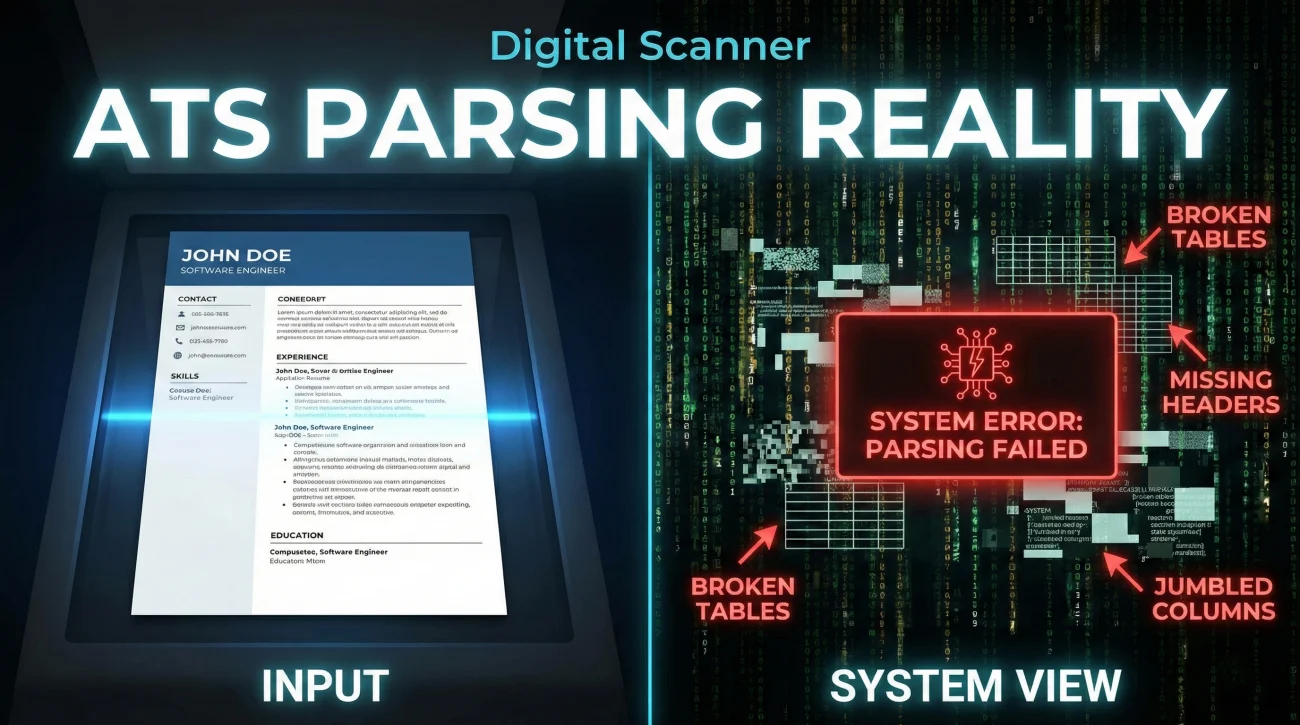
Most advice about Applicant Tracking Systems is either outdated or wrong. You have probably heard that ATS rejects 75% of resumes automatically. That statistic is misleading. Modern ATS systems do not reject resumes. They parse them, store them, and let recruiters search and filter.
The real problem is not rejection. It is parsing failure. When an ATS cannot read your resume correctly, your information gets scrambled, incomplete, or unsearchable. You might be in the database, but you are invisible to anyone looking for candidates with your qualifications.
What Actually Causes Parsing Problems
After watching candidates debug ATS issues for years, I have seen the same problems repeatedly. A marketing director named Elena had a beautifully designed resume with a two-column layout, custom fonts, and her contact information in a sidebar. The human eye loved it. The ATS saw gibberish.
Here is what commonly breaks parsing:
| Parsing Issue | What Happens | Fix |
|---|---|---|
| Headers and footers | Information disappears entirely | Keep contact info in main body |
| Multi-column layouts | Text merges incorrectly across columns | Use single-column structure |
| Tables for formatting | Content order becomes unpredictable | Use simple formatting instead |
| Creative section headings | System cannot categorize your experience | Use standard names: Experience, Education, Skills |
| Image-based PDFs | No text extracted at all | Use text-based PDFs from Word |
| Inconsistent date formats | Work history timeline gets confused | Pick one format and use it everywhere |
How to Test Your Own Resume
The simplest test takes two minutes. Open your resume in Word, select all, copy, and paste into a plain text editor like Notepad. If your information appears jumbled, out of order, or missing sections, an ATS will have the same problems.
💡 Pro Tip: The file format debate is mostly settled. DOCX parses more reliably than PDF in most systems. Unless the job posting specifically requests PDF, submit Word format.
Keywords Matter Less Than Structure
Keyword optimization gets too much attention. Yes, including relevant terms helps you appear in searches. But most candidates already include reasonable keywords naturally. The bigger issue is whether the system can read those keywords at all.
I have seen perfectly keyword-optimized resumes get zero traction because the ATS could not parse the experience section correctly. The keywords were there, but they were not associated with the right jobs or dates. The candidate looked unqualified even though they were perfectly matched.
Fix structure first. Keywords come second.
Age Signals: What Quietly Dates Your Resume
Age discrimination is real and documented. AARP research shows that 64% of workers over 50 have seen or experienced age discrimination in hiring. But here is what most advice misses: removing your graduation year is not enough.
A senior operations leader named David came to me frustrated. He had removed his graduation dates, trimmed his experience to the last 15 years, and used a modern template. Still getting screened out. When we analyzed his resume, we found seven other age signals he had not noticed.
Subtle Cues That Signal Age
Recruiters do not consciously look for age markers. But certain patterns trigger assumptions about whether a candidate is current or coasting:
- 📧 Email domains like AOL, Hotmail, or Yahoo instead of Gmail
- 📞 Listing a fax number or full mailing address
- 💼 Job titles with outdated terminology like Personnel Director instead of HR Director
- 🖥️ Skills sections listing obsolete technologies prominently
- 📝 Phrases like References Available Upon Request
- 📋 Objective statements instead of professional summaries
- 🔤 Formatting choices like two spaces after periods or all-caps headings
David had five of these. His AOL email address, a fax number on his contact line, skills listing Microsoft Office 2010, an objective statement, and he mentioned being responsible for personnel instead of talent management. Each one was small. Together, they painted a picture.
How to Emphasize Current Value
The goal is not hiding your experience. It is showing that your experience stays current. Consider these shifts:
| Dated Signal | Current Alternative |
|---|---|
| Listing every tool you have ever used | Focus on tools relevant to current roles |
| Detailed bullets for jobs from 20+ years ago | Brief mentions or consolidate as Earlier Experience |
| Emphasis on tenure and loyalty | Emphasis on recent impact and current skills |
| References to technologies no longer in use | Modern equivalents or remove entirely |
| Generic summary mentioning decades of experience | Summary focused on current capabilities and recent wins |
Key Point: Ageism screening is not about your actual age. It is about whether you seem current. Every resume element should reinforce that you are actively growing, not coasting on history.
Contract Histories: Making Gig Work Look Stable
Contract work has exploded. Industry data shows that by 2027, an estimated 86.5 million people will be freelancing in the United States. But resume conventions have not caught up. Most people list contract roles the same way they list permanent jobs, creating a pattern that looks like instability even when it reflects strategic career choices.
A consultant named Jenna had this problem. Five contracts over three years, all intentional, all with excellent outcomes. But her resume showed five employer entries in 36 months. To a recruiter scanning quickly, it looked like she could not hold a job.
What Recruiters Fear About Contract Histories
Understanding recruiter concerns helps you address them proactively:
- Churn risk means they worry you will leave quickly once something better appears
- Verification confusion means they cannot tell who your actual employer was for background checks
- Commitment questions mean they wonder if you can settle into a permanent team
- Scope uncertainty means they cannot tell if you had real responsibility or peripheral involvement
Framing Strategies That Work
The solution is not hiding contract work. It is framing it correctly so the stability signals come through:
For agency placements: List the staffing agency as your employer with end clients as project context. This matches what background checks will find and shows professional engagement rather than chaos.
Placed with Fortune 500 clients for operations improvement projectsClient: Global Retailer (8 months)
– Led process redesign reducing fulfillment time by 23%Client: Healthcare System (14 months)
– Managed integration of three acquired practices
For multiple contracts at the same company: Group them under one umbrella entry showing continuity and trust.
For intentional consulting: Lead with your consulting practice as the employer, with clients as engagements.
⚠️ Warning: Whatever framing you choose, make sure your LinkedIn matches your resume and both match what background checks will find. Verification mismatches kill offers.
The Consistency Checklist: Keeping Your Story Aligned
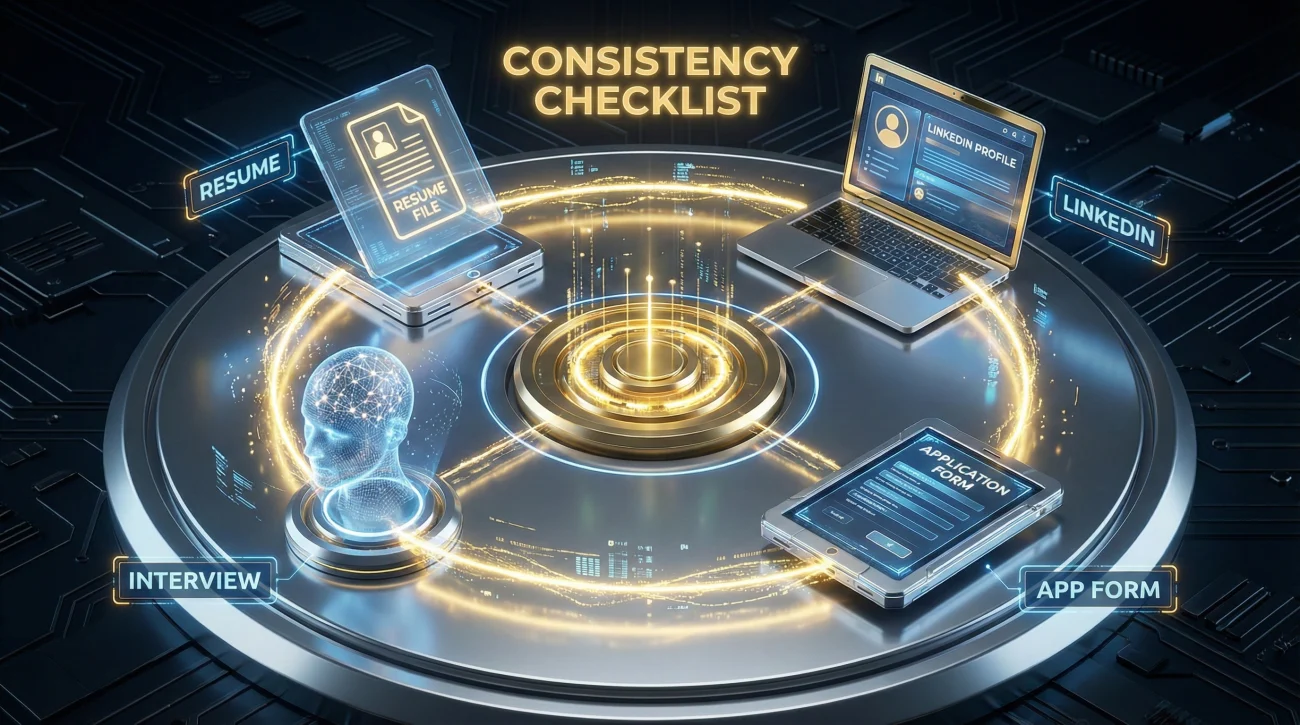
Here is what most candidates miss: your resume is not your only screening document. Recruiters check LinkedIn before or after reviewing your resume. They compare your application form answers. They listen to how you tell your story in interviews. Inconsistencies create doubt.
A product manager named Sasha lost an offer over this. Her resume said she managed a team of 8. Her LinkedIn said 6. Her interview answer said about a dozen. Each was technically defensible with different counting methods. But to the hiring team, it looked like she was inflating numbers.
Critical Alignment Points
Before submitting any application, verify these match across all touchpoints:
| Element | Resume | Application | Interview | |
|---|---|---|---|---|
| Job titles | Exact titles | Must match | Must match | Use same titles |
| Employment dates | Month/Year format | Must match | Must match exactly | Reference same timeframes |
| Employer names | Official names | Must match | Must match background check | Use same names |
| Team sizes | Specific numbers | Must match | Must match | Must match |
| Key metrics | Specific figures | If mentioned, must match | If mentioned, must match | Must match |
| Remote designation | Consistent labeling | Must match | Must match | Describe consistently |
Create One Source of Truth
The practical solution is maintaining a master document with your definitive information. When you update anything, update the master first, then sync all other documents. This prevents drift that happens when you update LinkedIn but forget to update your resume.
Your master document should include:
- Official employer names as they appear on W-2s and background checks
- Exact start and end dates for every role
- Specific metrics you can defend with context
- Consistent descriptions of team sizes, budgets, and scope
- Standardized explanation for any gaps or transitions
💡 Pro Tip: Before any interview, pull up your resume, LinkedIn, and the application you submitted. Review them side by side. Make sure you can speak to everything consistently.
Which Hub Fits Your Situation
This pillar covered the landscape of modern screening. The hubs below go deep on each specific context. Choose based on your primary challenge:
| Article | Description |
|---|---|
| Remote and Async Proof: Show You Can Work Remotely Without Saying It Loudly | Decision map for where to place remote proof, what proof nouns to use, how to show async habits, and what to do with no remote experience |
| ATS Reality: What the Parser Breaks and How to Stop It | What ATS actually extracts, where parsing fails, file types, headers, symbols, columns, section names, and line break rules |
| Age Signals: Hiding Your Age While Highlighting Your Experience | Subtle cues that date your resume, outdated skills and wording, contact details, summary strategy, and what to remove or reframe |
| Contract and Gig Context: Make a Contract-Heavy History Look Stable | Agency vs end client display, grouping contracts, continuity signals, conversion framing, and reference strategy |
If you face multiple challenges, start with the one causing the most friction in your current search. Most candidates find that fixing one context reveals issues in others that compound.
Moving Forward With Modern Requirements
The hiring landscape has changed. Remote work created new proof requirements. ATS adoption made parsing matter more than ever. Age bias research made subtle signals visible. Contract work became mainstream without resume conventions adapting.
Understanding modern resume requirements is not about following trends. It is about speaking the language that current screening processes understand. The candidates who adapt get interviews. The ones who assume the old rules still apply keep wondering why their applications disappear.
Start with the context causing your biggest friction. Fix it completely before moving to the next. And keep that consistency checklist handy. Nothing undermines a strong resume faster than contradicting it somewhere else in your application materials.
FAQ
🎯 How do I know which modern context is hurting my applications most?
Look at where your applications stall. If you get screened out before interviews, ATS parsing or keyword issues are likely culprits. If you get first interviews but no callbacks, age signals or remote readiness questions may be triggering concerns. If offers fall through at background check, contract verification mismatches are the problem. Track your funnel to identify the stage where things break.
📝 Do I need to address all four contexts even if only one applies to me?
Focus on what applies to your situation. If you have a traditional employment history with no remote work, the contract and remote sections matter less. But ATS formatting affects everyone, and age signals can affect anyone over 35. At minimum, verify your resume parses correctly and does not contain inadvertent age markers.
💼 Is the two-page resume still acceptable in 2026?
For senior professionals with 10+ years of relevant experience, two pages are fine if every line adds value. The issue is not length but density. A two-page resume full of outdated roles, irrelevant skills, and generic descriptions hurts you. A two-page resume showcasing recent impact with appropriate depth helps you. One page remains appropriate for early-career candidates.
🔍 Should I have different resume versions for different contexts?
Maintain one master resume with your complete information, then create targeted versions for specific job types. A remote role version might emphasize async communication skills. An in-office version might emphasize collaboration and leadership presence. The facts stay consistent, but the emphasis shifts. Never have versions with conflicting information.
⚠️ What if my LinkedIn has more detail than my resume?
⚠️ Disclaimer: ResumeSolving provides resume, cover letter, job search communication, and career transition guidance for informational purposes only. Hiring practices vary by employer, role, location, industry, and individual circumstances. We do not guarantee interviews, job offers, ATS results, or other outcomes. Verify employer requirements directly and follow applicable laws and workplace policies. For sensitive situations, use only information you are comfortable disclosing and keep all statements accurate.