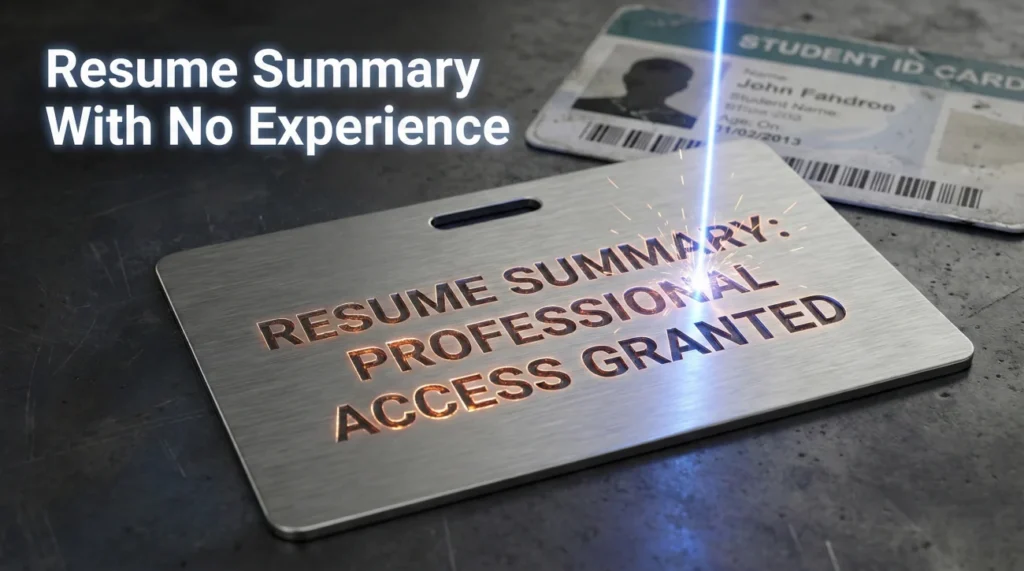
- A resume summary with no experience works only when it includes proof hooks, not personality adjectives.
- Your “proof” can be coursework outcomes, projects, labs, competitions, student leadership, or real-world artifacts.
- Use a 4-line structure: Target role, focus area, proof, working style. Skip anything that sounds like a class introduction.
The Weird Problem: You Need a Summary, But You Have Nothing to Summarize
I once worked with a candidate named Whitley who said, “I can write a cover letter, I can do the applications, I can even network. But the summary line makes me feel fake.” She was applying for entry-level analyst roles and her draft started with the usual stuff: motivated, eager, fast learner.
The truth is, she was motivated. She was eager. She was a fast learner. But the summary still read like a school hallway poster, not a hiring signal.
Here is the core shift that changed everything for her: A recruiter does not read a summary to confirm your vibe. They read it to answer one question fast: “What kind of work can this person do, and what proof do they have for it?”
That is why a resume summary with no experience can work, but only if it stops trying to sound confident and starts trying to sound specific.
What Recruiters Actually Scan For in Your First 6 Seconds
When someone has a few years of experience, the summary can be a highlight reel. When you do not, the summary becomes a navigation tool. It tells the reader where to look next on the page.
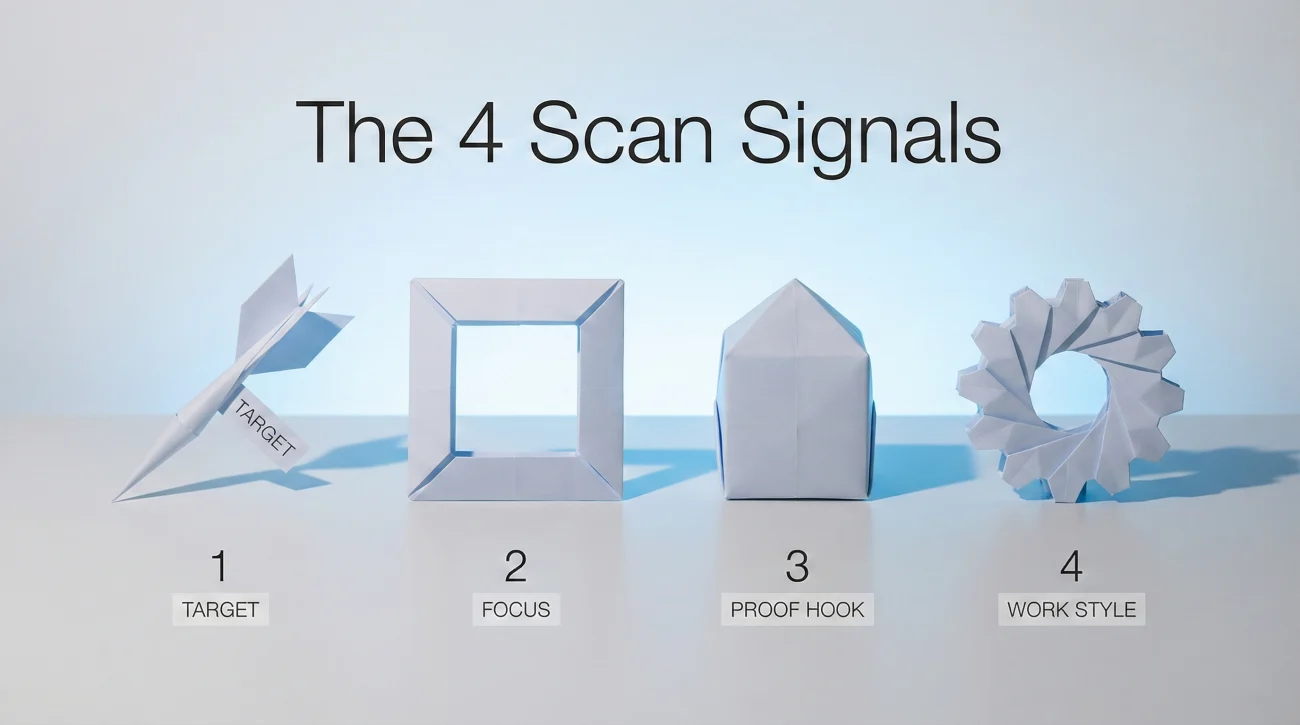
In practice, most recruiters scan your summary for four signals:
- Target: What role are you aiming for, in plain language?
- Focus: What part of that role are you already doing in some form?
- Proof hook: What artifact, outcome, or scope suggests you can deliver?
- Work style: How you operate, stated as behavior, not personality.
If any of these are missing, your summary becomes a motivational paragraph. That usually gets skipped, especially for entry-level roles where the recruiter expects to learn about you from projects and education anyway.
Key Point: The summary is not your origin story. It is your positioning line plus a proof hook that makes the next section feel worth reading.
Proof That Counts Even If You Have Never Had a Real Job
Internet advice often jumps straight to internships and volunteering. That is fine if you have it, but “no experience” should not require you to invent a life you have not lived.
One of my colleagues, Yoshie, mentors college seniors. She told me the same pattern keeps happening: Smart students bury their strongest proof because they do not label it as experience. They treat it like homework. Recruiters do not see it that way if you describe the outcome like work.
| Proof source | What to extract | How to phrase it in one line |
|---|---|---|
| Course project | Outcome + constraints | Built a pricing model in Excel for a case study, validated assumptions, and presented recommendations to a panel. |
| Lab / capstone | Process + reliability | Designed and tested an API integration, documented edge cases, and reduced test failures by tightening inputs. |
| Competition / hackathon | Speed + collaboration | Worked in a 4-person team to ship a working prototype in 24 hours, owning the data cleanup and dashboard. |
| Student leadership | Scope + impact | Led onboarding for a 20-member club, built a simple workflow, and improved attendance by standardizing reminders. |
| Personal build | Consistency + artifact | Built a small portfolio site and tracked conversion events, iterating based on user behavior and feedback. |
| Part-time or family responsibilities | Operating rhythm | Handled scheduling and inventory for a family shop on weekends, resolving stock issues and keeping records accurate. |
💡 Pro Tip: A proof hook does not need a big number. It needs a real artifact and a believable scope. “Built a dashboard” beats “strong analytical skills” every time.
A 4-Line Structure That Sounds Hireable, Not Like a Student Bio
If your summary is longer than 4 to 6 lines, it starts competing with your projects section. For entry-level candidates, that is the wrong fight. Keep it short, directional, and proof-based.
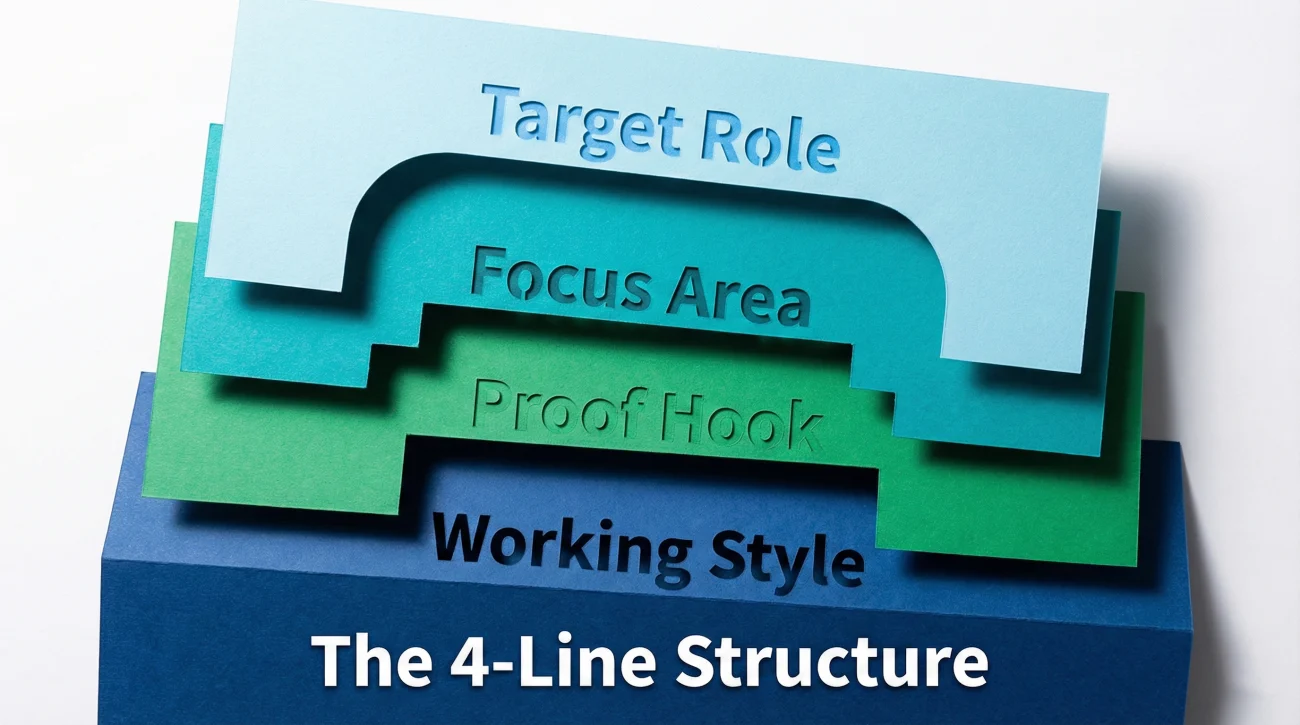
Use this structure:
[Target role] + [Focus area] + [Proof hook] + [Working style as behavior]
How to Fill It Without Lying
Target role: Pick the role you are applying for, not the degree you completed. “Data Analyst” is clearer than “Business student.”
Focus area: Choose one slice of the role. Do not list five. “Excel modeling and dashboard reporting” is better than “data, finance, marketing, and operations.”
Proof hook: One artifact. One outcome. One constraint if it helps. “Capstone project”, “case competition”, “lab build”, “portfolio”, “club ops”.
Working style: Describe how you behave. Avoid personality labels. Replace “hardworking” with “structured”, “deadline-driven”, “feedback-oriented”, “document-first”.
“If you do not have experience, stop trying to prove you are impressive. Prove you are specific.”
That quote is something I heard from a hiring manager friend after they screened a pile of entry-level resumes. It stuck with me because it explains the real difference between a summary that gets read and one that gets skipped.
10 Resume Summary Examples With No Experience
Below are examples designed to sound like someone who can do the work, not someone who wants a chance. Notice the pattern: each one has a proof hook that points the recruiter to the next section.
| Target role | Summary example |
|---|---|
| Data Analyst (Entry) | Entry-level Data Analyst focused on Excel modeling and clear reporting. Built a capstone dashboard using cleaned survey data and presented insights with actionable recommendations. Works document-first, checks assumptions, and iterates quickly based on feedback. |
| QA Tester | Entry-level QA Tester focused on test design and reproducible bug reporting. Created a test checklist for a class web app, logged defects with steps and screenshots, and helped reduce repeated failures by clarifying input rules. Detail-driven, structured, and consistent. |
| Marketing Coordinator | Entry-level Marketing Coordinator focused on content ops and basic performance tracking. Ran a student campaign project, built a posting calendar, and reported engagement patterns using simple dashboards. Reliable with deadlines and comfortable working across teams. |
| Business Analyst (Junior) | Junior Business Analyst focused on turning messy information into clear decisions. Delivered case competition work that translated stakeholder goals into a simple model and a concise recommendation deck. Communicates clearly, asks sharp questions, and documents assumptions. |
| Customer Support | Entry-level Customer Support candidate focused on calm problem-solving and clean handoffs. Handled scheduling and customer requests in a family business setting, keeping records accurate and resolving issues without escalation. Patient, organized, and service-oriented. |
| HR Assistant | Entry-level HR Assistant focused on coordination and process clarity. Supported a student organization by standardizing onboarding steps and organizing member records to reduce confusion during handoffs. Structured, detail-aware, and comfortable with sensitive information. |
| Finance Intern Candidate | Finance intern candidate focused on spreadsheet accuracy and practical analysis. Built a budget forecast for a coursework project, stress-tested assumptions, and summarized variance drivers in a short report. Careful with details and confident explaining numbers plainly. |
| Operations Coordinator | Entry-level Operations Coordinator focused on reliability and workflow basics. Led logistics for recurring student events, created checklists, and reduced last-minute issues by standardizing prep steps. Strong follow-through, clear communication, and deadline-driven. |
| Junior Designer | Junior Designer focused on clean layouts and fast iteration. Built a small portfolio of redesign concepts, gathered feedback, and refined work based on usability notes. Works in versions, explains decisions, and collaborates well with non-designers. |
| Software Engineer (Entry) | Entry-level Software Engineer focused on building and debugging small features. Shipped a working class project with API integration, documented edge cases, and improved reliability by tightening validation. Likes clear specs, writes readable code, and tests changes. |
If you want to make any of these feel more “you”, do not add adjectives. Swap the proof hook to match your real artifact and keep the structure intact.
What Not to Say: The Lines That Trigger Doubt
I have seen summaries get skipped for one simple reason: they read like a request. Hiring managers are not there to grant permission. They are there to reduce risk.
What makes a no-experience summary sound risky?
Anything that signals you are still in student mode, still undecided, or hoping the company will train you into basic readiness. Training is normal. Basic readiness is expected.
| Weak line | Why it fails | Swap to this |
|---|---|---|
| Enthusiastic student seeking an opportunity to learn. | Reads like an ask, not a capability. | Entry-level [Role] focused on [Focus], with proof from [Project or artifact]. |
| Hardworking, motivated, and passionate. | Unprovable adjectives. | Deadline-driven and structured, with a habit of documenting assumptions and changes. |
| Looking for a company that will train me. | Signals dependency. | Ready to contribute on [specific tasks], learning fast through feedback and clear documentation. |
| I have no experience but I am willing to work hard. | Highlights the weakest point first. | Built [artifact], delivered [outcome], and want to apply the same workflow to [role tasks]. |
| Team player with great communication. | Generic, overused. | Communicates clearly in writing, aligns on next steps, and closes loops with concise updates. |
⚠️ Warning: Do not try to “fix” no experience by inflating the summary. If your summary gets longer, it starts feeling defensive. Short and specific reads more confident.
Do You Even Need a Summary If You Are Entry-Level?
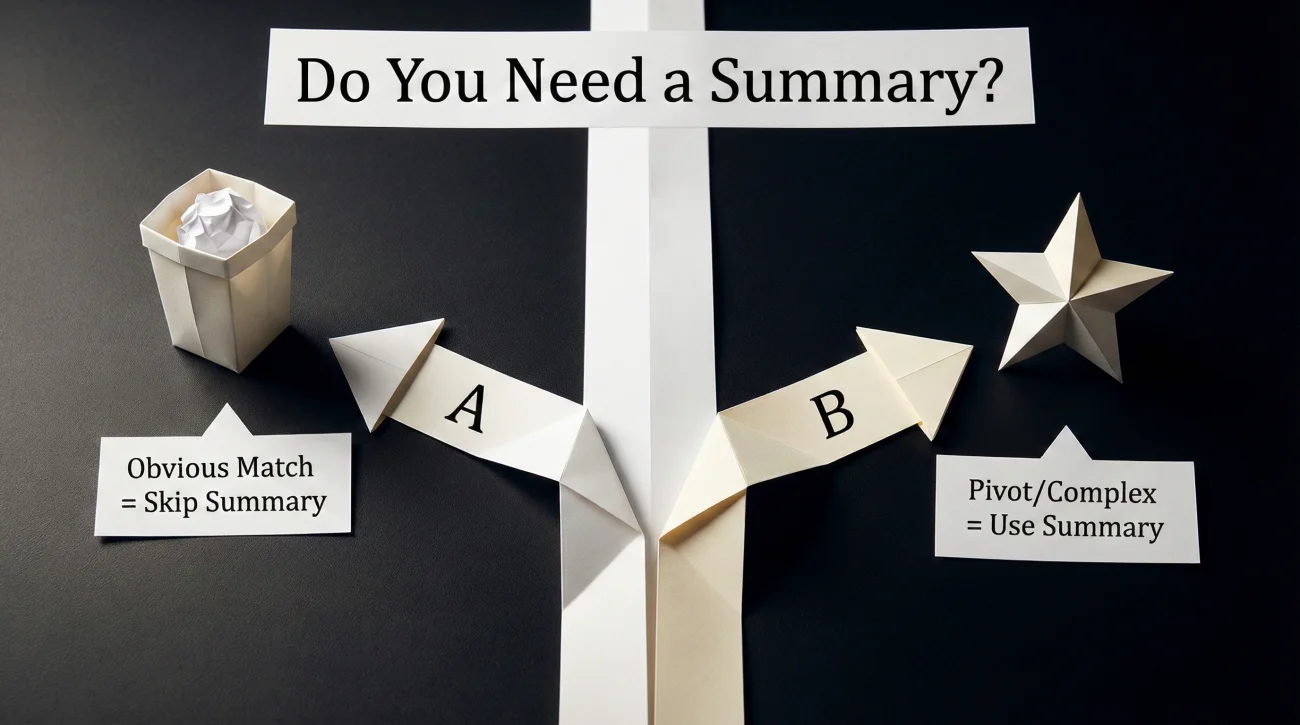
Sometimes, no. That is not a contradiction, it is a placement decision.
Here is the rule I use when I review entry-level resumes:
- If your target role is obvious from your degree and your projects match, a summary is optional.
- If you are pivoting, your degree is broad, or your projects need interpretation, a summary helps.
- If your resume is thin and your summary is generic, skip it and let projects lead.
A candidate named Linh once removed her summary entirely because it was just adjectives. We replaced it with a stronger first project bullet and a clearer project title. Her interviews improved, not because she hid anything, but because she stopped wasting the reader’s first glance.
So if you keep a summary, make it earn its space. The summary should not repeat what the section headers already say. It should position your proof.
Final
The best entry-level summary is calm. It does not beg, it does not overpromise, and it does not try to sound older than you are. It simply tells the truth in a way that makes your proof easy to find.
When you write a resume summary with no experience, your job is not to manufacture confidence. Your job is to show one real artifact, one believable scope, and one work style that sounds like how you actually operate on tasks.
If that feels small, good. Small and real reads stronger than big and vague.
❓ FAQ
🎓 Should I write “student” in my summary?
Only if it adds clarity. In most cases, the education section already shows you are a student or recent grad. Use the summary space to state the target role, focus area, and proof hook instead.
🧩 What if I truly have zero projects?
Use the closest real artifact you have: a class assignment with an outcome, a small portfolio piece, a competition attempt, or a responsibility where you handled records, scheduling, or coordination. The goal is not prestige, it is specificity.
🧪 Is coursework a weak proof hook?
Coursework is weak only when you describe it like school. If you describe an outcome, constraints, and what you delivered, it reads like work. Avoid listing course names in the summary.
🧠 How long should the summary be for entry-level?
Usually 3 to 5 lines. If it needs more than that to explain your fit, your projects or skills section probably needs cleaner titles and stronger first bullets.
📌 Should I use a resume objective instead?
An objective can work if it is not a wish list. If you choose an objective, treat it like a mini summary: target role, focus, and what you can contribute immediately, backed by a proof hook.
✅ What is the fastest way to improve my summary?
Delete every adjective you cannot prove. Replace it with one artifact, one outcome, and one behavior. If you only do that, your summary will already read more credible.
⚠️ Disclaimer: ResumeSolving provides resume, cover letter, job search communication, and career transition guidance for informational purposes only. Hiring practices vary by employer, role, location, industry, and individual circumstances. We do not guarantee interviews, job offers, ATS results, or other outcomes. Verify employer requirements directly and follow applicable laws and workplace policies. For sensitive situations, use only information you are comfortable disclosing and keep all statements accurate.