Resume Summary for Founders: Sound Hireable Without Apologizing

Resume Summary For Founders

If your summary starts with “Founder” and stops there, many recruiters will quietly worry about fit, stability, and working style. Use one of 3 founder-specific patterns: Target role first, add one scope cue, then proof that matches. Steal the structure of the 10 examples below and avoid the red-flag phrases that make you sound unavailable … Read more

Resume Summary for Freelancers: Signal Continuity and Team Readiness

Resume Summary For Freelancers

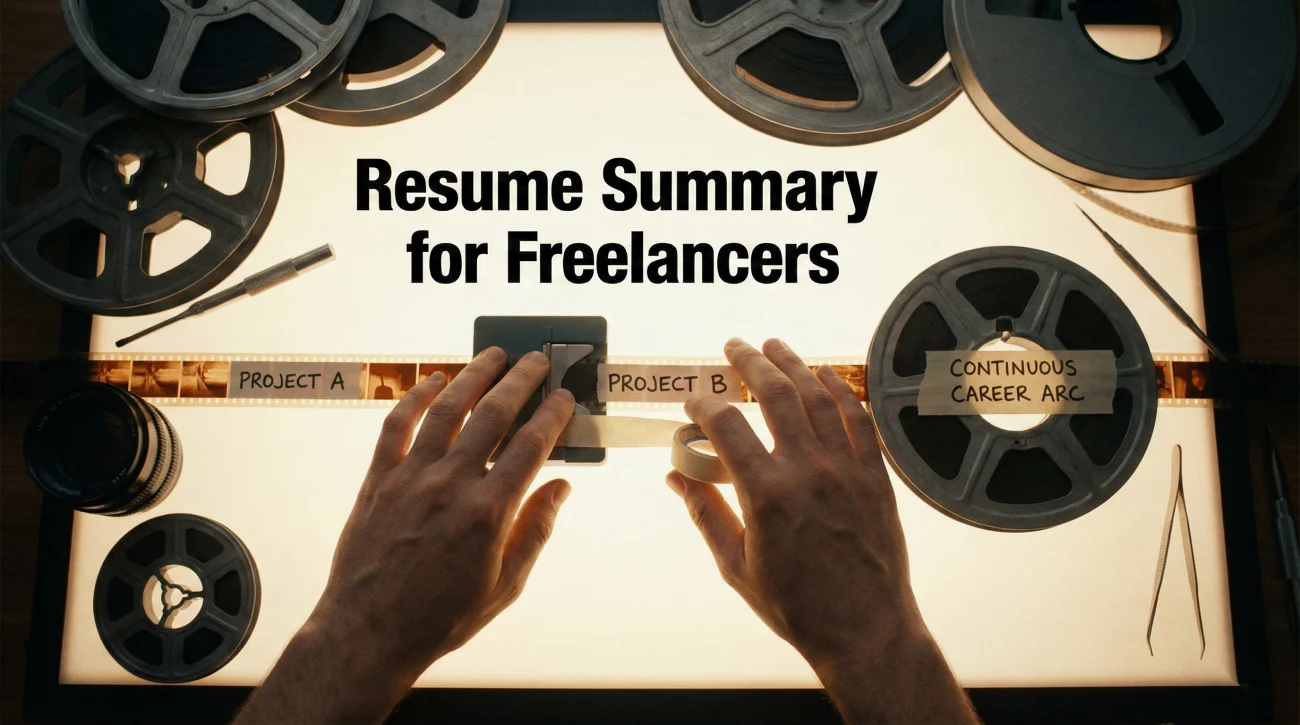
If your summary reads like you are still pitching for gigs, recruiters will assume you are not ready to commit. Use one of 3 freelancer-specific patterns: Role-first with client cue, In-house-ready consultant, or Specialist with repeatable outcomes. Add 2 proof hooks inside the summary: Scope, signal of continuity, and a team-ready operating style. When “Freelance” … Read more

Resume Summary for a Career Change: 4 Patterns That Make the Switch Feel Obvious

Resume Summary For Career Change

A career-change summary works when it reads like a decision you already validated, not a wish you’re announcing. Pick one proof type (project, credential, adjacent scope, measurable result) and build the first two lines around it. Use one of four patterns below, then tailor one sentence to mirror the job’s problem without keyword stuffing. Why … Read more

Resume Summary With No Experience: What to Say Without Sounding Like a Student

Resume Summary With No Experience

A resume summary with no experience works only when it includes proof hooks, not personality adjectives. Your “proof” can be coursework outcomes, projects, labs, competitions, student leadership, or real-world artifacts. Use a 4-line structure: Target role, focus area, proof, working style. Skip anything that sounds like a class introduction. The Weird Problem: You Need a … Read more

Resume Summary Examples: 20 Short Summaries With Notes, Proof Cues, and Fast Swaps

Resume Summary Examples

Most “resume summary examples” online fail because they do not show what your Experience bullets must support. Use a summary that passes three checks: Target role clarity, Evidence you can point to, And scope fit. Steal one of the 20 summaries below, then use the swap list to remove clichés fast without sounding robotic. Why … Read more

How to Write a Resume Summary: A Simple Formula That Sounds Human

How To Write A Resume Summary

A resume summary is not a mini bio. It is a proof-led positioning line that tells a recruiter what you do, where you fit, and what evidence backs it. Use a 4-part formula: Target role + Specialty + Proof anchor + Scope constraint. This is the fastest way to sound specific without sounding robotic. If … Read more

Resume Summary vs Resume Objective: Which One Works Now and Why

Resume Summary Vs Objective

If you can prove value, lead with a summary. If you need to prevent a wrong assumption, use a modern objective. The fastest decision rule: summary answers “What can you deliver?” objective answers “Where are you aiming, and why is it credible?” A 2026 objective only earns its space when it contains a target + … Read more

Downleveling After a Health Break: Explain Why This Level Now

How To Explain Taking A Lower Level Job After Health Break

If you are taking a lower level role after a health break, hiring teams are testing risk, retention, and readiness more than ambition. A strong explanation has three parts: the break is closed (without medical detail), the level is intentional, and your runway is stable. Pick one story framework and stick to it: Skill Anchor, … Read more

Resume Summary: Write 4-6 Lines That Make the Rest of Your Resume Easier to Believe

Resume Summary

A resume summary is not an introduction. It is a credibility snapshot that makes everything below it easier to believe. Four elements make summaries work: target role clarity, proof hint, scope signal, and professional tone. Miss any one and the summary falls flat. Keep it between 3 and 5 lines. Longer summaries read like you … Read more