- If your gap is already obvious, your headline’s job is not “confession”. Its job is to signal role clarity, recent proof, and availability.
- Use one of two patterns: Role-first (with recency proof) or Return-to-work (only when the gap itself is the filter you want).
- Avoid wording that sounds ongoing: It quietly triggers “Are they still unavailable?” even when your experience is strong.
The uncomfortable truth about headlines after a gap
I have a soft spot for candidates who come back after a gap, because I’ve watched how unfair the first impression can be. Not unfair in a dramatic way. Unfair in a quiet, administrative way: A recruiter skims, sees a date break, and their brain fills in a story before they’ve earned the right to have one.
That’s why resume headline for gaps is such a tricky phrase. People assume the headline is where you explain the gap. Most of the time, it’s not. The headline is where you remove doubt about three things: What role you’re targeting, whether your skills are current, and whether you’re actually ready to start.
A candidate named Everleigh taught me this without meaning to. She had a 14-month break after a layoff and caregiving overlap. Her first draft headline tried to “be transparent”. It was honest, but it planted the wrong question in my head: “Is this still happening?” When we rewrote the headline to be role-first with recent proof, the rest of her resume suddenly read like momentum, not absence.
Key Point: Your headline is not the place to prove you had a valid reason. It’s the place to prove you are current and hireable today.
What your headline is really doing after a gap
When someone has uninterrupted employment, a headline is often optional. After a gap, it becomes a steering wheel. It points the reader toward the interpretation you want before they start making their own.
Here’s the part most articles skip: Recruiters don’t “punish gaps” as a moral issue. The risk they’re scanning for is operational. They’re quietly asking: Is this candidate rusty? Are they going to disappear again? Are they still dealing with the thing that caused the gap? Even kind recruiters ask those questions because hiring is a risk management job.
I once sat next to a colleague during a high-volume hiring week. She didn’t say anything mean about a returning parent. She just sighed and said, “I hope she’s actually ready.” That sentence is the headline problem in one line: Your job is to make “ready” feel obvious without sounding defensive.
So should you mention the gap in the headline?
Usually, no. If the gap is visible in dates, you don’t need to re-announce it. Instead, you should announce what the gap cannot show: Recency, relevance, and readiness. The exception is when you are intentionally filtering for returnship programs, return-to-work roles, or employers who explicitly welcome career breaks. In that case, mentioning it can be a strength, but only with the right structure.
A simple decision matrix: When the gap belongs in the headline
If you’ve ever stared at your resume thinking, “If I don’t explain it, they’ll assume the worst,” you’re not alone. The fix is not oversharing. The fix is choosing the right placement for the right information.
| Situation | Headline move |
|---|---|
| Gap is visible in dates, and you have any recent proof (course, project, freelance, volunteer, certification, portfolio) | Do not mention the gap. Lead with role + proof + recency. |
| Gap is visible, but you have almost no recent proof and you’re applying to competitive roles | Do not mention the gap. Use headline to spotlight the strongest credibility anchor you do have. |
| You are applying to returnship, re-entry, or “career break welcome” programs | Mention the return-to-work angle, but keep it forward-looking and proof-based. |
| Your gap is not obvious (short break, contract work, or you’re listing years not months) | Do not mention the gap. You gain nothing by introducing a question they may not ask. |
| You are pivoting careers and the gap is part of the pivot story (study, retraining, bootcamp) | Consider a “pivot headline” that leads with target role and credibility, not the gap itself. |
⚠️ Warning: If you mention the gap in the headline, you are choosing to make the gap the first thing they process. Only do that when it helps you filter for the right kind of role or employer.
Pattern 1: Role-first headline that quietly solves the gap question

This is the pattern I use most when someone asks for a resume headline for employment gap and they’re tempted to write “Returning after a break”. The smarter move is to lead with the role and sneak the reassurance in through proof and recency.
Think of it like a movie trailer. You don’t open with the production delay. You open with the strongest scene.
[Target Role] + [Specialty or Scope] + [Proof] + [Recency Signal]
What counts as “proof” when you were not employed
Proof is not limited to payroll. A recent project, a certification, a portfolio refresh, a volunteer role with measurable output, a freelance engagement, even a structured self-directed build can count. The key is that it sounds specific and current, not vague and timeless.
A candidate named Kyler had a nine-month gap after a startup shutdown. His first headline was “Experienced Product Manager”. True, but empty. We changed it to highlight a recent product teardown portfolio and a small consulting engagement. That one line gave me something concrete to believe in.
| Weak headline fragment | Stronger proof-based fragment |
|---|---|
| Results-driven, motivated | Shipped 3 automation workflows, reduced manual reporting 40% |
| Skilled in project management | Led cross-team launch plan, hit deadline with 0 critical defects |
| Strong communicator | Partnered with 6 stakeholders, aligned scope and priorities |
Examples you can adapt
These are intentionally written to feel like a human, not a template. Keep them to one line in your layout.
- Customer Success Manager | Renewal strategy + retention saves | Recent SaaS portfolio refresh
- Data Analyst | SQL + dashboard automation | Built 5 KPI dashboards in the last 90 days
- Marketing Manager | Paid search + lifecycle | Increased qualified leads 28% on recent campaign work
- Operations Lead | Process redesign + SOPs | Cut cycle time 18% in latest engagement
- Frontend Developer | React + performance | Shipped 3 projects, improved Lighthouse scores
💡 Pro Tip: If you’re worried about sounding like you’re freelancing “too hard,” make the recency signal small and factual, not dramatic.
Pattern 2: Return-to-work headline that feels intentional, not apologetic
This is the pattern for people who are explicitly targeting programs and teams that want returners. Or for people whose gap is long enough that trying to hide it creates more suspicion than clarity.
The mistake I see is wording that sounds like a plea: “Looking for an opportunity after a break.” That line makes you feel small. We want language that makes the return feel like a decision.
Returning [Role] + [Current Skill Focus] + [Proof of Readiness]
Safe ways to signal return without triggering “still unavailable”
Use forward-facing words and current activity. You are not explaining the past. You are anchoring the present.
- Returning Project Manager | Rebuilt workflow toolkit | Available full-time, ready for delivery
- Returning UX Designer | Updated portfolio + case studies | Recent usability projects completed
- Returning Finance Analyst | Advanced Excel + modeling refresh | Current dashboards and templates ready
“I’m back on the market and I’m ready to start. I just need my resume to stop making me sound like I’m still halfway out the door.”
That sentence came from Hope, a candidate re-entering after a long family-care period. Her resume was not the issue. Her wording was. When we switched her headline from “Career break” to a return-to-work structure with a tangible proof point, interviews started coming in because the headline finally answered the operational question: “Is she ready now?”
Resume headline after a gap works best with this pattern when you add one concrete readiness anchor. A certification, a recent project, a clear availability signal, or a current specialization.
What to avoid: Words that accidentally sound like the gap is ongoing
The headline is tiny, which makes every word louder. Some words are honest but risky because they imply continuing constraints. The recruiter doesn’t know you. They will interpret your headline as a status update.
| Avoid in headline | Use instead |
|---|---|
| Taking time off, currently on break | Returning to work, available full-time |
| Stepping away, focusing on family | Re-entering the workforce, ready to contribute |
| Rebuilding confidence, getting back into it | Skills refreshed, recent projects completed |
| Exploring options | Targeting [Role], focused on [Specialty] |
❌ Note: “Exploring” and “transitioning” are fine in a longer summary if the job is flexible. In a headline, they often read like uncertainty.
Routing rules: Where the gap explanation belongs instead of the headline
If you don’t put the gap in the headline, you’re not “hiding” it. You’re placing it where it can be understood correctly. Think of this as component strategy: Each section should carry the type of information it can handle best.
Best place for a one-line explanation: The summary
Your summary can hold nuance. Your headline cannot. If you need one sentence of context, place it in the summary where it can be followed immediately by proof and skills.
Resume Summary (Line 2): Returned to the market after a family care period, now available full-time with recent portfolio work and updated tooling.
Resume Summary (Line 3): Strengths: Experiment design, onboarding flows, lifecycle metrics, stakeholder alignment.
Best place for dates: The experience section label
If you want to prevent “mystery dates,” a neutral entry can help. Keep it factual, not emotional, and do not inflate it into a fake job title.
Focus: Family responsibilities and skills refresh (Excel modeling, reporting automation, portfolio updates)
Best place for the full story: The interview
Most hiring managers will ask once. Your job is to answer once, calmly, and then return to value. If you wrote a strong headline and summary, the question usually comes with less suspicion and more curiosity.
A quick checklist before you lock the headline
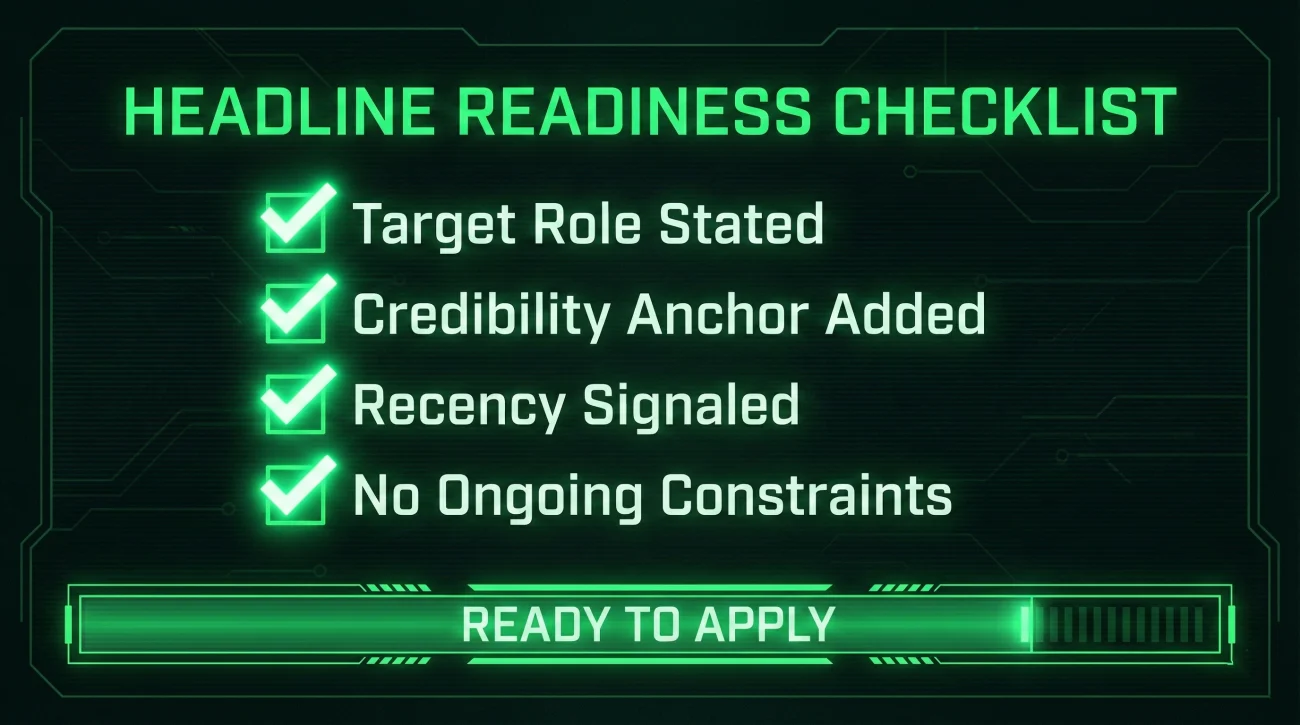
I tell candidates to read their headline like a stranger would. Not like a person cheering for them. Like someone who has 40 resumes open and wants to reduce risk fast.
- ✅ Does it clearly state the target role, not just “professional”?
- ✅ Does it include one credibility anchor: metric, project, tool, scope, or specialization?
- ✅ Does it signal recency in a calm way, not a desperate way?
- ✅ Does it avoid words that imply ongoing constraints?
- ✅ Can you defend every claim in an interview without overexplaining?
If you can hit those five, your headline is doing its job. If you can’t, the fix is usually not longer wording. The fix is better proof.
Final: The goal is “current”, not “perfectly explained”
Here’s the mindset shift I wish more people had. You do not need a headline that convinces every employer. You need a headline that gets the right employers to keep reading.
When someone searches “resume headline after unemployment,” they’re usually trying to solve embarrassment. But the recruiter is not grading your life. They’re grading your readiness. Lead with the role. Show one piece of recent proof. Keep the gap explanation out of the headline unless the gap itself is part of the role you’re targeting.
If you want a simple rule you can reuse across different resume components, it’s this: Put fragile information where it can be supported by context. Put strong information where it can stand alone. That’s the whole strategy behind a resume headline for gaps that actually works.
❓ FAQ
🎯 Should I write “career break” in my headline?
Most of the time: No. If the gap is visible in dates, you gain more by using the headline for role clarity and recency proof. Use a return-to-work headline only when you are intentionally targeting returnship or re-entry programs.
🧩 What if my gap is long and I have no recent projects?
Then your headline should highlight the most stable credibility anchor you still have: Scope, domain expertise, tools you are strong in, or the level you operated at. Put the gap explanation in the summary, and build one small proof item you can honestly reference.
✅ Can I say “available immediately” in a headline?
You can, but keep it calm. If you use availability language, pair it with role clarity and one proof point so it reads like readiness, not urgency.
🧠 Is it better to hide gaps by removing months from dates?
It depends on your market and the length of the gap. Removing months can reduce noise, but it can also create suspicion if the timeline feels too “smoothed.” If you choose years-only, make sure the rest of the resume still shows recency through projects, tools, or outcomes.
📌 Where should I explain the reason for the gap?
Use the summary for one neutral sentence if needed. Use the experience section for a factual label if you want to prevent timeline confusion. Save the full story for the interview, where you can answer once and pivot back to value.
⚠️ Disclaimer: ResumeSolving provides resume, cover letter, job search communication, and career transition guidance for informational purposes only. Hiring practices vary by employer, role, location, industry, and individual circumstances. We do not guarantee interviews, job offers, ATS results, or other outcomes. Verify employer requirements directly and follow applicable laws and workplace policies. For sensitive situations, use only information you are comfortable disclosing and keep all statements accurate.