
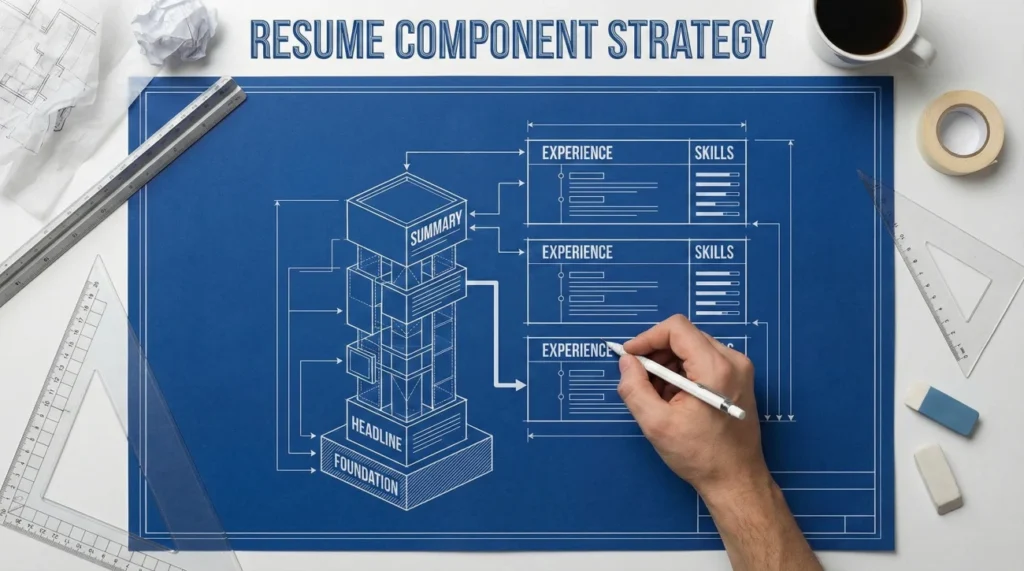
- Every resume section has one job: support your story. Headlines claim your target role. Summaries prove you belong. Bullets show you deliver. Dates build trust.
- Use the Clarity Framework for every section: Claim → Proof → Scope → Tone.
- Inconsistency between sections kills applications. Your headline, summary, and bullets must tell the same story.
- This guide routes you to specific playbooks for headlines, summaries, bullets, dates, and cover letter fixes.
Why Section-by-Section Strategy Matters
Most resume advice treats sections in isolation. Write a good summary. Use strong action verbs. Include metrics in your bullets. But resumes fail when the sections do not work together.
Your headline says “Senior Product Manager” but your bullets describe entry-level tasks. Your summary claims leadership experience but your dates show six-month stints. Your bullets prove technical skills but your headline targets a management role.
Recruiters notice these mismatches. They may not consciously identify them, but they feel something is off. The resume goes in the “maybe” pile, which really means the “no” pile.
A data scientist named Priya came to me after 50 applications with zero callbacks. Her resume looked fine at first glance. But her headline targeted “Data Science Manager,” her summary emphasized individual contributor work, and her bullets were split between analytics and unrelated admin tasks. The story was confused, and recruiters moved on.
We rebuilt her resume section by section, making sure each piece supported the same narrative. Same experience, same person. She had three interviews within two weeks.
The Five Sections That Make or Break Your Resume
Each section has a specific job. When every section does its job, the resume becomes greater than the sum of its parts.
| Section | Primary Job | Common Failure |
|---|---|---|
| Headline/Title | Claim your target role in 2 seconds | Vague identity soup, mixed roles |
| Summary | Prove you belong in that role with scope and credibility | Generic claims, no proof, too long |
| Bullet Points | Show specific work that matches the target role | Task lists, no outcomes, inflated verbs |
| Dates & Timeline | Build trust through consistency and clarity | Missing months, unexplained gaps, fuzzy dates |
| Cover Letter (when needed) | Address one specific concern the resume cannot | Repeating resume, over-explaining, blame |
Think of your resume as a legal brief. The headline is your opening statement. The summary provides context and establishes credibility. The bullets are evidence. The dates are the timeline that makes everything verifiable. The cover letter, when used, addresses the one thing the judge might object to.
The Clarity Framework
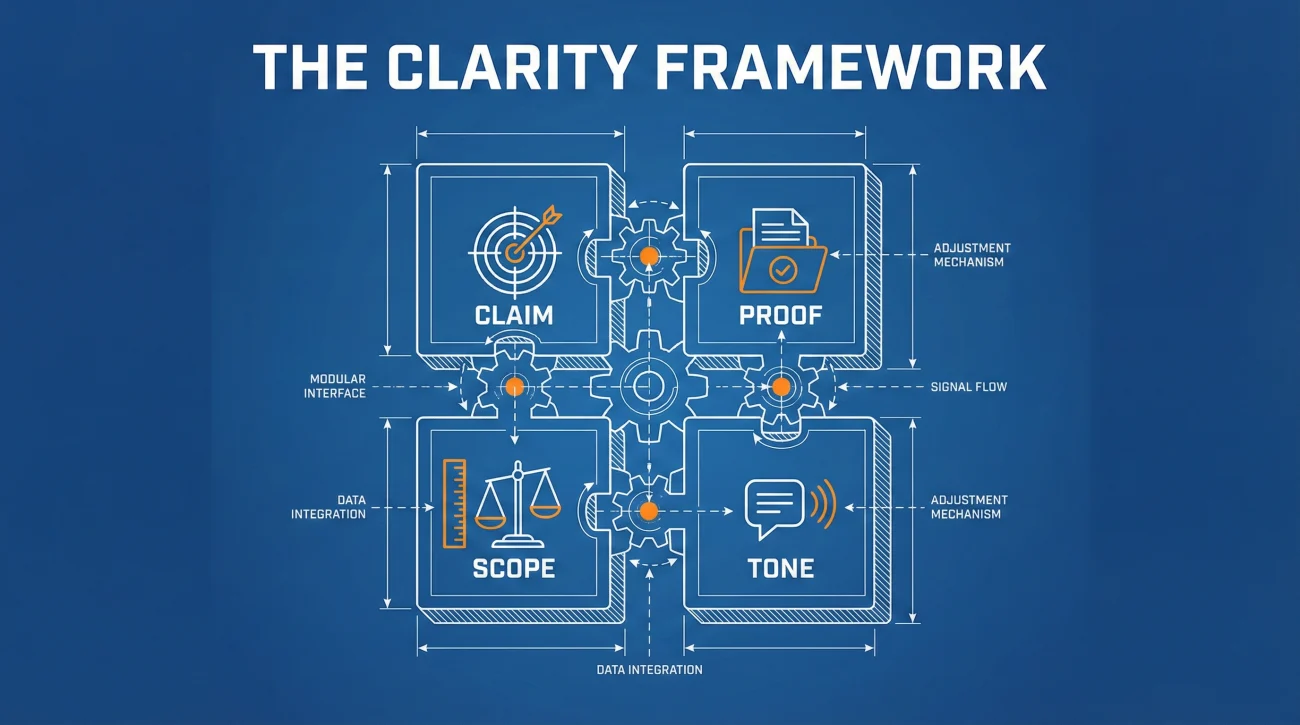
Every section should pass the same four-part test. If any element is missing or weak, the section fails.
- 1️⃣ Claim: What are you asserting? Every section needs a clear claim about who you are or what you did.
- 2️⃣ Proof: What evidence supports the claim? Without proof, claims are just words.
- 3️⃣ Scope: What was the scale and context? Scope makes claims believable and helps recruiters calibrate.
- 4️⃣ Tone: Does it sound human and confident? Wrong tone undermines even accurate content.
Applying the Framework to a Headline
Weak headline: “Experienced Professional Seeking Opportunities”
- ❌ Claim: Vague (what kind of professional?)
- ❌ Proof: None
- ❌ Scope: None
- ❌ Tone: Passive, generic
Strong headline: “Senior Product Manager | B2B SaaS | Growth & Retention”
- ✅ Claim: Senior Product Manager (clear role)
- ✅ Proof: B2B SaaS (domain expertise hint)
- ✅ Scope: Growth & Retention (specialization)
- ✅ Tone: Confident, specific
Applying the Framework to a Bullet
Weak bullet: “Responsible for managing projects and working with teams.”
- ❌ Claim: Vague (what projects? what teams?)
- ❌ Proof: None
- ❌ Scope: None
- ❌ Tone: Passive, filler language
Strong bullet: “Led cross-functional team of 8 to deliver checkout redesign 2 weeks ahead of schedule, reducing cart abandonment by 15%.”
- ✅ Claim: Led a team to deliver a project
- ✅ Proof: 15% reduction in cart abandonment
- ✅ Scope: Team of 8, checkout redesign
- ✅ Tone: Confident, specific
Run every section through this framework before you finalize your resume. If any element is missing, fix it or cut the content.
The Consistency Checklist
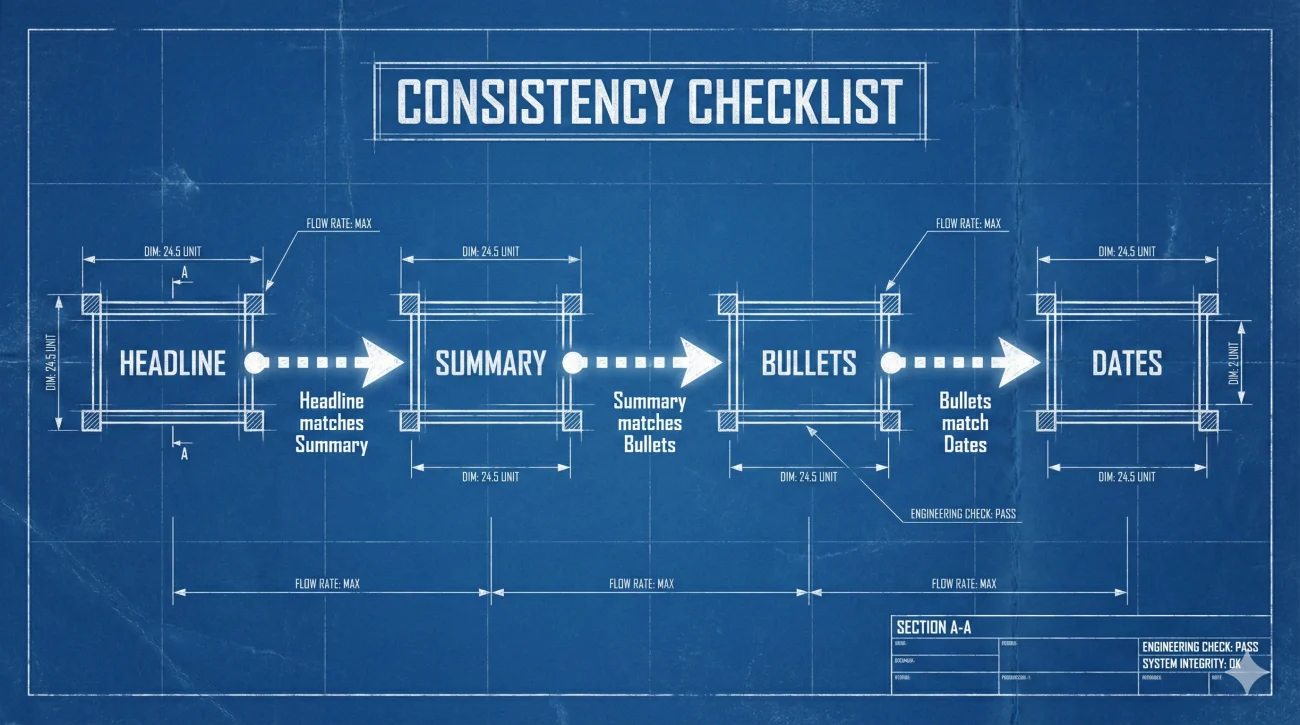
Sections working in isolation is not enough. They must work together.
Does your resume pass these consistency checks?
- Headline → Summary alignment: Does your summary expand on the headline claim with proof and scope?
- Summary → Bullets alignment: Do your bullets provide evidence for what the summary claims?
- Bullets → Dates alignment: Are the accomplishments in your bullets from verifiable time periods?
- Seniority consistency: Does your headline seniority match the scope in your bullets?
- Industry consistency: If your headline claims a domain, do your bullets show work in that domain?
- Role type consistency: If your headline says manager, do your bullets show management work?
A marketing manager named Derek had a resume that failed multiple consistency checks. His headline said “Marketing Director” but his most recent role was Marketing Coordinator. His summary mentioned “driving strategy” but his bullets were all execution tasks. His claimed industry expertise (fintech) was not supported by any fintech experience in his work history.
We realigned everything to his actual experience level and let his strong execution work shine. He got callbacks within a week.
Key Point: Recruiters do not read resumes top to bottom. They scan headlines, jump to recent experience, glance at dates. If these pieces tell different stories, they move on.
Think about it from the recruiter’s perspective. They have 200 resumes to review. They spend maybe 10 seconds on each one in the first pass. In those 10 seconds, they see your headline, maybe your summary, and your most recent job title and dates. If those pieces align, they slow down and read more. If those pieces conflict, they move on to the next resume.
Your sections must work as a team in that 10-second window.
Hard Cases That Require Extra Section Work
Standard resumes are straightforward. Hard cases require deliberate choices about what each section emphasizes.
📅 Employment Gaps
Gaps affect your dates section primarily, but they ripple through everything. Your summary may need a readiness signal. Your bullets may need to include recent non-employment activity. Your cover letter may need one paragraph of context.
The key is not to over-address gaps. One clear signal of “I am ready now” is usually enough. Repeating it in every section looks defensive.
🔄 Career Pivots
Pivots require translation in every section. Your headline claims the target role, not your old identity. Your summary bridges old experience to new relevance. Your bullets emphasize transferable outcomes. Your dates may need a “Recent Projects” section to show current relevance.
📈 Overqualified Applications
Downleveling requires scope reduction across sections. Your headline targets the right level. Your summary emphasizes fit over firepower. Your bullets show relevant work without org-wide metrics that dwarf the target role. Everything must signal “I want this scope” without underselling your capabilities.
💼 Freelance or Founder Backgrounds
Non-traditional backgrounds need structure signals in every section. Your headline uses a role-based title, not “Founder” or “Freelancer.” Your summary emphasizes outcomes and collaboration. Your bullets show deliverables that sound like employee work. Your dates show continuity, not chaos.
Deep Dive Guides by Section
This pillar gives you the framework. The hub pages below go deep on each section with formulas, examples, and hard-case playbooks.
| Hub | What It Covers |
|---|---|
| Resume Headline and Title: Write One Line That Makes Your Target Role Obvious | Headline formulas, examples, hard-case headlines for gaps, pivots, and non-traditional backgrounds |
| Resume Summary: Write 4-6 Lines That Make the Rest of Your Resume Easier to Believe | Summary formulas, length rules, hard-case summaries for each pivot type |
| Resume Bullet Points: Write Bullets That Sound Real Without Number Spam | Bullet formulas, non-numeric proof patterns, action verbs, hard-case bullets |
| Dates, Gaps, and Timeline: Make Your History Look Intentional | Date formatting rules, gap handling, timeline strategies for non-linear paths |
| Cover Letters for Hard Cases: When One Paragraph Helps and When It Hurts | Decision rules for when to include a cover letter, paragraph templates for layoffs, terminations, gaps, pivots |
Section Order: What Goes Where
The order of your sections affects how recruiters process your story.
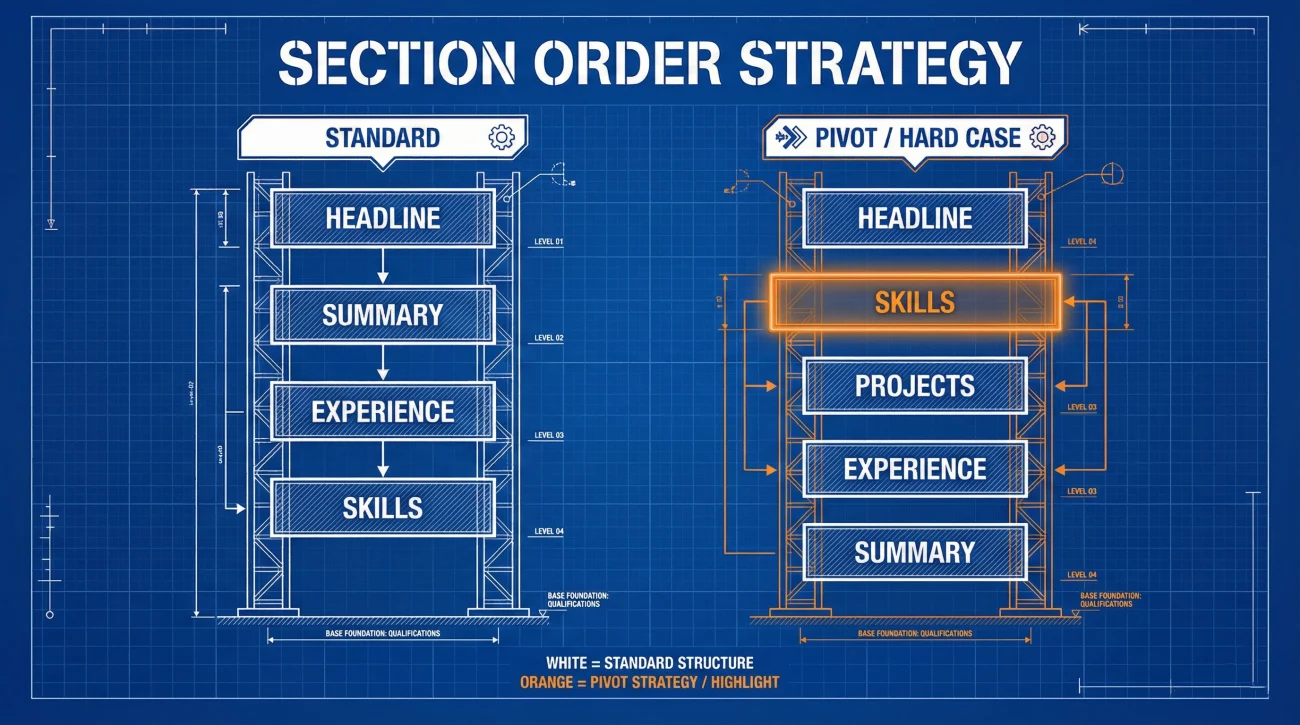
Standard Order
- 1️⃣ Name and contact
- 2️⃣ Headline/Title
- 3️⃣ Summary (optional but recommended for hard cases)
- 4️⃣ Experience (reverse chronological)
- 5️⃣ Education
- 6️⃣ Skills/Certifications
Pivot or Hard-Case Order
- 1️⃣ Name and contact
- 2️⃣ Headline/Title (targeting new role)
- 3️⃣ Summary (bridging old experience to new role)
- 4️⃣ Relevant Projects or Skills section (proving fit for new role)
- 5️⃣ Experience (with translated bullets)
- 6️⃣ Education/Certifications
The key difference: hard cases often benefit from a skills or projects section before experience, so recruiters see proof of fit before they see the “wrong” job titles in your history.
Cross-Section Mistakes That Kill Applications
❌ Headline Overpromises, Bullets Underdeliver
If your headline says “Senior” but your bullets describe junior work, recruiters feel misled. Match your headline to what your bullets actually prove.
❌ Summary Repeats Headline
Your headline claims the role. Your summary should prove you belong in it with specific scope, domain, and credibility signals. Do not waste summary space restating the headline.
❌ Bullets Are All Tasks, No Outcomes
“Managed social media accounts” is a task. “Grew Instagram following from 5K to 50K in 6 months” is an outcome. Every bullet should have an outcome or outcome signal.
❌ Dates Create Suspicion
Missing months, fuzzy timelines, and unexplained gaps make recruiters wonder what you are hiding. Use consistent date formatting and address gaps proactively.
❌ Cover Letter Dumps Everything
The cover letter is for addressing one thing the resume cannot. If you use it to repeat your resume, explain every career decision, and share your personal journey, you have lost the reader.
James, a sales professional, had all five problems on one resume. His headline said “VP of Sales” but his most recent role was Account Executive. His summary repeated “VP of Sales” without proof. His bullets listed responsibilities without outcomes. His dates had two unexplained gaps. His cover letter was 800 words of career autobiography.
We fixed each section systematically. Headline matched his actual level. Summary proved his readiness for promotion with specific metrics. Bullets focused on outcomes. Dates were clarified with brief gap notes. Cover letter was cut to one focused paragraph. He got three callbacks in the first week.
Testing Your Sections: The 10-Second Audit
Before you send your resume anywhere, run this quick test. It catches most cross-section problems.
Step 1: Cover Everything Below Your Headline
Read only your headline. Is your target role clear? Could a recruiter say “this person wants to be a [specific role]” in 2 seconds? If not, your headline needs work.
Step 2: Read Headline + Summary Together
Does your summary prove your headline claim? If your headline says “Senior Marketing Manager” but your summary could describe anyone in marketing, you have a mismatch.
Step 3: Read Only Your First Bullet From Each Job
First bullets are the only ones many recruiters read. Do they show outcomes? Do they support your headline claim? If your first bullets are all setup or context, reorder.
Step 4: Scan Just the Dates
Look at your resume with fresh eyes, focusing only on the dates column. Are there gaps? Suspicious short stints? Fuzzy timelines? Fix anything that would make you pause if you were the recruiter.
Step 5: The “So What” Test
Read each bullet and ask “so what?” If the answer is not obvious, the bullet is missing an outcome. Add the outcome or cut the bullet.
This 10-second audit catches 80% of resume problems. Do it every time before you submit.
Real Examples: Before and After Section Alignment
Example 1: Career Changer With Misaligned Sections
Before:
Summary: Dedicated worker with 8 years in retail management seeking new opportunities in tech.
First bullet: Responsible for daily store operations and staff scheduling.
After:
Summary: Operations leader with 8 years building scalable processes for high-volume environments. Reduced inventory discrepancies by 40% through system redesign. Completing Google Project Management Certificate. Targeting operations roles in SaaS.
First bullet: Redesigned inventory management process across 3 locations, reducing discrepancies by 40% and saving $120K annually.
The “after” version has aligned sections. Headline claims the target. Summary proves fit with a specific metric and shows active transition effort. Bullet leads with an outcome that matters in any industry.
Example 2: Freelancer Targeting Full-Time Role
Before:
Summary: Creative professional working with various clients on design projects.
First bullet: Created designs for multiple clients across different industries.
After:
Summary: Product designer with 6 years delivering end-to-end design for B2B platforms. Built design systems used by 12-person eng teams. Led user research driving 25% improvement in task completion. Seeking full-time role to own product design at scale.
First bullet: Designed and shipped checkout flow redesign for fintech client, reducing drop-off by 30% across 50K monthly users.
The “after” version removes freelance identity noise and emphasizes outcomes that sound like full-time work. The summary explicitly states the goal of full-time work and proves collaboration at scale.
Example 3: Gap With Inconsistent Story
Before:
Summary: Marketing specialist with experience in digital campaigns. Took time off for personal reasons.
First bullet: Managed Facebook and Instagram advertising campaigns.
After:
Summary: Performance marketer with 5 years driving ROI-positive paid campaigns for e-commerce brands. Managed $2M annual ad spend with 4x average ROAS. Recently completed Meta Blueprint certification. Ready for full-time role.
First bullet: Scaled paid social program from $50K to $500K monthly spend while maintaining 3.5x ROAS, driving $1.8M in attributed revenue.
The “after” version does not mention the gap in the summary because it does not need to. The “recently completed certification” signals readiness without drawing attention to the gap. The bullet leads with scale and outcome.
Make Every Section Work for the Same Story
A resume is not a collection of parts. It is an argument. Your headline states the claim. Your summary establishes credibility. Your bullets provide evidence. Your dates create trust. Your cover letter, when needed, addresses the objection.
When every section works together, your resume becomes more than the sum of its parts. Recruiters feel confidence instead of confusion. They see a clear candidate for a clear role. They move you forward.
The candidates who struggle are not the ones with the weakest experience. They are the ones whose resumes tell contradictory stories. A strong headline with weak bullets. A compelling summary with suspicious dates. Evidence of senior work paired with an entry-level title claim.
Fix the alignment, and you fix the outcome.
Use the Clarity Framework on every section. Run the consistency checks. Do the 10-second audit before every submission. And when you need to go deeper on any specific section, the hub guides linked above have the formulas, examples, and hard-case playbooks you need.
Your resume is your argument for why you belong in this role. Make every section support that argument, and you will get the interviews you deserve.
For the complete collection of section-by-section strategies, see the full resume sections strategy resource library.
FAQ
📄 Do I need all five sections on my resume?
Headline and experience are essential. Summary is highly recommended for anyone with a non-obvious path or hard case to explain. Dates are mandatory (no undated experiences). Cover letter is situational. Use it only when you have something specific to address that the resume cannot.
🎯 What if my sections tell different stories because my experience is diverse?
Pick one story per application. If you are targeting product management, your headline, summary, and bullets all emphasize product work. Other experience gets minimal space or is framed in terms of transferable skills. One resume, one clear story.
📏 How long should each section be?
Headline: one line. Summary: 3-5 lines maximum. Bullets: 3-6 per role, more for recent roles. Dates: month/year format for all roles. Cover letter paragraph for hard cases: 4-6 sentences. Keep everything tight. Longer is not better.
🔄 Should I customize sections for every application?
Customize your headline and summary for significantly different roles. Bullets can usually stay consistent if they are outcome-focused. Do not rewrite from scratch for every job, but do ensure your headline targets the right role and your summary emphasizes the right proof.
⚠️ What is the most common cross-section mistake?
Headline-bullet mismatch. People claim a senior role in the headline but their bullets do not show senior-level work. This disconnect is the number one reason good candidates get screened out. Make sure your bullets support your headline claim.
⚠️ Disclaimer: ResumeSolving provides resume, cover letter, job search communication, and career transition guidance for informational purposes only. Hiring practices vary by employer, role, location, industry, and individual circumstances. We do not guarantee interviews, job offers, ATS results, or other outcomes. Verify employer requirements directly and follow applicable laws and workplace policies. For sensitive situations, use only information you are comfortable disclosing and keep all statements accurate.