

- Crisis exits include layoffs, terminations, job hopping patterns, and toxic workplace departures. Each triggers different recruiter fears.
- Use one framework for all: Facts First → Structural Category → Impact Proof → Readiness Now → Pivot.
- Keep your story identical across resume, applications, LinkedIn, and interviews. Inconsistency is what gets you flagged.
- This guide routes you to specific playbooks for layoffs, firings, short tenures, and toxic exits.
When Your Exit Story Needs Damage Control
Not all job departures are created equal. Leaving for a better opportunity? Easy. Relocating for family? No problem. But getting laid off, fired, stuck in a job-hopping pattern, or fleeing a toxic workplace? Those require strategy.
I call these “crisis exits” because they trigger immediate recruiter suspicion. The hiring manager sees your resume and thinks: Was this person the problem? Will they be a problem here? Can I trust what they are telling me?
Your job is to neutralize that suspicion before it costs you the interview.
A marketing director named Elena came to me after three months of silence on her applications. She had been laid off during a company restructuring, but her resume just showed the end date with no explanation. Recruiters assumed the worst. We added one line clarifying it was a RIF affecting her entire department, and she had three interviews within two weeks.
The information was the same. The framing made all the difference.
The Four Types of Crisis Exits
Each type of crisis exit triggers a different fear in recruiters. Understanding what they are worried about helps you address it directly.
| Exit Type | Recruiter Fear | Your Goal |
|---|---|---|
| Layoff | Was it really structural, or were you selected for poor performance? | Prove it was company-wide or department-wide, not personal |
| Termination | Trust, judgment, or performance issues that will repeat here | Show accountability plus concrete changes you made |
| Job Hopping | You will leave us too, wasting our training investment | Explain the pattern and prove this role is different |
| Toxic Exit | You are difficult, dramatic, or will badmouth us later | Stay neutral and forward-looking, zero blame |
Notice that each fear is about the future, not the past. Recruiters do not care that much about what happened. They care about whether it will happen again. Your explanation needs to answer that question.
The FSIPR Framework for Crisis Explanations

Whether you are explaining a layoff, a termination, or a toxic exit, the same structure works. I call it FSIPR:
- 1️⃣ Facts First: State what happened in one sentence. No emotion, no justification.
- 2️⃣ Structural Category: Name the category (RIF, restructuring, role mismatch, leadership change) so they stop guessing.
- 3️⃣ Impact Proof: Briefly mention what you accomplished before the exit. This counters performance suspicion.
- 4️⃣ Readiness Now: Signal that you are ready, available, and focused on the next chapter.
- 5️⃣ Pivot: Redirect to why this specific role interests you and what you bring.
Here is how it sounds for a layoff:
And for a termination:
The framework keeps you from rambling, over-explaining, or sounding defensive. Practice it until it feels natural.
The Consistency Checklist
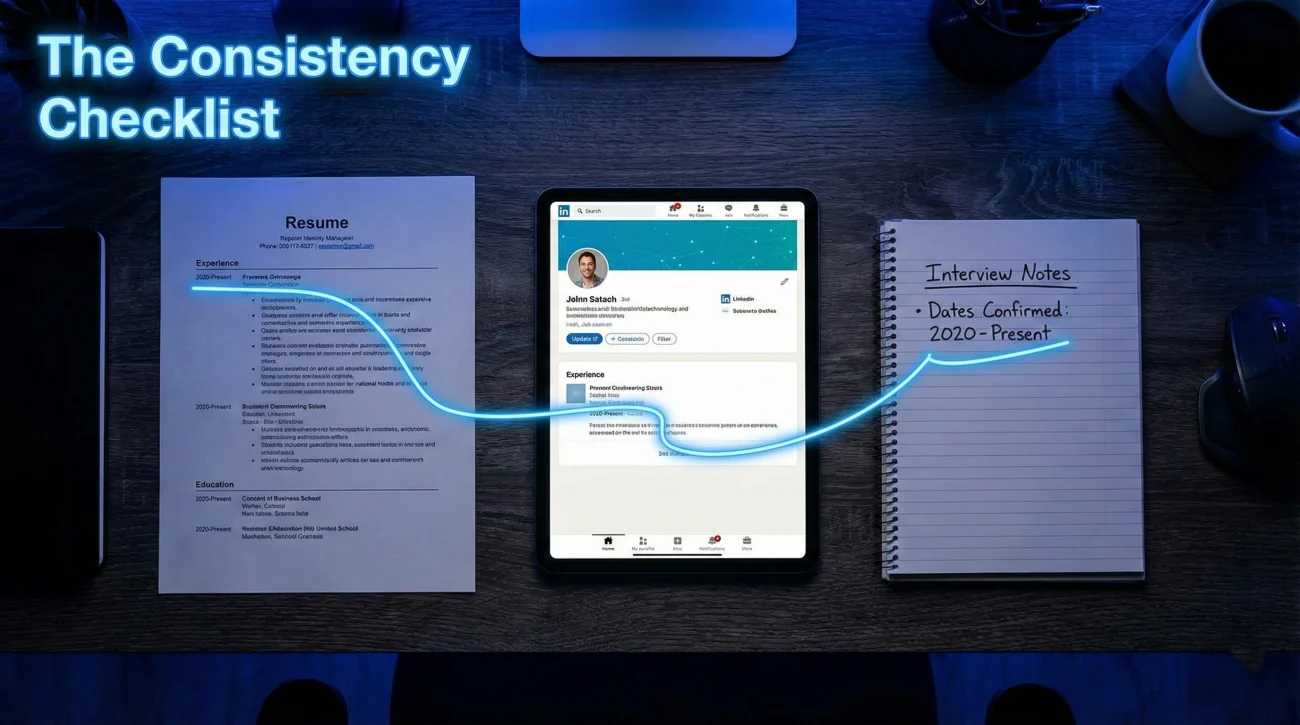
The fastest way to get flagged is telling different versions of your story to different people. Recruiters compare notes. Background checks verify dates. LinkedIn is public. If your stories do not match, you look like you are hiding something.
Where does your exit story need to appear?
- 📄 Resume: Brief note or implied by dates, depending on situation
- 📝 Application forms: “Reason for leaving” field
- 💼 LinkedIn: End date and any career break notation
- 📞 Phone screen: Verbal explanation when asked
- 🎤 Interviews: Deeper version if they probe
- 🔍 Background check: Dates verified with former employer
- 👥 References: What your former colleagues will say
Before you start applying, write out your exit explanation once. Then check it against each touchpoint. Same dates. Same category. Same tone. If your resume says “position eliminated” but you tell the interviewer you “decided to leave,” that mismatch will raise questions.
Key Point: Consistency does not mean robotic repetition. Your phone screen answer can be shorter than your interview answer. But the core facts, the category you use, and the timeline must match exactly.
Run Through This Before Every Application
- Do your resume dates match what your former employer will report?
- Does your LinkedIn end date match your resume?
- Is your “reason for leaving” on applications consistent with your interview script?
- Have you briefed your references on what you are saying?
- If there is a career break after the exit, is it explained the same way everywhere?
A candidate named Robert learned this the hard way. He told the recruiter he was laid off but wrote “resigned” on the application because he thought it sounded better. The background check flagged the discrepancy, and the company rescinded the offer. Same job, same qualifications, lost because of an inconsistency he thought no one would notice.
Crisis exits feel exposing, but you have more privacy than you think. Legally and practically, there are limits to what employers can ask and what you need to answer.
What Former Employers Typically Confirm
Most companies have policies limiting what HR can disclose to background check services. Typically, they confirm dates of employment, job title, and sometimes salary. Many will only confirm whether you are “eligible for rehire” without details.
They usually will not share performance reviews, reasons for termination, or internal conflict details. Some states have laws restricting what employers can disclose. According to the Society for Human Resource Management (SHRM), many employers stick to basic facts to avoid defamation liability.
What You Can Decline to Answer
In interviews, you can redirect overly personal questions. If someone asks for details you do not want to share, try:
- 🛡️ “I would prefer to keep the specifics confidential, but I can tell you the situation is resolved.”
- 🛡️ “That involves details about other people that I do not think are mine to share.”
- 🛡️ “I am happy to discuss what I learned from the experience and how I have applied it since.”
You are not obligated to reveal diagnoses, therapy, interpersonal conflicts, or legal disputes. A professional boundary is not evasion. It is appropriate workplace behavior.
Find Your Specific Playbook
This pillar gives you the framework. The hub pages below give you the specific scripts, wording, and examples for your situation. Find the one that matches your exit type.
| Hub | What It Covers |
|---|---|
| How to Explain Being Laid Off: Resume and Interview Fixes | RIF, restructuring, site closure, budget cuts. Scripts that remove performance suspicion. |
| How to Explain Being Fired: Resume and Interview Fixes That Reduce Risk | Terminations for performance, fit, or policy. Accountability language that rebuilds trust. |
| Job Hopping on a Resume: Stop the Pattern From Killing Your Applications | Multiple short tenures. How to explain the pattern and prove you will stay. |
| Left a Toxic Workplace: Explain It Without Sounding Bitter | Bad managers, hostile environments, culture mismatch. Neutral framing that avoids drama. |
Common Mistakes That Make Crisis Exits Worse
Even with the right framework, small errors can undermine your explanation. Watch for these patterns.

❌ Over-Explaining
The longer your explanation, the more suspicious it sounds. If you spend five minutes on why you were laid off, the interviewer starts wondering what you are hiding. Keep it tight. 30 to 45 seconds maximum for the initial explanation.
❌ Blame Language
Even if your former employer was genuinely terrible, blaming them makes you look bad. Phrases like “they were incompetent,” “management had no idea what they were doing,” or “it was a toxic environment” trigger concern that you will say the same about your next employer.
❌ Emotional Tone
If you still sound angry, hurt, or bitter about what happened, recruiters will worry you are not over it. Practice your explanation until you can deliver it with the same emotional neutrality as describing your commute.
❌ Vague Categories
Saying “it just was not a good fit” without specifics sounds like you are hiding something. Name a concrete category: restructuring, budget cuts, role scope mismatch, leadership change. Specificity signals honesty.
❌ No Pivot
If you end your explanation with the crisis, you leave the interviewer sitting in that negative space. Always pivot to what you are looking for now and why this role fits. Move them forward.
A product manager named Kenji had all the right facts but kept ending his layoff explanation with “so that is what happened.” Dead air. We added a pivot sentence about what he was looking for in his next role, and his interview energy completely shifted.
When to Address It vs When to Wait
Not every crisis exit needs to be explained upfront. Here is a general guide.
✅ Address It Proactively When:
- The exit was recent (last job or current unemployment)
- The timeline is confusing without explanation
- A background check will definitely reveal it
- You have a strong, confident explanation ready
⏸️ Wait Until Asked When:
- The exit was several jobs ago
- Your recent track record is strong
- You are not sure how to frame it yet
- Mentioning it would distract from your qualifications
The goal is not to hide information but to control timing. If you bring it up at the right moment with the right framing, you own the narrative. If it comes out awkwardly later, you look like you were hiding something.
Briefing Your References on Crisis Exits
Your references are part of your story. If they say something different from what you told the hiring manager, you have a problem.
Who to Use as References After a Crisis Exit
Ideally, find someone from the company who can speak positively about your work, even if the exit was bad. This might be a peer, a skip-level manager, or someone from another department who collaborated with you.
If no one from that company will work, use references from earlier roles who can speak to your general reliability and skills. A strong reference from two jobs ago is better than a lukewarm one from the crisis job.
What to Tell Them
Before listing anyone as a reference, have a conversation. Let them know what happened in your version, what category you are using to describe it, and what you would appreciate them emphasizing.
A script that works:
“Hey, I wanted to give you a heads up that I am job searching and might list you as a reference. As you probably know, my last role ended when the company did layoffs. If anyone asks, I have been describing it as a reduction in force that affected the whole department. I would really appreciate if you could speak to the project work we did together and my reliability on deadlines. Does that work for you?”
Most people are happy to help if you make it easy for them. Give them the framing, and they will use it.
When References Are Complicated
If you were fired and your former manager is unlikely to give a positive reference, you have options. You can use HR for employment verification only (dates and title) and provide character references from other sources. You can also proactively address it with the new employer: “My manager and I had different views on priorities, so I would suggest speaking with my colleague who worked closely with me on day-to-day projects.”
Recruiters understand that not every manager relationship is perfect. What matters is that you handle it professionally.
Real Stories: How Crisis Exits Became Non-Issues
Sometimes seeing how others navigated these situations helps. Here are three real examples from candidates I have worked with.
Marcus: Laid Off After 4 Months
Marcus joined a startup as a sales director. Four months in, they lost a major funding round and cut 60% of staff. His resume showed a 4-month stint followed by unemployment, which looked terrible.
We added a single line: “Position eliminated due to funding loss; company reduced headcount by 60%.” In interviews, he used the FSIPR framework, spending 20 seconds on the layoff and then pivoting to the $400K pipeline he built in those four months.
Three companies made offers. The short tenure became a footnote, not a headline.
Diana: Fired for Performance
Diana was let go from a management role after missing quarterly targets. She was devastated and initially tried to hide it, claiming she “left for new opportunities.” When a background check revealed she was not eligible for rehire, an offer was rescinded.
We rebuilt her approach. She acknowledged the termination, named it as a “performance mismatch in a role that was not the right fit,” described what she learned about the type of environment where she thrives, and highlighted her strong track record in previous roles.
Her next interviewer appreciated the honesty. She got the job and has been there three years.
Chris: Escaped a Toxic Workplace
Chris quit without another job lined up after his manager created an environment he described as “psychologically unsafe.” His instinct was to explain everything, including specific incidents, HR complaints, and his emotional state at the time.
We cut all of that. His new script: “I left after a leadership change created a significant shift in team culture and priorities. I decided to be intentional about finding a role where I could do my best work rather than jumping to the first option. I have been focused on roles like this one where collaborative problem-solving is valued.”
Zero drama. Zero blame. He got hired within six weeks.
The Mindset Shift That Changes Everything
Here is what I tell every candidate dealing with a crisis exit: You are not on trial. You are in a business conversation.
When you feel like you have to justify yourself, defend your choices, or prove you are not a bad person, you sound defensive. When you treat the exit as one data point in a longer career story, you sound confident.
Recruiters are not looking for perfect candidates. They are looking for capable people who can do the job and will not create problems. If you can demonstrate both, your crisis exit becomes background noise.
The candidates who struggle are the ones who cannot let go of what happened. They relive it in every interview. They over-explain because they are still processing. They get emotional because the wound is still fresh.
If that is you, it might be worth working through those feelings outside of interview prep. Talk to a friend, a therapist, or a career coach. Get to a place where you can discuss what happened without your heart rate spiking. Then practice your FSIPR explanation until it feels as routine as describing your last project.
Own Your Story, Then Move Forward
A crisis exit does not have to define your job search. Plenty of people get laid off, fired, or escape toxic workplaces and go on to land great roles. The difference is how they talk about it.
Use the FSIPR framework. Keep your story consistent everywhere. Practice until you can deliver it without hesitation. Then spend the rest of the interview talking about what you can do, not what happened to you.
The Bureau of Labor Statistics reports that the average American will hold multiple jobs over their career, and transitions are not always smooth. You are not alone in having a complicated exit story. You just need to tell it well.
For specific scripts, wording, and scenarios tailored to your situation, explore the hub guides linked above. And if you are navigating any kind of career setback, the complete laid off on resume resource collection has everything you need to get back on track.
FAQ
🤔 What is the difference between a layoff and being fired?
A layoff is typically a company decision driven by business factors like budget cuts, restructuring, or site closures. Being fired usually means termination for cause, whether performance, conduct, or policy violation. Recruiters view these very differently. Layoffs suggest bad luck; firings suggest potential problems.
📝 Do I have to explain my exit on my resume?
No. Your resume is not a legal document. You can leave exits unexplained and address them verbally if asked. However, if the exit created a confusing timeline or if a background check will reveal specifics, a brief note can prevent misunderstandings.
🔍 Will a background check reveal why I left?
Usually not in detail. Most employers only confirm dates, title, and sometimes eligibility for rehire. They rarely share performance details or termination reasons due to legal liability concerns. However, what they do confirm needs to match what you have said, so consistency matters.
💬 How long should my explanation be?
Your initial explanation should be 30 to 45 seconds. If they ask follow-up questions, you can expand, but keep each answer focused. Long explanations sound defensive. Short, confident answers sound like you have moved on.
🚫 What should I never say about a crisis exit?
Never blame individuals by name. Never use emotional language like “nightmare” or “worst experience.” Never claim legal disputes unless you are prepared for deep follow-up. Never lie about dates or categories. And never end without a pivot to what you are looking for now.
⚠️ Disclaimer: ResumeSolving provides resume, cover letter, job search communication, and career transition guidance for informational purposes only. Hiring practices vary by employer, role, location, industry, and individual circumstances. We do not guarantee interviews, job offers, ATS results, or other outcomes. Verify employer requirements directly and follow applicable laws and workplace policies. For sensitive situations, use only information you are comfortable disclosing and keep all statements accurate.