- Your resume headline is the first line recruiters read. It must make your target role obvious in under 2 seconds.
- Use a simple formula: [Target Role] + [Specialization or Proof Hint] + [Scope Cue].
- Choose from 4 headline patterns: role-first, proof-hint, scope-limited, or pivot headline depending on your situation.
- A weak headline loses the reader before they reach your experience. A strong one frames everything that follows.
The Line That Decides Whether They Keep Reading
Recruiters spend about 7 seconds on a resume before deciding to read more or move on. Your headline is what they see first. If it is vague, generic, or confusing, you have already lost them.
I reviewed a resume last month from a product manager named Derek. His headline read: “Results-driven professional with a passion for innovation and cross-functional collaboration.” I had no idea what job he wanted. Was he in product? Marketing? Operations? By the time I figured it out, I had already formed a negative impression.
We changed his headline to: “Senior Product Manager | B2B SaaS | Growth and Monetization.” Same person, completely different first impression. He started getting callbacks within a week.
Your resume headline is not a place to be clever or comprehensive. It is a label that tells the recruiter exactly what role you are targeting and gives them one reason to believe you can do it.
Headline vs Title: What Each One Does
People use “headline” and “title” interchangeably, but they serve different purposes.
| Element | Purpose | Example |
|---|---|---|
| Title | Labels the role you want. Simple and direct. | Senior Product Manager |
| Headline | Labels the role plus adds a proof hint or specialization. | Senior Product Manager | B2B SaaS | Growth and Monetization |
When do you need both?
Most resumes only need one. If you use a headline, it replaces the title. Use a title alone when simplicity serves you better, like when your experience speaks for itself and you are applying for an exact-match role. Use a headline when you need to clarify your target, signal a specialization, or bridge a gap between your past and your target.
Title Only Works When:
- Your recent job titles match the target role exactly
- You are applying through a referral who already knows your background
- The job posting uses simple, standard titles
Headline Works Better When:
- Your titles do not match the target role
- You are pivoting from a different industry or function
- You want to signal a specialization that differentiates you
- Your background includes noise you need to overcome (founder, freelance, overqualified)
The 5 Decisions Your Headline Must Make

Every strong headline answers these five questions. If yours does not, it is probably too vague.
- 🎯 Role Clarity: What job are you targeting? Use the exact title from job postings, not a creative version.
- 🔍 Proof Hint: What is one thing that makes you credible for this role? A specialization, industry, tool, or outcome.
- 📏 Scope Control: Are you senior or junior? Manager or IC? Make sure your headline matches the level you want.
- 🧹 Identity Noise Removal: Does your headline trigger any wrong assumptions? (Founder ego, freelance instability, overqualified flight risk)
- 📍 Placement: Is it positioned where recruiters will see it immediately, right below your name?
A marketing director named Yuki was applying for senior manager roles. Her original headline: “Marketing Executive | Strategic Leader | Brand Builder.” The word “Executive” triggered overqualified filters. We changed it to: “Senior Marketing Manager | Brand Strategy | Consumer Tech.” Same skills, right scope signal.
The Headline Checklist
Run through these seven questions before finalizing your headline.
- ✅ Does it name the exact role you are targeting?
- ✅ Would someone know your target job in under 2 seconds?
- ✅ Does it include at least one proof hint (specialization, industry, or outcome)?
- ✅ Is the scope appropriate for the roles you want?
- ✅ Does it avoid vague adjectives like “results-driven” or “passionate”?
- ✅ Is it free of identity noise that triggers wrong assumptions?
- ✅ Is it placed directly below your name and contact info?
If you cannot check all seven, revise before applying.
4 Headline Patterns You Can Use
Choose the pattern that fits your situation. Each one solves a different problem.
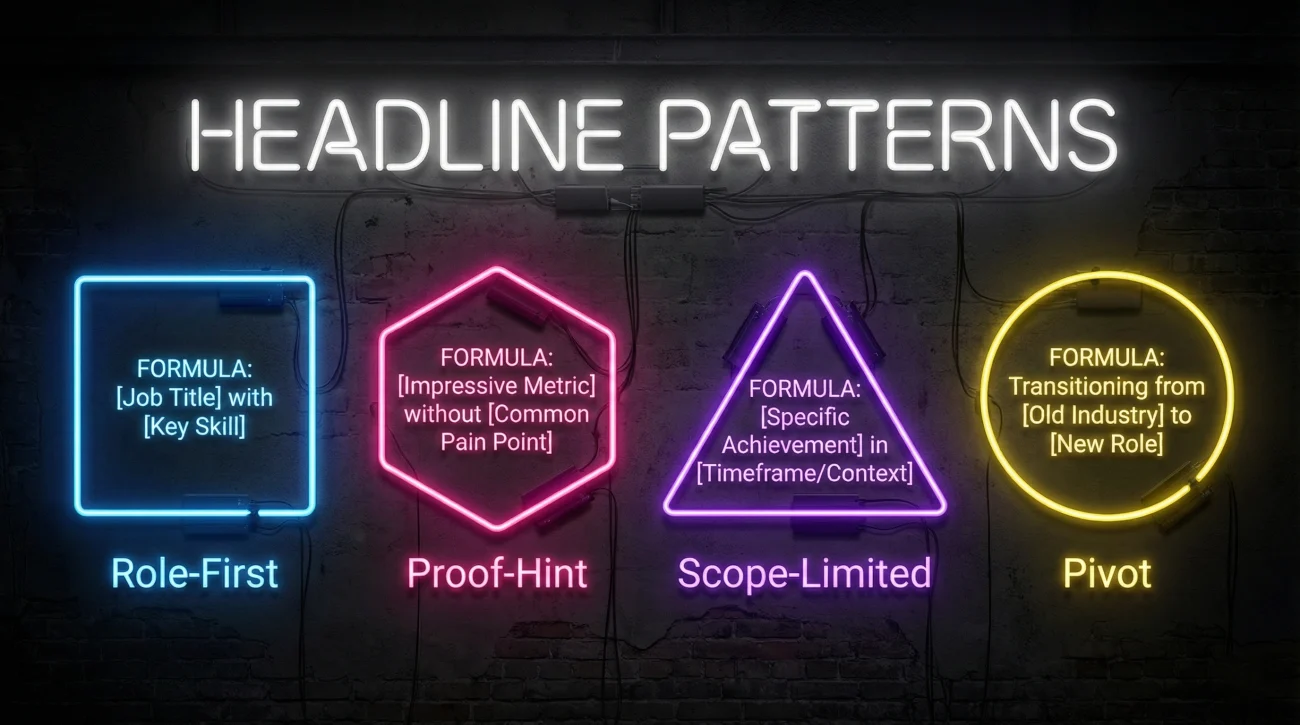
Pattern 1: Role-First Headline
Use this when your background matches the target role and you just need clarity.
[Target Role] | [Industry or Domain] | [Years or Level]
Senior Software Engineer | Fintech | Backend Systems
If your background already fits the role, this version just makes it obvious at a glance.
Pattern 2: Proof-Hint Headline
Use this when you want to differentiate yourself with a specific skill or outcome.
[Target Role] | [Specialization] | [Key Outcome or Tool]
Product Manager | Growth and Experimentation | 3x Conversion Improvements
This is the one you use when you need a single sharp detail to separate you from everyone else with the same title.
Pattern 3: Scope-Limited Headline
Use this when you are overqualified or want to signal you are targeting a specific level.
[Target Role] | [Craft or Function Focus] | [Scope Cue]
Engineering Manager | Hands-On Technical Leadership | Teams of 5-10
When you are worried you look too senior, this wording quietly sets expectations about the level and team size you are aiming for.
Pattern 4: Pivot Headline
Use this when your past does not match your target and you need to bridge the gap.
[Target Role] | [Bridge Proof from Past] | [Domain or Industry]
Product Manager | Former Engineer | Developer Tools
If your past roles do not point straight at the new role, this format gives the reader one bridge that makes the switch feel intentional.
Headlines by Situation
Here are quick examples for common scenarios.
Experienced Professional
Director of Operations | Supply Chain and Logistics | Manufacturing
This headline works because it names the exact target role, adds an industry specialization, and signals domain expertise. No fluff, just clarity.
Entry-Level or Student
Marketing Coordinator | Social Media and Content | Recent Graduate
Entry-level candidates often struggle with proof. This headline uses “Recent Graduate” as a scope signal that sets appropriate expectations while the specialization shows focus.
Career Changer
UX Designer | Former Teacher | EdTech and Learning Products
The bridge proof (“Former Teacher”) plus domain focus (“EdTech”) makes the career change feel intentional rather than random. The recruiter immediately understands why this person might be a strong candidate despite the nontraditional background.
Freelancer Going Full-Time
Senior Copywriter | Brand and Conversion | 8 Years B2B Experience
This headline counters the freelance instability fear by signaling tenure and specialization. “8 Years B2B Experience” reads as stable, not scattered.
Founder to Employee
Head of Product | 0-to-1 and Scale | B2B SaaS
Notice this does not say “Founder” or “CEO.” The headline targets the employee role while using founder-relevant proof (“0-to-1 and Scale”) that translates to corporate language.
Each of these headlines avoids buzzwords like “passionate,” “innovative,” or “results-driven.” They use specific role labels, proof hints, and scope cues that communicate clearly.
Headlines and ATS: What Actually Matters
People worry about ATS (Applicant Tracking Systems) rejecting their resume based on headlines. Here is what actually happens.
The Reality of ATS Parsing
Most ATS systems parse your resume into fields: name, contact, experience, education, skills. The headline usually gets parsed as a “title” or “objective” field. It is searchable, but it is rarely a make-or-break factor for ATS filtering.
What matters more is that your headline uses standard job titles that recruiters search for. If you use creative titles like “Growth Ninja” or “Marketing Rockstar,” you might not show up when recruiters search for “Marketing Manager.”
Simple ATS Rules for Headlines
- ✅ Use standard job titles, not creative alternatives
- ✅ Include keywords that appear in job postings you are targeting
- ✅ Keep formatting simple (no tables, text boxes, or graphics)
- ❌ Do not use special characters or symbols beyond basic punctuation
- ❌ Do not rely on the headline to carry all your keywords
A recruiter at a Fortune 500 company told me that headlines rarely cause ATS rejections. What causes rejections is missing keywords in the body of the resume or formatting that confuses the parser. Focus your ATS energy there.
Testing Your Headline
Before you finalize, test your headline with these three methods.
The 2-Second Test
Show your resume to someone for 2 seconds, then take it away. Ask them what job you are applying for. If they cannot answer confidently, your headline is not clear enough.
The Job Posting Match Test
Compare your headline to the title in the job posting you most want. If they do not match closely, you are making the recruiter work to see the connection.
The “So What” Test
Read each element of your headline and ask “so what?” If any part does not add clarity or credibility, cut it. Every word in a headline should earn its place.
Clare, a project manager, tested her headline with a friend who worked in HR. The friend said, “I know you want a project manager role, but I cannot tell what kind of projects or what industry.” Clare added “Healthcare IT” to her headline, and the feedback became positive. Sometimes one specific term makes all the difference.
When to Update Your Headline
Your headline is not permanent. Update it when your situation changes.
- 🔄 Changing target roles: New target means new headline
- 🔄 Gaining significant experience: Update scope signals (junior to senior)
- 🔄 Completing a pivot: Once you land the new role, your headline can drop bridge language
- 🔄 Switching industries: Update domain and industry cues
- 🔄 Getting feedback that it is not working: Low response rates signal headline problems
Treat your headline like a hypothesis. If it is not getting results, revise and test again.
5 Headline Mistakes That Kill Your Chances
I have reviewed thousands of resumes, and the same headline mistakes keep appearing. Here is what to avoid.

Vague Adjectives Instead of Role Labels
“Dynamic professional with strong communication skills” tells the recruiter nothing. They have no idea what job you want or what you have done. Name the job you want in clear terms.
A finance professional named Johnny had this exact problem. His headline was “Detail-oriented professional with analytical mindset.” We changed it to “Financial Analyst | FP&A | SaaS and Tech” and he went from zero callbacks to five in two weeks.
Multiple Roles Crammed Together
“Product Manager / Project Manager / Business Analyst / Scrum Master” makes you look unfocused. Recruiters wonder if you know what you actually want. Pick one target per resume version. If you are genuinely targeting multiple roles, create multiple resumes.
Inflated Titles That Do Not Match Your Target
If you are applying for manager roles, do not headline yourself as “Executive Leader” or “C-Suite Strategist.” The mismatch creates confusion and triggers overqualified filters. Match the scope of the jobs you are actually applying for.
Buzzwords Without Proof
“Innovative thought leader in digital transformation” is meaningless without specifics. Everyone claims to be innovative. Replace buzzwords with a concrete specialization or outcome that differentiates you.
Buzzwords to eliminate: passionate, results-driven, innovative, dynamic, strategic thinker, thought leader, guru, ninja, rockstar, enthusiastic, self-motivated, team player. These words have been so overused they now signal “I have nothing specific to say.”
Missing the Headline Entirely
Some resumes jump straight from the name to the summary or experience. Without a headline, recruiters have to work to figure out what you want. That extra cognitive load often means they move on to the next resume instead.
Carla, a data analyst, had been applying for months with no response. Her resume had no headline at all. Her experience was strong, but recruiters could not quickly tell if she was targeting analyst, scientist, or engineering roles. We added a simple headline: “Senior Data Analyst | Marketing Analytics | SQL and Tableau.” Response rate went from near zero to about 15%.
Deep Dive Guides for Specific Situations
This hub gives you the framework. The guides below go deeper into specific headline challenges.
One Line That Frames Everything
Your headline is small but powerful. It tells recruiters what to expect before they read anything else. A strong headline makes your summary more believable, your experience more relevant, and your application more likely to get a response.
Think of it as the lens through which recruiters view the rest of your resume. If the lens is clear, everything that follows makes sense. If the lens is foggy, they struggle to place you and often move on.
Pick a pattern. Fill in the formula. Check it against the checklist. Then move on to the rest of your resume, knowing that the first impression is handled.
The best headlines feel obvious in hindsight. When you read them, you think “of course, that is exactly what this person does.” That clarity is what you are aiming for.
For the complete framework on building every resume section so they work together, explore the full resume headline resource collection.
FAQ
📝 How long should a resume headline be?
One line, typically 5-12 words. If it wraps to a second line, it is too long. The headline is a label, not a paragraph. Save details for your summary and experience sections. Think of it as a newspaper headline: short, punchy, informative.
🎯 Should my headline match the exact job title in the posting?
Ideally, yes. Using the same title the company uses makes it obvious you are targeting their specific role. If their title is unusual, you can use the closest standard equivalent, but do not stray too far. When in doubt, use the most common industry term for that role.
🔄 Should I change my headline for every application?
Change it when the target role changes significantly. If you are applying for both Product Manager and Product Marketing Manager roles, you need two resume versions with different headlines. For similar roles at different companies, a consistent headline usually works fine. The key is matching the core role title, not customizing every word for every company.
❓ What if I do not have experience in the target role?
Use a pivot headline pattern that bridges your past to your target. Lead with the target role, then add proof from adjacent experience. For example: “Data Analyst | Former Financial Analyst | SQL and Python.” The bridge shows you are not starting from zero while being honest about your path. The cluster guide on career change headlines goes deeper on this.
📍 Where exactly should the headline go?
Directly below your name and contact information, before your summary or experience sections. It should be one of the first things visible, ideally in a slightly larger or bolder font than body text but smaller than your name. Most resume templates have a natural spot for this. If yours does not, add a line between your contact info and your summary.
💡 Can I use the same headline on LinkedIn?
Your LinkedIn headline serves a similar purpose but has a different audience. LinkedIn headlines can be slightly more conversational and are seen by a broader audience, not just recruiters reviewing your application. The core role and specialization should match, but the exact wording can differ. See the LinkedIn headline guide for specific advice.
⚠️ Disclaimer: ResumeSolving provides resume, cover letter, job search communication, and career transition guidance for informational purposes only. Hiring practices vary by employer, role, location, industry, and individual circumstances. We do not guarantee interviews, job offers, ATS results, or other outcomes. Verify employer requirements directly and follow applicable laws and workplace policies. For sensitive situations, use only information you are comfortable disclosing and keep all statements accurate.