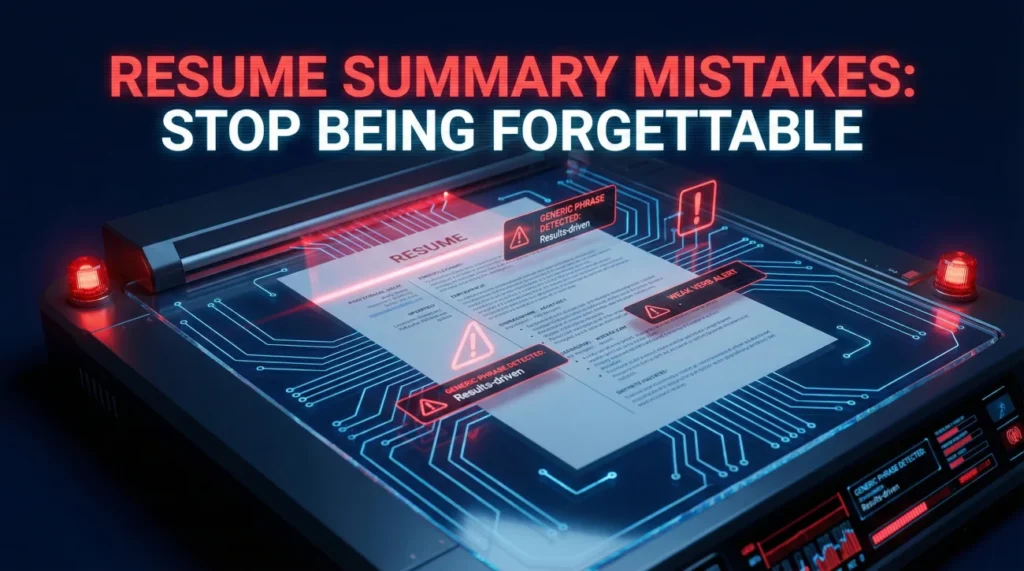
- A weak summary does not just waste space: It makes your direction and seniority feel unclear.
- Recruiters react to predictable lines fast: Generic openers, self-rating adjectives, and vague “seeking” language.
- This guide covers 15 resume summary mistakes recruiters notice quickly, plus a one-line fix for each and a 10-minute self-audit.
Why Your Summary Gets Judged Before Anything Else
I have watched strong candidates lose momentum because of four lines at the top of the page. Not because they were “bad writers”, but because their summary accidentally sounded uncertain.
A candidate named Sutton once sent me a resume that looked solid in the experience section. Promotions, scope, team leadership, measurable outcomes. But her summary opened with: “Results-driven professional seeking to leverage my skills in a challenging environment.” She was applying for a Senior Program Manager role.
Her experience was credible. Her summary was not. It read like she was applying to anything. In a stack of similar resumes, that is the fastest way to become forgettable.
This article is a quality-control guide for resume summary mistakes. Not “resume mistakes in general”. Just the red flags that make recruiters quietly worry: “Do they know what they are?”, “Are they exaggerating?”, “Are they still available?”, “Is this a career change that is not real?”
Key Point: Your summary is not a life story. It is a positioning statement: Target role + proof + scope + fit.
What A Resume Summary Is Actually For
When a recruiter skims, they are trying to answer a few basic questions quickly. Your summary should make those answers obvious without sounding dramatic or salesy.
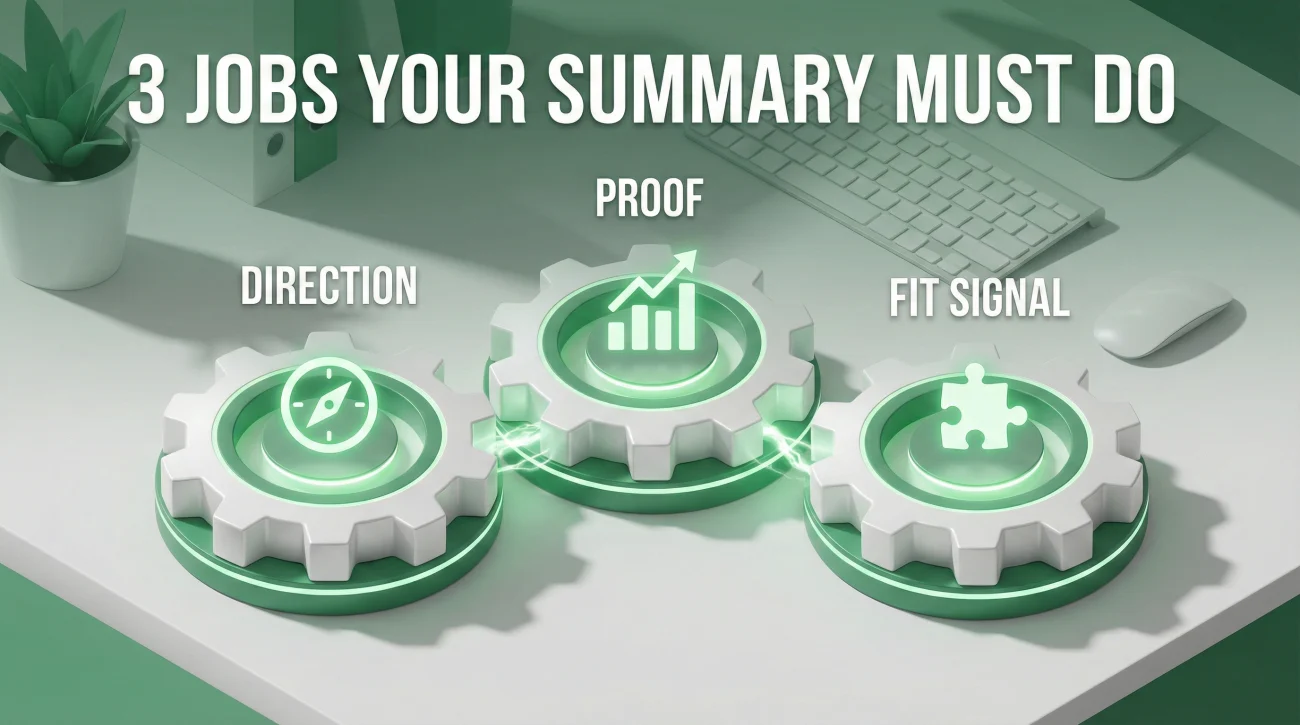
The three jobs your summary must do
- Direction: What role are you aiming at, and what lane are you in?
- Proof: What outcomes, scope, or evidence make you believable?
- Fit signal: Why you, for this type of role, right now?
💡 Pro Tip: If your summary could be pasted onto someone else’s resume and still “kinda works”, it is too generic.
The hidden part recruiters react to
Recruiters are trained by repetition. If they have seen the same phrases 5,000 times, they stop believing them. A summary becomes a signal of judgment, not just content.
That is why the mistakes below matter. They are not grammar mistakes. They are credibility mistakes.
Resume Summary Mistakes: 15 Red Flags And The Fast Fix
I am going to keep this practical. Each red flag includes: What it signals, and how to rewrite it into something that sounds stable and specific.
| Red Flag | What It Signals | Fast Fix You Can Use |
|---|---|---|
| 1) “Results-driven professional” opener | Template language, low signal-to-noise | Start with your target role and niche: “Program Manager focused on enterprise onboarding and retention.” |
| 2) “Seeking to leverage my skills” | Job-seeker mindset, not value mindset | Replace with proof: “Led rollout across 12 sites, improving adoption by 28%.” |
| 3) No target role mentioned | Unclear direction, “applying to anything” | Add a role label in the first 8 words: “Data Analyst with pricing and churn focus.” |
| 4) Three different roles in one summary | Identity confusion, harder to match to a req | Pick one role headline and move other lanes to bullets: “Operations Manager” first, then 1 line of adjacent strengths. |
| 5) Too many soft adjectives | Self-rating without evidence | Swap adjectives for scope: “Managed $2.4M budget” beats “highly organized.” |
| 6) “Team player” and “hard worker” | Low differentiation, sounds like filler | Show collaboration through a concrete setting: “Partnered with Sales and Legal to close enterprise contracts.” |
| 7) Empty “passion” language | Emotion without outcomes | Tie interest to evidence: “Built a customer feedback loop that reduced support tickets by 18%.” |
| 8) Vague industry: “various industries” | Hides lack of relevance | Name 1-2 relevant environments: “B2B SaaS and regulated healthcare operations.” |
| 9) Overclaiming seniority | Inflation risk, recruiter skepticism | Match title to scope: “Led a 4-person team” not “executive leader” if you were a team lead. |
| 10) “Expert in” without context | Unverifiable claim | Use measurable depth: “7 years in SQL analytics, building weekly exec dashboards.” |
| 11) Buzzword pile (synergy, dynamic, innovative) | Reads like marketing, not operations | Replace with 2 outcomes + 1 domain: “Cut cycle time by 22% in procurement.” |
| 12) A full paragraph wall of text | Hard to skim, low clarity | Split into 2-3 short lines: role, proof, scope or niche. |
| 13) The summary repeats your job titles | Wasted space, no added meaning | Add a “why you” angle: scope, outcomes, systems, or specialization. |
| 14) “Open to any role” or “willing to do anything” | Desperation signal, unclear fit | State a clear lane plus flexibility: “Targeting Customer Success roles in B2B SaaS, open to implementation-heavy teams.” |
| 15) Dated tech stack that dominates the summary | Out-of-touch signal if not relevant | Lead with outcomes and role, then 1 relevant tool: “Forecasting and demand planning using Excel and Power BI.” |
⚠️ Warning: One red flag alone does not kill you. The problem is stacking three or four of them in a row: generic opener + no target role + adjectives + buzzwords.
A Simple Rewrite Framework That Sounds Like A Real Person
When I help someone rewrite a summary, I do not start with “make it shorter” or “add keywords”. I start with: What do you want them to believe after reading this?
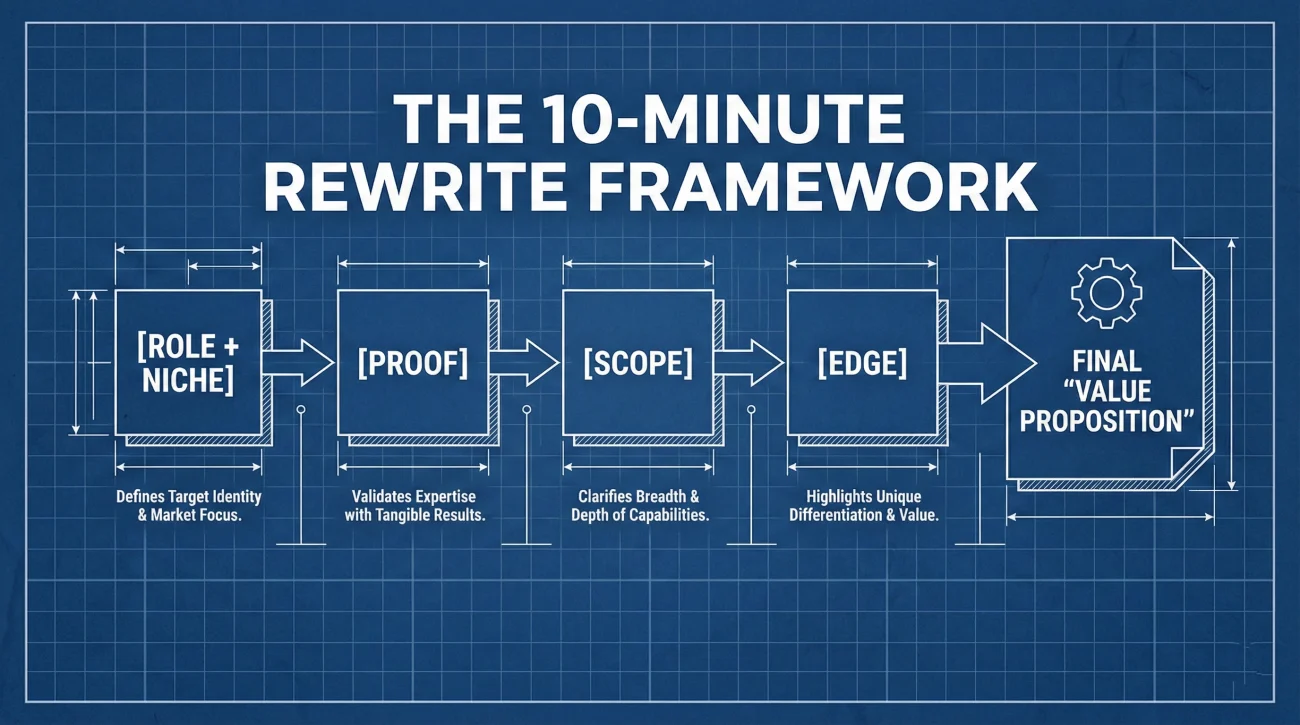
Use this structure
[Target Role + Niche] + [Proof] + [Scope] + [Edge]
It looks basic. It works because it forces clarity.
How to fill it in 10 minutes
- Pick one target role label that matches the job posting.
- Choose two proofs: outcomes, scale, or complexity.
- Add one scope marker: team size, budget, volume, region, or customer type.
- Add one “edge” that is relevant: domain depth, cross-functional strength, or a specific system you built.
“I feel weird writing a summary. It always sounds like I am selling myself too hard.”
I hear that a lot. The fix is not to remove confidence. The fix is to remove vague praise and replace it with facts you can stand behind.
Three Before And After Fixes That Remove The “Generic” Feeling
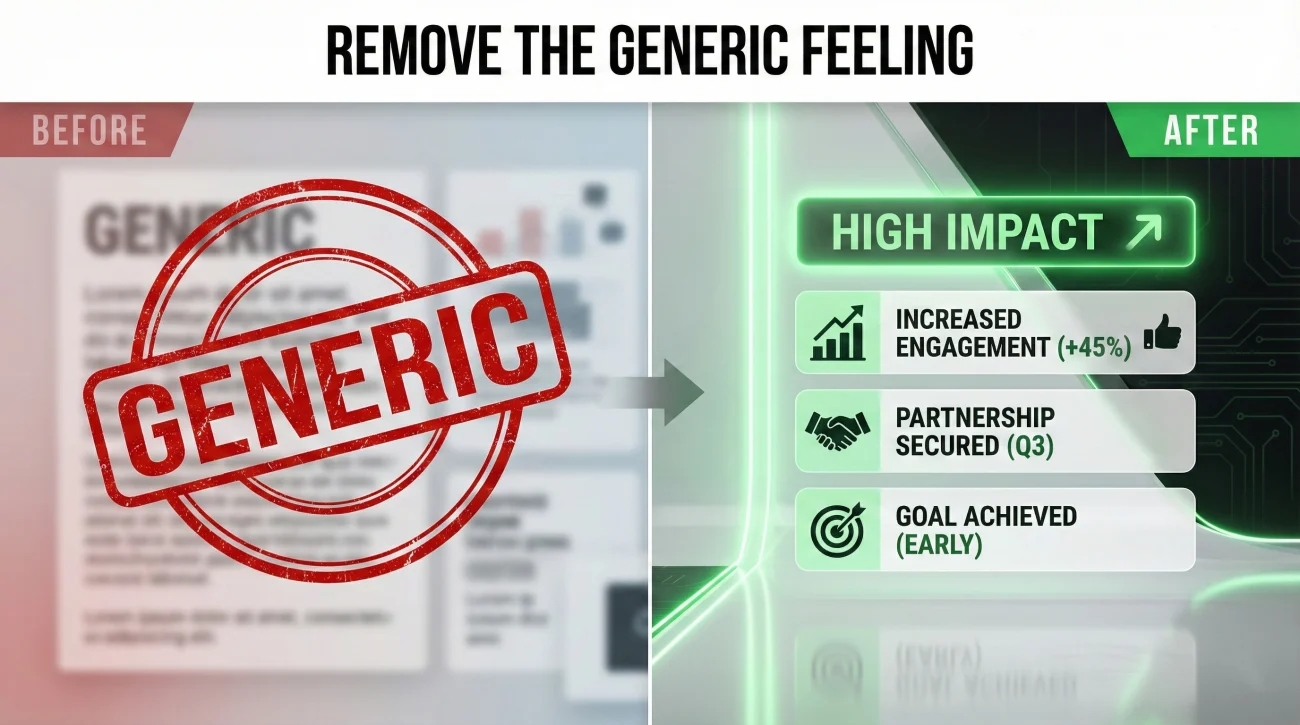
Here are three realistic rewrites I have done with candidates. Notice the pattern: we did not add fancy words. We added direction and proof.
Example 1 (Mid-level PM):
Example 2 (Generalist who needs a lane):
Example 3 (Career change without sounding imaginary):
💡 Tip: If you are early-career, your “proof” can be projects, coursework outcomes, or process improvements. What matters is that it is concrete.
Two Tricky Cases Recruiters See All The Time
Case 1: The true generalist (you did many things)
A colleague of mine, Cesar, was a startup operations lead. He owned hiring coordination, vendor negotiations, internal tooling, and even customer support workflows. His first summary tried to list everything. It felt chaotic.
What worked was choosing one “umbrella role” and one “signature strength”. That way, the recruiter can file him somewhere mentally.
💡 Pro Tip: Pick one role label, then one sentence that proves you can operate broadly: “Cross-functional ops lead” plus a scope marker is often enough.
Case 2: Senior experience, but the summary sounds junior
This happens when someone uses “seeking”, “eager”, “motivated”, and “passionate” as their main language. Those words are not wrong. They are just weak as the lead for senior hires.
If you have 8-12 years of experience, your summary should read like someone who has already done hard things, not someone hoping to get a chance.
What do I write instead of “seeking to leverage my skills”?
Write what you deliver: outcomes, scope, and the kinds of problems you solve. “Led turnaround of delayed launches” tells a recruiter far more than “eager to contribute.”
A Fast Self-Audit Checklist
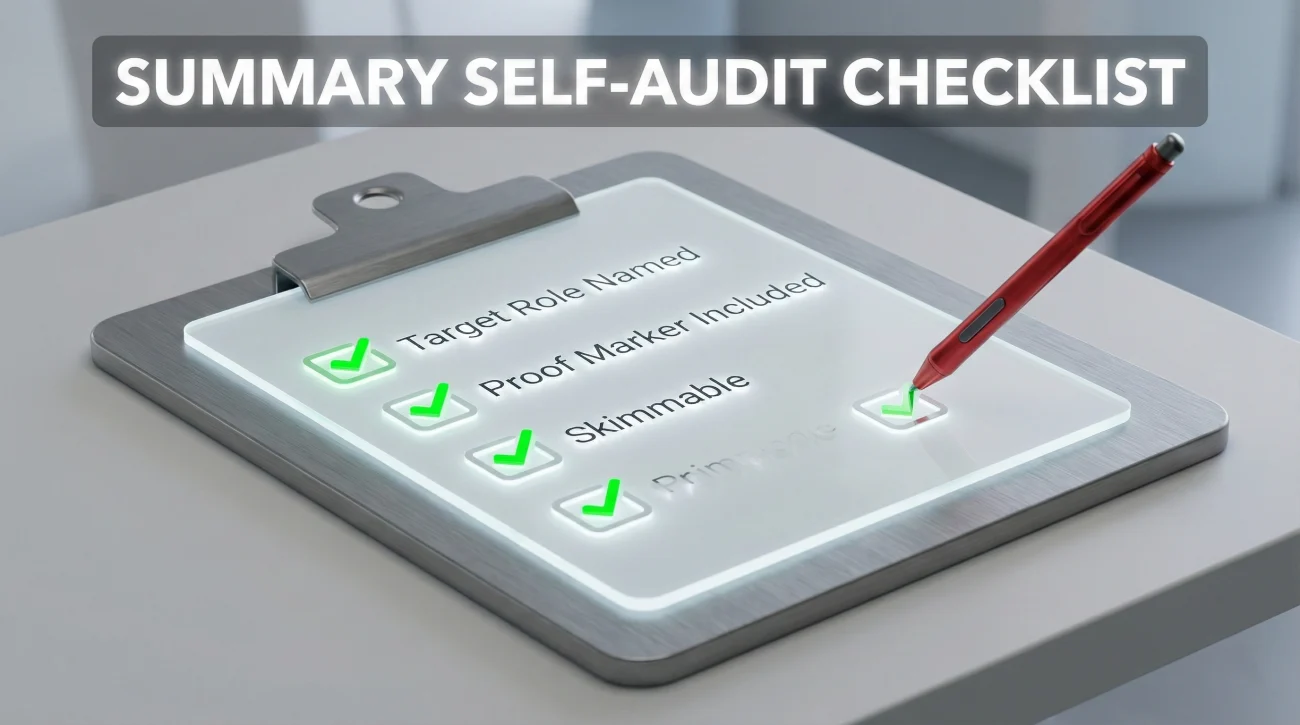
If you do not want to memorize 15 mistakes, use this checklist. It is a quick screen I use before I tell someone their summary is ready.
- ✅ Does the first line name a target role?
- ✅ Do I have at least one proof marker (number, scope, outcome, complexity)?
- ✅ Could this summary fit someone else’s resume without changes?
- ✅ Did I avoid self-rating adjectives unless I back them up?
- ✅ Is it skimmable in 2-3 short lines?
- ✅ Does it match the seniority I am applying for?
- ✅ Did I avoid “open to anything” language?
When someone fails this checklist, it does not mean they are unqualified. It means their summary is not doing its job yet.
Final
The easiest way to think about a summary is this: It is not an introduction. It is a decision assist.
If you remove the vague lines and replace them with direction and proof, recruiters stop guessing. They can place you faster, trust you faster, and move on to your experience with a better mindset.
Fixing resume summary mistakes is a small edit with an outsized impact, because it changes the first impression you create in the first few seconds.
❓ FAQ
🎯 Do I need a summary on my resume?
You do not always need one. But if your path is not obvious at a glance, a short summary can guide the reader and reduce misinterpretation.
🧩 How long should a resume summary be?
Most summaries work best at 2-4 lines. If it becomes a paragraph, it usually stops being skimmable and starts repeating the resume.
🛠️ What is the fastest way to make my summary less generic?
Add a target role label and one proof marker. Even one specific outcome or scope detail can change how believable the summary feels.
📌 Should I include keywords in the summary for ATS?
Include relevant terms naturally, but do not turn the summary into a keyword list. A human will still judge it first, and credibility matters.
🧠 What if I am a generalist and cannot pick one role?
Pick one umbrella role label aligned to the job you want, then use one sentence to signal breadth. If you list three roles, you usually match none.
⚠️ Disclaimer: ResumeSolving provides resume, cover letter, job search communication, and career transition guidance for informational purposes only. Hiring practices vary by employer, role, location, industry, and individual circumstances. We do not guarantee interviews, job offers, ATS results, or other outcomes. Verify employer requirements directly and follow applicable laws and workplace policies. For sensitive situations, use only information you are comfortable disclosing and keep all statements accurate.