- Your summary is not a confession: It is a readiness signal.
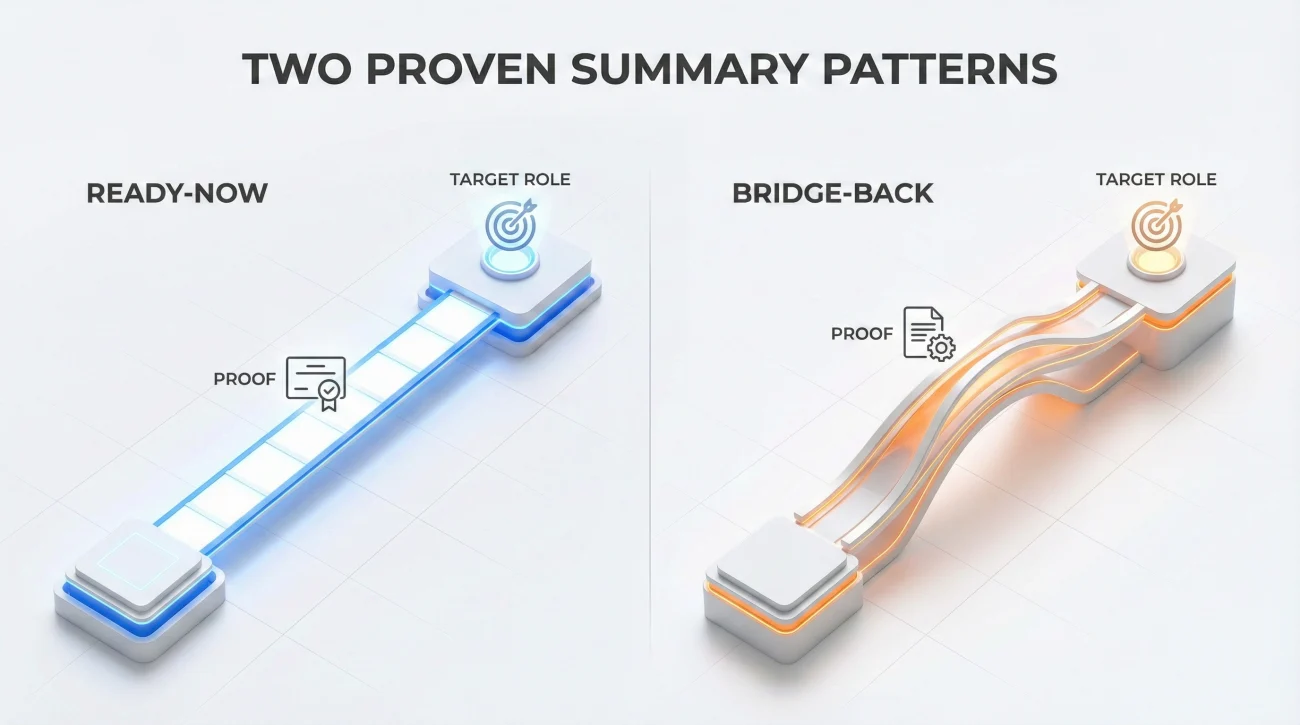
- Use one of two patterns: “Ready-Now” or “Bridge-Back,” depending on how you are returning.
- If you mention the gap at all, do it as a light clause: Then let proof and outcomes carry the paragraph.
The Real Job of a Summary When You Have a Gap
I have watched smart candidates lose the room in the first six lines, not because their gap was “too big,” but because their summary made the gap the most memorable thing on the page.
That is why resume summary after a gap is a very specific writing problem. You are not trying to defend the timeline. You are trying to make a hiring manager feel safe continuing to read.
When someone skims your top section, they are silently asking three questions:
- What role are you actually targeting?
- Are you current enough to do it today?
- What proof shows you will land well inside this team?
If your summary answers those three, the gap becomes background noise. If it does not, the gap becomes the headline, even when the gap is completely reasonable.
Why Most “Gap Summary Advice” Backfires
A lot of mainstream advice pushes a candidate to “address the gap” up top. It sounds brave. It sounds honest. It also creates a subtle framing problem: Your summary becomes an explanation, not a value proposition.
| What the candidate writes | What the reader hears |
|---|---|
| “Professional returning after time away from the workforce.” | “I might be rusty. Please be patient.” |
| “Career break due to personal reasons, now eager to contribute.” | “There is something here I should worry about.” |
| “Unemployed but actively learning and seeking new opportunities.” | “My situation is the story, not my skills.” |
| “Objective: To secure a challenging role…” | “I did not decide what I do best yet.” |
The tricky part is this: Being vague does not protect you. It creates curiosity, and curiosity turns into screening questions.
🗝️ Key Point: Your summary should make a gap feel like a closed chapter, without announcing the chapter title.
So instead of leading with “time away,” your best move is to lead with a clear role target, a current skill spine, and a proof marker that signals you are ready now.
Two Summary Patterns That Work After a Gap
In practice, I see two patterns that consistently reduce friction. They work because they sound like normal summaries, not special pleadings. Pick one based on how you are coming back.
Pattern 1: The Ready-Now Summary
This is for candidates returning to the same lane. Same function, similar level, similar responsibilities. The goal is to make the reader feel: “They are still that person.”
[Target role] + [Scope marker] + [Core strengths] + [Proof anchor] + [Current focus]
Notice what is missing: No dramatic announcement of the gap. Instead, the “Most recently” line creates a recency bridge without inviting a story time.
💡 Pro Tip: If your last official title is older, let “current focus” be the recency anchor. Tools, methods, and outputs age better than dates.
Pattern 2: The Bridge-Back Summary
This is for candidates where the gap changed something: You are returning with a slightly different angle, or you need to reconnect the reader to your credibility.
[Target role] + [Transferable spine] + [Recent proof] + [What you want to own next]
This pattern works because it gives the reader a clean bridge: Who you are, what skills you carry, what you did recently, what you want next.
⚠️ Warning: Do not label “Recent proof” as “Coursework” unless the output is strong. Name the deliverable: Dashboard, analysis, template, automation, audit, or report.
Readiness Signals That Quiet the Gap Question
Most hiring managers do not fear gaps. They fear uncertainty. Your summary can remove uncertainty with tiny, concrete signals that say: “I still operate at speed.”

Five Recency Anchors That Feel Natural
Choose one or two. You are not stacking proof to impress. You are placing just enough evidence to make the reader relax.
- ✅ Tool recency: Mention tools you use today (not a long list, just the relevant spine).
- ✅ Output recency: Mention a deliverable you created recently: A dashboard, a template, a process map.
- ✅ Scope marker: Budget size, team size, volume, or region covered.
- ✅ Operating rhythm: Weekly KPI reviews, monthly close, sprint cadence, stakeholder updates.
- ✅ Proof verb: Reduced, shipped, stabilized, rebuilt, negotiated, trained, implemented.
Here is what I mean by “small but powerful.” These are not full bullet points. They are one clean line that signals currency.
Those lines create a modern feel, even when your last full-time role is not recent.
What Not to Use as a “Recency Signal”
These phrases tend to trigger doubt because they sound like filler or like you are asking for grace.
- “Eager to re-enter the workforce.”
- “Motivated self-starter seeking an opportunity.”
- “Quick learner” with no proof attached.
- “Passionate” as the main descriptor of competence.
Energy is great. Energy is not proof. In a summary, one proof anchor beats five personality adjectives.
If You Must Mention the Gap, Keep It Small and Route It Correctly
Most of the time, you do not need to mention the gap in the summary. Your job is to make the top of the resume behave like a normal resume. But there are situations where a tiny clause can reduce confusion, especially when the gap is recent and obvious.
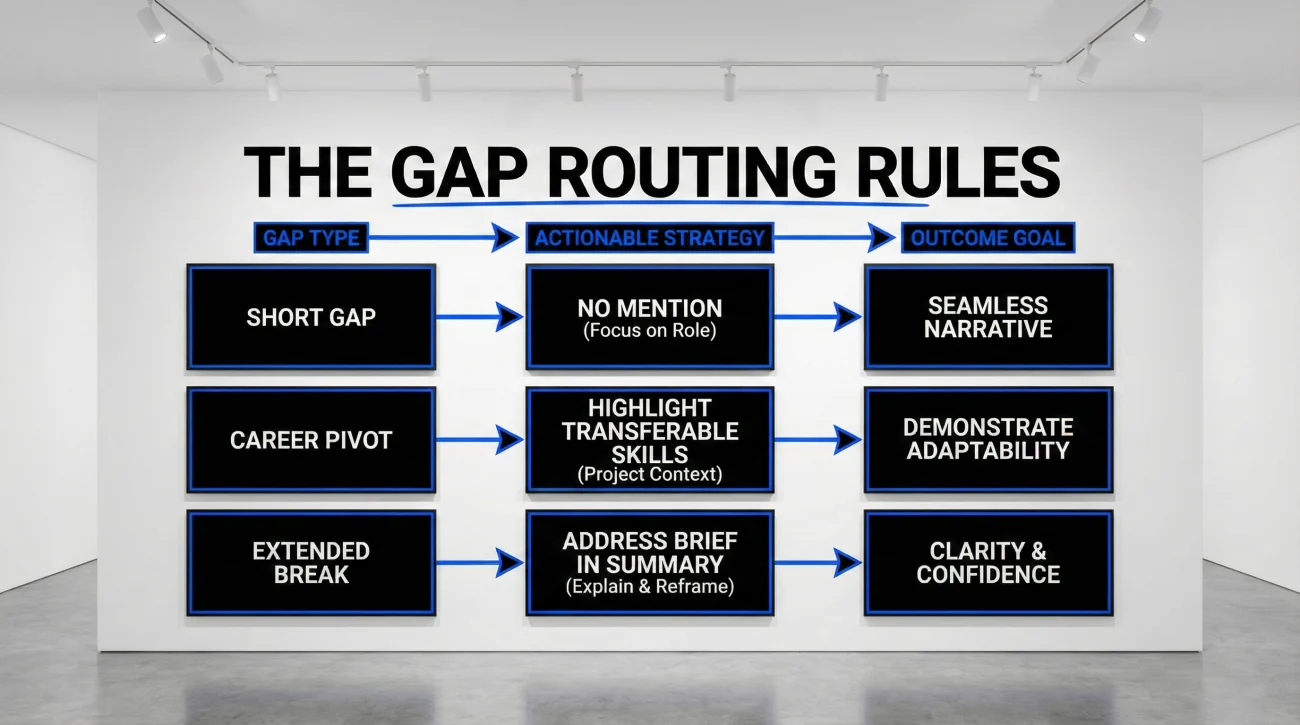
Routing Rules I Use With Candidates
- If the gap is short and not obvious: Do not mention it in the summary.
- If the gap is obvious and recent: Use one clause, then move on to value.
- If the gap needs formal clarity: Place explanation in the Experience section using a neutral entry, not in the summary.
- If the gap is sensitive: Keep the resume neutral and prepare a calm interview answer.
Here are two “light clause” options that do not hijack the summary:
Notice the trick: The clause is not “explaining.” It is simply framing the present tense.
What do I say if the interviewer asks directly about the gap?
Keep it short, neutral, and forward-facing. Your goal is to close the loop and move back to work value. If you over-talk it, you signal insecurity, even when the reason is normal.
“I stepped away for a period, and that chapter is fully resolved. I am back in a full-time search now, and I am focused on roles where I can contribute immediately in [target area].”
That answer works because it closes the loop, confirms readiness, and gives the interviewer a clean ramp back to your skills.
What I Have Seen Work in Real Hiring Loops
I want to ground this in reality, because templates only matter if they survive real readers.
Enid: A “Normal Summary” Beat the Urge to Explain
Enid had a clear gap. She kept trying to “be transparent” in her summary, and every draft started with the break. The more she explained, the more she sounded like she needed permission to be considered.
We rewrote her top section to do three things: Target role, scope marker, and recency anchor. The gap was still there in the timeline, but the reader did not meet the gap first. They met competence first.
The feedback she got later was telling: The first screen focused on her fit and her systems thinking, not the timeline.
Orlando: “Recent Proof” Was the Turning Point
Orlando had been unemployed longer than he wanted. He felt embarrassed and tried to compensate with enthusiasm words: Driven, motivated, eager. His callbacks were inconsistent.
What changed things was one line in the summary: A real output he built recently. Not a course name, not a vague claim. A deliverable. It gave the hiring manager something concrete to trust.
Once the top of the resume sounded current, his experience read differently. His older wins felt relevant again.
Gemma: The Bridge-Back Pattern Made the Switch Feel Clean
Gemma was returning after a career break, but she was also adjusting her lane slightly. Her early drafts felt like two different people: The “past Gemma” and the “future Gemma.” Hiring managers could feel the disconnect.
The bridge-back summary solved it by giving one spine: Transferable strengths, a recent proof line, and a clear next role target. It did not over-explain the break. It created continuity.
In later interviews, she said the gap barely came up. People asked about her workflow choices and how she communicated, which was exactly where she wanted the conversation to live.
Final
If your top section reads like a normal, current professional summary, most hiring managers will treat your gap as one detail, not the story. Lead with role clarity, keep your proof concrete, and let recency signals do the quiet work.
That is the component mindset behind a resume summary after a gap: Not explaining your life, but removing doubt so the reader can focus on your value.
❓ FAQ
🧩 Should I mention the employment gap in my resume summary?
Usually no. Your summary should behave like a normal summary: Target role, strengths, proof, and current focus. Only add a light clause if the gap is recent and you expect confusion during a fast skim.
🕒 What is the safest way to reference a career break in the summary?
Use a small present-tense bridge, then immediately return to value. One clause is enough. Avoid explaining reasons or adding emotional framing.
🧠 What matters more than the gap itself?
Readiness signals. Hiring managers want to know you can operate today: Tools, outputs, scope, and a clear role target. A single proof anchor often reduces concern more than any explanation.
📌 How do I add “recent proof” if I do not have a recent job?
Use an output-based line: A dashboard you built, a reporting pack, a process map, a volunteer workflow you improved, or a small project with clear deliverables. Name the output, not just the activity.
🧾 Can I use an objective statement instead of a summary?
Most objective statements are too vague and do not reduce doubt. A short summary with role clarity and one proof anchor usually performs better than “seeking a challenging role” language.
🎤 What is a strong interview one-liner about the gap?
Close the loop, confirm the present, then pivot to value. Keep it calm and short so the conversation returns to your skills and results.
⚠️ Disclaimer: ResumeSolving provides resume, cover letter, job search communication, and career transition guidance for informational purposes only. Hiring practices vary by employer, role, location, industry, and individual circumstances. We do not guarantee interviews, job offers, ATS results, or other outcomes. Verify employer requirements directly and follow applicable laws and workplace policies. For sensitive situations, use only information you are comfortable disclosing and keep all statements accurate.