- A strong bullet is not “a better verb”. It is a complete mini-story: action, context, method, outcome, and a proof noun.
- If you do not have numbers, you can still show impact with directional outcomes, scope, constraints, and what changed because of your work.
- Use the checklist at the end to catch vague claims, inflated verbs, and bullets that sound like everyone else.
The Real Reason Your Bullets Sound Like Everyone Else
Last month I reviewed a resume from a smart candidate named Micaela. Her experience was solid, but every bullet read like it could belong to ten other people on the same team. Same verbs, same “responsible for”, same vague outcomes. She asked me one question: How to write resume bullet points that do not feel generic without turning them into a braggy sales pitch?
Most advice online pushes action verbs and numbers. Helpful, but incomplete. In real hiring, the bullets that win are the ones that feel specific enough to trust. The recruiter does not need poetry. They need clarity, credibility, and a reason to believe you actually did the work.
This guide is built for that moment: when you are not trying to “sound impressive”, you are trying to sound real.
The Simple Bullet Formula That Prevents Generic Writing
If you only remember one thing, make it this: a good bullet has five slots. When one slot is missing, the reader fills the gap with skepticism.
[Action] + [Context] + [Method] + [Outcome] + [Proof Noun]
| Slot | What it does | What goes wrong when it is missing |
|---|---|---|
| Action | Your move, stated clearly. | Sounds passive or inflated. |
| Context | Scope and reality: what you were working on and for whom. | Feels like a duty list. |
| Method | How you did it: tool, approach, decision, constraint. | Reader assumes it was basic. |
| Outcome | What changed because of your work. | Looks like “activity”, not impact. |
| Proof noun | The artifact that makes the bullet believable. | Feels like a claim you cannot verify. |
💡 Tip: This is not about making bullets longer. It is about making them complete. You can keep it to one line if your slots are tight.
How to Fill Each Slot Without Guessing or Buzzwords

Slot 1: Action (Pick the verb that matches your actual level of control)
When candidates struggle, they often choose a “power verb” that does not match what they truly owned. That is how bullets start sounding defensive in interviews. If you “spearheaded” everything, the next question is: “Cool, so what exactly did you personally do?”
One of my colleagues, Jordan, coached a candidate who kept writing “led” for projects where she was really the analyst behind the scenes. We swapped the verb to “built”, “modeled”, and “validated”, and suddenly the bullets became more credible. Her callbacks improved, not because she sounded bigger, but because she sounded precise.
Key Point: The strongest verb is the one you can defend in 20 seconds without backtracking.
Slot 2: Context (Make the reader understand what world you were operating in)
Context is the missing line that turns a duty into a story. It answers: What was the thing? Who was it for? How big was it? What constraint mattered?
Context is often a short phrase: “for 12-person sales team”, “across 3 regions”, “for a legacy ERP migration”, “in a regulated environment”, “for a 1M user app”. Small details, big credibility.
What if my work was “just my job” and not a flashy project?
Then you use operational context: volume, frequency, complexity, stakeholders, risk. A week where you handled 200 tickets in a sensitive domain is context. A month where you reconciled messy data from five systems is context.
Slot 3: Method (Show the thinking, not just the motion)
Method is where generic bullets die. “Improved reporting” is vague. “Improved reporting by rewriting SQL joins and rebuilding a weekly KPI dashboard” is concrete.
This is also where you quietly surface skills without stuffing keywords: tools, frameworks, and decisions. Not a tool dump. Just the one that made the result possible.
Slot 4: Outcome (Choose the outcome the business actually cares about)
Outcomes do not have to be revenue. The best ones match the job you want next. For operations, it might be cycle time, error rate, throughput, risk. For support, it might be response time, deflection, satisfaction, backlog reduction. For product, it might be adoption, retention, activation, churn reduction.
If you are trying to write resume bullet points that land well, ask: “What would my manager highlight in a performance review?” That is usually your outcome language.
Slot 5: Proof Noun (The artifact that makes your bullet believable)
This is the slot most guides skip, and it is the easiest way to stop sounding generic. A proof noun is a “thing” your work produced or touched: dashboard, playbook, SOP, runbook, audit pack, test plan, campaign brief, training deck, pricing model, backlog, roadmap, QA checklist, stakeholder memo.
When a recruiter sees an artifact, they can picture the work. When they can picture it, they trust it more.
How to Show Impact Without Numbers (Or When Numbers Are Confidential)
“Add metrics” is easy advice when you have clean dashboards and public KPIs. In many real jobs, you do not. Some teams do not measure well. Some numbers are confidential. Some work is shared across a team.
I once worked with Lila, a candidate from healthcare operations. She could not share patient volume, and her work was spread across multiple sites. We reframed her outcomes using directional language plus proof nouns, and it worked because it still told a complete story.
| If you cannot use numbers, show this | Example outcome phrasing | Helpful proof nouns |
|---|---|---|
| Speed | Cut handoff time by removing approval bottlenecks. | Workflow map, SOP, runbook |
| Quality | Reduced recurring errors by standardizing intake checks. | Checklist, QA script, error log |
| Risk | Lowered compliance exposure through audit-ready documentation. | Audit pack, policy doc, control list |
| Clarity | Improved decision speed by aligning stakeholders on one KPI definition. | KPI glossary, dashboard, decision memo |
| Scale | Enabled the same process to work across multiple teams and regions. | Template kit, training deck, rollout plan |
⚠️ Warning: Do not replace missing numbers with fake precision. “Significantly improved” is not safer. It just sounds like you are hiding something. Use real-world constraints instead.
12 Before and After Examples Using the Formula
Below are examples across roles. Notice the pattern: the “after” version is not longer by default. It is simply more complete.
This is the core resume bullet point formula in action: five slots, one believable story.
| Role | Before (Generic) | After (Specific and Defensible) |
|---|---|---|
| Customer Support | Handled customer issues and improved satisfaction. | Resolved high-priority escalations for enterprise accounts by rebuilding the triage workflow, reducing repeat tickets and producing a reusable escalation playbook. |
| Data Analyst | Created reports for leadership. | Built a weekly KPI dashboard for marketing spend by rewriting SQL logic and aligning definitions, giving leadership one source of truth for budget decisions. |
| Operations | Improved processes across the team. | Streamlined vendor onboarding by standardizing intake steps and approval routing, reducing delays and shipping a documented SOP used across the department. |
| Project Coordinator | Supported project management activities. | Coordinated cross-team launch readiness by tracking dependencies and risks in a single rollout tracker, preventing last-minute blockers and improving handoffs. |
| Marketing | Managed campaigns and increased engagement. | Optimized lifecycle email campaigns by testing subject lines and segmentation rules, improving conversion quality and creating a repeatable experiment tracker. |
| Product Manager | Worked on product roadmap and user needs. | Prioritized a retention-focused roadmap by synthesizing user interviews and funnel drop-offs, shipping a revised onboarding flow and documenting the decision rationale in a product memo. |
| Software Engineer | Improved application performance. | Reduced API latency on a high-traffic endpoint by profiling bottlenecks and refactoring caching, improving reliability and adding a performance monitoring dashboard. |
| QA | Tested features and reported bugs. | Strengthened release quality by building regression test coverage and a release checklist, reducing recurring defects and improving handoff clarity for engineers. |
| HR / Recruiting | Supported hiring processes. | Improved hiring consistency by standardizing interview scorecards and training interviewers, reducing noisy feedback and producing a reusable interview kit. |
| Finance | Helped with forecasting and reporting. | Improved forecast reliability by reconciling spend categories and building a monthly variance review pack, enabling cleaner budget decisions across stakeholders. |
| Retail Management | Managed staff and store operations. | Stabilized shift coverage during peak periods by redesigning scheduling rules and training leads, reducing last-minute gaps and creating a repeatable staffing plan. |
| Healthcare Ops | Ensured compliance and documentation. | Reduced compliance risk by tightening documentation standards and building an audit-ready checklist, improving consistency and creating an audit pack template for the team. |
❌ Note: If your “after” bullet feels like three bullets glued together, you probably stuffed multiple outcomes into one line. Pick the strongest single change and keep the rest for another bullet.
A 60-Second Checklist for Good Bullets
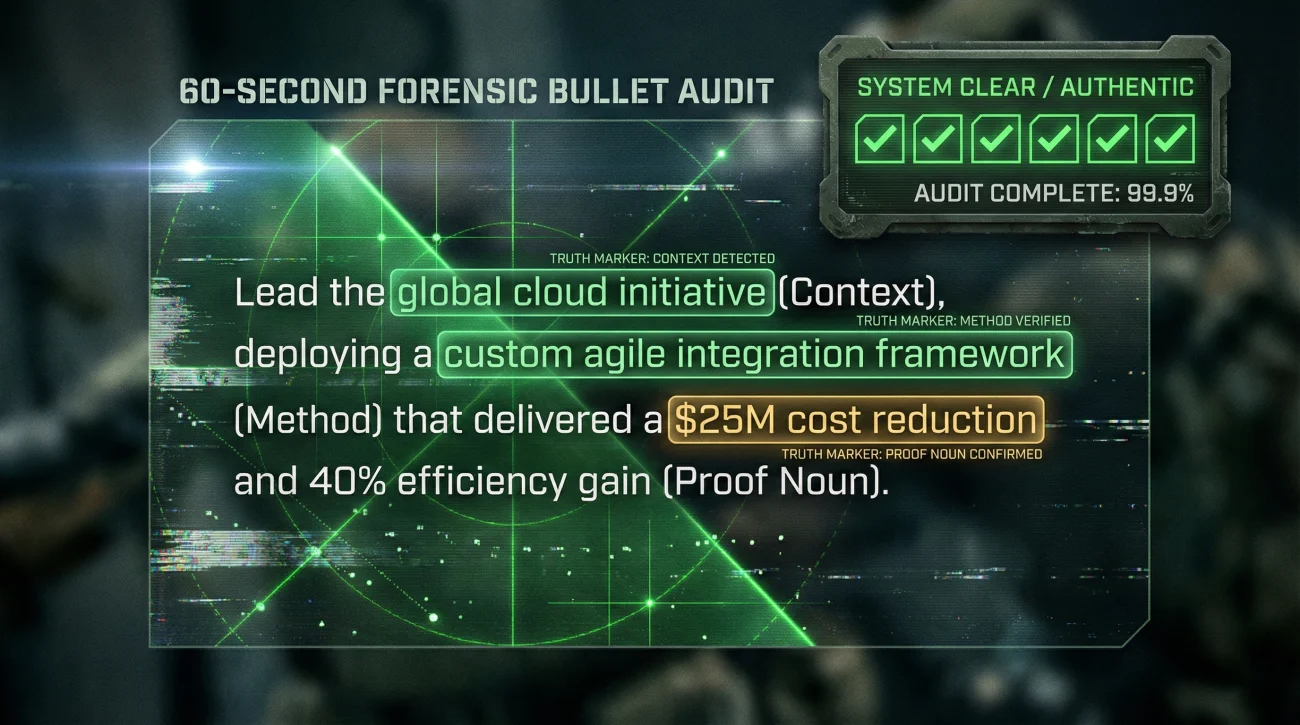
When candidates ask me for “good resume bullets”, I do not judge them by how confident they sound. I judge them by whether I can understand and trust them in one skim.
Run your bullets through this quick test:
- Does the bullet contain at least one real piece of context (scope, audience, constraint, system, volume)?
- Can you underline the method (tool, decision, approach) without listing five technologies?
- Is the outcome phrased as “what changed”, not “what you did”?
- Is the verb defensible, meaning you would use the same verb in an interview?
- Is there a proof noun (dashboard, playbook, SOP, checklist, memo, tracker, model)?
- Does the bullet avoid filler like “successfully”, “effectively”, and “various”?
- Can you explain the bullet in 20 seconds without adding brand-new details?
Final
If you have been fighting your bullets by swapping verbs, stop. The fix is structural, not cosmetic. A strong bullet is a mini-story with five slots: action, context, method, outcome, and proof noun.
Once you write a few bullets this way, you will notice something calming: you do not need to exaggerate. You just need to be specific. That is what makes recruiters trust your work, even when you cannot share perfect numbers or glamorous wins.
And if you want one line to keep on your screen while editing: how to write resume bullet points is really just learning how to tell one believable change at a time.
❓ FAQ
✅ How many bullet points should I use per job?
Use as many as you can defend, and as few as you need to stay readable. Most roles land well with 3 to 6 bullets, with more emphasis on the most recent and most relevant jobs.
🎯 Do resume bullet points need numbers to be strong?
No. Numbers help, but they are not the only form of proof. If numbers are missing or confidential, use scope, constraints, directional outcomes, and proof nouns like dashboards, SOPs, checklists, or decision memos.
🧩 What is a “proof noun” and why does it matter?
A proof noun is the artifact your work produced or improved. It makes a bullet feel real. Examples include a playbook, tracker, dashboard, training deck, QA checklist, audit pack, or rollout plan.
🛠️ Should every bullet include tools like Excel, SQL, or Jira?
No. Include the tool only when it explains the method or differentiates your work. A tool list without a method and outcome reads like keyword stuffing.
🧠 How do I avoid bullets that sound inflated?
Match the verb to your true level of control, then add context and a proof noun. Inflated bullets usually lack context, so the verb is doing all the “impressing” on its own.
⚠️ Disclaimer: ResumeSolving provides resume, cover letter, job search communication, and career transition guidance for informational purposes only. Hiring practices vary by employer, role, location, industry, and individual circumstances. We do not guarantee interviews, job offers, ATS results, or other outcomes. Verify employer requirements directly and follow applicable laws and workplace policies. For sensitive situations, use only information you are comfortable disclosing and keep all statements accurate.