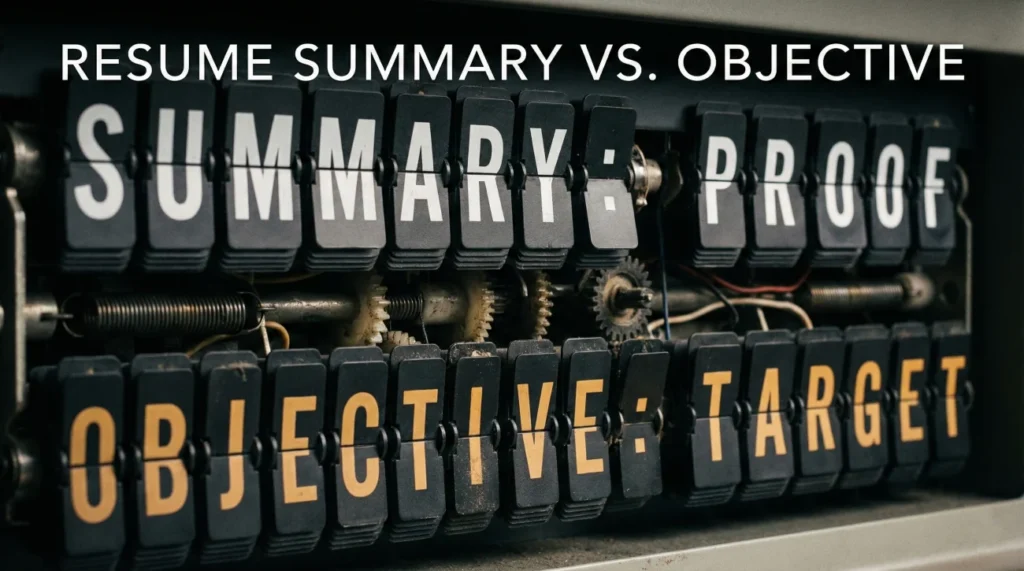
- If you can prove value, lead with a summary. If you need to prevent a wrong assumption, use a modern objective.
- The fastest decision rule: summary answers “What can you deliver?” objective answers “Where are you aiming, and why is it credible?”
- A 2026 objective only earns its space when it contains a target + a bridge + a proof hook. Otherwise, it is fluff.
The Difference People Think They Know (And the Part That Still Trips Them Up)
I still see this debate play out the same way: someone asks whether an objective is “outdated,” and the room splits into two camps. One says: “Just write a summary.” The other says: “Objective is fine for entry-level.” Both sides are half right, and both can produce a weak top-of-resume section if they do not understand what the reader is actually doing.
In a real screening moment, the top of your resume is not a “welcome paragraph.” It is a routing signal. It tells the reader what lane to place you in, and how confident they should feel about that placement.
That is why resume summary vs objective is not a style preference. It is a component decision. You pick the one that reduces confusion fastest.
One sentence definitions that do not lie
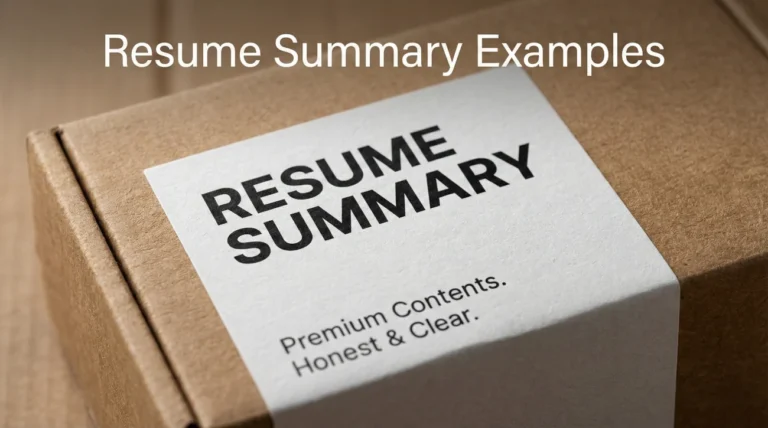
Summary: A compact proof-based preview of what you can deliver in the target role.
Objective: A compact targeting statement that explains the role you want and why that target makes sense.
The keyword that matters is “proof.” A summary should contain it directly. An objective should contain a proof hook, even if you are early career.
💡 Pro Tip: If your top section makes the hiring manager say “Okay, I get what you do,” it is doing its job. If it makes them say “Maybe,” it is costing you speed.
The 20-Second Decision Rule Recruiters Actually Use
I learned this rule from a colleague who moved from corporate HR into a high-volume recruiting team. She put it bluntly: “If the top of the resume does not tell me what to do with you, I keep scrolling until I can decide, or I move on.” That is the real risk. Not whether the word “objective” is old-fashioned.
Here is the decision rule I use when coaching candidates. It is simple enough that you can apply it without overthinking.
| Question | If the answer is “Yes” | If the answer is “No” |
|---|---|---|
| Can I prove I have done the target work (or adjacent work) already? | Lead with a summary. | Consider a modern objective, then prove with projects or bullets. |
| Is my target role already obvious from my last 1 to 2 jobs? | Summary or nothing. Objective adds little. | Objective can reduce guesswork if your background is wide. |
| Is there a risk the reader mislabels me (wrong level, wrong function, wrong industry)? | Use the top section to prevent the wrong label. | Summary is usually enough. |
| Do I have a credible bridge (coursework, portfolio, internship, volunteer, internal transfer story)? | Objective can work because it is believable. | A vague objective will backfire. Use a small summary instead. |
Notice what is missing: “years of experience” as a hard cutoff. In real hiring, I have seen a senior candidate need an objective because their title did not match what they were applying for. I have also seen a new grad skip an objective because their projects made the target obvious.
Summary vs Objective: What Each One Is Allowed to Say
Most weak top sections fail because they say something the section is not allowed to say. A summary is not the place for motivation. An objective is not the place for a life story. When those lines blur, the reader feels it instantly.
| Component | What it should focus on | What it should avoid | Typical length |
|---|---|---|---|
| Summary | Proof, scope, outcomes, specialty, tools or domain | “Seeking,” “passionate,” vague traits with no evidence | 3 to 6 lines |
| Objective | Target role + bridge + why credible right now | Generic goals, company flattery, “challenging position” | 1 to 2 lines |
So should you ever label the section “Objective”?
You can, but you do not have to. In practice, the label matters less than the content. Some candidates use “Target” or “Focus” because it feels modern. The real test is whether the lines do work that the rest of the resume cannot do quickly.
Note: The reader is not grading your writing style. They are grading how fast they can place you in the right hiring bucket.
What a “2026 Objective” Looks Like When It Is Not Fluff
Let’s talk about the phrase people keep searching: resume objective 2026. The only reason the objective is still alive is because some candidates genuinely need a routing line.
I worked with a candidate named Omar who had five years in customer support, but he was applying for Customer Success roles. He did not want to look like he was randomly upgrading his title. His resume needed one line that connected the dots without begging. The objective did that job.
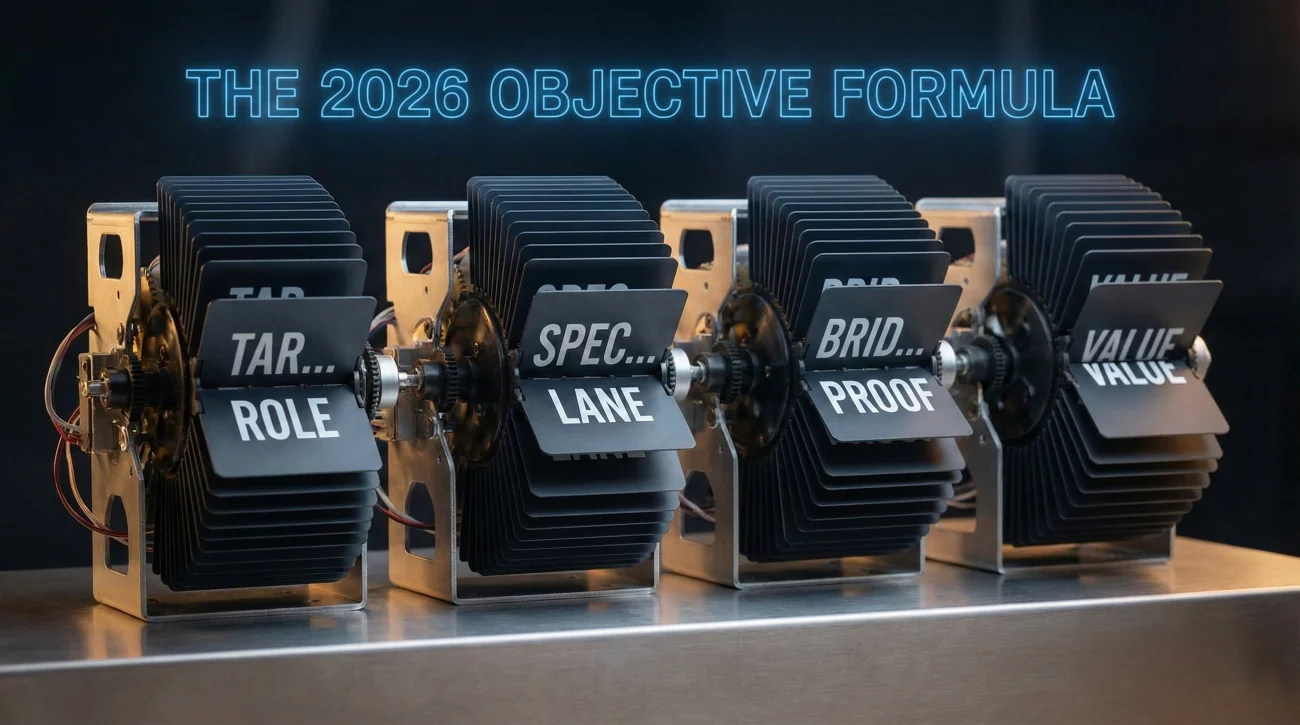
The only objective formula I trust
[Target Role] + [Specific lane] + [Bridge proof] + [Immediate value]
This is not a motivational statement. It is a credibility statement. If you cannot fill the “bridge proof” part, you probably should not use an objective.
Customer Success Associate targeting B2B SaaS onboarding, backed by 18 months handling enterprise support queues and leading a churn-reduction playbook rollout.
Entry-level Data Analyst role in healthcare, using a portfolio of Python dashboards built from public claims datasets and a recent internship in reporting automation.
⚠️ Warning: If your objective could be copied and pasted onto 10,000 other resumes, it does not belong on yours.
A small but important rewrite that fixes 80% of bad objectives
Old objective language usually starts with what you want. Modern objective language starts with what you are aiming at and why you are a believable pick.
Here is the swap I use in edits:
When a Summary Is the Clear Winner (Even If You Are Early Career)

A lot of advice says objectives are “for entry-level.” That is only true if you have nothing else to lead with. If you have real proof, even from school, projects, freelance, or volunteering, a summary can do more work than an objective because it starts with value.
I remember a candidate named Jade, a new grad who was convinced she needed an objective because she had no full-time experience. But she had two solid projects and a part-time role where she managed a small content calendar. We wrote a tight summary, and it instantly made her feel less like “entry-level hoping” and more like “junior contributor ready to execute.”
That is a summary. It does not pretend she has years of experience. It simply proves she can do the work.
The “proof hook” checklist for summaries
- ✅ Start with your target function or role level in plain language.
- ✅ Add 1 concrete scope marker: domain, audience, platform, team size, or deal size.
- ✅ Add 1 measurable outcome or deliverable.
- ✅ End with the lane you want: not a dream, a specific focus.
❌ Note: If your summary is only adjectives, it is not a summary. It is a personality paragraph.
When an Objective Still Helps (And What It Must Contain)
An objective is still useful when the reader might otherwise make the wrong assumption. That is the only reason to keep it.
Three situations where I have seen objectives save the read
1) Career change with a messy title trail. Your last title points to one function, but your target is another, and you need a clean bridge.
2) Returning after a break with a level question. The reader might assume you are “rusty” or not available. A precise target line reduces that fear.
3) Multiple directions on one resume. Some candidates have done product, ops, and marketing. Without a target line, the reader has to guess which version of you is applying.
I saw this with Ophelia, who took time away to handle family logistics and returned to project coordination. Her bullets were strong, but the top of the resume looked like a gap with no signal. We used one objective line to anchor the story, then let the experience prove it.
If my objective is specific, will it hurt me if the role is slightly different?
No, as long as you target a lane that matches the posting. The danger is not specificity. The danger is vagueness. A reader can forgive a narrow lane if you clearly match the job. They cannot forgive a top section that says nothing.
The Mistakes That Make Both Sections Look Weak
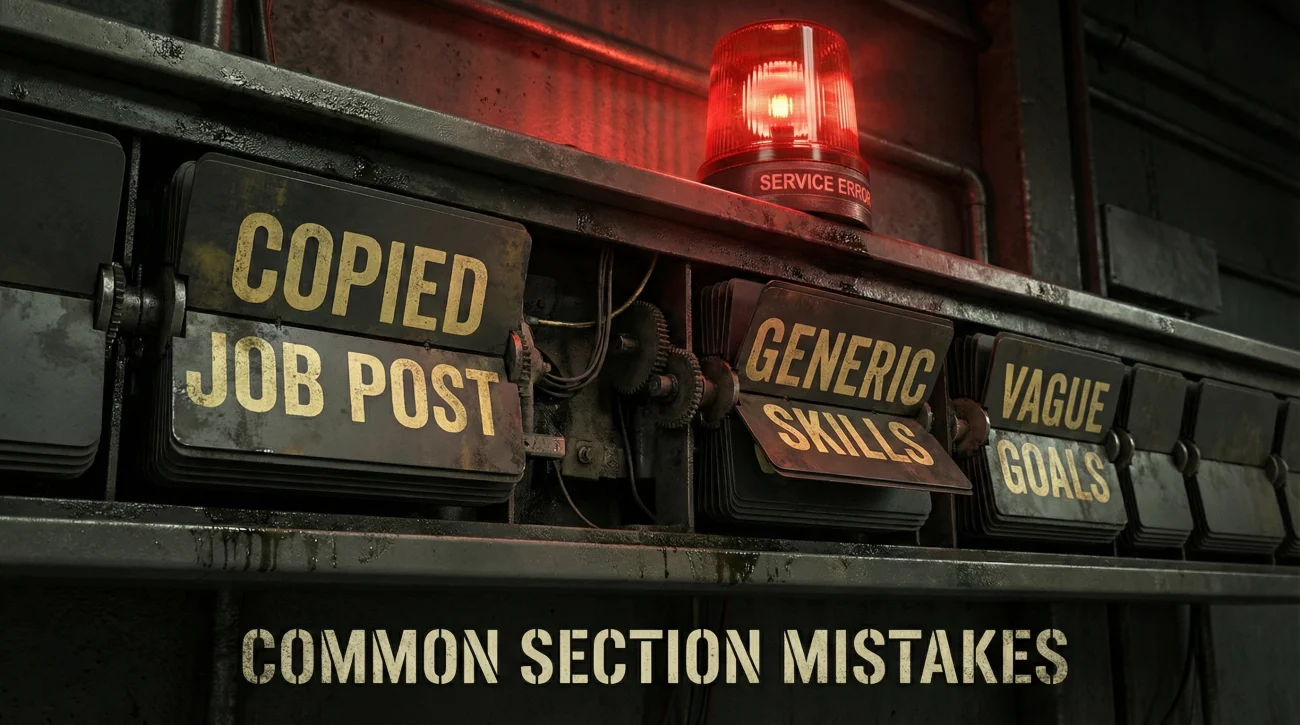
Whether you write a summary or an objective, there are a few patterns that consistently trigger eye-roll. You can spot them because they feel like filler.
Mistake 1: Saying the job posting back to the employer
If your top section sounds like you copied the job description and removed the company name, it will not build trust. It reads like compliance, not competence.
Mistake 2: Listing skills with no shape
“Hardworking, motivated, team player” is not a brand. It is a default setting. If you mention a skill, attach it to a deliverable or context.
Mistake 3: Using an objective when the target is already obvious
This is the most common waste of space for experienced candidates. If you are already applying for the job you have been doing, the objective adds nothing. A small summary (or a strong headline) is better.
“I kept seeing ‘Seeking a challenging role’ at the top of resumes, and it never helped me decide. It just told me the candidate did not know what to lead with.”
This quote came from a hiring manager I worked with on a cross-functional team. It is blunt, but it matches what many screeners feel: vague top sections slow the decision down.
Examples That Actually Sound Like a Real Person
Below are examples you can adapt. Notice how each one chooses either proof (summary) or routing (objective), and then commits to that job fully.
Summary examples
Operations Analyst with 3 years improving reporting workflows, reducing manual weekly updates by 40% through spreadsheet automation and clearer KPI definitions.
Frontend Developer focused on accessible UI, shipping 8 production features in the past year and partnering with design to reduce support tickets tied to usability issues.
HR Coordinator supporting onboarding and employee documentation across 120+ staff, known for clean process updates and fast follow-through during high-volume hiring months.
Sales Development Rep in B2B SaaS, consistently hitting activity targets and improving show rates through tighter email sequencing and cleaner qualification notes.
Objective examples (modern style)
Entry-level UX Research role, supported by a portfolio of moderated user interviews and synthesis reports from two app redesign projects.
Finance internship in FP&A, bringing coursework in forecasting and a recent project building a budget model with scenario testing.
Career change into Product Operations, leveraging 4 years in support escalation workflows and recent project work mapping onboarding friction points.
Coordinator role in events or community operations, backed by volunteer leadership running monthly meetups and sponsor outreach tracking.
💡 Pro Tip: If you are unsure which to choose, write both versions, then ask: which one makes the rest of my resume easier to read?
Final
When people ask me should i use objective on resume, I usually answer with a question back: “What wrong assumption are you trying to prevent?” If the answer is “none,” a tight summary (or even no top section at all) will often read cleaner. If the answer is “they might mislabel me,” then a modern objective can be the fastest way to set the lane before the bullets do the heavy lifting.
In the end, resume summary vs objective is about speed and accuracy. The best choice is the one that makes your reader place you correctly, without needing to guess what version of you is applying today.
❓ FAQ
🎯 Is a resume objective outdated in 2026?
Not automatically. It is outdated when it is vague. A modern objective is a targeting line that includes a credible bridge and a reason the target makes sense.
✅ Can I include both a summary and an objective?
Usually no. Most resumes do better with one clear top component. If you try to do both, you often end up repeating yourself and wasting space.
🧠 What if I have experience but I am changing industries?
Lead with a summary if you can prove transferable outcomes. Use an objective only if your background would likely be misread without a clear lane.
📌 Should I label it “Objective” or use a different heading?
The heading matters less than the content. “Objective,” “Target,” or “Focus” can all work. The real requirement is that the line does routing work and is not generic.
🛠️ How long should a resume summary be?
Most strong summaries are 3 to 6 lines. If you need more, it usually means you have not chosen a clear lane or you are listing instead of proving.
⚠️ Disclaimer: ResumeSolving provides resume, cover letter, job search communication, and career transition guidance for informational purposes only. Hiring practices vary by employer, role, location, industry, and individual circumstances. We do not guarantee interviews, job offers, ATS results, or other outcomes. Verify employer requirements directly and follow applicable laws and workplace policies. For sensitive situations, use only information you are comfortable disclosing and keep all statements accurate.