- Cover letters cannot fix major concerns – they can only prevent minor concerns from becoming rejection reasons.
- Most sticky situations are better addressed in interviews than in writing. Written explanations become permanent records.
- When you do explain, one tight paragraph maximum. Anything longer sounds defensive.
The Explanation Trap
A operations manager named Giulia had a two-year gap on her resume from caring for a sick parent. Well-meaning advice told her to address it proactively in her cover letter. So she wrote three paragraphs explaining the situation, her caregiving responsibilities, what she learned, and why she was ready to return.
The result: her cover letter read like a confession. Recruiters who might have simply asked about the gap in an interview were now reading detailed personal information before they had any context about her professional capabilities. Some felt uncomfortable with the level of disclosure. Others wondered why she was leading with the gap instead of her qualifications. Her response rate was worse than candidates with similar gaps who said nothing.
We cut the explanation to one sentence buried in the middle of her letter: “After a family caregiving period, I am fully focused on returning to operations leadership.” Then we rebuilt the letter around what she offered. Response rate doubled.
This is the explanation trap. The instinct to explain difficult situations is human and understandable. But written explanations in cover letters often backfire. They draw attention to concerns that might have been overlooked. They create permanent records of personal information. They shift focus from what you can do to what you need to justify.
Understanding cover letter sticky situations means knowing when explanation helps, when it hurts, and how to keep it brief when you do need to address something.
What Cover Letters Can and Cannot Fix

Be realistic about what a cover letter paragraph can accomplish:
Cover letters CAN:
- Prevent a minor question from becoming a rejection reason
- Signal awareness of potential concerns
- Provide context that makes a resume make more sense
- Show maturity and professionalism in how you frame difficulty
- Give recruiters language to use when advocating for you internally
Cover letters CANNOT:
- Overcome fundamental qualification mismatches
- Convince someone who has already decided against you
- Make a problematic history disappear
- Compensate for a weak resume
- Replace the nuanced conversation an interview allows
If your sticky situation is minor (short gap, career change logic, relocation reason), a brief explanation can help. If your situation is major (termination, multiple job losses, serious performance issues), the cover letter is not where you solve it. At best, you acknowledge it briefly and save the real discussion for interview.
Decision Framework: Explain or Not
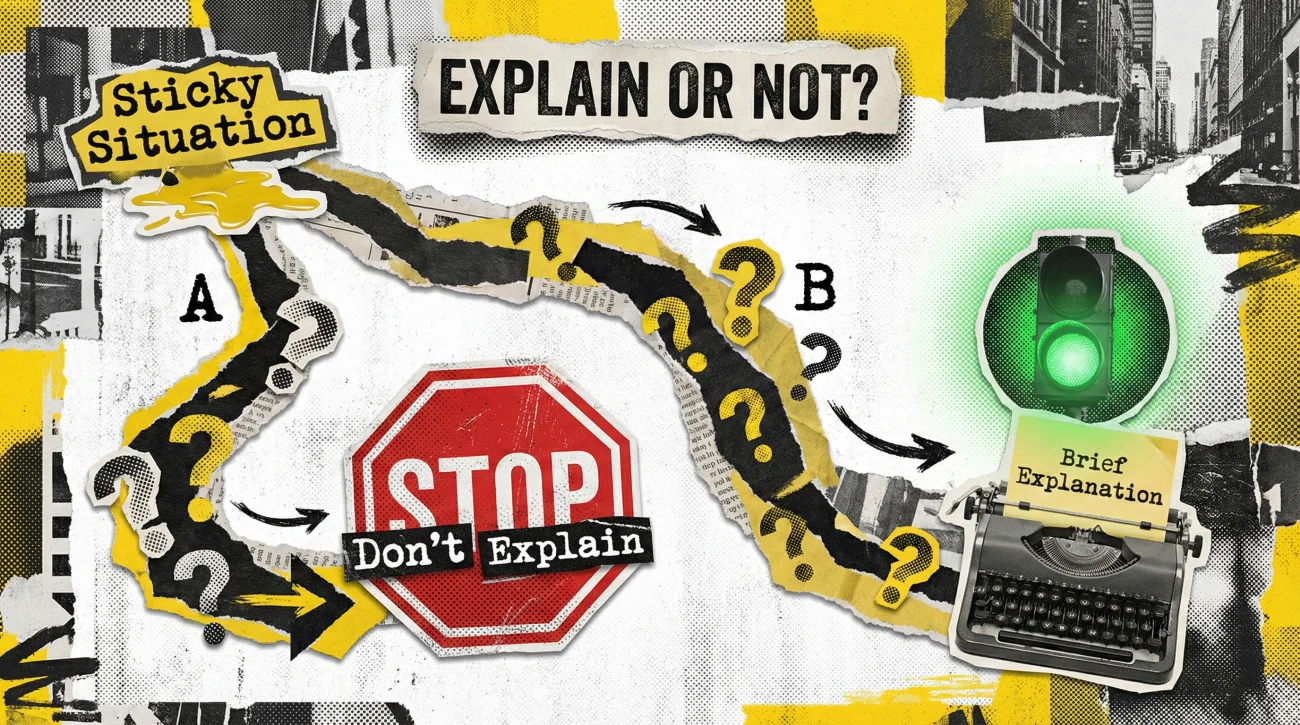
Before writing any explanation, run through these questions:
Will they definitely notice the issue without explanation?
If your resume already makes the situation obvious (clear gap, career change, relocation), brief context may help. If it is something they might not notice or focus on, explaining draws unnecessary attention to it.
Can this be explained better verbally?
Complex situations with nuance – terminations, workplace conflicts, health issues – are almost always better handled in conversation where you can read reactions and adjust. Written explanations are static and can be forwarded out of context.
Does the explanation require personal details?
If explaining requires disclosing health information, family situations, or other private matters, think carefully. You are creating a permanent document that will be filed, possibly shared, and exists forever. “Personal circumstances” is often enough without specifics.
Will the explanation take more than 2-3 sentences?
If you cannot explain it briefly, do not explain it in the cover letter. Long explanations sound defensive regardless of content. Save detailed context for interviews.
Does the posting ask about it?
Some job postings explicitly request explanation of gaps, relocation status, or specific circumstances. In these cases, address what they ask for – briefly.
💡 Default Position: When in doubt, leave it out. Most sticky situations are better addressed when asked rather than volunteered in writing.
When to Skip Explanation Entirely
Sometimes the best cover letter strategy is saying nothing about your sticky situation:
The issue is not obvious from your resume.
If your gap is 4 months and falls between two longer roles, many recruiters will not even notice. If your career change makes logical sense when you see the full history, you may not need to explain it. Do not draw attention to problems that might be overlooked.
The explanation requires significant personal disclosure.
Mental health challenges, family crises, medical issues, divorce, addiction recovery – these are legitimate reasons for career disruptions, but they are also deeply personal. A cover letter is a professional document that gets filed and forwarded. Consider whether you want this information in writing before anyone has met you.
The situation is too complex for a paragraph.
Some situations – wrongful termination disputes, failed businesses, complicated visa situations – cannot be explained briefly without sounding incomplete or raising more questions. Save these for interview conversations where you can read reactions and provide appropriate detail.
Your resume already addresses it.
If you have added a career break entry, a clear consulting umbrella, or other resume formatting that accounts for the situation, additional cover letter explanation may be redundant and draw extra attention.
The company did not request a cover letter.
If a cover letter is optional and your main reason for writing one is to explain a sticky situation, reconsider. You may be better off letting your resume speak and addressing concerns if they arise in screening calls.
Four Tones That Kill Cover Letters

Even when explanation is appropriate, wrong tone destroys your message. Watch for these patterns in your drafts:
🚫 The Over-Explainer. Multiple paragraphs justifying your situation. Extensive background about why things happened. Details that are not relevant to whether you can do the job. This tone signals insecurity and suggests you expect rejection.
Example: “I want to explain the gap in my employment. In March 2022, my mother was diagnosed with a serious illness. As the oldest child in my family and the one living closest to her, I made the difficult decision to take time off to help coordinate her care. This involved managing appointments, medications, insurance, and eventually transitioning her to assisted living. It was an incredibly challenging period but also taught me valuable lessons about prioritization and resilience…”
🚫 The Blame Shifter. Explanations that attribute problems to employers, coworkers, circumstances, or bad luck. Even when true, blame signals you might not take accountability for your own performance.
Example: “I left my previous position because the management was chaotic and the company made promises about the role that they did not keep. The team was understaffed and the expectations were unrealistic…”
🚫 The Legal Threatener. Language that hints at discrimination, wrongful termination, hostile work environment, or potential lawsuits. Even subtle legal undertones make you seem like a liability.
Example: “I departed my last company under circumstances that I am not at liberty to discuss in detail, but I have documentation of the situation and my attorney has reviewed the matter…”
🚫 The Desperate Pleader. Language that begs for a chance, over-emphasizes willingness to take anything, or sounds like you are trying to convince someone to take a risk on you.
Example: “I know my background might not be traditional, but I am willing to do whatever it takes. I just need someone to give me a chance to prove myself…”
Before and After: Real Rewrites
These rewrites show how to transform problematic explanations into professional ones:
Employment Gap:
“I need to address the gap in my resume. From 2022 to 2024, I was caring for my mother who was diagnosed with Alzheimer’s disease. This was an incredibly difficult time for my family, and I had to take on significant responsibilities including managing her medical care, finances, and eventually transitioning her to memory care. While I was not working professionally, I learned a lot about crisis management, working with healthcare systems, and making difficult decisions under pressure.”
“Following a family caregiving period, I am now fully focused on returning to project management. I have maintained my PMP certification and completed an Agile certification during this time to ensure my skills remain current.”
Career Change:
“I know my background in education might seem unrelated to corporate training, but I believe my skills transfer well. Teachers do many of the same things corporate trainers do – we design curriculum, present information, assess learning, and adapt to different audiences. I am very passionate about making this transition and I hope you will give me a chance to prove myself.”
“My teaching background translates directly to corporate training: curriculum design, live facilitation for varied audiences, and learning assessment. I have supplemented this with an ATD certification and a volunteer training project for the local Chamber of Commerce.”
Four Mini Paragraphs by Case
When explanation is warranted, these templates show appropriate length and tone:
Employment Gap (Caregiving, Health, Personal)
Career Change
Relocation
Short Tenure / Quick Departure
Notice what these share: brief acknowledgment, forward-looking focus, no extensive detail, no blame, no pleading. One paragraph. Done.
Where to Place the Explanation
Placement affects how the explanation reads:
Opening paragraph: Never start with your sticky situation. This signals you see yourself as a problem to be explained rather than a candidate to be considered. Always lead with what you offer.
Middle paragraph: Best placement for most explanations. You have established your qualifications first, addressed the concern briefly, then returned to forward-looking content. The explanation is context, not headline.
Closing paragraph: Acceptable for minor issues like relocation timing or availability. Not appropriate for significant concerns – ending on the sticky situation leaves it as the last impression.
Separate section or PS: Sometimes a brief “Note:” or post-script works for logistical matters (visa status, relocation timeline). Not appropriate for career history explanations, which should be integrated naturally.
Length Rules
Hard limits for explanation content:
- Maximum: One paragraph, 3-4 sentences
- Ideal: 1-2 sentences integrated into a larger paragraph
- Total cover letter: Should not exceed one page, preferably 3-4 paragraphs
- Explanation ratio: No more than 20% of your cover letter should address sticky situations
If you find yourself writing more, you are either over-explaining or facing a situation that cannot be solved in a cover letter. Step back and reconsider whether written explanation is the right approach at all.
Detailed Guides
| Article | Description |
|---|---|
| Do You Need a Cover Letter: A Decision Guide for 2026 Job Applications | A clear decision framework for when a cover letter helps in 2026, when it is ignored, and what to do instead when time is tight. |
| Cover Letter Paragraph for an Employment Gap: One Tight Explanation Only | A single paragraph template that explains a gap without turning it into a confession, plus the one line that signals closure. |
| Cover Letter Paragraph After a Layoff: Keep It Factual and Move On | A layoff paragraph that stays factual, avoids bitterness, and quickly pivots to fit, value, and readiness. |
| Cover Letter Paragraph After Being Fired: Keep It Short, Accountable, and Safe | A short, accountable paragraph that reduces risk, avoids oversharing, and keeps the reader focused on what you can deliver now. |
| Cover Letter Paragraph for Job Hopping: One Paragraph That Reduces Flight Risk | A paragraph that frames frequent moves as coherent, shows commitment to the role’s scope, and lowers the “will they leave” concern. |
| Cover Letter Paragraph After Leaving a Toxic Workplace: Neutral, Short, and Professional | A neutral exit paragraph that avoids accusations, keeps tone professional, and protects you from sounding reactive or dramatic. |
| Cover Letter Paragraph for Freelancers: Signal Team Readiness and Continuity | A paragraph that translates freelance work into team-ready signals: collaboration, ownership, consistency, and long-term intent. |
| Cover Letter Paragraph for Founders: Make the Pivot Sound Intentional | A founder pivot paragraph that frames the move as intentional, clarifies your role preference, and removes the “will they quit” fear. |
| Cover Letter Mistakes: 18 Lines That Turn a Hard Case Into a Red Flag | A list of common cover letter lines that backfire for sensitive situations, plus cleaner swaps that sound steady and credible. |
Less Is Almost Always More
The best approach to cover letter sticky situations is usually restraint. Question whether explanation is needed at all. If it is, keep it to one brief paragraph in the middle of your letter. Lead with what you offer, not what you need to justify. Let your qualifications be the headline and your sticky situation be a footnote. The recruiters reading your letter are looking for reasons to move you forward, not detailed explanations of your past. Give them what they need.
❓ FAQ
🎯 Should I always include a cover letter for sticky situations?
No. If the application does not require a cover letter and your sticky situation is not immediately obvious from your resume, you may be better off not volunteering information. Let them ask in an interview where you can have a real conversation.
📝 What if they specifically ask about the issue in the application?
If they ask directly – through an application question or posting requirement – answer briefly and factually. Do not evade questions they explicitly ask. But still keep it brief: 1-2 sentences addressing exactly what they asked.
💼 Can a great cover letter overcome a problematic history?
Rarely. Cover letters can prevent minor concerns from becoming rejections. They cannot overcome fundamental mismatches or serious red flags. Focus on positions where your background is a reasonable fit and the sticky situation is a minor factor, not the defining issue.
🔍 What if I have multiple sticky situations?
Address only the most significant one, and only if necessary. A cover letter that explains a gap, a termination, and a career change all at once reads like a list of problems. Pick the one most likely to be noticed and keep the others for interview if asked.
⚠️ Disclaimer: ResumeSolving provides resume, cover letter, job search communication, and career transition guidance for informational purposes only. Hiring practices vary by employer, role, location, industry, and individual circumstances. We do not guarantee interviews, job offers, ATS results, or other outcomes. Verify employer requirements directly and follow applicable laws and workplace policies. For sensitive situations, use only information you are comfortable disclosing and keep all statements accurate.