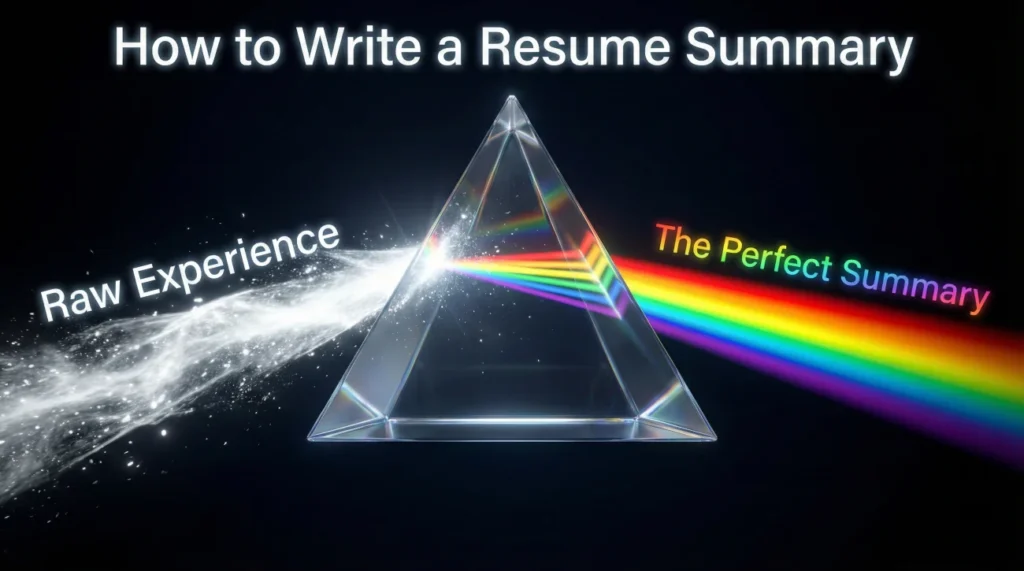
- A resume summary is not a mini bio. It is a proof-led positioning line that tells a recruiter what you do, where you fit, and what evidence backs it.
- Use a 4-part formula: Target role + Specialty + Proof anchor + Scope constraint. This is the fastest way to sound specific without sounding robotic.
- If your summary cannot be supported by the first two bullet points under your most recent role, it is marketing copy, not positioning.
The real problem with most resume summaries
I have reviewed thousands of resumes over the years, and I can usually predict the outcome of the first screen from one small detail: Whether the summary makes a clear claim that the rest of the resume can prove.
Most summaries fail for a boring reason. They try to sound impressive before they sound true. They lean on safe phrases like “results-driven,” “team player,” or “fast learner,” and the recruiter learns nothing about what the candidate actually does.
If you are searching for how to write a resume summary, here is the mindset shift that makes the whole thing easier: Your summary is a one-glance map. It should help a recruiter place you quickly, then want to read your proof.
💡 Pro Tip: A summary does not need to be “unique.” It needs to be uniquely supported by your evidence.
What a strong summary does in 6 seconds

A recruiter is not reading your summary as literature. They are using it as a sorting shortcut. In their head, they are trying to answer three questions fast:
- What role are you aiming for?
- What kind of work have you done inside that role (specialty or domain)?
- What proof suggests you can do it here (scope, outcomes, scale, systems)?
When candidates skip those questions, the recruiter has to infer the story from scattered bullets. That is where good candidates get mislabeled as “unclear fit.”
Key Point: A summary works best when it reduces recruiter guessing. If it creates more questions than it answers, it is taking space away from proof.
One of my former colleagues, Gracelyn, used to describe summaries like this: “The summary is the label on the box. The bullets are what is inside.” When the label is vague, people assume the box is empty.
The simple formula that sounds human

The easiest way to write a resume summary that sounds like a real person is to stop chasing perfect wording and start filling a structure that forces clarity.
[Target Role] + [Specialty] + [Proof Anchor] + [Scope Constraint]
Part 1: Target role
This is not your current title if you are pivoting. It is the role you want the recruiter to consider you for. Keep it clean and recognizable. If you over-customize the title, you risk sounding like you are inventing a role.
Example: “Product Marketing Manager” beats “Strategic Growth Storytelling Lead.”
Part 2: Specialty
Specialty is where most summaries get fuzzy. “Cross-functional” is not a specialty. “Stakeholder management” is not a specialty. Specialty is the slice of the work you repeatedly did, or the domain you repeatedly worked in.
Good specialties look like: B2B SaaS onboarding, payroll compliance, demand gen lifecycle, warehouse operations, financial reporting close, customer retention analytics.
Part 3: Proof anchor
The proof anchor is the one signal that makes the recruiter believe you have substance. It can be a number, a scale indicator, a system, a scope, or a credential that matters in your target role.
Notice what I did not say: It is not a list of soft skills. Soft skills can show up, but only after proof exists.
Part 4: Scope constraint
This is the piece most “top ranking” articles skip. Scope constraint means you show the boundary of your experience so it feels honest. It also helps the recruiter match you faster.
Scope constraints include: team size, market segment, region, deal size, volume, tool stack, environment (startup, enterprise, regulated, high-growth).
⚠️ Warning: If your summary says “expert” but your scope constraint is tiny, the mismatch reads as inflation.
How to pick proof that does not feel like bragging
Most people get stuck here. They have experience, but they do not know what proof belongs in the summary. Here is the rule I use in coaching:
What proof belongs in the summary?
The proof that helps a recruiter place your level and relevance fastest. Save the deeper metrics for your bullets. In other words: Put the “shape” of your impact in the summary, and the “math” in the experience section.
| Proof type | When it works best | Example phrasing |
|---|---|---|
| Scale | Ops, finance, analytics, support, logistics | “Supported 50+ internal stakeholders across 3 regions” |
| Outcome | Revenue, growth, performance roles | “Improved conversion on key funnel steps” |
| System or tool stack | Roles where tooling signals competence | “Built reporting in SQL + Looker for weekly exec reviews” |
| Environment | Startup vs enterprise matters for fit | “High-growth B2B SaaS, tight iteration cycles” |
| Domain credibility | Regulated or specialized fields | “Payroll compliance and audit support in regulated settings” |
A candidate named Justin once sent me a summary that was basically a personality paragraph. He was a strong analyst, but the top of his resume read like a dating profile: “Curious, passionate, energetic…” We changed one line to include tool stack + scope, and suddenly the resume felt real.
Nothing about him changed. Only the proof signal did.
10 examples you can adapt (without copying the soul out of them)
These are intentionally written to sound like a human wrote them. You will notice they do not rely on buzzwords. They rely on role clarity, proof anchors, and honest scope constraints.
Example 1 (Mid-level):
Operations Manager with 7+ years in warehouse and last-mile workflows, improving throughput and safety compliance across high-volume sites. Known for calm execution during peak periods and process fixes that stick.
Notice the proof anchor here is not a giant number. It is “high-volume sites” plus the environment signal of peak periods.
Example 2 (B2B SaaS):
Customer Success Manager focused on retention and expansion for B2B SaaS accounts, partnering with product and support to reduce churn drivers. Experienced managing complex renewals and building simple health scoring habits.
My friend Lina used a version of this after a layoff. She did not have a clean “I grew ARR by X%” metric, but she had credible scope and the right kind of work. She got interviews because she sounded like a real CSM, not a motivational poster.
Example 3 (Career switch):
Aspiring Data Analyst with a background in customer support operations, translating messy ticket data into weekly insights for leadership. Strong in Excel and SQL basics, with projects focused on churn patterns and response-time drivers.
This is how you do a switch without pretending you already held the new title for years. The proof anchor is the work: translating ticket data into insights, plus project focus.
Example 4 (Finance):
Financial Analyst supporting monthly close and forecasting in a multi-department environment, building reporting that leaders actually use. Comfortable with variance analysis, stakeholder questions, and tight timelines.
Example 5 (Marketing):
Performance Marketer specializing in paid social testing and landing page iteration, improving lead quality through tighter targeting and clearer messaging. Most experienced in lean teams where speed matters.
💡 Pro Tip: “Lean teams where speed matters” is a scope constraint that signals fit without sounding defensive.
Example 6 (HR):
HR Generalist with hands-on experience across onboarding, employee relations support, and manager coaching in growing teams. Known for practical policy guidance and clean documentation that reduces repeat issues.
Example 7 (Project):
Project Coordinator supporting cross-functional delivery across marketing and operations, keeping timelines honest and stakeholders aligned. Strong in meeting facilitation, risk tracking, and follow-through.
Example 8 (Engineering adjacent):
Technical Support Engineer bridging customer issues to engineering teams, writing clear reproductions and tracking fixes end-to-end. Experienced in ticket triage, logs, and customer communication during incidents.
Example 9 (Executive assistant):
Executive Assistant supporting senior leaders with calendar strategy, travel logistics, and meeting preparation. Known for proactive organization and steady handling of last-minute changes.
Example 10 (New grad):
Recent graduate targeting entry-level UX research, with project experience conducting interviews, synthesizing findings, and translating insights into actionable recommendations. Most interested in user onboarding and product clarity.
If you are chasing a good professional summary, steal the structure, not the words. Your recruiter is looking for truth signals, not poetry.
A quick checklist before you lock it in
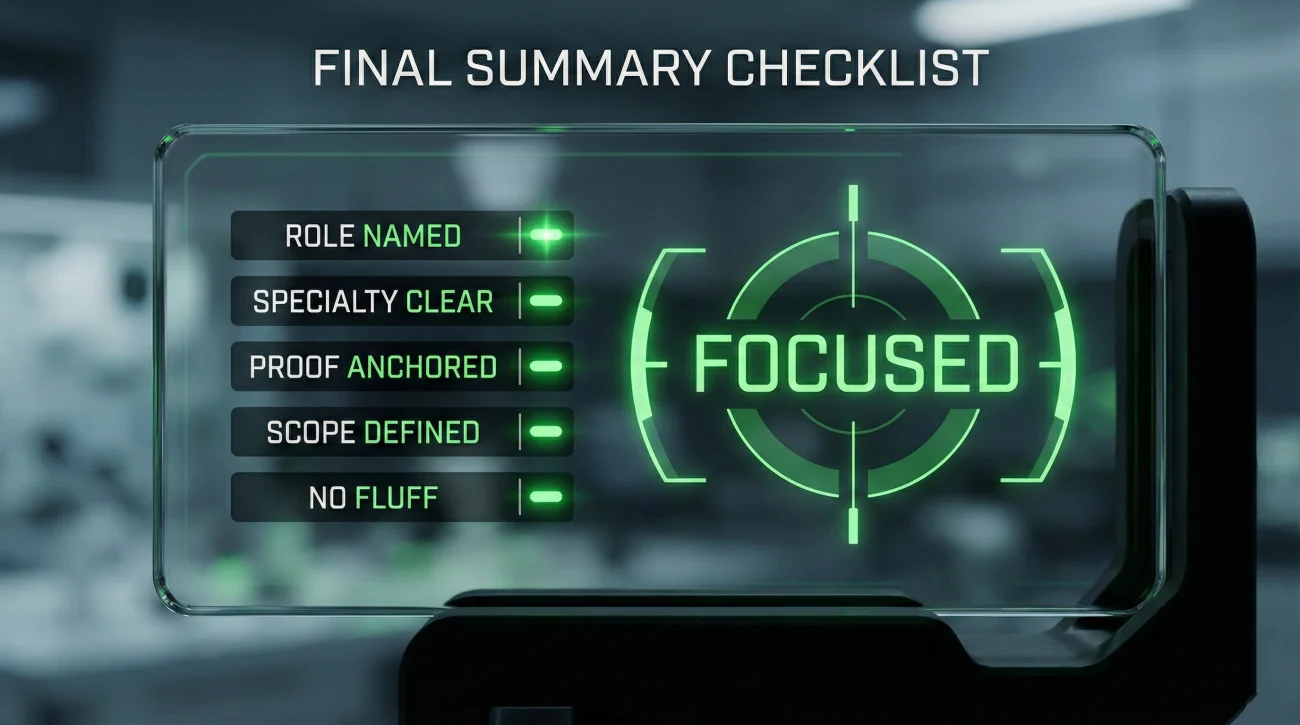
I tell candidates to run this checklist before they send applications. It is faster than rewriting five times from scratch.
- ✅ Does your first phrase name the target role clearly?
- ✅ Did you include a specialty that is not a soft skill?
- ✅ Do you have one proof anchor (scale, system, outcome, or environment)?
- ✅ Did you include one honest scope constraint so it feels grounded?
- ✅ Can your next two bullets prove what the summary claims?
- ✅ Did you avoid “seeking,” “passionate,” and other filler openers?
One more practical test: Read your summary out loud. If it sounds like a company mission statement, rewrite it as if you are explaining your work to a smart friend over coffee.
Mistakes that quietly kill credibility
These are the patterns I see most often when a resume feels “off,” even if the candidate is qualified.
Mistake 1: The summary makes promises instead of claims
Promises sound like: “Looking to leverage my skills to help your company succeed.” A claim sounds like: “Operations manager focused on warehouse throughput and safety compliance.”
A promise asks the recruiter to imagine your value. A claim shows them where to look for proof.
Mistake 2: Keyword stuffing at the top
People panic about ATS and try to pack the summary with every keyword in the posting. It reads unnatural, and it also creates a mismatch if your bullets do not back it up.
If you want ATS alignment, weave keywords into your role bullets where you can show context. The summary should stay readable.
Mistake 3: The summary fights the rest of the resume
This happens when the summary claims leadership but the resume shows mostly individual work, or when the summary claims a domain you have not actually touched.
The fix is not bigger words. The fix is a tighter scope constraint: Tell the truth about the size of your arena, then let the bullets show your competence inside it.
❌ Note: If your summary needs three adjectives to sound strong, you probably need one proof anchor instead.
When I helped a candidate named Ocean pivot from agency writing to in-house content strategy, the first summary she wrote was full of energy words. We replaced one sentence with a proof anchor about content systems and stakeholder work. It immediately felt like strategy, not enthusiasm.
Final
A strong summary is quiet confidence. It does not beg. It does not perform. It places you accurately and invites the recruiter to read your evidence.
The easiest way to keep it human is to use structure, then choose proof that your resume can actually support. Your tone can be warm, but your signal should be sharp.
Once you practice this resume summary formula a few times, the top of your resume stops feeling like a blank page and starts feeling like the simplest part to control.
If you want to go section by section and make the whole document feel consistent, this is part of the larger approach behind how to write a resume summary.
FAQ
🧠 How long should a resume summary be?
For most candidates, 3 to 5 lines is enough. If you need more than that, your summary is probably doing the job of your experience section. Keep the summary as a map, not a biography.
🎯 Should I use a summary or an objective?
A summary usually works better because it leads with proof and positioning. An objective can work for very early career situations, but it should still include a proof anchor and a clear target role, not vague ambition.
🛠️ What if I do not have measurable results?
Use other proof anchors: scope, volume, tools, systems, environment, or domain credibility. Numbers help, but they are not the only form of evidence.
🔍 Can I tailor the summary for each job without rewriting everything?
Yes. Keep the same structure and swap only two parts: your specialty emphasis and the proof anchor. If the rest of your resume supports it, small changes are enough.
🧩 Is it okay to include soft skills in the summary?
Only after you have at least one proof anchor. Soft skills alone sound like claims without evidence. If you include them, tie them to behavior: how you work, in what environment, and what that enables.
⚠️ Disclaimer: ResumeSolving provides resume, cover letter, job search communication, and career transition guidance for informational purposes only. Hiring practices vary by employer, role, location, industry, and individual circumstances. We do not guarantee interviews, job offers, ATS results, or other outcomes. Verify employer requirements directly and follow applicable laws and workplace policies. For sensitive situations, use only information you are comfortable disclosing and keep all statements accurate.