- A resume title is a target-role label. A headline is a claim with a hint of proof.
- You do not always need both. Use both when your target is clear but your credibility needs a fast bridge.
- If you only write one line, build a hybrid that reads like a title first, then proof.
Why This Debate Exists in Real Hiring
Most candidates only feel the difference between the two when they are under pressure: They rewrite the top of the page five times, still unsure why it reads “fine” but not convincing. The phrase resume headline vs resume title sounds like semantics, but the outcome is practical. One line tells me what you are aiming for. The other line tells me why I should believe you belong there.
I remember reviewing a stack of resumes for a client-side role after a reorg. Two candidates had the same role history on paper. One used a clean title that matched the opening. The other used a “headline” that was basically adjectives. Guess who got the follow-up question from the hiring manager: “So what does this person actually do?” The debate is not about wording. It is about what questions you leave unanswered in the first five seconds.
Key Point: If your top line does not answer “What role is this?” and “Why you?” fast, the rest of the resume works harder than it should.
Resume Title vs Headline: The Two Jobs They Are Supposed to Do
Resume title: A label that makes your target unmissable
A resume title is the shortest possible role label that tells the reader what you want to be considered for. Think of it as the name tag on your application. It is not the place to be clever.
💡 Pro Tip: A good title is boring in the best way. It matches the job family and removes ambiguity fast.
Resume headline: A claim plus a “proof hint”
A headline is one line that adds meaning to the label. It can signal scope, specialization, or a measurable outcome so the reader gets a reason to keep scanning.
In other words: Title answers “What.” Headline answers “Why you, and why now.” If you have ever wondered about resume headline meaning, that is it. It is not a summary paragraph. It is a claim that implies evidence.
| Line | Best format | What it should accomplish | What it should avoid |
|---|---|---|---|
| Title | Target role label | Make your job target obvious in one glance | Adjectives, mission statements, vague goals |
| Headline | Claim + proof hint | Add credibility, specificity, and a reason to read on | Buzzwords, empty “passionate” language, soft claims with no anchor |
Why Advice Online Conflicts
Here is the unglamorous truth: Many writers use “title” and “headline” interchangeably. Others define them as separate lines. Both can be “right” depending on the template they assume.
In practice, templates drive the definitions. Some resumes have one line under the name, so that line gets called either a title or a headline. Other resumes use two lines, and then people start splitting the terms to explain why each line exists.
A recruiter does not care what you call it
I have never heard a hiring manager say: “I only interview candidates with a headline, not a title.” What they do say is: “I cannot tell what this person is targeting,” or “This feels inflated.” The names do not matter. The signals do.
“If I have to guess your target role from your bullets, you are already behind. Make the top do its job.”
⚠️ Warning: When you copy a top-of-resume template without understanding the job of each line, you can accidentally create two lines that repeat each other and waste the most valuable real estate on the page.
When You Need Only One Line vs When You Need Both
Use only a title when your story is already obvious
If your most recent role matches the target role and your resume reads like a straight line, a title may be enough. The rest of the page will confirm the story quickly.
- Same role family, normal progression, no major industry pivot.
- Well-known job titles that do not require translation.
- Resume is dense already and you need space for proof.
Add a headline when the reader needs a bridge
A headline earns its space when the title alone is true but not persuasive. I see this a lot in career changes, downleveling, returning after a break, or when your previous titles are internal and unclear.
- You are switching functions or industries and need a credibility bridge.
- Your past titles do not map cleanly to the market title.
- You need to surface a hard proof signal early: Metric, scope, certification, niche expertise.
Use both when you want clarity and persuasion
The cleanest setup is often two lines: A title that is purely the target label, and a headline that adds a proof hint. That combination reduces confusion without sounding like marketing copy.
| Your situation | Best choice | What the top should accomplish |
|---|---|---|
| Direct match, standard titles | Title only | Confirm target role instantly, let experience do the talking |
| Career switch or hybrid background | Title + headline | Clarify target, then justify it with a proof hint |
| One-line space only (tight one-pager) | Hybrid one line | Read like a title first, then proof after a comma or pipe |
| Executive or niche specialist | Title + headline | Signal scope and niche fast, avoid vague leadership language |
How to Write Each Line Without Sounding Generic

Rules for a resume title
- Match the target role wording used in the job posting when it is accurate.
- Stay specific enough to be searchable: “Data Analyst” beats “Analytics Professional.”
- Do not stack claims into the title. Save proof for the headline or bullets.
Rules for a resume headline
A headline should feel like a compressed proof statement, not a slogan. If you want a simple structure, use this:
[Target role or specialty] + [Scope or niche] + [Proof hint]
Proof hints that work well: Years (only if meaningful), measurable outcomes, scale (budget, team size, volume), certifications, domain specificity.
If you can only use one line: Build a hybrid that still scans clean
Some templates give you one line under your name. That is where resume title vs headline becomes practical. In one line, you can do both jobs if you keep the order right:
[Title first], [proof hint]
Title first matters because the first few words are what the eye catches in a scan.
💡 Pro Tip: If your “headline” begins with adjectives, you probably built a slogan. Start with the role label instead.
Examples That Show the Difference (Title Only, Title + Headline, Hybrid)
I will use the same candidate background and show how the top changes the reader’s first impression.
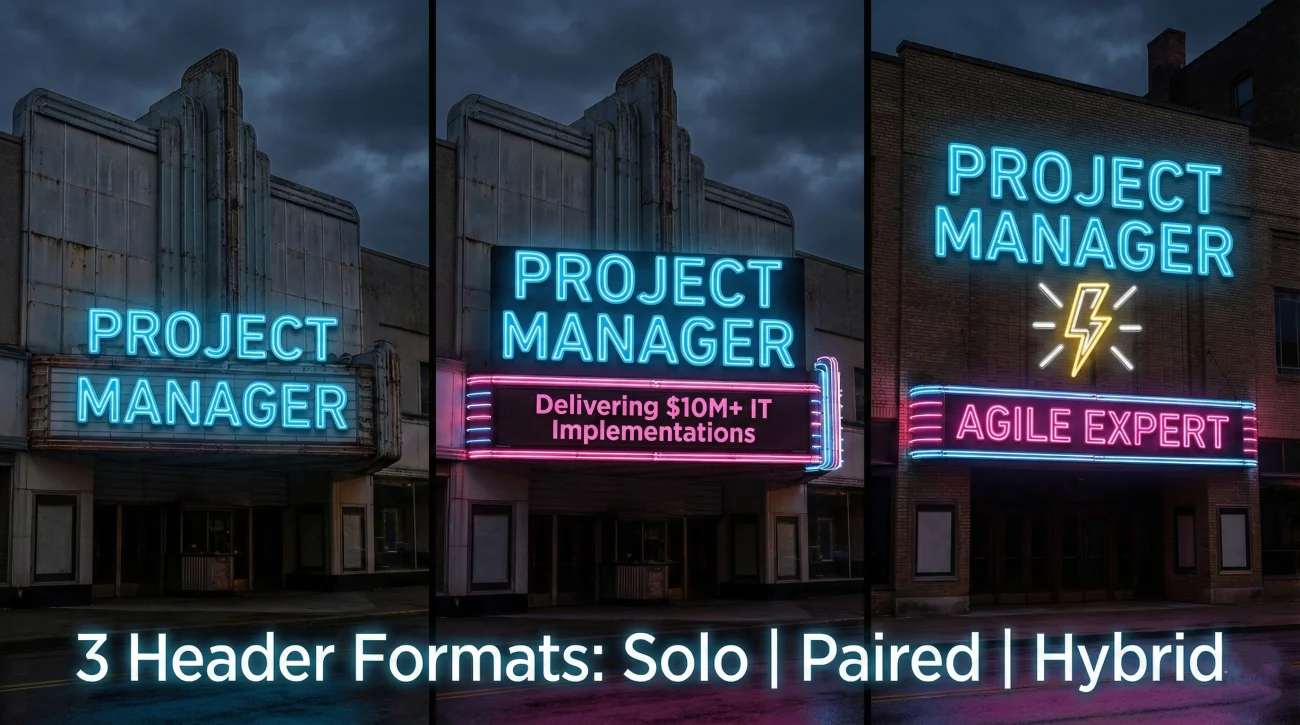
Example 1: Title only (straight-line candidate)
Customer Success Manager
B2B SaaS | Retention + Expansion | 5+ years
This works because “Customer Success Manager” already tells the story, and the bullets can carry the proof.
Example 2: Title + headline (career change bridge)
One candidate I coached, Lila, had “Operations Coordinator” titles but was applying for Project Manager roles. Her experience was real, but the top of the resume made her look misaligned. We rewrote the top like this:
Project Manager
Operations projects across 3 sites, built schedules and risk logs, improved on-time delivery by 18%
The title makes the target explicit. The headline gives a proof hint that explains why the title is not a fantasy.
Example 3: Hybrid one line (tight space)
It reads like a title first, then gives a reason to keep reading.
Do Not Do List: The Patterns That Trigger Doubt

Empty claims that cannot be verified quickly
- “Results-driven leader” with no scale, no metric, no context.
- “Innovative professional” with no domain specificity.
- “Seeking a challenging role” which centers your needs, not theirs.
Duplicating the same line twice
If your title is “Product Manager” and your headline says “Product Manager with product management experience,” you burned space and added zero trust. Use the second line only if it adds new information: scope, niche, proof hint.
Inflated titles that do not match the evidence
One of the fastest ways to lose credibility is labeling yourself “Director” while the resume reads like an individual contributor role. If you are stretching, the headline cannot save you. It only makes the mismatch easier to spot.
⚠️ Warning: A title is a promise. If the rest of the page does not cash it, the reader assumes exaggeration.
Final: The Simple Rule I Use When Editing the Top of a Resume
I treat the top of the resume like a handshake. It should be clear, calm, and specific. If your target role is obvious, a title can be enough. If your target role is clear but your story needs a bridge, add a headline that hints at proof instead of shouting confidence.
When candidates get stuck, I ask one question: “What would a stranger misunderstand in five seconds?” If the answer is “They will not know what I am targeting,” fix the title. If the answer is “They will not believe I belong there,” fix the headline and make it evidence-flavored.
That is the real point of resume headline vs resume title: Two lines, two jobs, one clean first impression.
❓ FAQ
🎯 Can I use “resume title” and “headline” as the same thing?
You can, because many templates only have one line under your name. But the better approach is to think in functions. Even if it is one line, make it behave like a title first and a proof hint second.
🧠 Where should the headline go on the page?
Place it directly under your name and contact info. If you use two lines, put the title first, then the headline. That order mirrors how people scan.
✅ Should I include years of experience in the headline?
Only when it adds clarity. If you have 1 to 2 years, a stronger proof hint is usually skills plus scope. If you have 7 to 10+ years, years can help set expectations quickly.
🔎 Does ATS care about title or headline?
ATS typically parses text. The safer move is to include the target role wording in the first line so both humans and systems see it early, then keep the rest readable and specific.
🧩 What if my current job title is very different from the role I want?
Use the target role as your title only if the resume supports it with matching work. Then use the headline to bridge the gap with concrete proof hints: Projects, scope, and measurable outcomes.
⚠️ Disclaimer: ResumeSolving provides resume, cover letter, job search communication, and career transition guidance for informational purposes only. Hiring practices vary by employer, role, location, industry, and individual circumstances. We do not guarantee interviews, job offers, ATS results, or other outcomes. Verify employer requirements directly and follow applicable laws and workplace policies. For sensitive situations, use only information you are comfortable disclosing and keep all statements accurate.