- Your heads proof words that make your keywords feel earned.
- Use three buckets: Findable keywords (role + domain), believable proof (outcome + scope), and safe specifics (tools, stakeholders, constraints).
- If your headline cannot be backed up by one bullet below it, the headline reads like buzzwords, even if every word is “relevant”.
Resume Headline Keywords Are Not The Problem
I can usually tell within ten seconds when someone Googled resume headline keywords, picked five shiny terms, and stitched them together like a bracelet. The words are “right”. The line still feels fake.
It is not because the candidate is lying. It is because the line has no gravity. No proof. No sense of what you actually did with those terms.
One of my colleagues, Lucinda, reviews resumes for a mid-sized SaaS company. She told me something I now repeat to candidates: “A headline is a promise. I only trust it if the resume keeps the promise immediately.” That is the whole game.
This article is a word bank, yes. But it is also a set of rules for how to choose words that sound real, not performative.
What Counts As A Keyword In A Headline
People use “keyword” as a catch-all, but headlines work better when you separate language by job:
| Word type | What it does | What it sounds like in a headline |
|---|---|---|
| Findable keyword | Helps matching and search | Target role, domain, specialization |
| Proof word | Makes claims believable | Built, shipped, owned, reduced, scaled |
| Scope word | Signals level and size | Leading, cross-functional, multi-region, 0 to 1 |
| Evidence anchor | Points to verifiable context | Pipeline, retention, cycle time, compliance, uptime |
| Noise word | Fills space but adds doubt | Results-driven, go-getter, dynamic, innovative |
Most “keyword advice” stops at the first row. But the first row alone creates buzzwords. Proof words are what stop the reader from rolling their eyes.
💡 Pro Tip: If you only change one thing after reading this, let it be this: Every keyword in your headline should be “paid for” by a proof word.
Why Buzzword Headlines Fail Even When The Keywords Are Correct
A recruiter does not reject your resume because you used the wrong word. They reject it because your line feels like it was written for a system, not for a human.
Here is the pattern I see again and again:
- The headline stacks nouns: “Marketing Strategy, Growth, Branding, Analytics”.
- It adds flattering adjectives: “high-impact”, “innovative”, “dynamic”.
- It avoids verbs, because verbs force you to commit to a real action.
One candidate, Mateo, was transitioning from agency to in-house. His headline was basically a pile of marketing nouns. When we rewrote it, we only changed a few words, but we added a promise he could back up right away.
“I thought keywords were the whole point. The moment I added ‘built’ and ‘grew’, it stopped sounding like my LinkedIn bio and started sounding like my work.”
That is the shift. Not more keywords. Better proof.
The Selection Rules That Keep Keywords From Feeling Like Stuffing
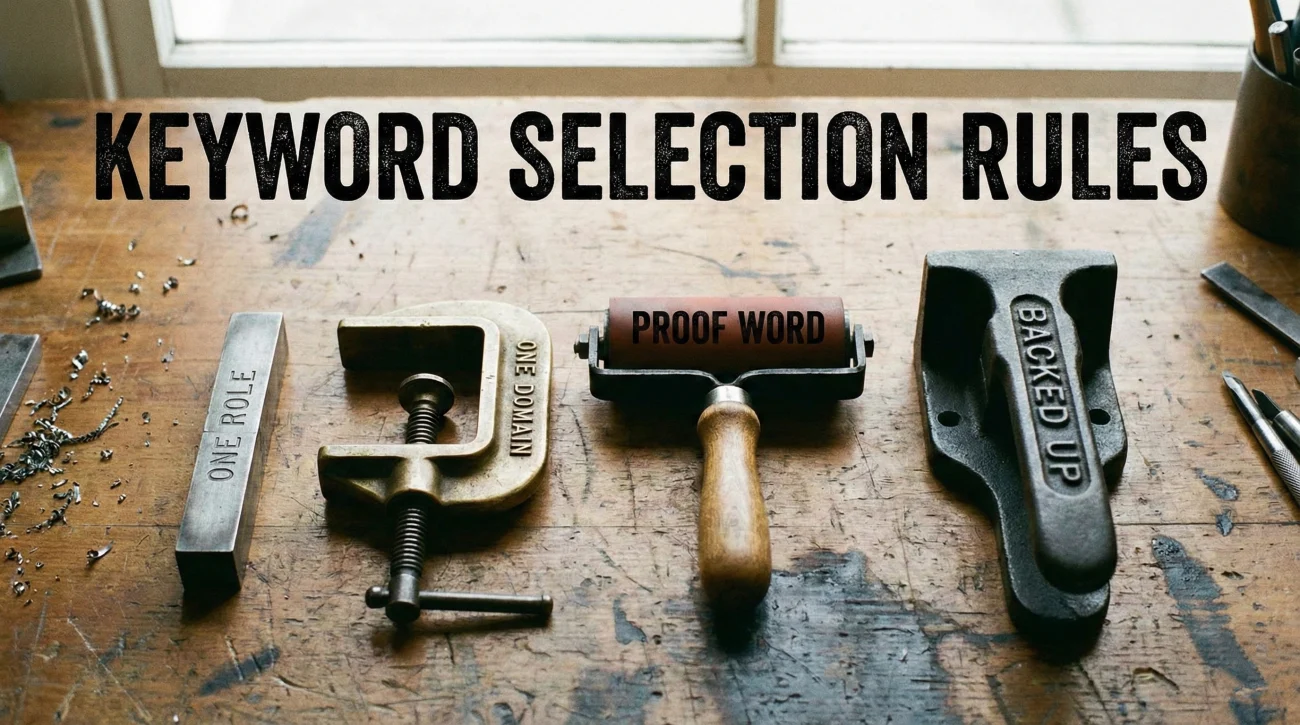
Rule 1: Start With One Target Role Keyword, Not Five
Your headline is not a skills section. It is one line that tells the reader where to place you.
Pick one role label that matches the posting. If the posting says “Customer Success Manager”, do not headline yourself as “Client Partner / Account Manager / Relationship Lead”. Pick the one that will be searched and recognized.
⚠️ Warning: Multiple role titles in one headline is where “keyword stuffing” starts to smell obvious. Choose one, then support it.
Rule 2: Add One Domain Keyword That Narrows You
A domain keyword is not a tool. It is the arena you have actually worked in. Examples: B2B SaaS, fintech compliance, marketplace growth, healthcare operations, enterprise onboarding.
Domain keywords work because they help the reader imagine your context. That makes your claims easier to believe.
Rule 3: Use Proof Words Before You Use “Skills Words”
People often ask for words to use in resume headline like a list of “skills”. The problem is that skills without verbs are just labels.
Instead of “stakeholder management”, you want “aligned stakeholders”. Instead of “process improvement”, you want “reduced cycle time”.
Rule 4: Every Proof Word Must Be Backed Up Within Two Scrolls
If you claim “scaled”, you need a bullet that shows what was scaled and what changed. If you claim “improved retention”, you need one bullet that proves retention was part of your work.
This is how you stay human. Humans trust receipts, not adjectives.
Proof Word Bank For Resume Headlines
Below are proof words that do a specific job. Use them like seasoning, not like a paragraph. One or two is usually enough in a headline.
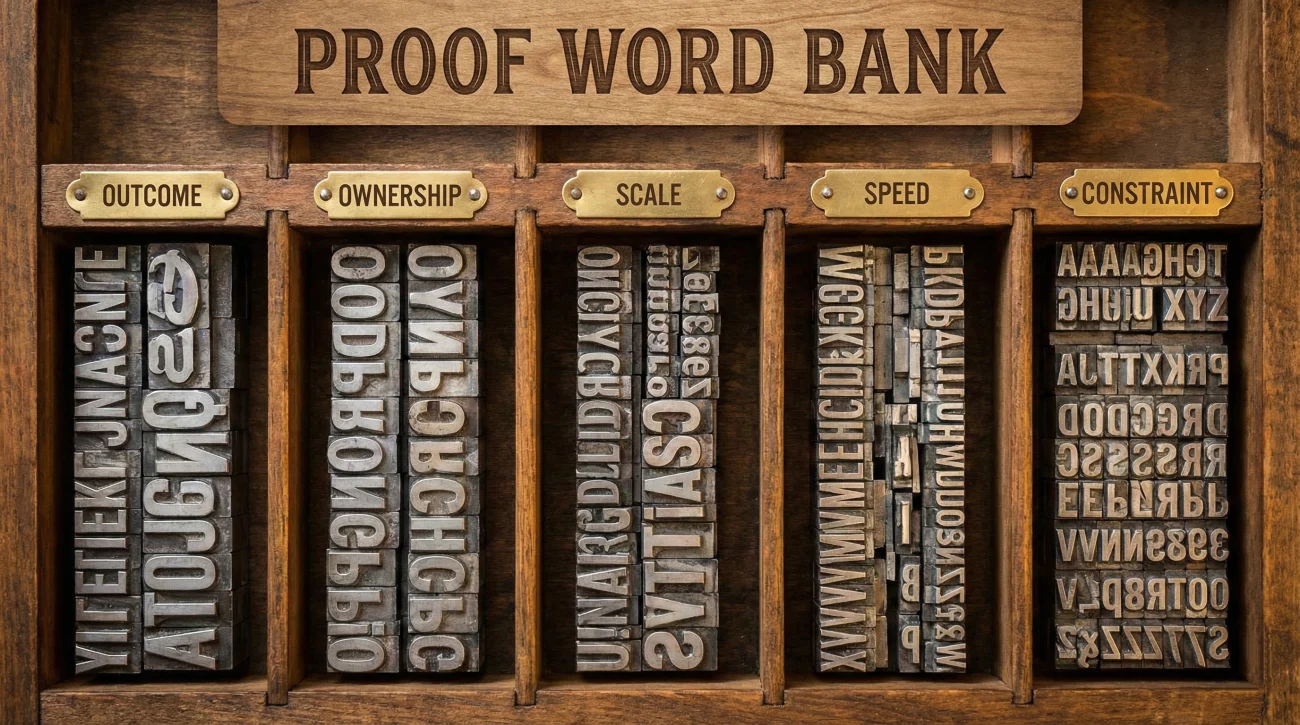
Outcome Proof Words
These words imply that something changed because of your work. They are powerful because they naturally invite the reader to look for the supporting bullet.
- Increased, improved, reduced, accelerated
- Converted, retained, stabilized, recovered
- Prevented, avoided, mitigated
- Unblocked, streamlined, simplified
Example pattern: “Role + Domain + outcome anchor”. Keep it short.
Ownership Proof Words
Ownership words signal accountability. They are especially useful when you cannot share metrics or when results were shared across a team.
- Owned, led, built, launched
- Designed, implemented, operationalized
- Managed, mentored, coached
- Partnered, aligned, coordinated
Ownership words make your headline feel like a real person wrote it, because real work has ownership.
Scale And Complexity Proof Words
Scale words communicate seniority without needing to write “senior” ten times. They can refer to users, regions, systems, volume, or stakeholders.
- High-volume, multi-region, enterprise
- Cross-functional, multi-stakeholder
- End-to-end, full lifecycle
- 0 to 1, 1 to n, growth-stage
💡 Pro Tip: Scale words are safer than inflated titles. “Enterprise onboarding” is a clue. “Global thought leader” is a red flag.
Speed And Execution Proof Words
These words signal pace. They work well for operators, project roles, and candidates who want to show momentum without sounding dramatic.
- Shipped, delivered, deployed, rolled out
- Turned around, stabilized, executed
- Shortened, compressed, accelerated
- Automated, standardized
Constraint And Trust Proof Words
Constraints make you believable. When a headline admits the reality of limits, it reads less like self-praise.
- Within budget, under deadline
- Compliance-driven, audit-ready
- NDA-bound, regulated environment
- Risk-aware, privacy-first
Use constraints sparingly. One constraint can make the whole line feel grounded.
Buzzword To Proof Swap List
This is where most resumes instantly improve. You keep the idea, but you replace the “self-description” with “work description”.
| Buzzword | Why it triggers doubt | Proof swap |
|---|---|---|
| Results-driven | Everyone claims it | Improved X by doing Y |
| Strategic leader | No evidence anchor | Led cross-functional roadmap delivery |
| Innovative | Undefined value | Built new workflow to reduce cycle time |
| Hardworking | Trait, not outcome | Delivered under tight timelines |
| Excellent communicator | Unverifiable | Aligned stakeholders across teams |
| Team player | Too generic | Partnered with Sales and Product to ship |
| Data-driven | Often empty | Used SQL to diagnose funnel drop-off |
Notice the pattern. The swap adds a verb and a context anchor. That is what makes the reader believe you.
Headline Templates That Use Keywords Without Sounding Robotic
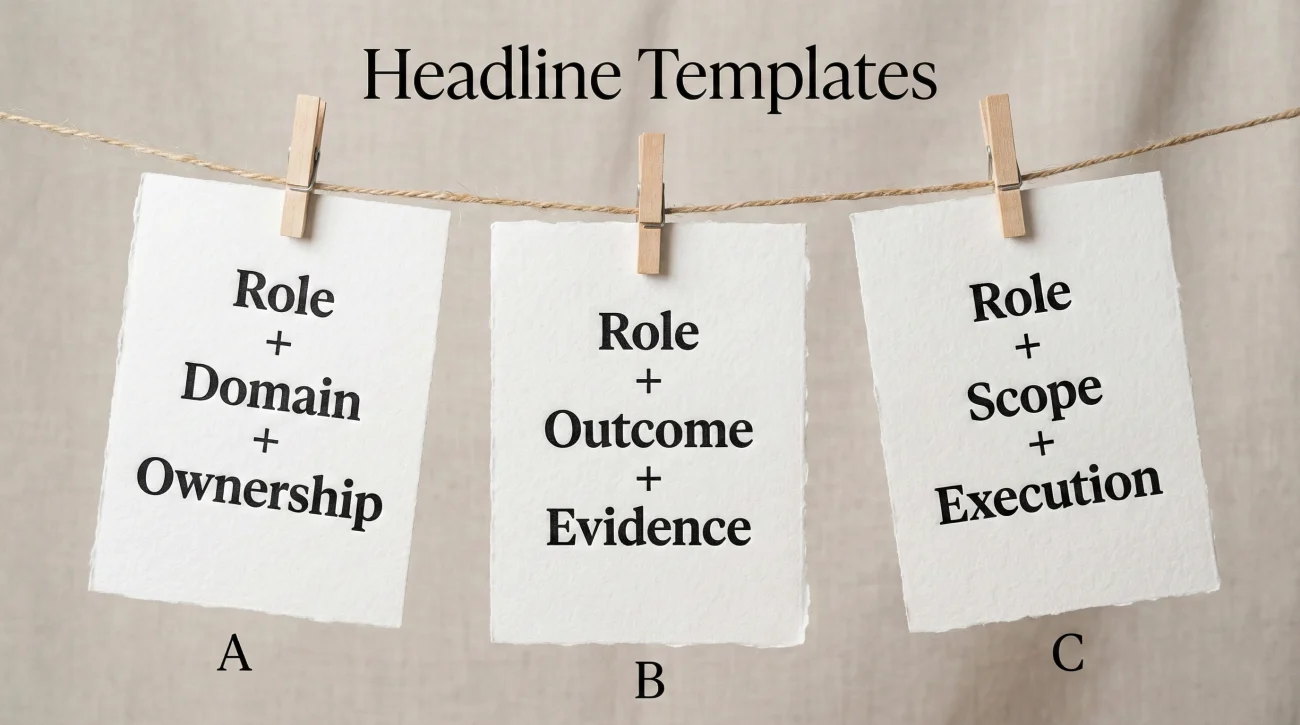
These are not “copy and paste” lines. They are structures. You fill them with your truth.
Template A: Role + Domain + Ownership
Best when you have credible responsibilities but cannot share metrics.
Template B: Role + Proof Outcome + Evidence Anchor
Best when you have one clear “receipt” that can appear in the first few bullets.
Template C: Role + Scope + Execution
Best for project roles, operations, and candidates who want to signal pace and complexity.
⚠️ Warning: If you cannot back up the verb, downgrade the verb. “Led” without leadership bullets reads worse than “partnered” with strong bullets.
Where “Resume Headline Skills” Actually Belong
I get why people search for resume headline skills. Skills are searchable. Skills feel safe.
But a headline is not a safe place to dump ten skills because the reader cannot tell which ones matter, and they cannot tell if you have depth.
If you want skills language in a headline, use one of these two approaches:
- Choose one differentiating skill and attach it to an action: “SQL-driven churn analysis” instead of “SQL”.
- Choose one skill that implies domain depth: “SOC 2 readiness” instead of “security”.
Everything else belongs in your skills section and bullets. The headline should feel like a headline, not like a tag cloud.
The Reality Check: A Quick Test Before You Ship The Headline
When I workshop headlines with candidates, I use a simple test. If the headline passes, it usually reads human.
Does the headline contain a verb that implies real work?
If there is no verb, add one. “Built” beats “innovative”. “Reduced” beats “results-driven”.
Can you point to a bullet that supports the verb within the next section?
If not, either move the bullet up or downgrade the claim. Credibility is a positioning asset.
Would a skeptical coworker recognize you from this line?
If your coworker would laugh at the headline, it is probably too abstract. Add a context anchor: product area, system, stakeholder, constraint.
Does the headline read like one job, not three jobs?
If it reads like three jobs, you are over-keywording. Pick the role you want to be hired for, then narrow with domain and proof.
Final
Most people do not need more keywords. They need fewer words that try to impress, and one or two words that prove.
When your headline uses a real verb, a real context anchor, and a role label that matches the market, it stops feeling like a performance. It starts feeling like a person with a track record.
If you want a simple goal for today, aim for this: One target role keyword, one domain keyword, one proof word. Then make sure the next section of your resume pays it off.
And if you are still stuck, do not hunt for “better” synonyms. Use your existing truth and write it in a way that a reader can verify. That is how resume headline keywords stop sounding like buzzwords.
❓ FAQ
🎯 How many keywords should a resume headline include?
Usually 2 to 4 is enough: One role keyword, one domain keyword, and one proof anchor. More than that starts to read like a tag list unless the wording is extremely tight.
🧩 Are tools like SQL or Salesforce good headline keywords?
They can be, but tools land better when attached to a job outcome. “SQL funnel analysis” reads more credible than a bare tool list.
🧠 What if I do not have metrics I can share?
Use ownership, scope, and constraint proof words. “Owned onboarding for enterprise accounts” can be credible even without numbers, as long as your bullets show real responsibilities.
🚦How do I avoid keyword stuffing while still being ATS-friendly?
Keep the headline focused, then let your experience bullets carry the rest of the matching language. A clean headline plus relevant bullets is safer than cramming every term into one line.
🛠️ Should I copy keywords directly from the job description?
Copy the role label and the real domain terms, yes. But translate vague phrases into proof language. If the posting says “strong communicator”, your headline should say what you communicated and with whom.
⚠️ Disclaimer: ResumeSolving provides resume, cover letter, job search communication, and career transition guidance for informational purposes only. Hiring practices vary by employer, role, location, industry, and individual circumstances. We do not guarantee interviews, job offers, ATS results, or other outcomes. Verify employer requirements directly and follow applicable laws and workplace policies. For sensitive situations, use only information you are comfortable disclosing and keep all statements accurate.