- Your headline is not a brag line. For overqualification, it is a scope agreement in one sentence.
- Use one of 3 patterns: Scope Lock, Value at This Level, or Stability Signal. Then add proof that fits the target role.
- Avoid “big” words that trigger flight-risk. Swap leadership language for hands-on, day-to-day impact language.
Why an overqualified headline fails in three seconds
I have watched strong candidates get filtered out before the recruiter even reached the first bullet. Not because the resume was “bad,” but because the top line accidentally screamed: “Temporary.”
That is the problem an overqualified applicant has to solve fast. Your headline is the earliest place to solve it, because it sets the frame for everything underneath.
In this guide, I am focusing on one thing only: The resume headline for overqualified candidate that tells a reader: “Yes, I can do more. I am choosing this scope on purpose.”
💡 Pro Tip: If you feel tempted to “sound smaller,” stop. The goal is not to shrink your competence. The goal is to shrink the reader’s fear.
What hiring managers are actually worried about
When someone looks overqualified, the most common concern is not capability. It is retention and fit. Will you be bored. Will you push for a bigger title. Will you leave the moment something “more appropriate” shows up.
That is why generic headlines backfire. If your headline says “Senior leader” and the role is “Coordinator,” the reader does not think: “Wow, impressive.” They think: “Why are they here.”
| Headline signal | What the reader hears |
|---|---|
| Big-scope language (strategic, executive, enterprise-wide) | This person wants a bigger seat than we are hiring for. |
| Vague humility (willing to do anything, open to any role) | This person is desperate, or they will leave when they recover. |
| Specific scope + role-shaped proof | They understand the job. They want this job. They will likely stay. |
🗝️ Key Point: For overqualification, the best headline is not “bigger.” It is “clearer.”
I remember a candidate named Phoebe, a former Head of Operations who wanted a calmer, execution-focused role after a company restructure. Her first draft headline started with “Operations Leader.” Great title, wrong message. We rewrote it to lock scope and show hands-on proof. She started getting replies that sounded like: “We like your experience, and we appreciate that you are targeting this level intentionally.”
The three headline patterns that reduce “flight risk”
You do not need a clever line. You need a pattern that makes the reader relax. Below are three patterns I use most when someone is applying below their previous level.
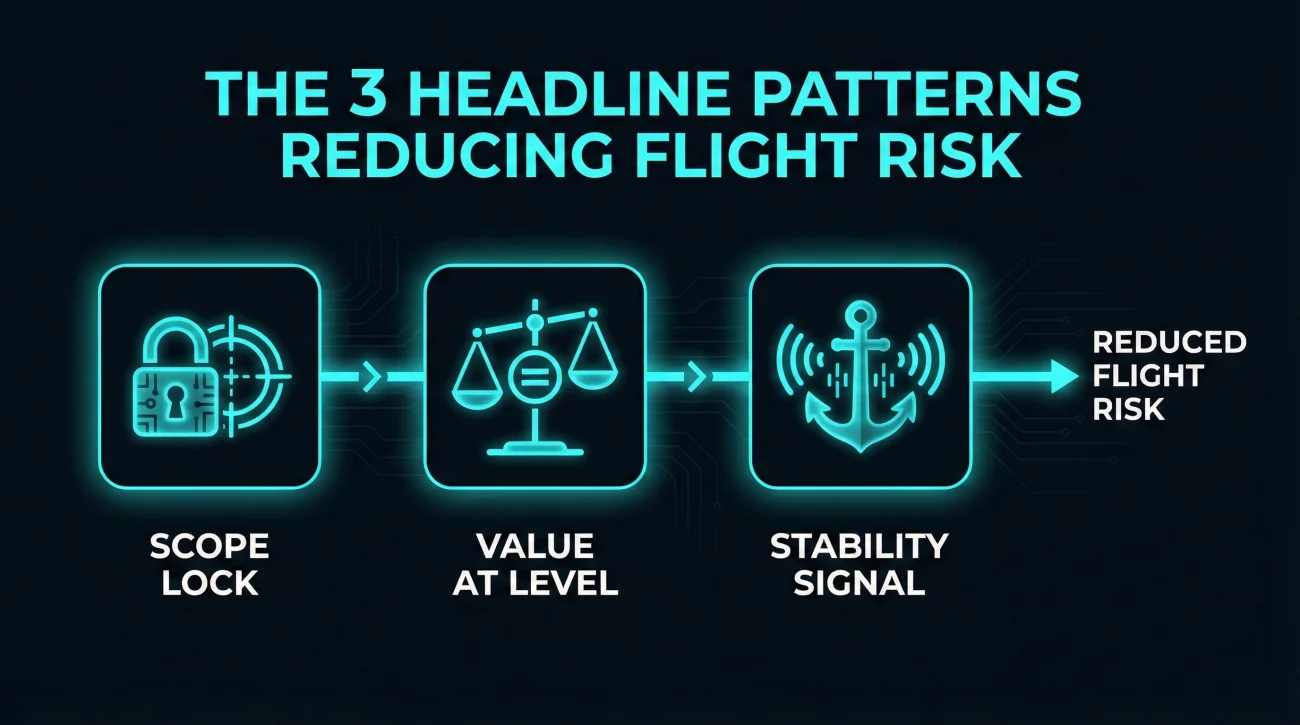
Pattern 1: Scope Lock
This is the cleanest option when your past titles are significantly more senior than the target job. You lock the day-to-day scope right in the headline.
[Target Role] + [Hands-on Scope] + [Proof Metric or Domain]
⚠️ Warning: “Hands-on” only works if the rest of the resume supports it. If your bullets read like board-level strategy only, the headline will look like theater.
Operations Coordinator (Hands-on) | Scheduling, Vendors, and Process Follow-Through | Reduced weekly backlog 18%
Customer Support Lead (Player-Coach) | Queue Management + Escalations | 4.7 CSAT over 12 months
Accounting Specialist | Month-End Close Support + Reconciliations | Cut errors by 22% in 90 days
IT Support Technician | Ticket Triage + Onsite Troubleshooting | 30% faster resolution time
Notice what is missing. No “executive.” No “enterprise transformation.” The person may have done that before. But the headline is signing a contract for the scope they want now.
Pattern 2: Value at This Level
This pattern works when you are not trying to hide seniority, you are trying to prove you will use it to make the current role easier, faster, and more reliable.
[Target Role] + [Value Verb] + [Role-Level Outcome]
It is especially effective for roles that suffer from operational chaos: admin, support, coordinator, analyst, associate roles. You are saying: “I will bring calm and output, not politics.”
Office Manager | Stabilize Vendors, Calendars, and Onsite Operations | Zero missed deadlines in 6 months
Logistics Coordinator | Improve Dispatch Accuracy + Follow-Through | 98% on-time routing rate
Sales Operations Associate | Clean CRM Data + Reporting | Improved pipeline hygiene across 3 teams
One of my colleagues in HR, Marcus, once told me he hires “overqualified” candidates when they show they will do the work that others avoid. Not because they talk about leadership, but because they talk about execution. Pattern 2 does exactly that.
Pattern 3: Stability Signal
This one is delicate. You do not want to sound like you are pleading. You want to sound settled. The best stability headlines use neutral words: “long-term,” “consistent,” “day-to-day,” “steady,” and then attach them to the actual scope.
[Target Role] + [Steady Scope Phrase] + [Domain Fit]
Executive Assistant | Long-term Support for Scheduling + Comms | 8+ years supporting senior stakeholders
Warehouse Supervisor | Steady Shift Leadership + Safety | 365 days incident-free team record
Administrative Coordinator | Day-to-day Ops + Documentation | Fast onboarding and clean handoffs
If you are thinking: “Should I literally write ‘I will stay’,” no. That is what interviews are for. The headline’s job is to make “They might stay” feel plausible.
How to choose the right pattern for your situation
Different overqualification stories create different doubts. Here is a simple way to pick the right direction without rewriting your entire identity.
What is the biggest mismatch the recruiter will notice first?
If the mismatch is title level, start with Scope Lock. If the mismatch is “too strategic,” use Value at This Level. If the mismatch is “why would they want this,” use Stability Signal.
| If your background looks like | Use this pattern first |
|---|---|
| Director or VP titles, applying for coordinator or specialist | Pattern 1: Scope Lock |
| Senior role, but the target job is execution-heavy and measurable | Pattern 2: Value at This Level |
| Career pause, burnout recovery, relocation, or lifestyle shift | Pattern 3: Stability Signal |
Now layer in your keyword reality. Your headline still needs to match the job posting language. You can be scope-clear and ATS-friendly at the same time, as long as the title is the target title.
Quick note on long-tail intent, because people search this in different ways:
- If you are literally searching overqualified resume headline, you probably need Pattern 1 and Pattern 3 most.
- If you are searching applying for lower role headline, you probably need Pattern 2 plus a calm, practical proof.
- If you are searching resume headline for lower position, you usually need to remove “big-scope” verbs and replace them with role-level outcomes.
Red flags that accidentally announce: “I will not stay”
Most red flags are not lies. They are tone problems. The headline reads like a promotion pitch, while the job is asking for dependable coverage and steady output.
| Avoid in the headline | Use instead |
|---|---|
| Executive, enterprise-wide, strategic leader | Hands-on, day-to-day, operational, cross-functional support |
| Transformational change, vision, thought leadership | Stabilize, streamline, reduce errors, improve turnaround |
| Overly humble lines (willing to do anything) | Specific scope acceptance (this role, this function, this type of work) |
| Future-facing ambition (seeking growth into leadership) | Present-focused impact (reliability, quality, consistent delivery) |
Here is a real conversation I have heard in slightly different words, more than once:
“They look impressive, but why are they applying for this. Are we just a stop on the way back up.”
That sentence is exactly what your headline must prevent. Not with explanation. With framing.
A five-minute headline checklist before you apply
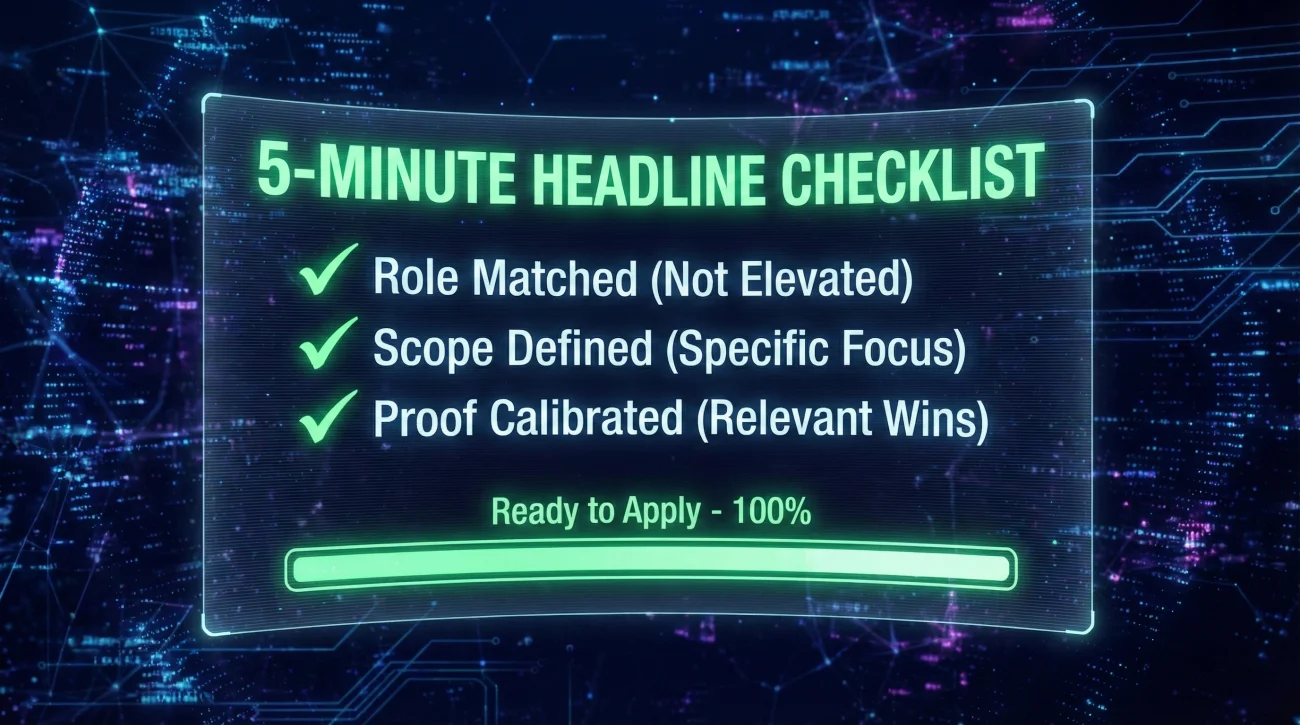
You can do this fast, even if you are applying at night and you are tired.
- Does the headline start with the target role title exactly as the posting uses it.
- Is there one scope phrase that makes your day-to-day intention obvious.
- Is the proof role-level, not boardroom-level.
- Did you remove at least one “big-scope” word that triggers doubt.
- Can you defend every word in a 30-second interview answer without sounding defensive.
❌ Note: If your headline requires a paragraph to explain, it is not a headline. It is a summary trying to escape the summary section.
Final: A headline is a scope agreement, not a status badge
When you are overqualified, you are not fighting for attention. You are fighting for trust. The easiest way to earn that trust is to be specific about the work you are choosing, then back it up with proof that fits the level.
Once you do that, the reader stops guessing what you “really want” and starts reading you like a real candidate for this job, today. That is the whole point of a resume headline for overqualified candidate.
❓ FAQ
🎯 Should I remove senior titles from my headline?
In most cases, yes. Your headline should lead with the target role title, not your highest historical title. You can keep senior titles in experience where they belong, and let the headline sign the scope you want now.
🧠 Will recruiters assume I am desperate if I apply down?
They might, if your headline is vague. Specific scope language reads intentional. “Open to anything” reads unstable. Precision is what protects you.
🧩 Can I use “overqualified” in the headline to address it directly?
No. Labeling yourself “overqualified” invites the exact filter you are trying to avoid. Use scope acceptance and role-level proof instead.
✅ What if my achievements are too big for the lower role?
Pick proof that matches the role’s daily outcomes: accuracy, turnaround time, backlog reduction, customer satisfaction, fewer errors, smoother handoffs. Big achievements can stay in bullets, but the headline should speak the target language.
🛠️ Should my headline match my resume summary?
They should agree on scope. The headline locks the role and the type of work. The summary can add context, but it should not contradict the headline by sounding like you are aiming higher.
📌 How many keywords should I put in the headline?
Keep it readable. Title plus one scope phrase plus one proof is usually enough. If it starts looking like a keyword list, it will trigger skepticism even if ATS likes it.
⚠️ Disclaimer: ResumeSolving provides resume, cover letter, job search communication, and career transition guidance for informational purposes only. Hiring practices vary by employer, role, location, industry, and individual circumstances. We do not guarantee interviews, job offers, ATS results, or other outcomes. Verify employer requirements directly and follow applicable laws and workplace policies. For sensitive situations, use only information you are comfortable disclosing and keep all statements accurate.