- A resume headline works when it signals: Target role, niche, proof, and scope in one clean line.
- Use a 4-part formula so you stop sounding like everyone else: Role + Specialty + Proof Hint + Scope Cue.
- If your headline can’t be defended by the next 3 bullet points on the page, it’s too fluffy.
The real problem with most resume headlines
One of my candidates, Yasmina, had a strong resume. Great experience, solid outcomes, clean layout. But her headline was the classic: “Results-driven professional with excellent communication skills.” It sounded fine, yet it told me nothing. Worse, it made her feel interchangeable.
We rewrote it in two minutes and suddenly the resume read like a person, not a template: how to write a resume headline is not about sounding impressive. It’s about sounding specific enough that a recruiter can predict what the next section will prove.
That’s what this article is built for: A simple structure you can reuse without turning your resume into buzzword soup.
Austin, TX | [email protected] | 555-0100 | Portfolio: jordanpatel.com
Product Marketing Manager | B2B SaaS | Launched 8+ features, improved activation by 18%
💡 Pro Tip: Your headline should feel like a label plus a hint of evidence. Not a mini cover letter.
What a headline is supposed to do in 6 seconds
Recruiters don’t read your resume like a novel. They skim for role fit signals, then decide whether the rest is worth their attention. A headline is your first “routing sign.” It answers: “What lane should I place this person in?”
Here’s the test I use internally: If your headline disappeared, would the resume still be instantly categorized? If the answer is no, you’re relying on the wrong section to do the heavy lifting.
| Headline type | What it signals to a recruiter |
|---|---|
| Role-only label | “I match the job title,” but I am not telling you why I’m different. |
| Role + proof hint | “I match the job title, and I’ve done something measurable in that lane.” |
| Role + niche + scope | “I match the job title, and I’ve done it in your kind of environment.” |
| Fluffy traits | “I’m generic,” or “I’m hiding behind adjectives.” |
🗝️ Key Point: A headline is not where you promise value. It’s where you preview the proof that’s about to show up in the bullets.
The 4-part resume headline formula

If you’ve been stuck, here’s the simplest structure that consistently works because it reads like a human sentence, not a slogan.
[Target Role] + [Specialization] + [Proof Hint] + [Scope Cue]
Let’s unpack each piece in practical terms.
Part 1: Target role
Use the role you are applying for, not the role you happened to have last. If you are making a role shift, this is where you signal your intent. Keep it clean, no cute titles.
⚠️ Warning: If your resume bullets do not support that target role within the first half-page, the headline will look like a costume.
Part 2: Specialization
This is the “which version of that role” detail. Think domain, audience, channel, or environment. Pick one, not five.
- Domain: B2B SaaS, healthcare, fintech, logistics
- Audience: SMB, enterprise, consumer, internal stakeholders
- Channel: paid search, lifecycle email, customer onboarding, outbound sales
- Environment: high-growth startup, regulated industry, global ops
Part 3: Proof hint
This is not your full achievement bullet. It is a small piece of evidence that makes the reader believe the rest of the resume will back you up.
Good proof hints look like: one metric, one output, one recognizable responsibility, or one credential that matters for the role.
Part 4: Scope cue
Scope is what keeps your headline from sounding like a brag or a vague claim. Scope can be team size, budget, volume, region, stage, or cadence. It turns “I did marketing” into “I did marketing in a context like yours.”
How to choose a proof hint and scope cue without overclaiming
Most people fail here because they pick proof hints that are too big (“drove revenue growth”) or too soft (“strong communicator”). Instead, choose a proof hint that the next section can support fast.
A proof hint menu by seniority
| Your level | Proof hints that sound believable |
|---|---|
| Entry level | Internship output, capstone project, certification, portfolio, volunteer deliverable |
| Mid level | Metric movement, system/process you owned, cross-functional launch, recurring responsibility |
| Senior | Scope leadership, budget, strategy ownership, multi-team coordination, business outcomes tied to initiatives |
| Career change | Transferable proof: same outcomes in a different context, plus one bridge signal (project, course, side work) |
Scope cues that do not sound arrogant
- Team: Led a 4-person team, partnered with Sales and Product
- Scale: Supported 120+ enterprise accounts, shipped 8 releases per year
- Budget: Managed a $250K annual spend, negotiated vendor contracts
- Stage: Pre-Series A to Series C, post-merger integration
- Region: North America rollout, EMEA stakeholder group
“I wrote: ‘Strategic leader delivering exceptional results.’ My recruiter friend told me: ‘That could describe anyone. Show me one thing you did.’”
That feedback is harsh, but it’s accurate. A headline is not where trust is built with personality. Trust is built with “small proof” that feels checkable.
A quick build process you can repeat for any job
Here’s how I help candidates write a resume headline in under ten minutes, without forcing keywords into weird places.
Step 1: Copy the job title and one business keyword
Pick one keyword that reflects the business lane, not a random skill list. Examples: “B2B SaaS,” “enterprise,” “regulated,” “performance marketing,” “customer onboarding.”
Step 2: Pick one proof hint from your last 12 months
If you can’t support it with a bullet from your most recent role, it is too risky. Choose one proof that you are comfortable defending in an interview.
Step 3: Add one scope cue that matches the employer’s world
Scope is where your headline becomes a match signal. If the employer is a small team, avoid enterprise-scale language unless you truly have both contexts.
❌ Note: Avoid stacking claims in the headline. If you need three commas to fit everything, you’re trying to solve the whole resume in one line.
12 resume headline examples that sound like a real person
These are not meant to be copied word-for-word. They are templates with an identifiable logic. Each one includes: Role, niche, proof hint, and scope cue.
Examples across common roles
| Role | Headline example |
|---|---|
| Project Manager | Project Manager | Client implementations | Delivered 14 launches on time | Mid-market SaaS |
| Data Analyst | Data Analyst | Growth reporting | Built dashboards used weekly by leadership | SQL + Looker |
| Customer Success | Customer Success Manager | Retention and expansion | Managed 80-account book | B2B subscription |
| Software Engineer | Backend Engineer | APIs and performance | Reduced p95 latency by 28% | High-traffic platform |
| Marketing | Lifecycle Marketer | Onboarding and activation | Improved activation by 18% | Product-led SaaS |
| Sales | Account Executive | Mid-market | Consistently 110%+ to quota | Multi-stakeholder deals |
| HR | HR Generalist | Employee relations and onboarding | Supported 300-person org | Multi-site operations |
| Finance | FP&A Analyst | Budgeting and forecasting | Owned quarterly reforecast | $40M spend portfolio |
| Operations | Operations Manager | Process improvement | Cut cycle time by 22% | Warehouse network |
| Designer | Product Designer | UX for onboarding | Shipped redesign in 6 weeks | B2C mobile app |
| Career change | Business Analyst | Stakeholder management | Built KPI reporting for exec team | Transitioning into Product Ops |
| Entry level | Junior Analyst | Excel + SQL projects | Built a churn dashboard | Portfolio available |
If you want a good resume headline, the goal is not to sound “big.” The goal is to sound testable. The reader should feel: “I know what I’m about to see in the bullets.”
Headline checklist to prevent vague claims
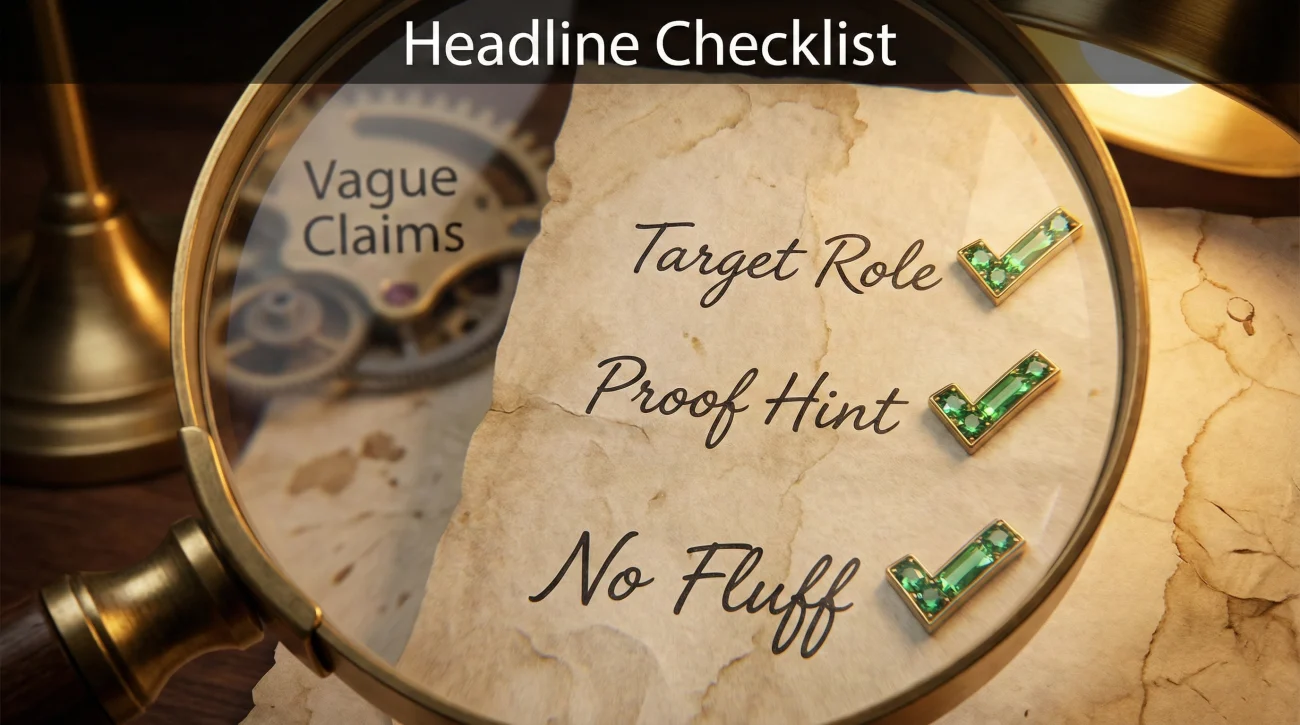
Run these checks before you lock it in
- ✅ It starts with a target role that matches the posting.
- ✅ It includes one specialization so you are not a generic “professional.”
- ✅ It includes one proof hint that is supported by a bullet on the page.
- ✅ It includes one scope cue that fits the employer’s world.
- ✅ It avoids empty adjectives like “dynamic,” “hardworking,” “results-driven.”
- ✅ It can be read out loud without sounding embarrassed.
💡 Pro Tip: If your headline feels long, remove the weakest part first. Usually it’s the adjective, not the proof.
A fast rewrite pattern for weak headlines
[Generic claim] → [Role + niche] → [Add one proof hint] → [Add one scope cue]
Final
A resume headline is not a place to hype yourself. It’s a place to give the reader a confident preview: “This is the role, this is the lane, and here’s the kind of proof you’re about to see.” When you use the resume headline formula properly, you stop sounding like a template and start sounding like a specific hire.
If you remember one thing, remember this: how to write a resume headline is really about making your intent and proof easy to spot, before anyone has time to doubt you.
❓ FAQ
🎯 Do I need a resume headline for every job?
No. If your resume already screams the target role through a clear summary and first bullets, a headline is optional. Use it when you need faster routing: Career change, ambiguous past titles, or a crowded market.
🧠 Is a resume headline the same as a resume title?
They’re often treated as similar, but you can separate them cleanly. Title is a simple label (usually just the role). Headline is title plus one to two signals of proof or context.
✅ Where should the headline go on the resume?
Put it under your name and contact info, before your summary or skills. It should be visible without scrolling.
📌 How long should a resume headline be?
One line is the target. If it wraps to a second line, it’s usually because you added too many claims. Keep role, one specialization, one proof hint, and one scope cue.
🔍 Can I use keywords in my headline for ATS?
Yes, but do it naturally. Use the target job title and one relevant domain keyword. Do not stuff a list of skills into the headline, because it reads poorly to humans even if a system parses it.
🛠️ What if I don’t have metrics?
Use a different proof hint. Outputs (launched X, built Y), scope (managed Z accounts), or responsibility (owned onboarding, handled escalations) can still create trust without fake numbers.
⚠️ Disclaimer: ResumeSolving provides resume, cover letter, job search communication, and career transition guidance for informational purposes only. Hiring practices vary by employer, role, location, industry, and individual circumstances. We do not guarantee interviews, job offers, ATS results, or other outcomes. Verify employer requirements directly and follow applicable laws and workplace policies. For sensitive situations, use only information you are comfortable disclosing and keep all statements accurate.