- A freelancer headline has to solve one fear first: Continuity.
- Use a team-ready cue so you look like someone who can plug into a real org, not just take tasks.
- Pick one of 3 patterns, then add proof hints that work even if you cannot name clients.
Why Freelancers Get Judged Faster Than They Expect
I have watched smart, capable freelancers lose attention in the first five seconds for a reason that has nothing to do with skill. The recruiter does not doubt they can do the work. The recruiter doubts the work will “fit” inside a team.
That is why a resume headline for freelancer cannot be a generic “Role + Skills” line. It has to quietly answer two questions: Have you been working continuously, and do you work like someone who can ship inside a structured environment.
One candidate I worked with, Noelle, had a strong portfolio and a steady stream of contracts. But her headline was “Freelance Designer | Creative | Passionate”. The feedback she kept hearing was vague: “We went with someone more aligned”. When we rewrote her headline to signal continuity and how she worked with product teams, she started getting replies from companies that had previously ignored her.
The Real Job of a Freelancer Headline
Most headline advice assumes the reader already accepts your employment model. Freelancers do not get that luxury. A recruiter often reads “freelance” and immediately tries to predict risk: Availability, stability, and whether you will struggle with structure.
Your headline should do one primary thing: Make your work history feel like a continuous, professional operating mode.
| What the recruiter fears | What your headline should signal |
|---|---|
| “This looks like side work between gaps.” | Ongoing practice with clear role identity and recent outcomes. |
| “They might not work well with a team.” | Team-ready cues: Embedded collaboration, stakeholders, delivery cadence. |
| “They are too broad. Hard to place.” | Specific lane: Client type, domain, tool stack, or problem category. |
| “They will be hard to manage.” | Structured execution: Sprint delivery, documentation, handoffs, measurable results. |
🗝️ Key Point: Your headline is not a brand slogan. It is a risk reducer that makes freelance experience read like professional continuity.
A colleague of mine, Marcus, did contract product management for two years. His early headline was “Contract PM | Startup Lover | Fast Learner”. He kept getting interviews for chaotic short-term gigs, not the stable roles he wanted. The fix was not adding more adjectives. The fix was signaling the operating context: cross-functional teams, product delivery, and measurable outcomes.
3 Headline Patterns That Signal Continuity and Team Readiness
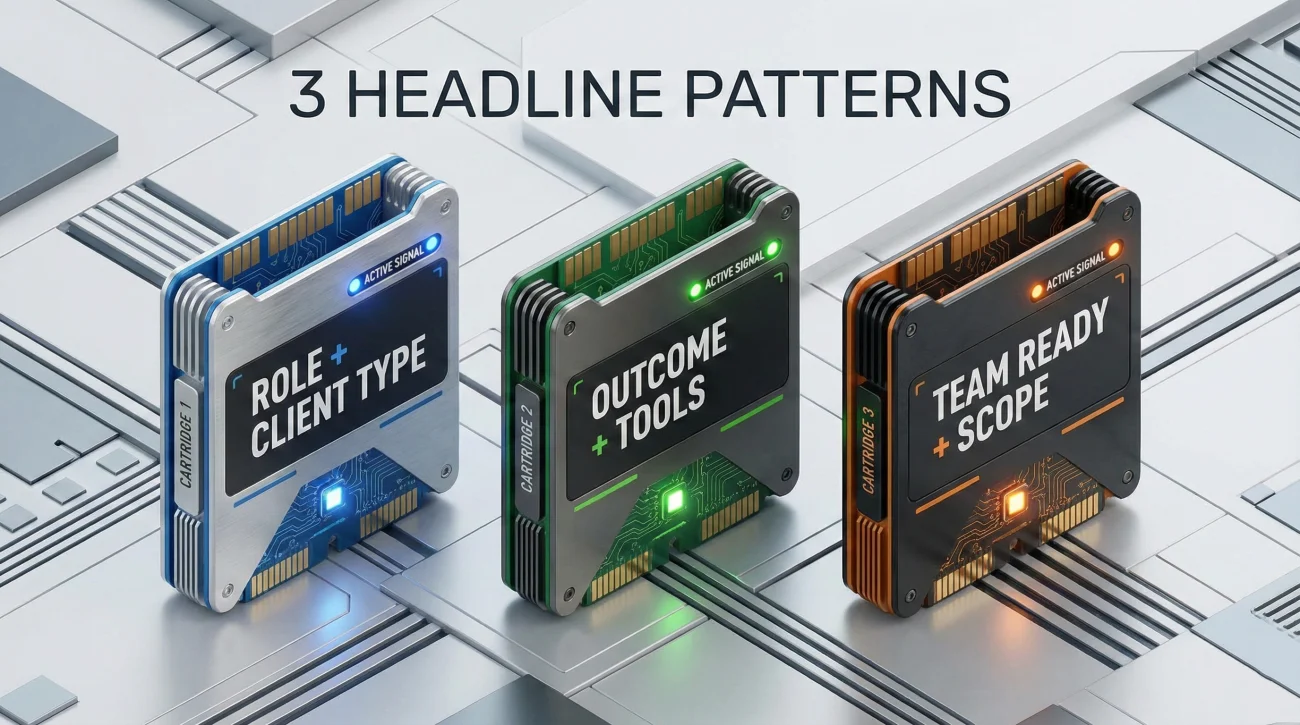
Pattern 1: Role First, Then Client Type Cue
This pattern works when your target job has a clear title, and your freelance work has been in a consistent lane. The client type cue prevents you from looking generic, and it helps the recruiter place you quickly.
[Target Role] + [Client Type or Domain] + [One Proof Signal]
Notice what is missing: No “passionate”, no “self-employed”, no “available now”. The line feels like a professional role that happens to be delivered across clients.
Pattern 2: Outcome First, Then Tools or System Cue
Use this when your strongest advantage is the measurable impact you create, especially if your title varies across contracts. The tools cue anchors you in a real workflow so the outcome does not sound like marketing fluff.
[Outcome] + [Role Identity] + [Tools or System Cue]
This pattern is also a good shield when you cannot name brands. Metrics and systems are credible even without client names.
Pattern 3: Team Ready Cue, Then Role and Scope
This is the most underused pattern, and it is where most freelancer headlines can outperform generic templates. You lead with the operating style that companies care about: Embedded work, stakeholder alignment, and delivery rhythm.
[Team Ready Cue] + [Role] + [Scope or Specialty]
If you are trying to move from freelance to full time, this pattern often beats “Freelance [Role]” because it makes you feel less like an external vendor.
“I’m not looking for a loose gig setup. I’m used to working inside weekly rituals, stakeholder reviews, and handoffs that keep a team moving.”
10 Resume Headline Examples for Freelancers
These examples are written to be pasted and then adjusted. The goal is not to sound impressive. The goal is to sound placeable, steady, and easy to imagine inside the team you are applying to.
| Target direction | Headline example |
|---|---|
| Product design | Product Designer | B2B SaaS | Shipped roadmap features with PM and Engineering |
| Growth marketing | Growth Marketer | Funnel and lifecycle | Built measurable acquisition and retention loops |
| Content strategy | Content Strategist | SEO and editorial systems | Built repeatable workflows that scale publishing |
| Front-end development | Front-End Developer | React and performance | Delivered sprint-based features with clean handoffs |
| Data and analytics | Data Analyst | Dashboards and forecasting | Stakeholder-ready insights using SQL and BI tools |
| Project management | Project Manager | Cross-functional delivery | Roadmaps, risk tracking, and on-time launches |
| Operations | Operations Specialist | Process cleanup and SOPs | Reduced chaos with simple systems and ownership |
| UX writing | UX Writer | Product and onboarding flows | Clear microcopy tested with user feedback loops |
| QA and release support | QA Analyst | Release readiness | Bug triage, regression testing, and clear defect reporting |
| Business analysis | Business Analyst | Requirements and stakeholder alignment | Turned ambiguity into usable specs |
💡 Pro Tip: If you feel tempted to add “Freelance” to every headline, add it only if the job posting is explicitly seeking freelance. Otherwise, lead with the role identity first.
Proof Hints That Work Without Naming Clients

Sometimes you cannot name clients. Sometimes you should not, even if you can. Either way, you still need credibility. The trick is to add proof hints that feel concrete but keep privacy intact.
Here are proof hints I have seen work consistently:
- Scope cues: “end-to-end onboarding”, “pricing page rebuild”, “migration support”, “analytics instrumentation”.
- Operating cues: “sprint-based delivery”, “weekly stakeholder reviews”, “handoffs and documentation”.
- Team cues: “partnered with PM and engineering”, “worked with sales enablement”, “collaborated with design systems”.
- Domain cues: “B2B SaaS”, “healthcare workflows”, “ecommerce retention”, “fintech compliance”.
- Volume cues: “supporting 6 to 8 projects per quarter”, “multi-client pipeline”, “long-running retainer”.
- Outcome cues: “reduced cycle time”, “improved conversion”, “cut support tickets”, “increased qualified leads”.
Jules, a freelance analyst I met through an HR friend, had a headline that sounded strong but still vague. He refused to name clients, which was fair. We added two proof hints: the delivery rhythm and the artifact type. Suddenly it sounded real.
⚠️ Warning: Do not hide behind “various clients” or “multiple industries” unless you pair it with a concrete artifact, cadence, or result. Without that, it reads like you are avoiding detail.
Freelance Headline Mistakes That Quietly Kill Credibility
These are not “bad writing” mistakes. They are interpretation mistakes. The recruiter reads the headline and makes a conclusion you did not intend.
- “Self-employed” as the main identity: Sounds like you do not have a stable lane. Lead with the role first.
- “Available immediately” or “open to opportunities”: Signals instability, not enthusiasm. Let your dates and experience show readiness.
- Too many adjectives: “Dynamic, results-driven, detail-oriented” reads like filler. Replace with one proof hint.
- Trying to cover every service: A headline with five specialties reads unfocused. Pick the lane that matches the job.
- Client name dropping without context: Brands without outcomes can look like borrowed credibility. Add what you shipped and how you worked.
If you are thinking, “But I really do a lot of things”, that can still be true. The point is: The headline is not the place to list your menu. It is the place to choose the story the role needs.
Freelancer vs Contractor vs Consultant: Which Word Belongs in Your Headline
This is where many templates fail because they treat all three as synonyms. In hiring, they create different expectations.
| Word | What it implies | When to use it |
|---|---|---|
| Freelancer | Independent, project-based, sometimes perceived as “side gig”. | Use when the role or industry is freelance-forward and you want that identity upfront. |
| Contractor | Time-bound, execution-focused, often embedded in a team. | Use when applying to structured orgs that understand contracts and team integration. |
| Consultant | Advisory, expertise-led, higher-level problem solving. | Use when your value is strategy, audits, roadmaps, or decision support. |
If you are applying for a full time role, you do not need to force a label into the headline. Many candidates do better by leading with role identity and team-ready cues, then letting the experience section carry the freelance structure.
Still, if you do want the label for clarity, choose one and commit. A headline that alternates between “freelance, contract, consulting” in one line can feel like you do not know what you are.
To satisfy keyword intent without sounding robotic, you can keep the language natural while still aligning with search terms. For example, you might write one variant for your files that is explicitly a freelancer resume headline, another that reads like a contractor resume headline, and a third that leans into a consultant resume headline. Same core story, different expectation.
Final
If you take one thing from this, take this: A freelancer headline is not about sounding impressive. It is about sounding stable. You want the reader to feel, “This person has been working, they have a lane, and they know how teams ship work.”
Pick one pattern, add one team-ready cue, then add one proof hint that does not require brand name dropping. That combination is what turns a resume headline for freelancer from a slogan into a credibility signal.
❓ FAQ
🎯 Should I put “Freelance” in my headline?
Only if the job posting is explicitly looking for freelance help, or if your market expects that label. Otherwise, lead with the target role and use a team-ready cue so you look placeable in a full time org.
🧩 What if my freelance titles were inconsistent across clients?
Use a role identity that matches the job you are applying to, then anchor with outcomes, tools, and operating cues. Your experience section can explain the variety. The headline should reduce confusion, not mirror it.
🔒 How do I prove credibility if I cannot name clients?
Use proof hints that are still concrete: scope, cadence, artifacts delivered, team size, domain, tools, and measurable outcomes. It is possible to feel real without revealing names.
🚫 What words should I avoid in a freelancer headline?
Avoid filler adjectives and availability signals like “available immediately”. Also avoid making “self-employed” your primary identity. Lead with the role, then show how you work and what you ship.
🧠 Is “consultant” better than “freelancer”?
It depends on the expectation you want to create. “Consultant” implies advisory expertise. “Contractor” implies embedded delivery. “Freelancer” implies independence but can be misread as side gig in some hiring contexts. Choose the one that matches the role’s reality.
⚠️ Disclaimer: ResumeSolving provides resume, cover letter, job search communication, and career transition guidance for informational purposes only. Hiring practices vary by employer, role, location, industry, and individual circumstances. We do not guarantee interviews, job offers, ATS results, or other outcomes. Verify employer requirements directly and follow applicable laws and workplace policies. For sensitive situations, use only information you are comfortable disclosing and keep all statements accurate.