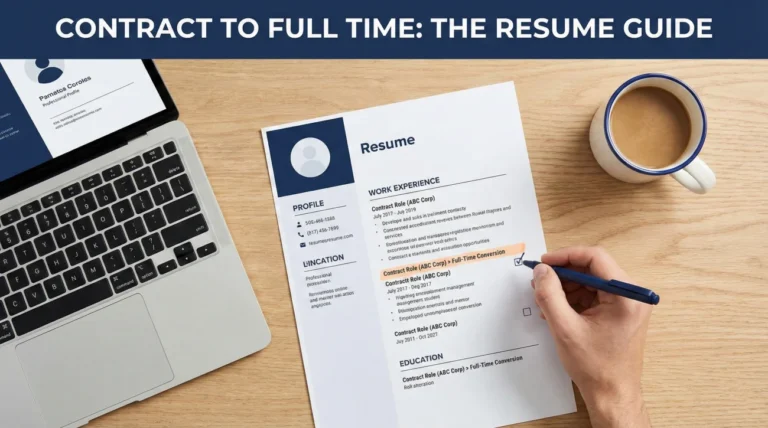
- Your headline has one job: Name the target role and give one concrete proof hook.
- Career change headlines work best in 4 patterns, depending on how “far” the pivot is.
- Every word in the headline must route to visible proof in the next sections, or it reads like wishful branding.
The problem with most career change headlines
I’ve watched smart people lose interviews before the first bullet point, just because their top line sounded like a negotiation instead of a decision.
One candidate, Spencer, was moving from Account Management into Customer Success. Her resume had real proof: Renewals, upsells, onboarding cleanups, even churn reduction. But her headline said: “Results-Driven Professional Seeking Customer Success Role.” The hiring manager read it like: “So you want the job. Cool. Who are you, though?”
The fix was not adding more words. The fix was choosing a pattern that makes the switch feel already underway, not merely requested. In this guide, I’ll show you four patterns that do that, plus 12 examples you can adapt quickly.
Resume headline for career change works when it is specific, short, and backed by something you can point to within two scrolls.
What your headline must do in 12 words or less
A headline is not a summary. It is a label that tells a recruiter what bucket to place you in, and what proof to look for next.
| Headline job | What it signals | What the reader expects next |
|---|---|---|
| Declare the target role | I am applying as this role, not my old one | Keywords, tools, or projects that match that role |
| Add one proof hook | This is grounded, not a fantasy pivot | A bullet, project, metric, or credential that supports the hook |
| Route the scan | Here’s where to look first | Skills block, Projects, or first experience bullets that confirm it |
🗝️ Key Point: If your headline cannot be proven by something visible in the top third of the page, it reads like branding, not positioning.
That is why generic lines fail. They do not create a measurable expectation. They create a mood.
Choose one of the 4 career change headline patterns
Pick the pattern based on how your proof looks on paper, not how confident you feel. Confidence is helpful. Evidence is what gets you moved forward.
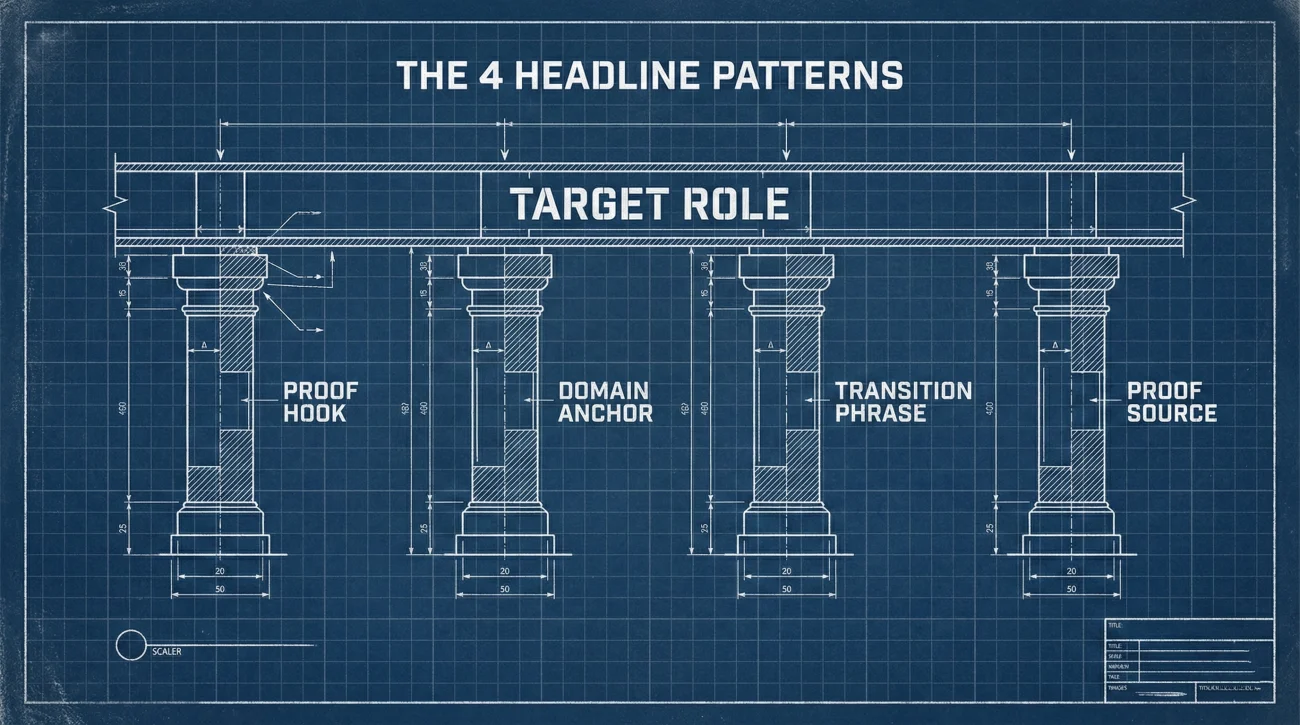
Pattern 1: Target Role + Proof Hook
Use this when you have at least one strong “bridge” achievement that already smells like the new role. This is common in adjacent pivots: Sales to Customer Success, Ops to Program Management, Support to QA, Teacher to L&D.
Your proof hook should be something the target role cares about, not something your old role cared about. Think outcomes, tools, or scope that translate cleanly.
Data Analyst | SQL + Dashboarding for Weekly Stakeholder Reporting
Product Manager | User Research + Prioritization Using Experiment Results
💡 Pro Tip: If your hook is a tool, pair it with a purpose. “SQL” is better when it ends with what you used it for.
Pattern 2: Target Role + Domain Anchor
Use this when you are changing function but keeping the same industry or domain. Domain continuity is underrated. I’ve seen healthcare candidates pivot into analytics faster than generic “career switchers” because they kept the domain anchor and reduced the perceived ramp-up risk.
This pattern is also useful when the company values domain fluency: Fintech, healthcare, manufacturing, compliance-heavy environments.
UX Researcher | B2B SaaS Workflow and Admin Tool Experience
Product Operations | Marketplace Compliance and Quality Systems
One colleague of mine, Marcus, pivoted from HR Generalist to People Analytics. His headline did not scream “career change”. It simply said “People Analytics | HR Data + Reporting”. That small choice kept him in the right mental bucket.
Pattern 3: Target Role + Transition Bridge Phrase
Use this when the pivot is real, but you need one short phrase that connects old work to new work without sounding like you are borrowing the title.
This is where most people overdo it. They write a full sentence, add “seeking”, add “passionate”, then wonder why it reads soft. Keep the bridge phrase factual and short.
Technical Writer | Transitioning from Support to Product Documentation Systems
Project Coordinator | Transitioning from Event Ops to Cross-Functional Delivery
Here is the rule: The bridge phrase should point to the type of work, not your emotions. If the headline contains motivation instead of proof, it weakens the scan.
Pattern 4: Target Role + Proof Source (Projects, Certification, Portfolio)
Use this when you do not have direct experience bullets that match the new role yet, but you do have a proof source that is visible on the resume: a projects section, a certification, a portfolio link, or structured training with outputs.
This pattern is your best friend when you are early in the pivot. It keeps the headline honest while still claiming the target direction.
Front-End Developer | Projects in React and UI Component Builds
HR Coordinator | Certification-Backed Pivot into Talent Operations
⚠️ Warning: If you use “certification” as your proof source, make sure the rest of the page shows outputs, not just the credential.
And yes, this is where you can naturally fit a secondary keyword once, without stuffing. For example, if you need the exact phrase career change resume headline, Pattern 4 is often the cleanest place to use it because it sounds like a label, not a plea.
Routing rules: Every headline must point to visible proof
Most career changers fail because the headline and the next section disagree. The recruiter feels that mismatch instantly, even if they cannot name it.
Use this routing table like a wiring diagram. If your headline uses a hook, make sure the hook has a home.
| If your headline includes | Your proof should appear in | What that proof looks like |
|---|---|---|
| A tool (SQL, Tableau, Jira) | Projects or first bullets | One line showing what you built, analyzed, or improved |
| An outcome (churn reduction, cycle time) | Experience bullets | A metric tied to a business impact, not a task |
| A domain anchor (healthcare, fintech) | Experience context line | Industry terms that show fluency without jargon dumping |
| A proof source (portfolio, certification) | Projects or education add-on | Named projects, capstones, or work samples |
💡 Pro Tip: If the headline says “Data Analyst”, your first project title should not be “Practice Dashboard”. Name it like a business problem.
One more rule that matters in ATS-heavy environments: Avoid funky titles that no job posting uses. “Strategic Career Change Optimizing Operations Efficiency” sounds clever, but it is hard to match. Keep the title searchable, then add the hook.
And for the keyword requirement, here is a clean place to include it once: If you are writing a switching careers resume headline, your safest formula is “Target Role | Proof Hook”. That keeps the label aligned with how roles are indexed.
A quick rebuild process that stops the headline from sounding needy
I use a simple edit pass with candidates because most “bad” headlines are not wrong, they are just uncommitted. They read like the candidate is asking permission to be considered.
Run your line through these three checks, then rewrite once.
- Check 1: Does the line start with the target role, not your personality.
- Check 2: Is the hook something you can prove in two scrolls.
- Check 3: Would a stranger know what job to route you into.
| Weak | Stronger | Why it works |
|---|---|---|
| Motivated professional seeking a new career | Project Coordinator | Cross-Functional Scheduling + Vendor Delivery | Names the role and shows a job-relevant hook |
| Former teacher looking to transition to tech | L&D Specialist | Training Design + Facilitation at Scale | Claims the function using transferable proof, not identity |
| Experienced professional with transferable skills | Data Analyst | Portfolio Projects in SQL and Business Dashboards | Gives proof source that the reader can verify |
And if you need the phrase resume headline for transitioning in your content, use it once in a sentence that is actually helpful, like this: A resume headline for transitioning should name the destination first, then show the bridge in one proof hook.
Final: The headline is a contract, not a slogan
When a career change is real, your resume should sound like someone who is already operating in the new direction. Not someone waiting to be chosen.
The cleanest approach is to pick one of the four patterns, then make sure the next sections keep the promise. Once the top line and the proof agree, the reader relaxes. They stop arguing with your identity and start evaluating your fit.
That is the whole point of resume headline for career change: One line that routes the rest of the page into a coherent story.
❓ FAQ
🧠 Should I write “career changer” in my headline?
Usually no. “Career changer” describes your situation, not your fit. If you need a bridge phrase, use a factual transition line that points to work, tools, or domain continuity.
🧩 Is “Former X turned Y” a good idea?
It can work in niche cases, but it often creates doubt. A safer option is to claim the target role and use a proof source like projects, domain anchor, or a measurable hook.
📌 How long should the headline be?
Aim for one line. If it wraps into two lines, cut adjectives first, then cut soft phrasing like “seeking” or “motivated”. Keep the role, keep one hook, drop the rest.
🧾 What if I have no direct experience yet?
Use Pattern 4. Claim the target role and cite the proof source: Portfolio projects, certification outputs, capstones, or structured training work that is visible on the resume.
⚙️ Will the wrong title hurt me in ATS?
It can. If the job posting uses “Customer Success Manager”, do not headline yourself as “Client Happiness Partner”. Keep the searchable title, then add your hook after it.
⚠️ Disclaimer: ResumeSolving provides resume, cover letter, job search communication, and career transition guidance for informational purposes only. Hiring practices vary by employer, role, location, industry, and individual circumstances. We do not guarantee interviews, job offers, ATS results, or other outcomes. Verify employer requirements directly and follow applicable laws and workplace policies. For sensitive situations, use only information you are comfortable disclosing and keep all statements accurate.