- If your bullet starts with “Responsible for,” it reads like a job description, not proof.
- Pick a replacement verb based on ownership: Owned, Led, Built, Improved, Coordinated, Maintained, Protected.
- You can rewrite even without metrics by adding scope, frequency, or a concrete deliverable.
Why “Responsible For” Makes Strong People Look Passive
I want to start with a pattern I’ve seen in real screening sessions: Two candidates can do the same work, but the one who writes it as ownership gets the interview.
One line causes more unnecessary damage than most people realize: responsible for resume.
It is not that the phrase is “wrong English.” It is that it sends the wrong signal in a six second scan. It tells the reader: “I had duties.” It does not tell them: “I did something, and it changed something.”
Years ago, I helped a candidate named Valerie who kept losing out on mid level operations roles. Her resume was clean, her experience was real, but every other bullet started the same way. Once we rewrote just the first words of each bullet to show action and ownership, the resume suddenly read like a person who drives outcomes, not someone who waits for tasks.
“When I see ‘Responsible for,’ I assume you copied your job description. Show me what you actually did.”
If you are using “Responsible for” because you do not have numbers, you are not stuck. You just need a different starting verb and one extra detail that proves the work was real.
What Recruiters Hear When They Read It
Most hiring teams do not reject “Responsible for” because they are grammar snobs. They reject it because the phrase is vague. It hides three important things that the reader is scanning for.
Signal 1: You are describing duties, not outcomes
“Responsible for managing calendars” could mean you did it well, or you struggled, or you inherited a broken system and kept it alive. The reader cannot tell. The bullet describes a category of work, not evidence of performance.
In practice, this pushes your resume into the same bucket as candidates who paste a job posting into their experience section. Even if you are excellent, your writing makes you look average.
Signal 2: You are avoiding ownership language
There is a subtle difference between “Responsible for X” and “Delivered X.” The first sounds like responsibility was assigned. The second sounds like you executed and finished.
A colleague of mine, Jordan, screens sales and CS resumes. He once told me he treats “Responsible for” as a yellow flag in roles that require initiative. Not a deal breaker, but a sign he will look for stronger proof somewhere else. If your resume is full of it, there is no “somewhere else.”
Signal 3: You might not know what the proof is
When someone has done real work, they usually remember at least one of these: the tool, the volume, the frequency, the process change, the stakeholder, or the outcome. “Responsible for” often appears when the writer cannot point to any of those.
⚠️ Warning: If your bullet starts with “Responsible for,” and the rest of the line is also generic, the reader assumes you are hiding behind vague language.
| What you wrote | What it implies | What a better start implies |
|---|---|---|
| Responsible for onboarding new hires | Duties, unclear ownership | Onboarded, Built, Standardized, Trained |
| Responsible for reporting | Job description language | Produced, Automated, Consolidated, Presented |
| Responsible for customer satisfaction | Sounds like a goal, not work | Resolved, Reduced, Improved, Retained |
The key idea is simple: Replace “Responsible for” with a verb that shows what you did, then add one proof detail.
When It Feels True, But Still Reads Weak
Some people push back because “responsible for” is technically accurate. They were the named owner. They were the person accountable. That is valid.
The problem is that resumes are not legal documents. They are persuasion documents. Even if you were accountable, the phrase does not show what you executed.
Case 1: Compliance, risk, safety, or finance ownership
In regulated roles, people often want to communicate accountability without sounding like they are claiming outcomes they cannot control. That is where “Responsible for” shows up a lot.
You can keep the accountability and still write actively. Replace it with “Owned,” “Oversaw,” “Ensured,” or “Maintained,” then add the artifact: audit pack, control checklist, risk log, incident report, approval workflow.
Case 2: Entry level roles with repetitive tasks
If the work is repetitive, the temptation is to describe it as duty. But even repetitive work has scope. Volume, frequency, speed, quality, and error rate are all forms of proof.
A candidate named Mateo once told me he had “nothing to quantify” in his admin role. When we talked for five minutes, he mentioned he supported six managers, processed travel weekly, and reduced scheduling conflicts by creating a template. That is proof. It is not bragging. It is concrete.
Case 3: Team work where you do not want to overclaim
You can show contribution without pretending you were the sole hero. Use verbs like “Partnered,” “Supported,” “Coordinated,” “Contributed,” “Built with,” or “Implemented with.”
💡 Pro Tip: The fix is not “sound more senior.” The fix is: “sound more specific.” Specific is believable at any level.
The Replacement Map: Pick a Verb That Matches Your Ownership
Here is the decision rule I use when I rewrite bullets with candidates: Choose your first verb based on what you actually owned.
🗝️Key Point: Your first verb should answer: “Did you own it, lead it, build it, improve it, coordinate it, maintain it, or protect it?”
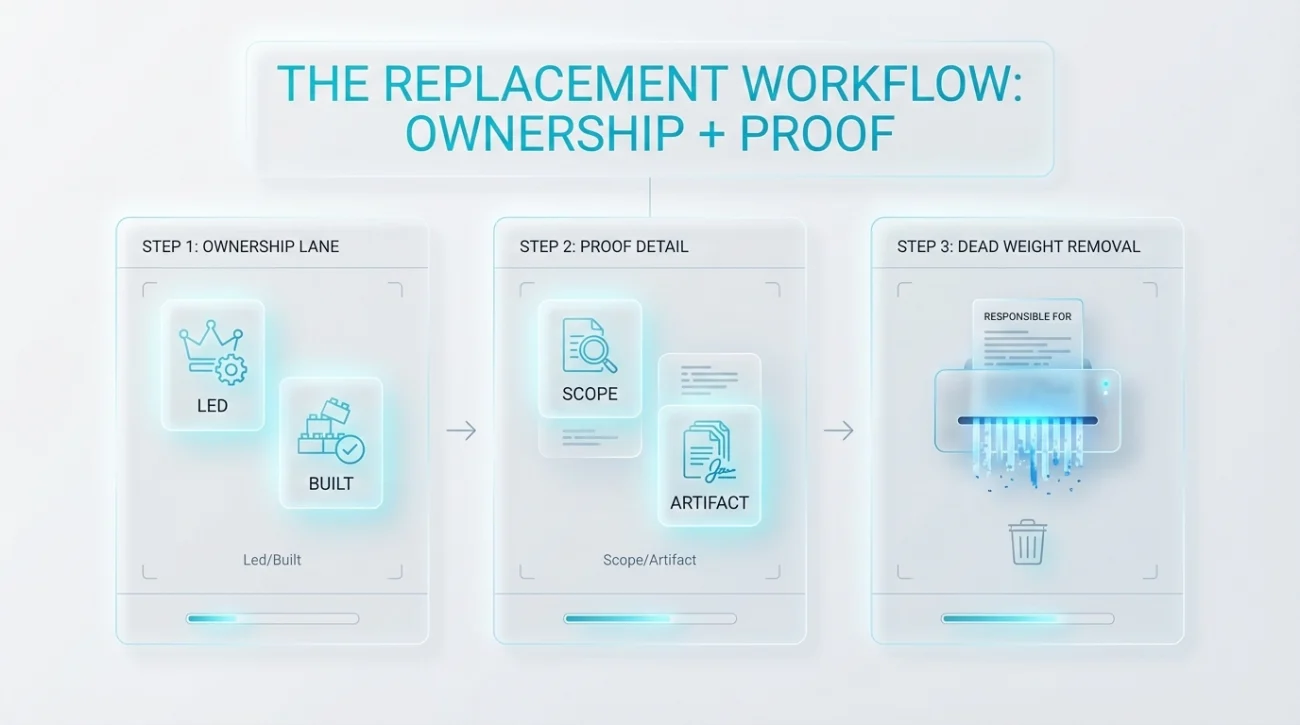
Step 1: Choose your ownership lane
If you were the accountable owner, start with “Owned,” “Oversaw,” “Directed,” or “Led.” If you built something, start with “Built,” “Created,” “Designed,” or “Implemented.” If you improved something, start with “Reduced,” “Improved,” “Streamlined,” or “Optimized.”
This step alone makes your bullet read like action instead of assignment.
Step 2: Add one proof detail that is easy to remember
You do not need perfect metrics. Pick one of these, whichever is easiest:
- Scope: Team size, number of stakeholders, regions, accounts, queues
- Volume: Tickets per day, reports per week, orders per month
- Artifact: Dashboard, checklist, template, SOP, playbook, training pack
- Process: New workflow, handoff rule, QA step, escalation path
- Outcome: Reduced errors, faster turnaround, fewer escalations, higher retention
Step 3: Remove the dead weight words
“Responsible for managing” can usually become “Managed.” “Responsible for handling” can become “Handled” or “Resolved,” depending on whether you finished the problem. This is a small edit that makes the whole resume feel more confident.
25 Better Bullet Starts That Replace “Responsible For”
This is not a random verb list. Each group below has a purpose. Pick the group that matches the story you want the bullet to tell.
Owned and Led: When you were accountable
| Use this when | Better bullet starts |
|---|---|
| You were the named owner or accountable lead | Owned, Led, Directed, Oversaw, Managed |
| You set priorities and drove execution | Prioritized, Drove, Steered, Launched, Rolled out |
| You made decisions and handled tradeoffs | Decided, Approved, Governed, Evaluated, Selected |
These verbs work best when you add scope right after. Example: “Owned weekly reporting for 4 regional teams,” or “Led onboarding for 12 hires across two quarters.”
Built and Implemented: When you created something
Use these when the work produced an artifact, system, or process that did not exist before.
- Built
- Designed
- Created
- Implemented
- Developed
- Deployed
Even if your artifact is “just a spreadsheet,” it still counts if it changed how the work was done.
Improved and Optimized: When you made something better
These verbs instantly imply impact. They also reduce your dependence on perfect numbers, because “improved” implies a before and after.
- Streamlined
- Reduced
- Improved
- Optimized
- Automated
- Standardized
Add one proof detail like a time saved, fewer errors, fewer escalations, or faster turnaround. If you do not know the exact metric, you can still reference the mechanism: “by adding a QA step,” “by consolidating templates,” “by introducing a triage rule.”
Coordinated and Supported: When you were not the owner, but you made it happen
A lot of strong candidates avoid action verbs because they fear overclaiming. You can still sound active without claiming ownership.
- Coordinated
- Partnered
- Supported
- Facilitated
- Aligned
- Contributed
These verbs work best when you name the stakeholders: “Partnered with Sales and Product,” or “Coordinated handoffs across Finance and Ops.”
Maintained and Protected: When the win is stability
Some roles are about keeping systems stable, compliant, and reliable. That is real value. The verbs just need to show execution.
- Maintained
- Ensured
- Monitored
- Safeguarded
- Resolved
- Prevented
These are especially good in IT ops, compliance, finance controls, HR operations, and customer support.
10 Before and After Rewrites You Can Model
I am going to show rewrites across different roles because the best replacement depends on the work. Copy the pattern, not the exact verbs.
| Before | After |
|---|---|
| Responsible for scheduling meetings and managing calendars | Coordinated calendars for 10 staff; reduced conflicts by standardizing request forms and lead times |
| Responsible for customer satisfaction | Resolved escalations and rebuilt follow up templates; improved repeat resolution by clarifying next steps after each case |
| Responsible for monthly reporting | Produced monthly KPI reports for 3 departments; consolidated data sources into a single dashboard for faster reviews |
| Responsible for onboarding new hires | Onboarded 15 new hires across two quarters; built a checklist and training pack to reduce first week confusion |
| Responsible for social media content | Created weekly content calendar and drafted campaign assets; improved posting consistency across priority channels |
| Responsible for inventory management | Maintained inventory accuracy through weekly cycle counts and exception tracking; prevented stockouts by tightening reorder triggers |
| Responsible for vendor relationships | Managed vendor communications and renewals; aligned SLA expectations and resolved recurring delivery issues |
| Responsible for training team members | Trained new team members using role based scenarios; reduced ramp time by creating a simple SOP library |
| Responsible for QA checks | Monitored QA results and introduced a quick pre submit checklist; reduced avoidable errors through tighter handoffs |
| Responsible for budget tracking | Tracked budget spend and flagged variances early; improved forecasting by tightening categories and approvals |
Notice what changed. The “After” lines do not magically invent achievements. They simply make the work concrete: who, what, how often, and what changed.
If you feel like the “After” version sounds too confident, it is usually because you are not used to writing actively. Read it again. If it is true, it is fair to write it.
Quick Self Check: Is Your Bullet Still a Job Description?

Use this as a fast filter. If you cannot answer at least two items below for each bullet, the line probably reads generic.
- ✅ Did I start with an action verb that matches my ownership?
- ✅ Did I include one proof detail: Scope, volume, artifact, process, or outcome?
- ✅ If it was team work, did I show my contribution without claiming full ownership?
- ✅ Did I remove filler: “Responsible for,” “tasked with,” “worked on,” “helped with”?
- ✅ Does the line sound like something a manager would say in a debrief?
One more real example. A candidate named Lien sent me a resume with strong experience but weak bullets. She said she hated “selling herself.” We did not sell. We clarified. We replaced “Responsible for stakeholder communication” with “Aligned stakeholders on weekly priorities and documented decisions.” Same truth. Different signal.
Final
The phrase “Responsible for” is a silent downgrade. It makes capable people sound like they are reporting duties instead of proving impact. You do not need to exaggerate to fix it. You need a verb that shows execution and one proof detail that makes the work real.
Once you remove it, your resume stops reading like a job posting and starts reading like a person. If you want to keep improving bullets section by section, this is exactly the kind of small component fix that responsible for resume is meant to address.
❓ FAQ
🧠 Is “Responsible for” always a mistake?
It is rarely the best choice. Even when it is technically true, it usually reads vague. You can keep the meaning by switching to “Owned,” “Led,” “Maintained,” or “Ensured,” then adding a concrete artifact or scope detail.
📌 What if I have no metrics at all?
You still have proof options. Add scope, volume, frequency, stakeholders, or an artifact like a checklist, template, dashboard, SOP, or training pack. Specific beats numeric when numbers are not available.
🧩 What is the fastest rewrite pattern?
Use: Verb + scope + proof detail. Example: “Coordinated calendars for 10 staff; reduced conflicts by standardizing request forms.” Start with the verb first. The rest becomes easier.
⚖️ How do I avoid overclaiming on team projects?
Choose collaboration verbs: “Partnered,” “Supported,” “Contributed,” “Coordinated,” or “Implemented with.” Then name the stakeholders and your slice of the work. Clarity prevents overclaiming.
🛠️ Can I use “Ensured” instead?
Sometimes. “Ensured” is better than “Responsible for,” but it can still sound abstract. Make it concrete with what you ensured: “Ensured compliance by maintaining audit packs and closing control gaps monthly.”
⚠️ Disclaimer: ResumeSolving provides resume, cover letter, job search communication, and career transition guidance for informational purposes only. Hiring practices vary by employer, role, location, industry, and individual circumstances. We do not guarantee interviews, job offers, ATS results, or other outcomes. Verify employer requirements directly and follow applicable laws and workplace policies. For sensitive situations, use only information you are comfortable disclosing and keep all statements accurate.