- You do not need fake numbers. You need proof that feels specific, testable, and anchored in real work.
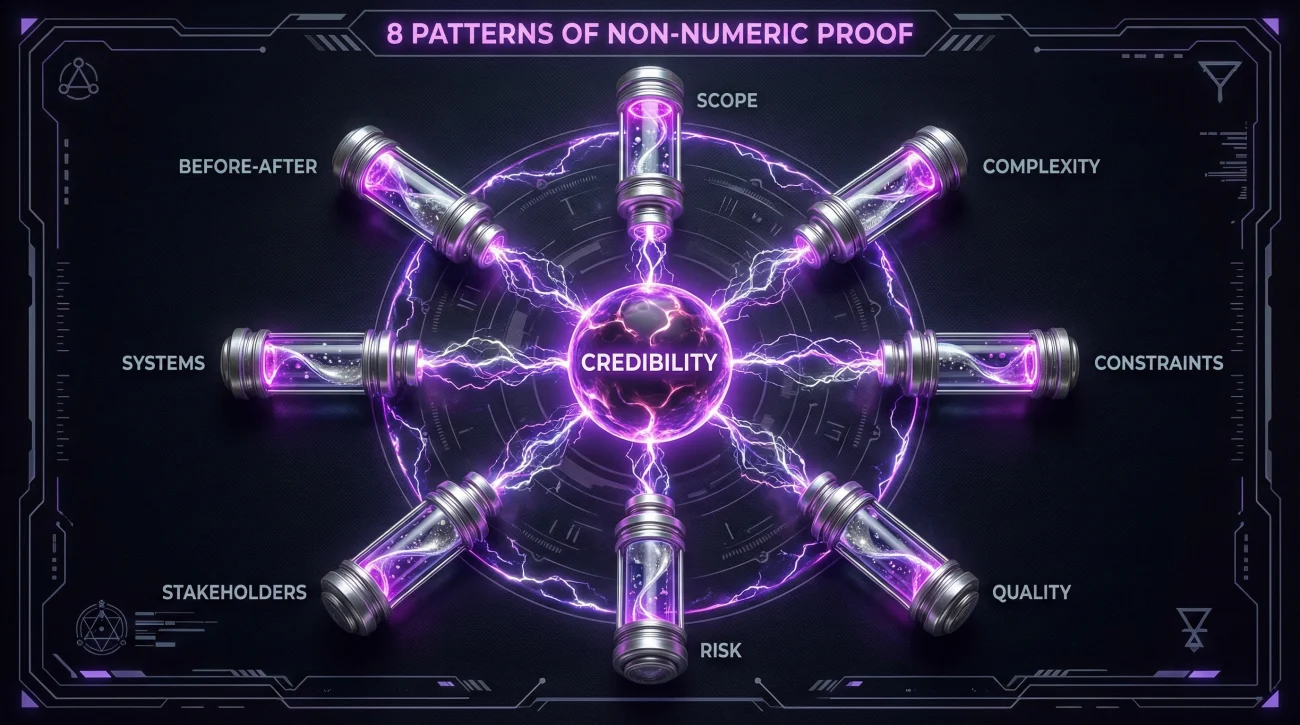
- Use 8 non numeric proof patterns: Scope, Complexity, Constraints, Quality, Risk, Stakeholders, Systems, and Before-After clarity.
- Steal the 20 bullet examples and the “do not do” list to avoid bullets that sound like empty confidence.
Why This Problem Happens More Than People Admit
I have watched smart candidates freeze at the same moment: They open a blank resume doc, stare at their job history, and realize they cannot attach a clean percentage or dollar sign to most of what they did.
That panic creates a bad fork in the road. Some people give up and write soft bullets like “Assisted with various tasks.” Others do the opposite and manufacture numbers they cannot defend. Both choices hurt credibility.
Here is the truth recruiters rarely say out loud: We like numbers because they are an easy shortcut. But the real goal is not “math.” The goal is believable proof. If you can build that proof, resume bullet points without numbers can still read like impact, not like duties.
One candidate, Daniela, had a customer support role at a company that tracked everything internally but never shared dashboards with frontline staff. She told me, “I cannot prove I improved anything.” That was not true. She could not prove it with KPIs, but she could prove it with process, ownership, and outcomes people could verify in an interview.
Numbers Are One Kind of Proof, Not the Definition of Proof
When a recruiter sees a bullet, they are doing a quick mental check: “Could this be real, and could the candidate explain it if I ask a follow up?” Numbers help, but they are not required.
In many roles, you are structurally blocked from metrics. Maybe finance owns the revenue data. Maybe you were not given access to analytics. Maybe the organization never measured anything cleanly. Maybe you worked in a non profit, healthcare, education, internal ops, or early stage chaos where reporting was a moving target.
If you cannot quantify, do not “inflate.” Replace the missing number with a different kind of specificity that a hiring manager recognizes as real work.
| What weak bullets do | What strong non numeric bullets do |
|---|---|
| Claim impact with vague adjectives | Show the mechanism of impact and the boundary conditions |
| Hide behind buzzwords | Name the system, process, stakeholder, or constraint |
| Sound like a job description | Sound like a specific moment of ownership |
| Borrow fake KPIs | Use verifiable signals: Artifacts, decisions, standards, handoffs |
Key Point: If your bullet can survive one skeptical follow up question, it is doing its job, even with zero numbers.
The 8 Non Numeric Proof Patterns Recruiters Actually Trust
Pattern 1: Scope Proof, What You Touched and How Wide It Reached
Scope is a substitute for metrics when impact is real but not measured. Scope can be teams, geographies, products, workflows, or stakeholder groups. It signals scale without pretending you know the exact delta.
Good scope proof includes a concrete object: A queue, a playbook, a training program, a release process, a compliance workflow. If you can name it, it sounds real.
Pattern 2: Complexity Proof, What Made the Work Hard
Complexity is not “fast paced environment.” Complexity is: messy inputs, ambiguous requirements, conflicting stakeholders, legacy systems, high risk changes, cross functional dependencies.
A bullet that includes complexity gives recruiters a reason to respect the work even without a numeric result. It also sets you up to tell a sharper story in interviews.
Pattern 3: Constraint Proof, The Limits You Worked Under
Constraints create credibility. When you say you delivered a process improvement “with limited resources,” that is still vague. But if you say you delivered it with “no new tooling,” “no headcount,” “limited access,” or “tight approval gates,” it feels like lived reality.
I have seen hiring managers lean in when a candidate explains impact inside constraints, because it suggests judgment, not just effort.
Pattern 4: Quality Proof, Standards, QA, and Fewer Mistakes
Quality is measurable, but often not shared. Still, you can show quality proof through standards and safeguards: QA checklists, peer review, documentation rules, escalation protocols, test coverage practices, accessibility reviews, or compliance steps.
If your bullet shows you reduced errors by tightening a standard, that is impact even if you cannot claim a percentage.
Pattern 5: Risk Proof, What You Prevented or Stabilized
Many roles are defensive. You prevent outages. You prevent legal issues. You prevent customer churn. You prevent confusion. Risk proof is a powerful substitute for revenue metrics because it signals maturity.
⚠️ Warning: Do not write “prevented major losses” without context. Write the risk category, the trigger, and the safeguard you built.
Pattern 6: Stakeholder Proof, Who Relied on Your Work
If your work influenced leadership decisions, enabled another team, or reduced friction between functions, that is proof. Stakeholder proof shows your work had consumers, and those consumers were real humans inside an org.
This is especially useful for ops, program management, HR, internal comms, and product roles where outcomes are shared and distributed.
Pattern 7: Systems Proof, Tools, Workflows, and Artifacts
Systems proof means you name the artifact you created or maintained: A SOP, a runbook, a training deck, a triage rubric, a migration plan, a knowledge base structure, a tagging taxonomy.
A recruiter may not know your exact business metrics, but they know what a runbook does. They know what a triage rubric changes. That is the point.
Pattern 8: Before After Proof, Clarity Without Percentages
Before after proof is not “improved efficiency.” It is describing the prior state and the new state in observable terms. For example: “Requests came in through five channels” becomes “Requests routed through one intake form with clear ownership.”
That contrast is compelling even without a number, because it describes reality, not a claim.
A Bullet Builder That Forces Proof, Not Fluff
When you lack metrics, you need a structure that prevents you from writing job descriptions. This is the builder I use with candidates who keep defaulting to “Responsible for” language.
[Action] + [Specific object] + [Proof pattern] + [Why it mattered]
“Proof pattern” is where you plug in one of the eight patterns above. That single decision changes the tone from generic to credible.
| Proof pattern you choose | What to add to the bullet |
|---|---|
| Scope | Teams touched, workflow coverage, product area, region, volume proxy like “high volume queue” |
| Complexity | Dependencies, legacy constraints, ambiguous inputs, cross functional alignment |
| Constraints | No budget, limited access, tight approvals, time pressure, no new tools |
| Quality | QA steps, review gates, standards, documentation rules, fewer errors described as fewer escalations or rework |
| Risk | Risk category, trigger, safeguard, monitoring, escalation path |
| Stakeholders | Who relied on it and what decision or workflow it enabled |
| Systems | Name the artifact: SOP, rubric, playbook, runbook, taxonomy, intake form, template |
| Before-After | Old state vs new state described in observable terms |
A quick story: I worked with a candidate, Marcus, who did internal IT support. He kept trying to invent “time saved” numbers. Instead, we rewrote his bullets using Systems and Risk proof. His resume started sounding like someone who stabilized a business, not someone who “helped with tickets.” Two weeks later, he told me hiring managers finally asked the right questions in interviews, the ones he could answer with confidence.
20 Resume Bullet Examples With Zero Numbers, Still High Proof
These examples are intentionally metric free. Each one uses at least one proof pattern, so it reads like a real moment of ownership.
💡 Pro Tip: Do not copy blindly. Swap the object, system, and stakeholder to match your role. The structure is what matters.
• Created a triage rubric for incoming requests, clarifying priority rules and ownership to reduce confusion during peak periods.
• Consolidated scattered process notes into a searchable knowledge base, standardizing tags and templates so updates stayed consistent.
• Led cross functional intake sessions to translate vague requests into clear requirements, preventing late stage rework and scope drift.
The bullets above lean on Systems, Quality, and Before-After proof. They tell a recruiter: “This person changes how work flows.”
• Owned the handoff workflow between Product and Support, defining what “ready to ship” meant so releases stopped surprising frontline teams.
• Introduced a peer review step for client facing reports, tightening quality checks before delivery to executives.
• Built a lightweight incident playbook for recurring issues, defining triggers, responders, and communication rules during disruptions.
These are Stakeholder and Risk proof bullets. They show maturity because they describe coordination and prevention.
• Trained new hires on internal tools and workflow standards, using role specific scenarios to build confidence in the first weeks.
• Refined meeting cadences and decision notes for a project team, improving clarity on owners and next steps without adding bureaucracy.
• Maintained governance for a shared template library, ensuring changes followed review rules and stayed aligned with brand standards.
Those bullets lean on Scope and Quality proof. They sound like someone who builds consistency.
• Navigated legacy process constraints by introducing a bridge workflow that kept compliance steps intact while improving speed of handoffs.
• Reduced recurring confusion in customer updates by standardizing language guidelines and response templates across the team.
• Improved reliability of recurring deliverables by adding preflight checks and clear ownership for dependencies.
These use Complexity and Constraint proof. They show you can work inside reality, not inside ideal conditions.
• Led a cleanup of outdated internal pages, removing contradictions and consolidating the “source of truth” to improve trust in docs.
• Coordinated a vendor onboarding workflow, clarifying required artifacts and security reviews so stakeholders knew what to expect.
• Created a training guide for recurring tasks, reducing reliance on tribal knowledge and making coverage easier during absences.
Last set leans on Systems, Scope, and Before-After proof. It is “impact” without pretending to know a numeric delta.
Do Not Do This, It Makes Your Bullets Sound Fake
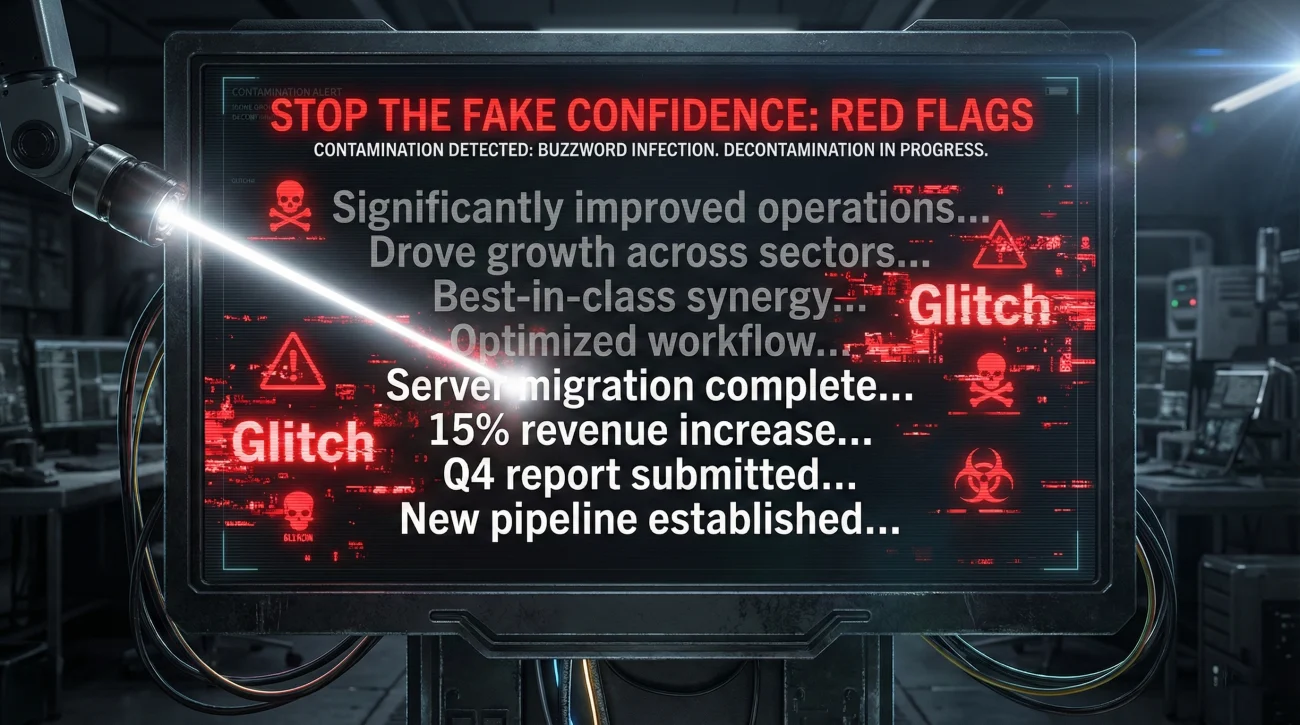
When candidates do not have numbers, they often compensate with swagger words. That usually backfires. Here is the short list of red flags I see repeatedly.
- “Significantly improved” with no description of what changed.
- “Drove business growth” in roles that did not touch growth inputs.
- Percentages that cannot be explained, especially “increased efficiency by 30%” with no baseline definition.
- Bullets that name tools only, like “Used Jira, Confluence, Slack,” with no object or outcome.
- Buzzword stacking, like “cross functional, strategic, agile, results driven,” with no concrete artifact.
A colleague of mine reviewed a resume where every bullet had a percentage, but none of them had a mechanism. She said, “It reads like a press release.” That is the risk. Numbers without reality feel worse than no numbers.
“I do not mind missing metrics. I mind bullets that sound like they were written to impress me instead of describe work.”
Quick Fixes If Your Bullets Still Feel Flat
If you rewrite with the patterns above and it still feels weak, it is usually because the bullet is missing one of these anchors.
| If your bullet sounds like a duty | Add this anchor |
|---|---|
| It does not name an object | Name the artifact: Playbook, rubric, SOP, template, intake form |
| It has action but no reason | Add “so that” and state what got easier, clearer, safer, or more consistent |
| It claims impact but feels abstract | Describe before vs after in observable terms |
| It is tool focused | Say what the tool enabled and who used the output |
Another candidate, Valeria, worked in HR operations. She thought her role was “admin.” Once we named her artifacts, intake forms, compliance checklists, and onboarding workflows, her resume stopped sounding small. No numbers changed. The clarity did.
Final: Credibility Comes From Specificity, Not Math
If you remember one thing, let it be this: You do not need to perform confidence with made up metrics. You need to describe real work in a way that a skeptical reader can recognize as true.
Pick one proof pattern, name the object, show the constraint or complexity, and explain why the change mattered. That combination reads like ownership.
Once you build that habit, resume bullet points without numbers stop feeling like a weakness. They start feeling like a signal that you understand how work actually gets done.
❓ FAQ
✅ Is it okay to have zero metrics on a resume?
Yes. Many roles do not have clean access to KPIs. Replace numbers with proof: Artifacts, scope, constraints, stakeholders, risk controls, and before-after clarity.
🧠 Should I estimate numbers if I am not sure?
Only if you can explain the estimate method calmly and it is genuinely defensible. If not, use a non numeric proof pattern. A believable bullet beats a shaky number.
🎯 What is the fastest way to upgrade a weak duty bullet?
Name a specific object and add a before-after contrast. Duties sound like “handled tickets.” Proof sounds like “built a triage rubric so requests routed to owners consistently.”
🧩 Which proof pattern works best for junior roles?
Systems and Quality proof are usually safest. Juniors can show they built reliable habits: Checklists, documentation, clean handoffs, QA steps, and consistent outputs.
⚠️ How do I avoid sounding like I am overselling without metrics?
Avoid big adjectives and vague claims. Anchor your bullet in something concrete: The artifact, the stakeholders, the constraint, or the risk you prevented.
⚠️ Disclaimer: ResumeSolving provides resume, cover letter, job search communication, and career transition guidance for informational purposes only. Hiring practices vary by employer, role, location, industry, and individual circumstances. We do not guarantee interviews, job offers, ATS results, or other outcomes. Verify employer requirements directly and follow applicable laws and workplace policies. For sensitive situations, use only information you are comfortable disclosing and keep all statements accurate.