- Contractor references work best when each person has a clear “verification job”: Performance, scope, or admin confirmation.
- Avoid scrambling by building a simple contractor reference list that mixes end-client proof with low-risk backups.
- Send a one-page reference brief so your referees stay consistent, especially when projects were short or under NDA.
Why contractor references feel harder than they should
I had a candidate named Tamara who did everything “right” on paper: Great portfolio, clean contract timeline, strong outcomes. Then the recruiter asked for references early, and she froze. Not because she had something to hide. Because contractor work is messy in a very normal way. Your best proof lives with people who are busy, moved on, or technically not allowed to speak.
This is why references for contractors need a different approach than the standard advice you see online. You are not just proving you are competent. You are proving your work was real, your scope was clear, and your engagement ended normally.
I am going to keep this practical: Selection rules, a one-page brief you can reuse, and scripts that do not feel awkward or salesy.
The real problem: Contractors have multiple “truth sources”
For employees, references usually follow a simple logic: Manager confirms your job, performance, and dates. For contractors, those truths get split.
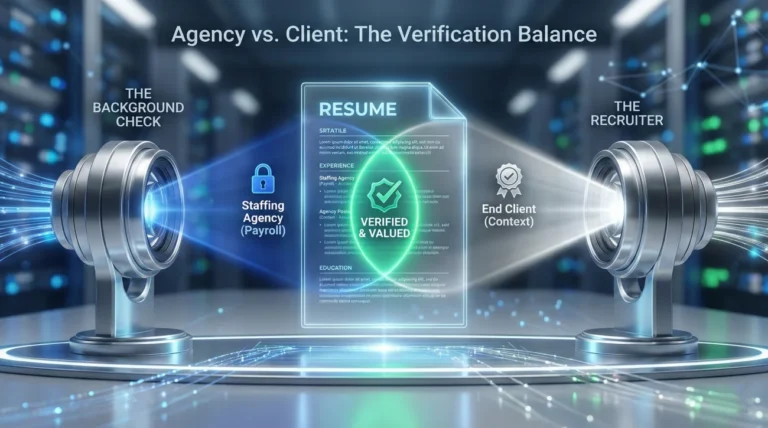
One person knows the work quality. Another person can confirm the engagement existed. A third person can confirm you were paid, cleared onboarding, and did not vanish mid-project.
💡 Pro Tip: If you treat references as “people who like me,” you will pick the wrong mix. Treat references as “people who can confirm specific facts,” and the process becomes calmer.
The three questions your references must answer
Most hiring teams, even when they say “references,” are trying to reduce three risks. Your references should cover these directly.
- Did you actually do the work? Scope, deliverables, outcomes.
- Were you reliable to work with? Communication, deadlines, how you handled feedback.
- Would they work with you again? Not a love letter, just a clear yes.
A quick story that explains why this matters
Nolan was a product analytics contractor who bounced between three short engagements in one year. His best stakeholder was a director who loved his work, but that director left the company. The only “official” contact left was an HR inbox that would confirm dates only.
When Nolan used the HR inbox as his main reference, it sounded thin. When he used only peers, it sounded unofficial. The fix was simple: One sponsor who could speak to outcomes, plus one admin verifier who could confirm the engagement existed, plus one peer who could describe collaboration style.
🗝️ Key Point: A contractor reference plan is a coverage problem, not a popularity contest.
Who to use: A reference mix that makes sense for contract work
Here is the rule I teach candidates: Pick references by “what they can credibly verify,” then check the risk level of using them. This is especially true if you are balancing references for contract work across multiple clients.
| Reference type | Best for | Risk level | What to prep them to say |
|---|---|---|---|
| End-client line manager | Performance, scope, outcomes | Medium | What you owned, what changed, what improved |
| Project sponsor or stakeholder | Impact and decision credibility | Medium | Why you were brought in, what you delivered |
| Agency account manager | Engagement existence, professionalism | Low | Reliability, onboarding, extension history |
| Client-side HR (date-only) | Administrative confirmation | Low | Dates, title, contract arrangement (if allowed) |
| Peer lead (senior collaborator) | How you work day-to-day | Low | Communication style, speed, quality bar |
Should you use an agency recruiter as a reference
This is where internet advice gets sloppy. The truth is: It depends on what you need verified.
If the recruiter only placed you and never saw your work, they are not a performance reference. They can still be useful as an “admin anchor”: Someone who can confirm you were consistently placed, easy to work with, and extended. That is valuable when your end-client manager is unavailable.
⚠️ Warning: If an agency asks for references before you have even interviewed, pause. In contractor markets, early reference collecting can sometimes be used for lead generation. Protect your clients’ contact details until the hiring process is real.
Use this framing in your head: agency recruiter as reference equals “process and professionalism,” not “deep work quality.”
Build your contractor reference list like a small system
Most contractors wait until they are asked. That is when the panic starts: People are busy, emails bounce, and you end up over-sharing to compensate.
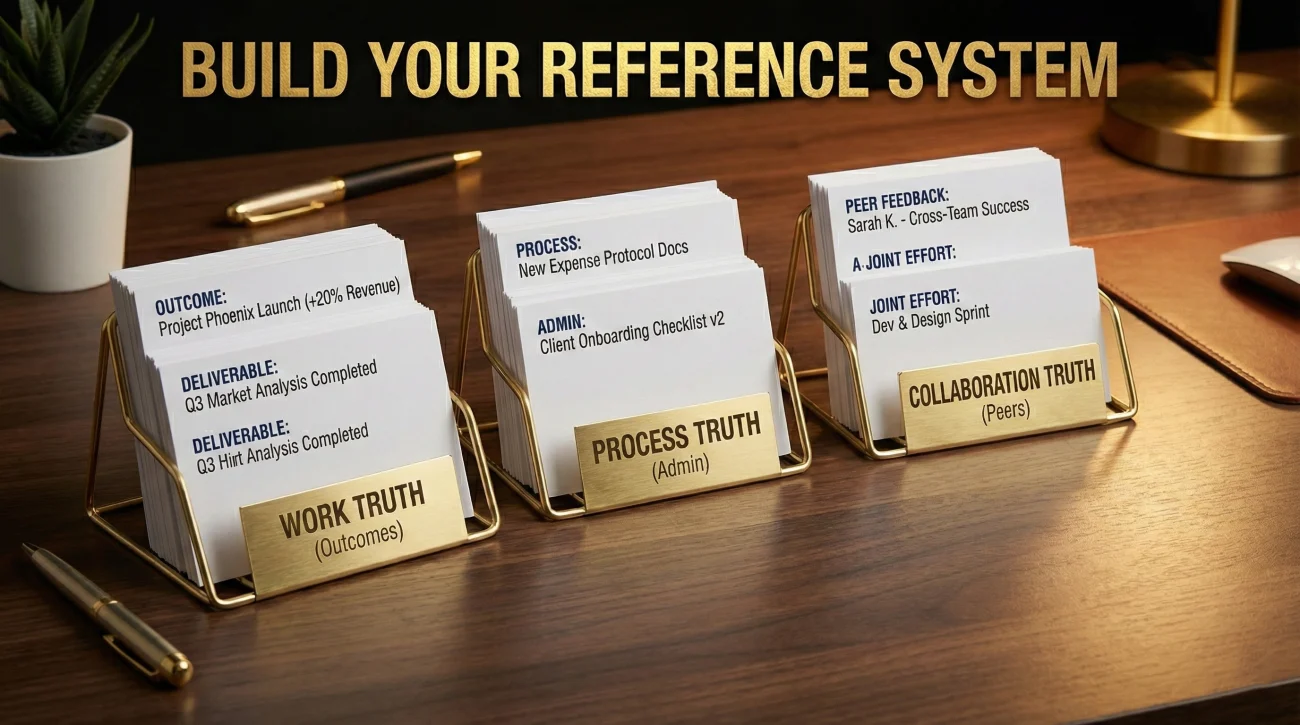
Instead, keep a living list of 5 to 7 names, then select 2 to 3 per application based on the role. Your goal is not volume. Your goal is fit and coverage.
A structure that reduces risk and awkwardness
- Two “work truth” references: Sponsor, manager, or stakeholder who can describe outcomes.
- One “process truth” reference: Agency account manager or client ops contact who can confirm engagement basics.
- One “collaboration truth” backup: Senior peer who can describe how you show up.
💡 Pro Tip: If you have many short contracts, rotate references by theme. One person for analytics projects, one for change management, one for delivery leadership. That way you are not always leaning on the same contact.
What if your work was under NDA or the client is confidential
This is common in consulting, product work, security, PR, and certain enterprise builds. You can still use references, but you need to set boundaries.
- Ask the reference to describe your scope without naming confidential details.
- Use generalized client descriptions: Industry, size, region, problem type.
- Keep deliverables framed as outcomes, not proprietary methods.
In practice, I have seen this work best when you send a short “safe wording” note along with your brief, so your reference does not accidentally overshare.
The one-page reference brief that makes everything easier
If you take only one thing from this article, make it this: References go smoother when you do the thinking for them.
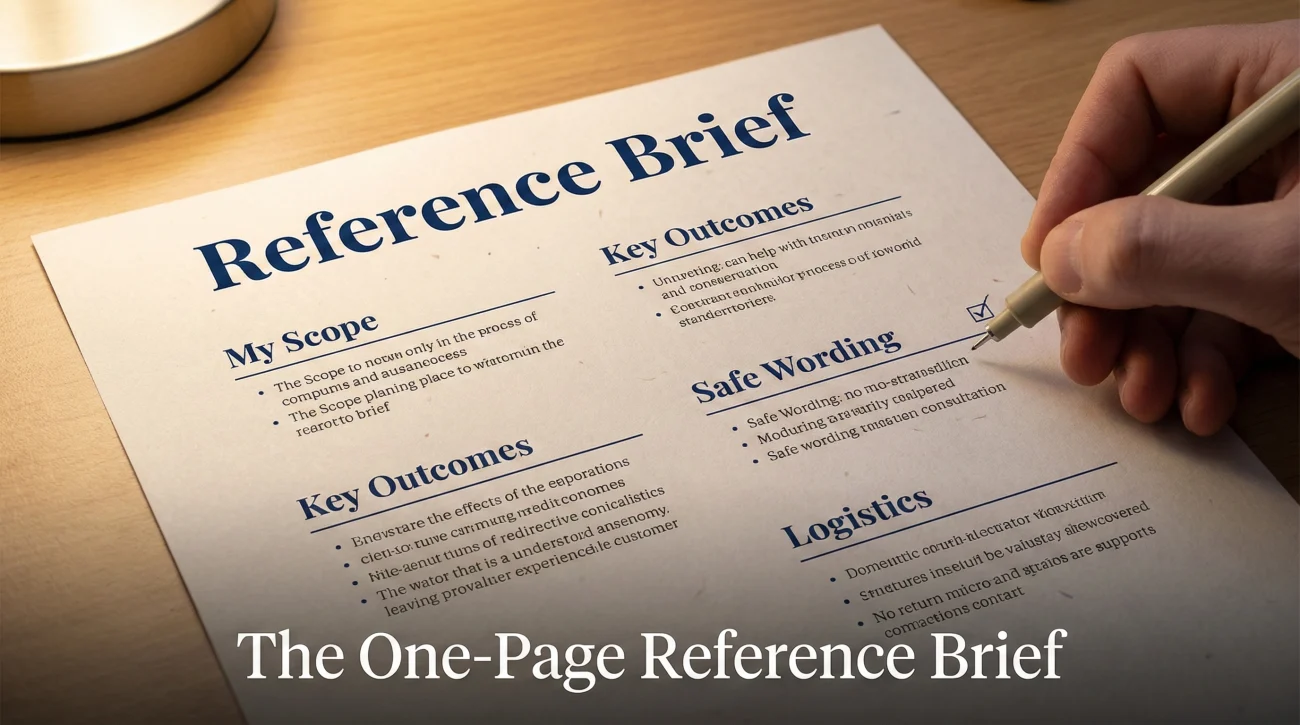
Your references should not have to remember your timeline, your scope, and your results from a six-week engagement last year. A brief keeps them confident and consistent.
What to include in the brief
- Role you are applying for and why it is a fit
- What you did together and when
- 2 to 3 outcomes that are easy to repeat
- 1 collaboration note: How you communicate and handle feedback
- Any sensitive boundaries: NDA, confidentiality, do-not-share items
Reference Brief (One Page)
Candidate: [Your Name]
Role Target: [Role Title] in [Industry/Team Type]
How we worked together: [Client/Team], [Project Type], [Month Year to Month Year]
My scope: [One sentence: What you owned]
Outcomes worth highlighting:
– [Outcome 1 with metric or clear result]
– [Outcome 2 with metric or clear result]
– [Outcome 3: quality, speed, risk reduction, revenue, cost, customer impact]
How I work:
– Communication: [cadence, clarity, ownership style]
– Feedback: [how you iterate without drama]
Confidentiality notes:
– Please avoid: [client names, proprietary system names, sensitive numbers]
– Safe wording: “A mid-market fintech” / “A global retail brand” / “An enterprise healthcare network”
Logistics:
– Best contact method: [email/phone]
– Best time window: [time zone and range]
💡 Pro Tip: When candidates do this, references stop sounding vague. They also stop “over-explaining,” which can accidentally create new questions.
How to ask without making it weird
Most people overthink the ask because they make it feel like a favor. The trick is to make it feel like a quick, bounded professional request, with an easy exit if they cannot do it.
Client reference request email that feels normal
This is a clean client reference request email structure: Context, the specific role, what you need, the timeframe, and the boundary around sensitive details.
Subject: Quick reference request (2 to 3 minutes)
Hi [Name],
I hope you have been well. I am applying for a [Role] and the hiring team asked for a reference from someone who worked with me on [Project or Team] around [Timeframe].
Would you be comfortable being a reference for me? If yes, they may contact you within the next [X days]. I will send a one-page brief to make it easy, including a few outcomes you can reference and a note on what to avoid sharing due to confidentiality.
If your company policy makes references difficult, no worries at all. I appreciate you considering it either way.
Thank you,
[Your Name]
A short ask for an agency contact
When you ask an agency contact, you are usually asking them to confirm reliability and engagement basics. Keep it tight.
“Hey [Name], I am in final stages for a contract-friendly role. Would you be open to confirming my engagement history and professionalism if the employer reaches out? I can send a one-page summary so it stays quick.”
A peer reference ask that does not feel junior
Peer references can be powerful if the person is senior enough to sound credible. Make the purpose explicit: Collaboration truth, not authority theater.
“Quick ask: If a hiring manager wants a collaborator’s perspective, can I list you as someone who can speak to how I work day-to-day? I will send a short brief so you are not guessing what to emphasize.”
⚠️ Warning: Do not send a generic “Can you be my reference?” message with no role context. It forces your referee to do extra work and makes them less confident when they are contacted.
If you cannot use your best client, do this instead
Sometimes your best manager is unavailable. Sometimes policy blocks them. Sometimes you left on good terms, but the organization does not allow personal references. This is where contractors often spiral and over-correct.
Three realistic options that still sound credible
- Use a sponsor instead of the manager: Someone who approved the work or benefited directly from it.
- Use a senior peer with clear context: Especially if they led the workstream you supported.
- Pair an admin verifier with a performance voice: One confirms engagement existence, the other confirms impact.
What not to do: Overshare your explanation
I once watched a candidate talk themselves into trouble by explaining why their manager “cannot be used.” They were trying to be transparent, but it sounded like conflict.
Instead, keep it simple: “Company policy limits formal references, so I am providing a sponsor who can speak to outcomes and an admin contact who can confirm engagement dates.” Then stop talking.
❌ Note: Avoid listing only friends or only peers. It makes hiring teams wonder why no one with decision authority is willing to speak.
Final: References are part of your contract story, not a separate chore
If you have done contract work for any length of time, you already know the truth: Your career is a set of projects, not one continuous ladder. Your reference plan should match that reality.
A calm system beats last-minute scrambling. Pick people by what they can verify, protect client contacts when the process is not real yet, and send a one-page brief so your referees sound consistent.
When references for contractors are handled this way, they stop being stressful. They become one more proof signal that your contract-heavy path is stable, professional, and easy to trust.
❓ FAQ
🎯 Should contractors put references on a resume
Usually no. Keep references in a separate document so your resume stays focused on outcomes. Share references when the employer asks, or when you are near final stages.
🧩 How many references should a contractor prepare
Keep 5 to 7 in your master list, then choose 2 to 3 per application. Aim for coverage: Outcomes plus engagement confirmation.
🛡️ What if my contract work is under NDA
You can still use references. Ask your referee to describe scope and outcomes without naming confidential details. Provide safe wording in your one-page brief so they do not have to improvise.
📌 Can an agency contact be a reference
Yes, but be clear about what they can confirm. They are strongest for engagement existence and professionalism. Pair them with someone who can speak to performance and outcomes.
✅ How to ask for a reference as a freelancer without sounding desperate
Make it bounded and easy: Provide role context, a short timeframe, and a one-page brief. Also give them a graceful exit if they cannot do it due to policy or bandwidth. That tone reads confident and professional.
⚠️ Disclaimer: ResumeSolving provides resume, cover letter, job search communication, and career transition guidance for informational purposes only. Hiring practices vary by employer, role, location, industry, and individual circumstances. We do not guarantee interviews, job offers, ATS results, or other outcomes. Verify employer requirements directly and follow applicable laws and workplace policies. For sensitive situations, use only information you are comfortable disclosing and keep all statements accurate.