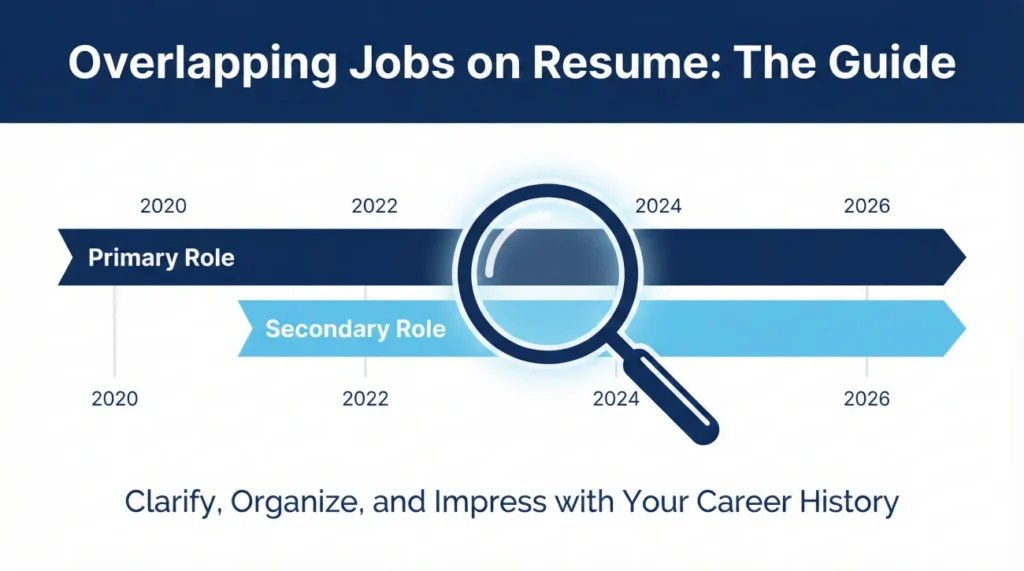
- If your dates overlap, the resume must answer one thing fast: This was intentional, not a typo.
- Use month-year dates, pick one “primary” role, and keep the secondary role visually lighter.
- Only add a micro-explanation when the overlap could look like split loyalty or double full-time.
Why Overlaps Make Recruiters Squint
I have seen recruiters zoom into dates the same way they zoom into a missing degree: Not because they love details, but because dates are where “risk” hides. If you have overlapping dates on resume, a reader usually jumps to one of three assumptions: A typo, a messy exit, or split loyalty.
A candidate named Leena once told me she got pushed into a weird defensive tone in a screening call. Her resume showed a full-time role and a contract role overlapping by eight months. The recruiter did not ask about her accomplishments first. They asked, “So were you still working there?” That is the problem: Overlap steals the first question.
This guide is not about hiding anything. It is about formatting your timeline so the resume reads like a clean story, not a mystery novel.
The 3 Types of Overlap and Why Each Needs Different Formatting
Most advice online treats overlap as one issue. It is not. The format that works for an internal promotion can look suspicious for two different employers.
| Overlap Type | What The Reader Fears | Best Visual Strategy |
|---|---|---|
| Same company, two titles | You inflated roles or repeated work | Stack titles under one employer header |
| Full-time plus side contract | Split loyalty, burnout, time conflict | Make one role primary, one role clearly “additional” |
| Transition overlap (notice period, handover) | Double employment, timeline confusion | Use month-year and keep the overlap visually quiet |
The goal is not perfect chronology, it is instant clarity
Recruiters do not reward you for “maximum detail.” They reward you for a timeline that is easy to trust. If your overlap forces a reader to do math, you already lost a little confidence.
💡 Pro Tip: Treat overlaps like footnotes in a contract. Only add the minimum needed to prevent a wrong assumption.
The 10-Second Clarity Test Recruiters Use (Even If They Don’t Admit It)

Here is what the brain is doing when it sees two jobs at the same time. It is trying to answer three questions without thinking too hard. If you design the resume to answer them, the overlap stops being a “thing.”
- ✅ Question 1: Which role was the main one?
- ✅ Question 2: Is the overlap normal (contract, part-time, promotion), or weird (two full-time)?
- ✅ Question 3: Did this overlap create risk for the employer?
A simple rule: One primary, one secondary
If you present both roles with equal visual weight, you force a reader to guess. Instead, pick a primary role based on relevance to the target job. Then “downshift” the secondary role using one of these approaches:
- Move the secondary role into an “Additional Experience” subsection.
- Keep it in the Experience section but reduce bullets and keep dates precise.
- Convert it into Projects if it was outcome-based and short.
When people search two jobs same time resume, they usually want permission. The real answer is: You can list both, but you have to control what question your resume invites first.
Formatting Rules That Keep Overlaps From Looking Messy
Below are the rules I use when I review resumes with concurrent timelines. They are designed to be ATS-safe and human-scanner-safe.
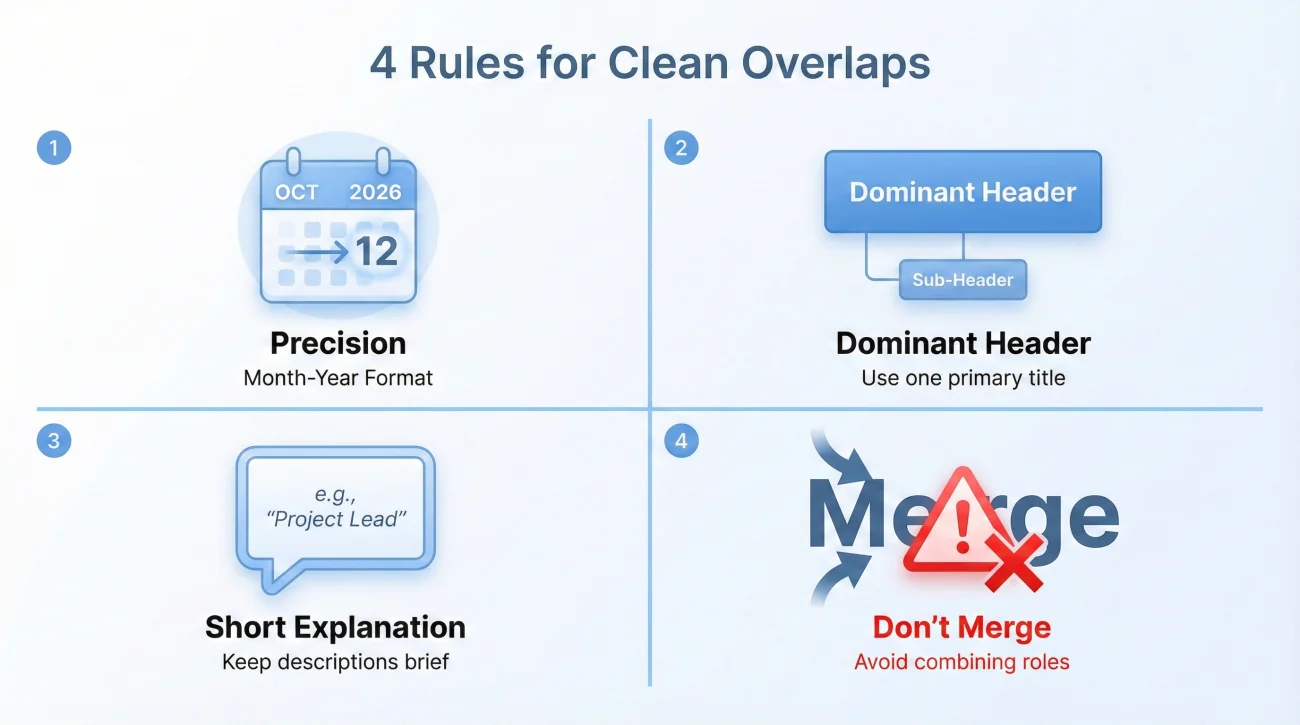
Rule 1: Use month-year dates when anything overlaps
Year-only dates hide too much. They make overlaps look bigger than they are. Month-year shows the overlap is often just a transition month or a limited side contract.
If you want a phrase to remember: overlapping dates resume format works best when the dates are precise and consistent across the whole Experience section.
Rule 2: Keep one employer header dominant
In a full-time plus side contract scenario, make the full-time role the anchor. Give it the richer bullets. Then keep the secondary role lean and specific.
⚠️ Warning: If both roles look full-size with 5 to 6 bullets each, many screeners assume “two full-time jobs.” Even if that is not true, your layout suggests it.
Rule 3: Only add an explanation when the overlap can be misread
The best explanation is short, neutral, and placed where the eyes already are: Right after the date range of the secondary role.
(Part-time, evenings) | (Concurrent contract) | (Project-based)
This is the cleanest version of a resume overlapping dates explanation because it does not invite follow-up drama. It just removes the wrong assumption.
Rule 4: Do not “merge” jobs unless you can defend it
Some corners of the internet suggest combining work from multiple roles into one entry. Sometimes that is a reasonable simplification, but only if the work truly happened under the employer you list and you can substantiate it later.
❌ Note: Never create a blended entry that implies responsibilities belonged to Employer A when they belonged to Employer B. Even if nobody checks, your resume will sound oddly vague because you are subconsciously trying not to lie.
6 Clean Examples You Can Copy (Without Triggering Split Loyalty)
These examples cover the common overlap scenarios I see in real screening calls. Use them as a template, then swap in your own proof.
Example 1 (Full-time plus freelance):
Feb 2022 – Present
– Led onboarding rewrite that improved activation by 14% within 60 days
– Partnered with Sales to rebuild pitch deck and shorten sales cycle by 9%Freelance Copy Strategist | Self-Employed
Jun 2023 – Mar 2024 (Concurrent, project-based)
– Wrote lifecycle email sequences for 3 ecommerce brands, lifting repeat orders by 8% to 12%
This works because the primary role stays dominant and the freelance line explains the overlap in six words. It answers the concern without sounding defensive.
Example 2 (Full-time plus part-time outside your field):
Apr 2021 – Present
– Built weekly reporting model that reduced manual spreadsheet work by 6 hours per week
– Created QA checks that caught claim anomalies before month-end closeShift Lead (Part-time) | Harbor Market
Nov 2022 – Aug 2023 (Weekends)
– Trained 6 new hires and stabilized weekend coverage during staff shortage
Sometimes the part-time job is not “career relevant,” but it is life-relevant. I have seen candidates like Monroe keep it because it explains a period where savings were thin. The key is: Keep it small, label it clearly, and do not let it compete visually with the main role.
Example 3 (Two titles at the same company, overlap from transition month):
Senior Account Manager | May 2023 – Present
Account Manager | Jan 2021 – Jun 2023
– Expanded a mid-market book of business from $1.2M to $1.8M annualized revenue
– Built renewal playbook that reduced churn in top segment by 6%
This is the stacked-title format. It is perfect when overlap is internal and logical. It also prevents the “duplicate employer” look that makes some resumes feel padded.
Example 4 (Advisor or board role overlapping a full-time role):
Mar 2020 – Present
– Reduced time-to-fill for operations roles from 41 days to 28 days through process redesignAdvisor | Women in Supply Chain Nonprofit
Sep 2022 – Present (Volunteer, monthly)
I like this structure because it frames the secondary role as limited and mission-based. A colleague of mine, Yoshie, used something similar and it changed the tone of interviews. Instead of “Are you too busy?” she got “What did you advise them on?”
Example 5 (Contract role overlapping because you were retained after starting a new job):
Jan 2024 – Present
– Ran 18 user interviews and rebuilt onboarding flow based on drop-off pointsContract Researcher | Bayfield Studio
Aug 2023 – Feb 2024 (Retainer, 5 hrs/week)
This scenario is incredibly common and rarely explained well online. If you do not label it, it can look like you “double-booked.” The retainer note makes it normal.
Example 6 (Two employers with overlap, but you choose one as primary for this application):
Jun 2021 – Apr 2024
– Implemented inventory cycle count system that reduced stock variance by 22%Project Coordinator | City Redevelopment Office
Sep 2023 – Present (Part-time, evenings)
This example answers the “What if it looks like two full-time jobs?” worry by labeling the secondary role. It also shows a real-life pattern: People take a second role to pivot industries or build credibility.
“I can clarify the overlap quickly: The coordinator role was evenings and scoped to a single project, so it never conflicted with my main job.”
If you want to name the concept once, call it concurrent employment resume formatting. The idea is simple: Make concurrency visible and bounded, not vague and open-ended.
The Do-Not-Do List That Creates “Messy Timeline” Vibes
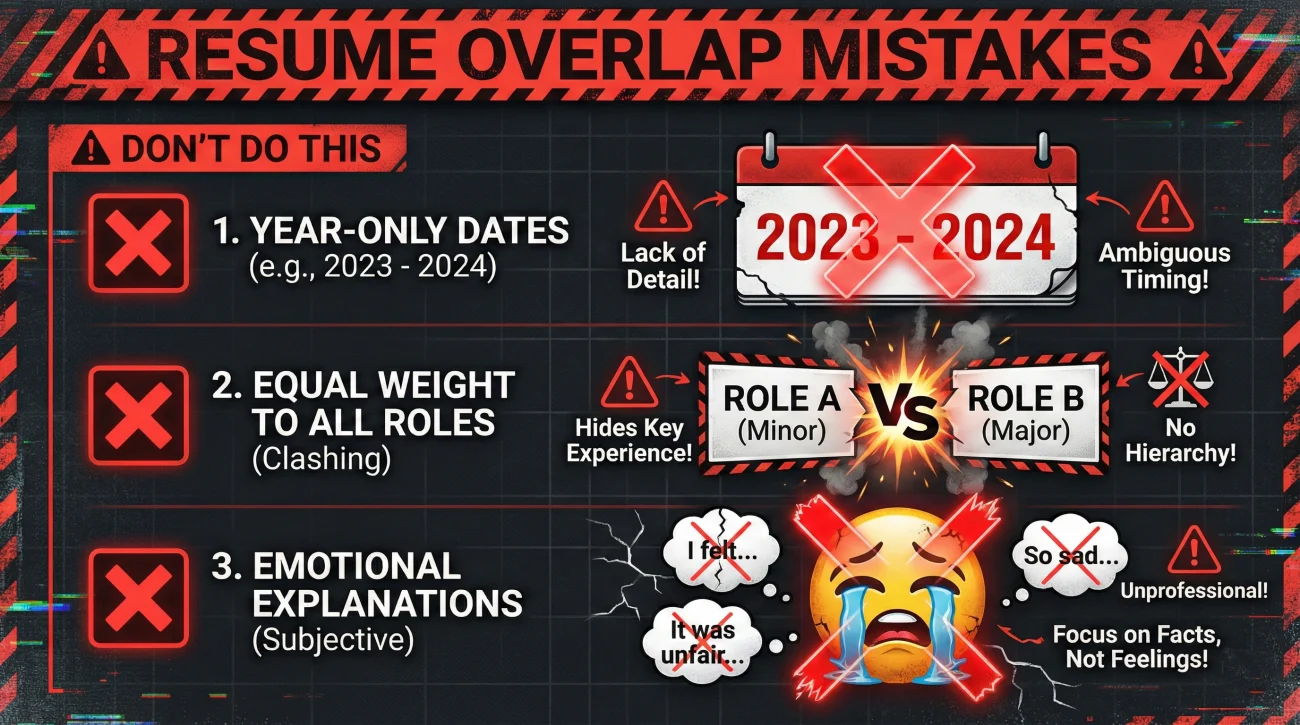
These are the mistakes that make a harmless overlap feel suspicious.
- Using year-only dates when overlap exists.
- Giving both overlapping roles the same number of bullets and the same intensity of claims.
- Adding an emotional explanation like “needed extra income” in the Experience section.
- Writing a long parenthetical that reads like a confession.
- Leaving the overlap unlabeled when the secondary role could be interpreted as full-time.
One sentence is enough, but it has to be the right sentence
A candidate named Chandan once wrote: “Worked two jobs to survive.” It was honest, but it made the resume feel unstable. We replaced it with “(Part-time, weekends)” and kept the human story for the interview, where tone and context exist. The resume does not need to carry your whole life.
Final
Overlaps are not automatically a red flag. The red flag is a timeline that forces a recruiter to guess. If you use month-year dates, choose a clear primary role, and label the secondary role only when it can be misread, the overlap becomes just another detail, not the headline of your candidacy.
When you treat overlapping dates on resume as a formatting problem instead of a moral problem, your experience reads cleaner, calmer, and more believable.
❓FAQ
🎯 Should I list both jobs if they overlap?
If the second role adds relevant proof or explains your timeline, list it. If it only adds confusion, downshift it into Additional Experience or Projects so it does not compete with your primary role.
🧭 What date format looks most credible for overlap?
Month-year is usually the cleanest when dates overlap because it reduces ambiguity and makes small overlaps look small.
🛠️ Do I need to explain why the overlap happened?
Only when a reader could misinterpret it. A short label like “(Part-time, evenings)” is often enough. Save the full story for an interview where context matters.
🔎 What if the overlap is from an internal promotion?
Stack titles under one company header. It signals progression and avoids the “duplicate employer” look. Overlap in that scenario is usually read as normal.
🧩 Can I hide the overlap by removing months?
You can use year-only dates, but it often backfires because it makes overlaps look larger. If overlap exists and could raise questions, month-year tends to be safer.
⚠️ Disclaimer: ResumeSolving provides resume, cover letter, job search communication, and career transition guidance for informational purposes only. Hiring practices vary by employer, role, location, industry, and individual circumstances. We do not guarantee interviews, job offers, ATS results, or other outcomes. Verify employer requirements directly and follow applicable laws and workplace policies. For sensitive situations, use only information you are comfortable disclosing and keep all statements accurate.