- Your contract work can verify cleanly if employer names and dates match across resume, application, and background check forms.
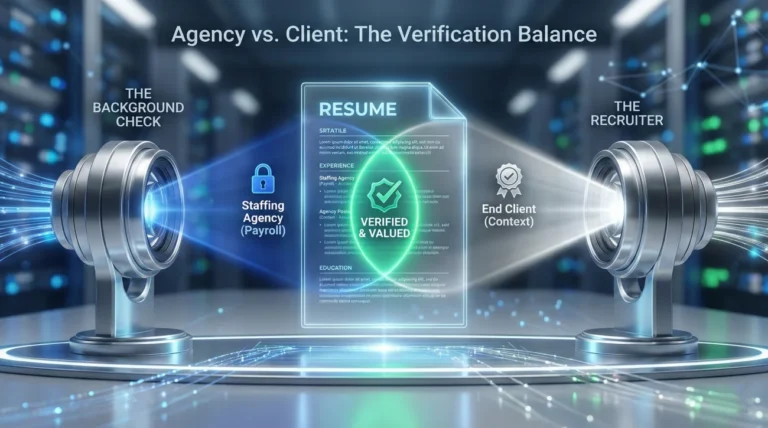
- The biggest trap is agency vs client: The company you served is not always the company that can confirm you.
- Build one “source of truth” sheet, then copy from it every single time.
Why Contract Work Background Checks Get Weird Fast
I’ve watched otherwise solid candidates lose a week of momentum because the background check came back with a “discrepancy” that was basically paperwork math. Not fraud. Not drama. Just messy contract history.
Here’s the uncomfortable truth: A contract work background check does not fail because you worked contracts. It fails because three different documents tell three slightly different stories.
A friend of mine, Jeremy, did eight months at a well-known client through a staffing agency. His resume showed the client name only because that’s where he actually worked. The background check form asked for “employer.” He typed the client again. The verifier called the client’s HR, and HR had no record. Cue the dreaded email: “We need clarification.”
This guide is the clean fix: What gets verified, where people accidentally create mismatches, and a checklist to keep your employer names and dates consistent without turning your resume into a legal contract.
What Usually Gets Verified for Contract Work
Most verifiers aren’t trying to understand your whole career story. They’re trying to confirm a few fields match a record someone can actually access.
| Verification item | What can go wrong with contract work | What “clean” looks like |
|---|---|---|
| Employer name | You list the client, but only the agency can confirm payroll records. | Employer-of-record is consistent everywhere, with the client shown as context. |
| Dates (month and year) | Overlapping contracts, extension months, or you round dates differently each time. | One master timeline, copied into resume and forms with the same month-year format. |
| Title | Client role title differs from agency HR title, or you “upgrade” the title for clarity. | Resume uses a readable title, but background check form uses the HR-record title when needed. |
| Supervisor or contact | Agency can verify employment but cannot speak about your day-to-day work. | Agency confirms employment; client manager is listed as reference if requested. |
💡 Pro Tip: Assume the verifier will confirm months, not your exact start day. Your job is to keep the months consistent across documents.
The 6 Mismatch Traps That Trigger “Please Clarify” Emails
When candidates tell me “I don’t know why they’re questioning it,” it’s usually one of these. None of them are moral failures. They’re formatting failures.
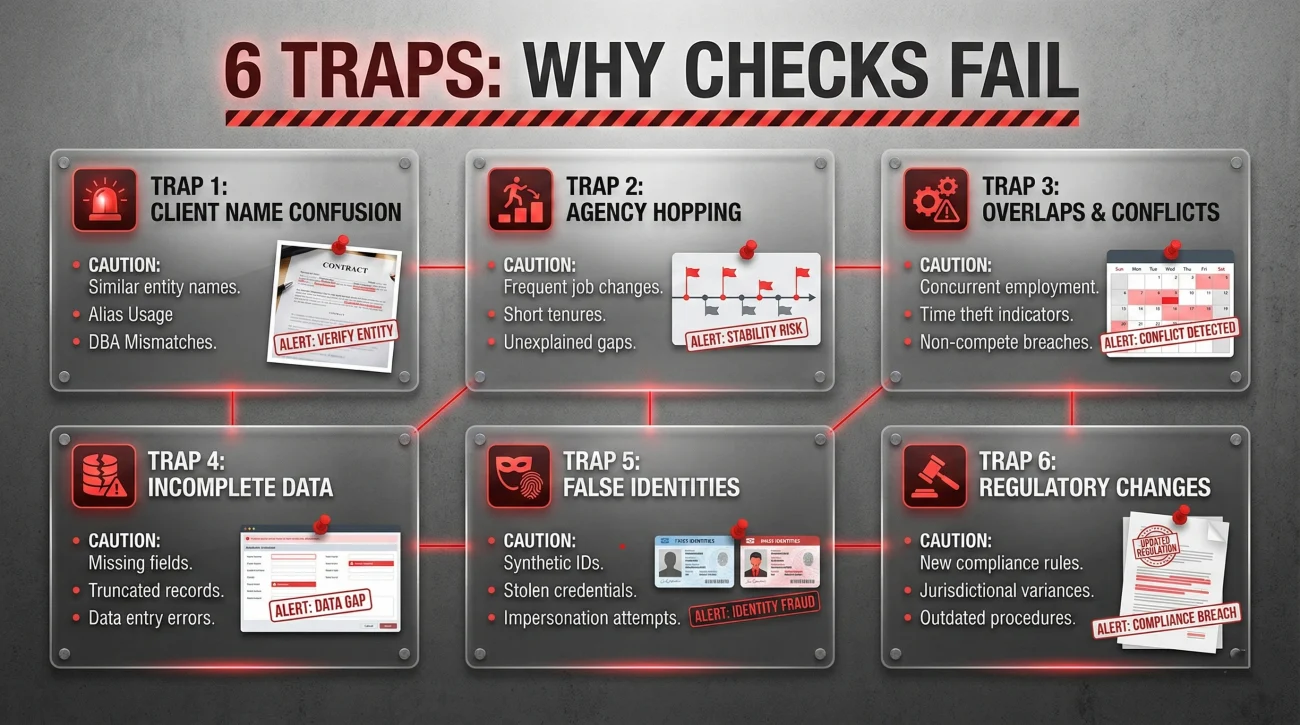
Trap 1: Client-only employer name
This is the classic. You did real work at the client. Your badge had the client logo. You tell your friends you worked at the client. But payroll and HR record sit with the agency.
🗝️ Key Point: If the client cannot find you in HR records, the verifier interprets it as “unverified employment,” even when it was legitimate.
Trap 2: “Agency hopping” that looks like job hopping
Same client, new contract vendor every few months. On paper, it looks like you had three employers in one year. People panic and try to hide it by compressing entries. That’s where inconsistencies begin.
One candidate I coached, Juliana, had the same project for 14 months but was paid by two agencies due to procurement changes. Her resume showed one continuous line. Her background check form listed both agencies separately with slightly different dates. That mismatch created a flag, not because either version was “wrong,” but because both versions existed.
Trap 3: Overlapping dates from extensions and renewals
Some contracts renew without a clean “end date” in your memory. People keep the old end month on a resume, then put a different end month on the form because they found a final invoice later. Even a one-month mismatch can trigger follow-up.
⚠️ Warning: Fixing overlaps by “editing history” after the fact is what makes verifiers suspicious. Fix it by creating a single timeline and sticking to it.
Trap 4: Title drift between client and HR records
Your client called you “Product Analyst.” The agency HR system stored “Consultant I.” Your resume uses the client-facing role title because it’s understandable. That’s fine, but the background check form may need the HR title to match verification records.
Trap 5: You list the wrong entity name
Some agencies operate under parent companies, payroll subsidiaries, or rebranded names. You remember the brand. Payroll remembers the legal entity. This is where the “background check staffing agency” confusion shows up.
If you only remember the brand name, your “source of truth” sheet should store the legal name once you confirm it, then you reuse it.
Trap 6: You treat resume dates and form dates as separate worlds
The easiest way to trigger a discrepancy is to “round” one way on the resume and another way on the form. If you want to round, round once and keep it everywhere.
Build One Source of Truth (Then Copy-Paste Forever)
If you want contract work employment verification to feel boring, you need one master record you trust more than your memory.
It can be a Google Doc, a note, or a spreadsheet. The key is: This is where you decide what’s “official,” and everything else is a copy.
Contract Work Source of Truth (Copy Template)
For each contract, store:
1) Employer of record (payroll company legal name): __________
2) Client served (context name): __________
3) Location or team (optional): __________
4) Role title on resume (human readable): __________
5) Role title in HR record (if different): __________
6) Start month/year: __________
7) End month/year (or Present): __________
8) Proof you can show if asked (one item): Pay stub, contract letter, invoice, W-2/1099, offer email
9) Verification contact: Agency HR number or email, plus client manager reference if requested
Once, when I helped Joey fix his situation, we didn’t rewrite his past. We wrote this sheet, then aligned his resume and form entries to match it. The follow-up email disappeared in one day because the story became consistent.
How to Write Employer Names and Dates Without Creating Mismatches
There’s a difference between what looks best on a resume and what verifies easiest on a form. You can do both if you separate “employer of record” from “client context” clearly.
If you were W-2 through a staffing agency
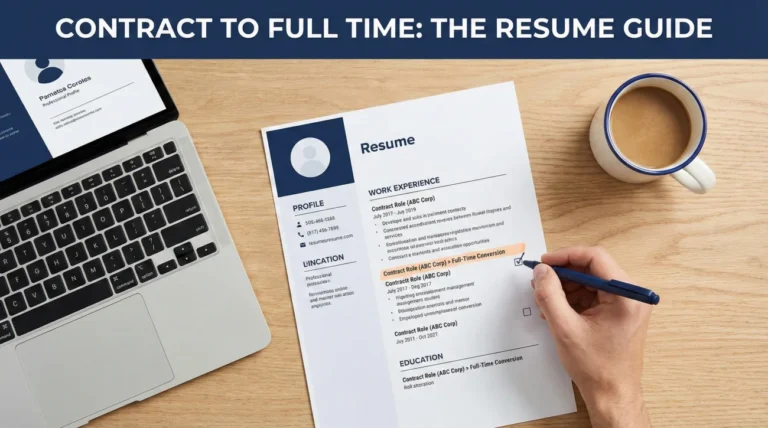
For verification, the staffing agency is usually the one that can confirm employment dates. Your resume can still show the client, but do it as context, not as the employer.
Contract Role Title | MM/YYYY – MM/YYYY
Key achievement line that proves impact at the client
This format avoids the “I worked at ClientCo” implication while still giving recruiters the brand context they care about.
If you were 1099 (independent contractor)
For “employer,” you may need to list your business name or “Self-employed,” then list clients as projects. This is the cleanest way to verify contract employment without pretending you were an employee of each client.
Role Specialty | MM/YYYY – MM/YYYY
Proof line: Delivered X outcome, supported by invoice or contract letter if requested
If you had overlapping contracts
Overlaps are not automatically disqualifying. The risk is when overlaps look hidden or accidental. If there was an overlap because of a transition month, show it consistently, and be ready to explain it in one sentence if asked.
Do I need exact days?
Usually months are enough, but whatever level you choose, keep it identical across resume, application, and forms. If you pick month-year, use month-year everywhere.
If a Background Check Flags a Discrepancy, Do This (Calmly)

The best response is not a long explanation. It’s a clean clarification that makes the verifier’s job easier.
- ✅ Step 1: Ask what field is mismatching (employer name, dates, or title).
- ✅ Step 2: Confirm your employer of record from pay stubs, tax forms, or contract paperwork.
- ✅ Step 3: Reply with one aligned version and a short reason (agency vs client, vendor change, extension).
- ✅ Step 4: Offer one proof item only if requested, not as a panic dump of documents.
❌ Note: Avoid “I forgot” as your main explanation. Use “Employer of record was X, client served was Y” and you’ll sound organized instead of uncertain.
One manager told me they don’t mind clarifications. They mind when the clarification introduces a fourth version of the story. Your goal is one version, repeated perfectly.
A Short HR Call Script You Can Use
This is for the moment you need to message HR or the recruiter after you realize the form might not match your resume. Keep it short, factual, and easy to forward to the verifier.
“Quick heads up: My contract role was performed at ClientCo, but my employer of record was StaffingAgency LLC. If the verifier checks employment, the agency can confirm my dates and title. I can share the agency HR contact if that helps.”
If you want to add one line, add only the reason it might look confusing, like “The client won’t have me in their employee HR system.” Then stop.
Final
Contract-heavy resumes don’t need to be defensive. They need to be consistent. Once you separate employer of record from client context, most “discrepancies” stop happening, and verifiers stop emailing you.
The simplest rule I give candidates is this: Build one source of truth, then copy-paste from it every time. No “resume version,” no “form version,” no “LinkedIn version.” Just one.
If you want a single place to anchor this strategy inside the bigger reality of modern hiring, that’s exactly what contract work background check preparation is about: Clear records, clean verification, and zero unnecessary confusion.
❓ FAQ
🧾 Should I list the staffing agency or the client on background check forms?
Most of the time, list the employer of record (the company that paid you). Then add the client in the role description or notes if the form allows it.
📅 What if my contract dates overlap by a month?
Overlaps can be normal during transitions or extensions. The key is consistency: Use the same month-year range everywhere and be ready with a one-sentence explanation if asked.
🏷️ My HR title was different from what I used on my resume. Is that a problem?
Not automatically. If the verifier is strict, use the HR-record title on the background check form and keep your resume title readable. The mismatch becomes a problem only when it looks like you invented a role.
📨 Do I need to send documents proactively to prove my contract work?
Usually no. If a discrepancy is flagged, clarify the employer of record and dates first. Provide one proof item only if the verifier requests it.
🧩 How should I write contract roles on a resume so recruiters still understand the brand?
Use a format like “Agency (Client: ClientCo)” so the employer of record is accurate while the client brand is still visible. It’s clean for recruiters and safe for verification.
⚠️ Disclaimer: ResumeSolving provides resume, cover letter, job search communication, and career transition guidance for informational purposes only. Hiring practices vary by employer, role, location, industry, and individual circumstances. We do not guarantee interviews, job offers, ATS results, or other outcomes. Verify employer requirements directly and follow applicable laws and workplace policies. For sensitive situations, use only information you are comfortable disclosing and keep all statements accurate.