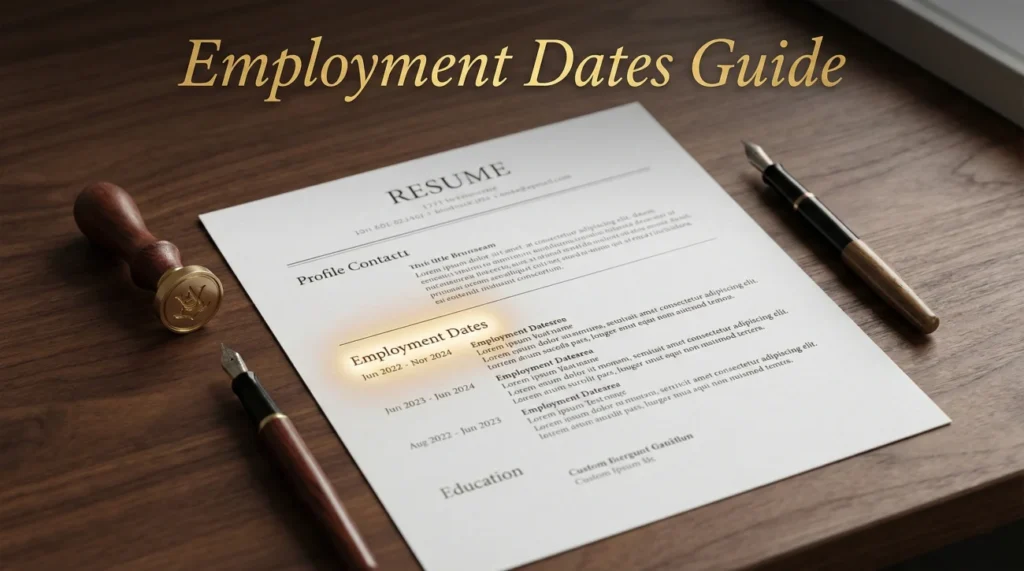
- Employment dates are a trust signal: The goal is to remove ambiguity, not to look “clever.”
- Pick one month-year style, keep it consistent, and handle edge cases with clear structure.
- Use the six examples to copy patterns for short stints, overlaps, internal promotions, and contract work.
Dates Are Not Decoration: They Are a Trust Signal
I have watched hiring managers scan a resume in seconds, and dates are one of the first places their eyes land. Not because they love math. Because dates answer a basic question: “Is this person giving me a clean, readable timeline, or are they trying to make me guess?”
If you are searching for how to list employment dates on resume, you are probably not asking for typography tips. You are trying to write dates that look normal, boring, and easy to verify. That “boring” feeling is the win.
Tip: Your date formatting should reduce questions, not create a new one. When a recruiter has to calculate, interpret, or “decode” your timeline, they become more skeptical, not less.
“If I have to do mental math to figure out how long someone stayed, I assume there is a reason they made it hard.”
The Date Rulebook Recruiters Actually React To
Most people think date formatting is about style. In practice, it is about clarity. Recruiters do not need perfection. They need a timeline that reads the same way across every role.
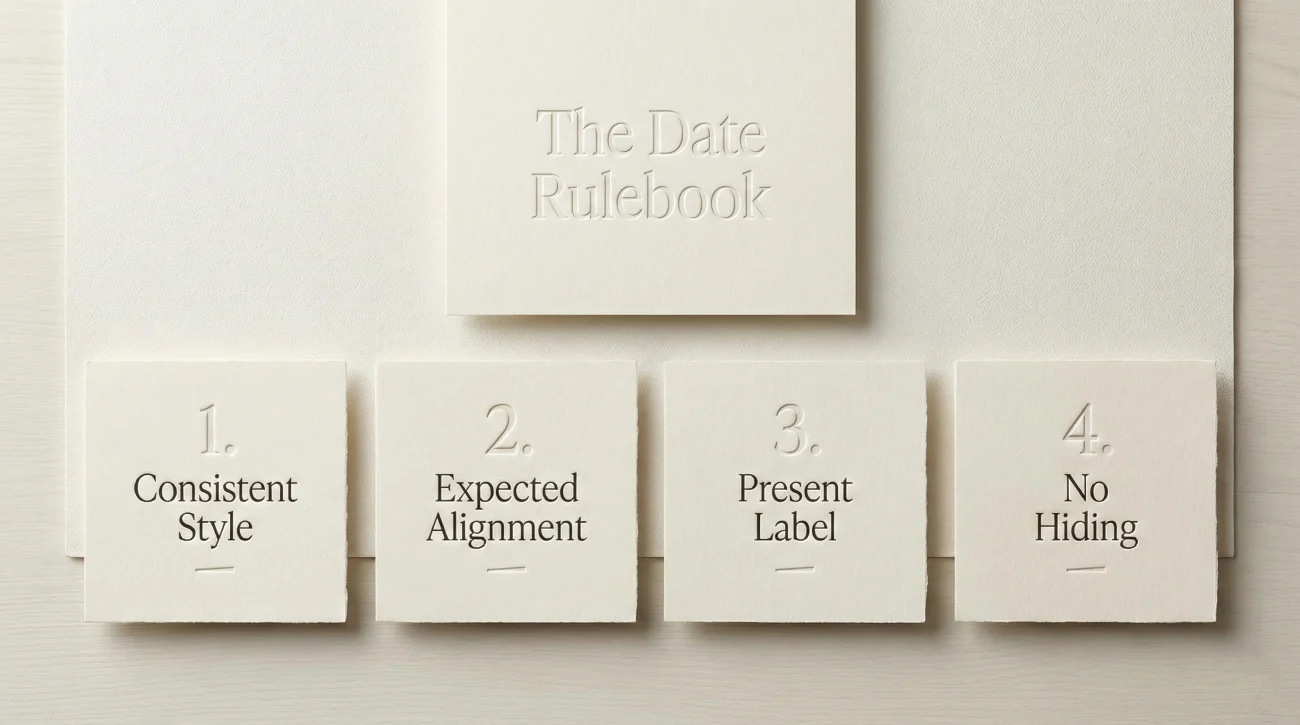
Rule 1: Pick One Month-Year Style and Use It Everywhere
The fastest way to look inconsistent is to mix formats. If one job says “Jan 2023” and another says “01/2021,” your resume starts to feel patched together. Choose one style and stick to it across roles, education, certifications, and any projects that include dates.
Two safe patterns that read cleanly are:
- Jan 2022 – Mar 2024
- 01/2022 – 03/2024
⚠️ Warning: Do not mix year-only with month-year in the same section unless you have a very deliberate reason. Most readers interpret mixed precision as selective hiding.
Rule 2: Put Dates Where the Eye Expects Them
Humans scan patterns. If dates jump around the page, the reader slows down. Keep dates aligned in the same position for every role. If your template uses right alignment, keep it right aligned. If it is inline, keep it inline. The goal is that the recruiter can skim your timeline without hunting.
This is also where resume employment dates format quietly matters. The “best” format is the one you can repeat without exceptions.
Rule 3: Current Role Always Ends With Present
For an active job, your end date should be “Present.” Not “Current.” Not “Now.” Not blank. Blank end dates look like an omission, even when you did not mean it that way.
Simple pattern:
[Start Month Year] - Present
Rule 4: Short Roles Should Be Clear, Not Disguised
People try to “smooth” short roles by removing months, but that often backfires. A year-only date can look like you are trying to stretch time. A cleaner approach is to keep month-year, then let your bullet points carry the credibility.
If a role was genuinely short but legitimate, the best defense is not hiding the length. It is showing why you were there and what you produced. You are answering the doubt before it becomes a question.
Key Point: A short stint looks less scary when the dates are clean and the impact is specific.
Edge Cases That Usually Trigger Suspicion
Most resumes are not messy because the person is messy. They are messy because real careers include overlaps, transitions, and internal moves. The trick is to format those moments so they read like a normal timeline.
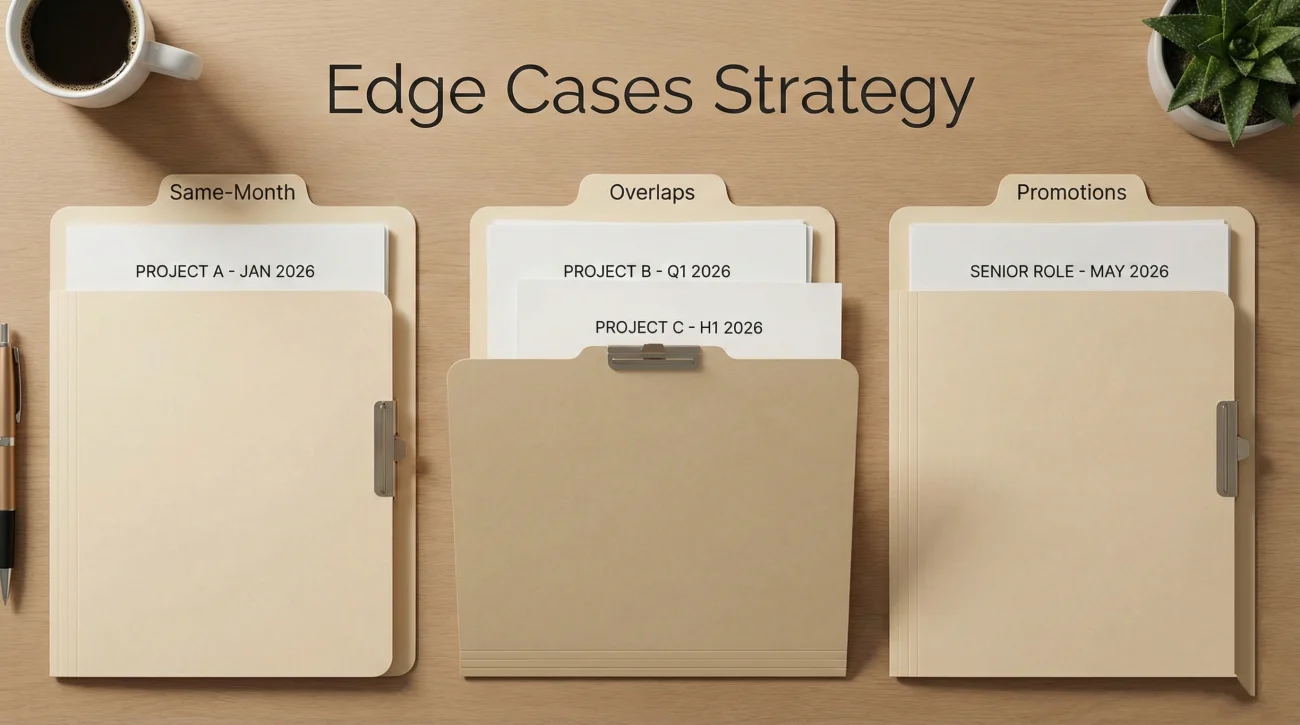
Same-Month Transitions: Do Not Create Weird Ranges
If you started and ended a role in the same month, writing “May 2023 – May 2023” looks strange. It screams “placeholder.” In that case, you have two cleaner options:
- Use a single month-year for that role: “May 2023”
- If it crossed months, even slightly, use the true range: “May 2023 – Jun 2023”
People worry that a single month looks too short. In reality, it looks more honest than a range that appears artificially padded.
Overlapping Jobs: Make It Read Like Two Tracks, Not a Lie
Overlaps happen. Part-time roles, consulting, freelance, or a transition period where the start date overlaps a resignation month. The danger is not the overlap itself. The danger is when your formatting makes it look accidental or contradictory.
Keep both roles in the same month-year style. Let the overlap stand, and make sure titles or labels tell the story clearly (Full-time vs Part-time, Contract vs Permanent). This is where resume date ranges should stay consistent, even when the timeline is not perfectly linear.
Internal Promotions: One Company, Two Roles, One Clean Story
Internal moves are a common place people accidentally create confusion. They list Company once, then stack titles without dates, or they list two jobs with dates that look like they overlap.
A clean approach is either:
- Company line with an overall range, then each title with its own sub-range
- Two separate entries under the same company, each with its own range, placed in sequence
The choice depends on your space and the importance of the promotion. If the promotion is a key proof point, give it its own dated line so it reads as progression, not formatting noise.
❌ Note: Do not “merge” dates in a way that quietly changes the truth. HR verification often checks start month and end month. A resume that looks like it is stretching time can cause a trust problem you did not need.
Six Date Examples You Can Copy Without Looking Weird
These are not fantasy examples. They are based on the kind of timelines I see when people are switching industries, taking contracts, getting promoted, or juggling work while finishing school. I am keeping them intentionally plain because “plain” is what reads credible.
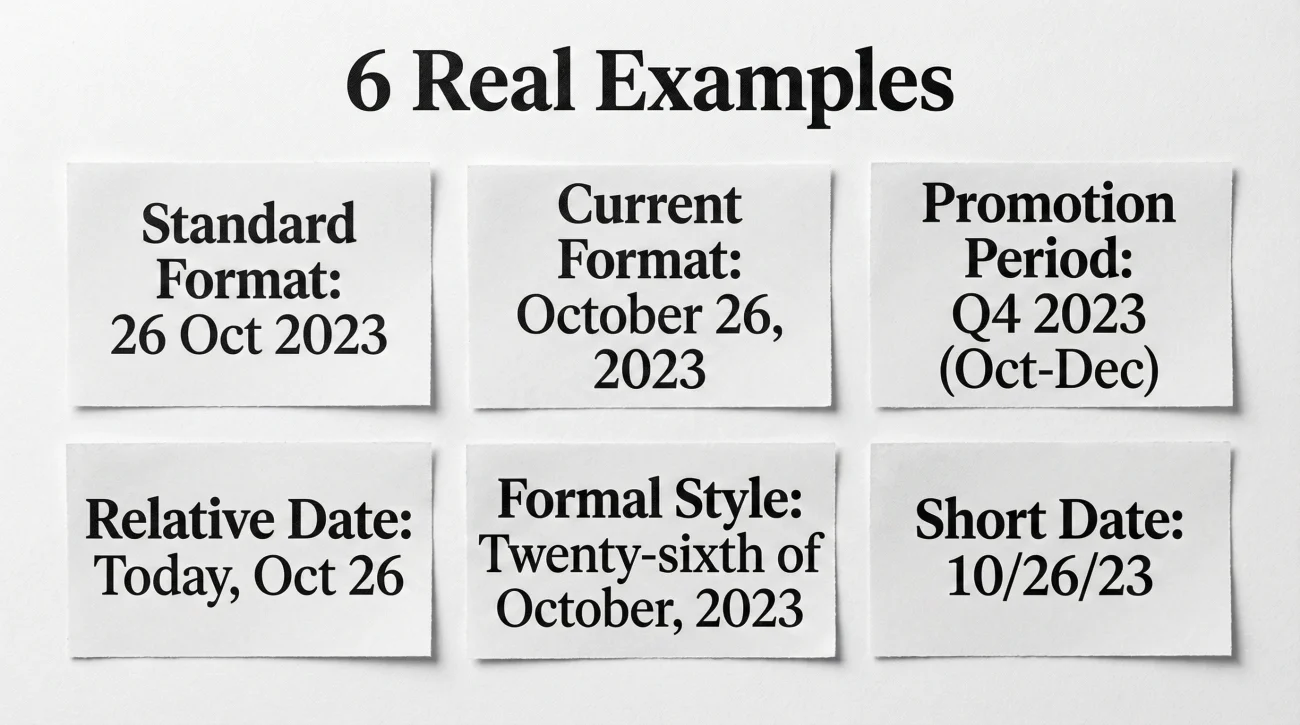
Example 1: Standard Role With Clean Range
Jan 2022 – Mar 2024
– Owned 120-account portfolio and reduced churn from 6.1% to 4.3% through onboarding redesign
– Built renewal playbook that shortened renewal cycle time by 18% across mid-market accounts
Example 2: Current Role
Apr 2024 – Present
– Automated weekly KPI reporting and reclaimed 5 hours per week for the team
– Standardized vendor scorecards to improve on-time delivery performance tracking
Example 3: Internal Promotion With Overall Company Range
Senior HR Generalist | Jul 2023 – Dec 2025
HR Coordinator | Feb 2022 – Jul 2023
– Led manager training rollout for 40 people leaders and improved policy compliance adoption
– Streamlined onboarding checklist and reduced first-week ticket volume by 22%
Example 4: Overlap With Part-Time Contract
– Owned email lifecycle updates and increased trial-to-paid conversion by 9%Contract Content Strategist (Part-time) | Jan 2024 – Jun 2024
– Built content briefs and refreshed legacy pages to improve qualified organic leads
This is where people often ask about job dates on resume when two roles overlap. The clean version is not to hide one role. It is to label it properly so the overlap reads as intentional.
Example 5: Project-Based Contract With Defined Range
– Consolidated CRM records and reduced duplicate contacts by 31% across sales and support pipelines
– Documented field mapping rules so the client could maintain data hygiene after handoff
If you are wondering how to write job dates on resume for contract work, the winning move is to show a range that matches the contract period and keep it in the same date style as everything else.
Example 6: Very Short Role Without Making It Look Like a Panic Exit
– Handled high-volume checkout and maintained accuracy during peak holiday weeks
– Trained two new hires on POS workflows and customer escalation basics
Short does not automatically mean suspicious. Short plus vague bullets is what creates the “What happened here?” reaction.
Common Date Mistakes That Make You Look Like You Are Hiding Something
I want to be careful here: Most of these mistakes are not “bad person” mistakes. They are “template” mistakes. But recruiters read them as signals anyway.
| What You Do | What It Can Signal |
|---|---|
| Mix month-year and year-only within Experience | You are being selective about precision, which can look like hiding short stints |
| Leave end date blank on current role | An omission, or a resume that was not carefully reviewed |
| Use inconsistent separators (to, until, random punctuation) | The timeline feels messy, and the reader has to decode it |
| Write “2023 – 2024” for a role that could be 2 months | Ambiguity, which often triggers follow-up questions |
| Put dates in different places for different jobs | The resume feels stitched together, not controlled |
A Quick Self-Check Before You Hit Submit
Run your eyes down the page and answer these three questions:
- Do all dates use the same format from top to bottom?
- Can someone skim your timeline without stopping to calculate durations?
- Would an employment verification call match what you wrote?
If the answer is yes, your dates are doing their job: They are staying out of the way while your impact does the talking.
Final: The Goal Is a Timeline That Feels Uninteresting
The irony is that the best date formatting is the kind nobody notices. When dates look clean, consistent, and easy to read, the recruiter moves on to what actually matters: Your role clarity, your bullets, and whether your story holds together.
If you want a simple north star for how to list employment dates on resume, it is this: Remove ambiguity. Do not try to “outsmart” the reader. Make the timeline feel like it can be verified in one glance, because in many processes, it will be.
That is how you keep dates from becoming the most memorable part of your resume.
❓ FAQ
🧭 Should I list months for every job?
Most of the time, yes. Month-year reduces ambiguity and reads like a normal employment timeline. If you decide to use year-only for older roles, keep that choice consistent and avoid mixing precision in the same section.
🔎 Can I write year-only to make short jobs look better?
Be careful. Year-only often creates more suspicion because the reader cannot tell whether the role was two months or twenty months. If a role was short, a clearer approach is month-year plus strong, specific bullets.
🧩 What do I do if two roles overlap?
List both roles with the same date style and label them clearly (Part-time, Contract, Freelance). Overlap is not automatically a problem. Confusing formatting is.
📌 How should I write dates for internal promotions?
Either show one overall company range and give each title its own sub-range, or list two separate entries under the same company in sequence. Choose the structure that makes progression obvious and keeps the timeline readable.
🧼 Is it okay to use different date formats for education and work?
It is better to keep a single pattern across the whole resume. When education uses a different style, it can look like the document was assembled from different templates.
🧠 What is the biggest date mistake that triggers recruiter doubt?
Inconsistency. Mixed formats, missing end dates, or ambiguous year-only ranges force the reader to guess. The moment they guess, they start looking for what might be hidden.
⚠️ Disclaimer: ResumeSolving provides resume, cover letter, job search communication, and career transition guidance for informational purposes only. Hiring practices vary by employer, role, location, industry, and individual circumstances. We do not guarantee interviews, job offers, ATS results, or other outcomes. Verify employer requirements directly and follow applicable laws and workplace policies. For sensitive situations, use only information you are comfortable disclosing and keep all statements accurate.