- “Modernize” is less about fancy words and more about swapping old signals (self-praise, responsibility-only) for evidence.
- Use the 20-phrase replacement table to update Summary and bullets without sounding robotic.
- Run a 6-second self-check: If a line could fit any job, it is probably dated wording.
The Real Problem With “Old-Sounding” Resume Language
I can usually tell when a resume has not been touched in years, even before I see dates. It is the tone. The “objective.” The confident-but-empty adjectives. The bullet points that describe duties like a job posting instead of outcomes.
A candidate named Juliette once sent me a resume that started with: modernize resume wording as her goal. She had the right instinct, but her edits were mostly synonyms. “Responsible for” became “accountable for.” “Seasoned professional” became “experienced professional.” It still read like an older template, just with new paint.
This guide fixes the deeper layer: The phrases that quietly signal “dated,” and the modern alternatives that keep your meaning while making your work feel current, specific, and hireable.
Why Wording Ages a Resume Faster Than Dates
Language is a timestamp
Hiring managers do not consciously think, “This person is older.” They react to signals. Some signals are visual (layout, fonts, heavy formatting). Others are linguistic. Certain phrases were popular in older resume advice, older corporate culture, or older job boards. When those phrases show up today, they can create a subtle mismatch: “This person might not be current.”
I have seen this play out with two people who had almost the same background. Russell, a strong operations lead, wrote: “Proven track record of success.” Naomi wrote: “Reduced cycle time by 18% across two plants by standardizing handoffs.” Same competence. Different signal. One sounds like an era. The other sounds like evidence.
Modern wording is evidence-first, not adjective-first
Modern resumes still use confident language. The difference is where the confidence comes from. Instead of “dynamic,” “results-driven,” or “go-getter,” modern resumes show a result, a scope, or a decision you owned. That shift matters because recruiters are reading quickly, and ATS screening pushes you toward concrete nouns and verbs anyway.
💡 Pro Tip: If a line is true but could be copied into 50 other resumes without changing a word, it is usually dated wording.
The 3 Types of Dated Wording That Hurt You Most
| Type | How it sounds | What it signals | Modern direction |
|---|---|---|---|
| Template lines | Objective, references, “seeking a challenging role” | Old resume norms | Replace with role fit and measurable focus |
| Self-praise adjectives | Seasoned, dynamic, hardworking, go-getter | Claims without proof | Show evidence, scope, outcomes |
| Responsibility-only bullets | Responsible for, duties included, worked on | Job description, not contribution | Verb + object + result + context |
Most “resume buzzword” articles focus on the second type. The bigger win, especially for senior professionals, is fixing the first and third types. That is where your resume starts to feel modern without trying too hard.
Rules for Updating Wording Without Sounding Like a Bot
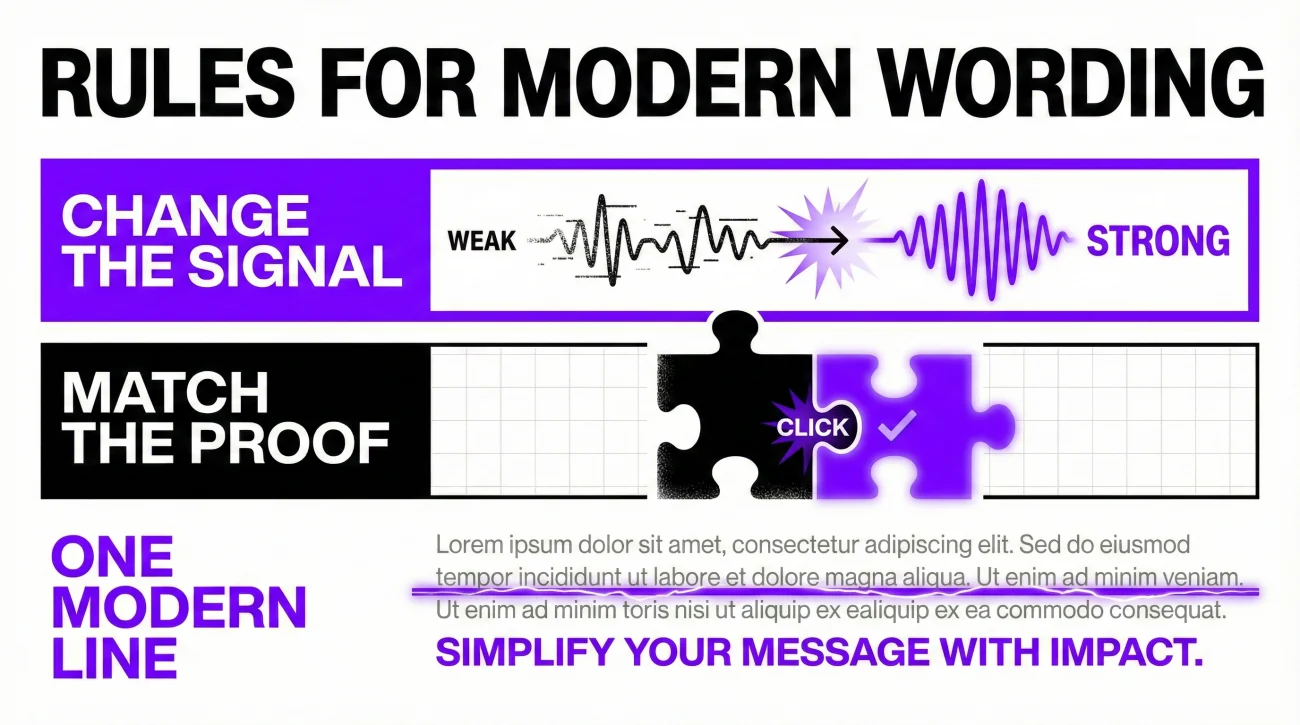
Rule 1: Keep the meaning, change the signal
If you were “responsible for vendor management,” the meaning is ownership. The dated signal is the phrase. Modern wording keeps the ownership but adds a concrete object or result: “Owned vendor scorecards and cut late deliveries from 14% to 6%.”
Rule 2: Choose proof that matches your level
Entry-level proof can be volume, accuracy, turnaround time, or customer metrics. Mid-level proof can be process improvements, cross-team execution, or measurable project outcomes. Senior-level proof can be decisions, tradeoffs, business impact, and scale.
Rule 3: One modern line beats ten “modern words”
It is easy to over-edit and end up with corporate AI language. Keep it simple. Plain verbs, clear nouns, specific outcomes. If a line feels like a slogan, rewrite it as a fact.
[Strong Verb] + [Specific Object] + [Result] + [Scope or Constraint]
⚠️ Warning: Swapping words only in the Summary while leaving duty-bullets untouched creates a weird split personality. Recruiters feel it even if they cannot name it.
Modernize Your Resume Wording: 20 Dated Phrases and Better Replacements
| Dated phrase | Modern replacement | Best place to use it |
|---|---|---|
| Objective: | Summary focused on role fit and outcomes | Top of resume |
| Seeking a challenging position | Target role + value: “Product Ops lead focused on cycle time and adoption” | Summary |
| References available upon request | Remove it | Delete |
| Seasoned professional | Role-specific identity: “Operations leader” or “Finance partner” | Summary |
| Proven track record | One concrete win: “Delivered X, improved Y, reduced Z” | Summary |
| Results-driven | Result shown: “Grew retention 9 points” | Summary or bullets |
| Team player | Collaboration shown: “Partnered with Sales and CS to…” | Bullets |
| Hardworking | Reliability shown: “Handled 40 tickets/day with 98% SLA” | Bullets |
| Go-getter | Initiative shown: “Started X, shipped Y, saved Z” | Bullets |
| Excellent communication skills | Communication artifact: “Wrote weekly stakeholder updates for…” | Bullets |
| Responsible for | Owned, led, built, implemented, improved | Bullets |
| Duties included | Delivered, executed, reduced, launched | Bullets |
| Worked on | Shipped, deployed, redesigned, negotiated | Bullets |
| Assisted with | Supported by doing X: “Supported launch by…” | Bullets |
| Tasked with | Owned end-to-end, led cross-functional work | Bullets |
| Successfully managed | Managed with proof: scope + outcome | Bullets |
| Synergy / cross-pollination | Plain language: “Aligned Marketing and Product on…” | Bullets |
| Think outside the box | Describe the decision: “Reframed X, tested Y, chose Z” | Bullets |
| Detail-oriented | Quality metric: “Cut errors from X to Y” | Bullets |
| Microsoft Office (as a highlight) | Use only if relevant: “Excel modeling for…” | Skills or bullets |
Notice what the replacements do: they move you from “I am good” to “Here is what I did.” That is the fastest modernization available.
Before and After: Five Bullet Rewrites That Instantly Sound More Modern
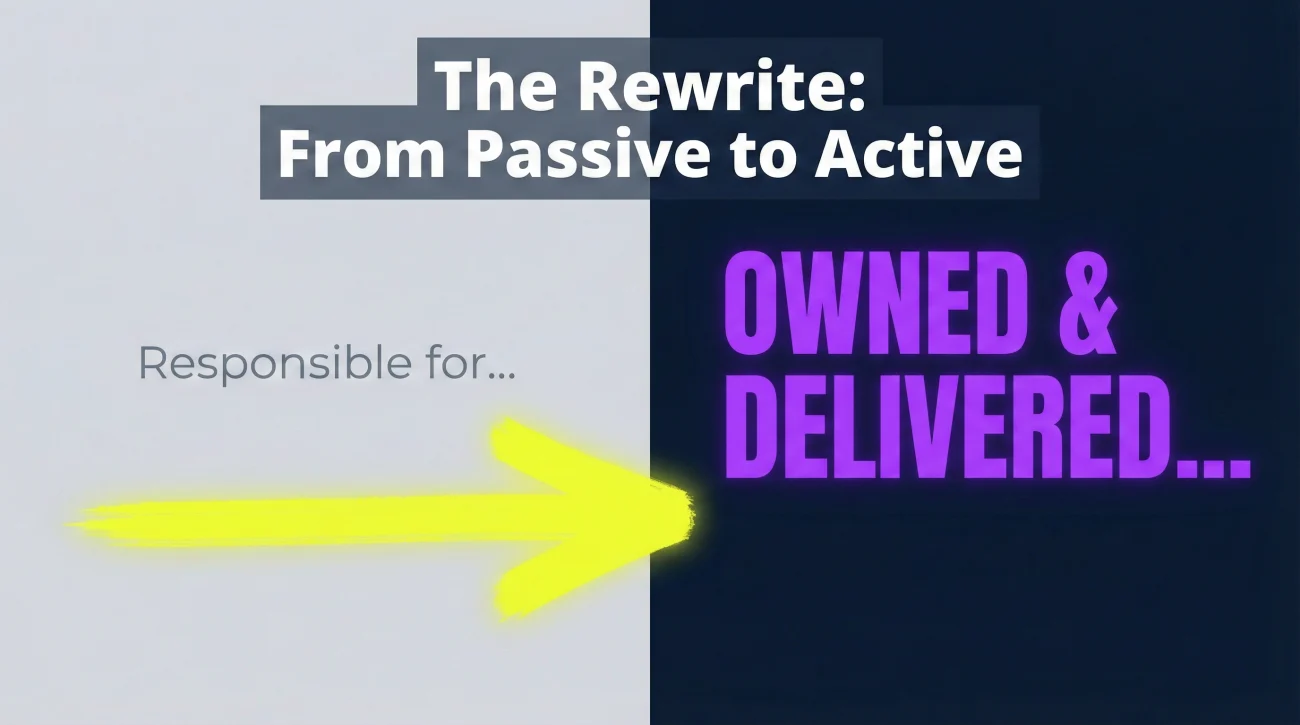
Example 1: Operations
- Before: Responsible for inventory management and vendor coordination.
- After: Owned inventory reorder points across 3 SKUs and cut stockouts by 22% by tightening vendor lead-time tracking.
The “after” version keeps the meaning (ownership), but adds scope and outcome. Even if your numbers are estimates, you can often state direction and scope honestly: fewer delays, faster turnaround, reduced rework.
Example 2: Customer Support
- Before: Handled customer inquiries and resolved issues.
- After: Resolved 35 to 50 tickets per day across billing and product issues while maintaining a 4.7/5 CSAT average.
This is not “modern wording” because of fancy verbs. It is modern because it reads like a measurable contribution.
Example 3: Project Management
- Before: Worked on multiple projects with cross-functional teams.
- After: Led a 6-week migration with Product, Eng, and CS, shipping in two phases to avoid downtime and hitting the deadline.
Words like “multiple” and “cross-functional” are not bad, they are just empty without a shape. Give one project a shape.
Example 4: Marketing
- Before: Results-driven marketer with strong communication skills.
- After: Improved lead-to-demo conversion from 2.1% to 3.0% by rewriting landing page messaging and tightening audience targeting.
When people ask me how to “sound confident” without buzzwords, this is the answer: put the confidence inside the result.
Example 5: Finance
- Before: Assisted with monthly reporting and forecasting.
- After: Built monthly reporting pack and supported forecast refresh by reconciling variance drivers and flagging risks two weeks earlier.
“Assisted with” is not automatically wrong. It becomes modern when you show what you did inside the support.
Words That Quietly Trigger Age Signals and What to Use Instead
The trap is not experience, it is how you label it
Most older-worker clients I have supported are not losing roles because of competence. They lose attention because the resume accidentally labels them in a way that invites stereotypes.
If your Summary opens with “seasoned,” “veteran,” or “over 20 years,” you are giving the reader an identity label before you give them a business reason. Swap identity labels for role labels, then lead with what you do now.
🗝️ Key Point: Your years are not the hook. Your current-value evidence is the hook.
Safer patterns that still respect your seniority
- Use scope instead of years: “Led teams of 8 to 20 across multi-site operations.”
- Use complexity instead of tenure: “Owned pricing strategy across 4 regions.”
- Use change instead of nostalgia: “Modernized reporting from manual to automated monthly pack.”
- Use decision signals: “Set priorities, aligned stakeholders, removed blockers.”
❌ Note: Avoid “old-fashioned resume wording” by deleting identity adjectives first. They are the fastest giveaway, and they rarely help ATS matching.
A 6-Minute Self-Check to Make Your Resume Sound Modern
Pass 1: Highlight lines that could belong to anyone
Print your resume or view it in a plain text editor. Highlight any line that could be pasted into another person’s resume without changing facts. Those are your modernization targets.
Pass 2: Convert “claims” into “receipts”
For each highlighted line, choose one receipt:
- ✅ A number: Volume, percentage, dollars, time saved
- ✅ A scope: Team size, regions, product lines, customers served
- ✅ A constraint: Tight timeline, budget cap, compliance rule
- ✅ A decision: Tradeoff made, priority set, risk reduced
Pass 3: Do a “read-aloud cringe test”
If you read a sentence aloud and it sounds like a motivational poster, rewrite it as a report. This is how you avoid “make resume sound modern” edits that drift into robotic corporate language.
💡 Pro Tip: If your resume sounds too polished, remove half the adjectives and add one concrete noun per bullet.
Final
The point of “modern wording” is not to impress. It is to remove doubt. When your resume language is current, specific, and evidence-led, the reader stops guessing and starts trusting. If you want a broader view of what “current” looks like in today’s screening reality, tie your updates back to the bigger rules in modernize resume wording and keep your edits simple, human, and provable.
❓FAQ
🎯 How many “modern” changes should I make at once?
Enough to remove the biggest dated signals first: Objective, references line, identity adjectives, and “responsible for” bullets. After that, focus on your top 6 to 10 bullets that matter most for the role.
🧠 Will removing buzzwords hurt ATS matching?
Usually the opposite. ATS matching improves when you keep role keywords as nouns and show them through actions and outcomes. Replace vague adjectives with concrete tools, processes, and deliverables that actually match job descriptions.
🧩 What if I do not have metrics for my bullets?
Use scope and specificity instead: volume ranges, typical turnaround time, customer segments, team size, regions, or the constraint you operated under. A precise “what” often reads more modern than a fake number.
📌 Is “experienced professional” also dated?
It is not always wrong, but it is usually weak. If you want a senior signal, use role and scope: “Program manager leading multi-team delivery” or “Finance partner for a $XM portfolio.”
🚫 Should I delete all soft-skill words like “collaborative”?
Do not delete the idea, delete the label. Instead of “collaborative,” show the collaboration: “Partnered with Legal and Sales to…” That keeps the soft skill without sounding like a template.
⚠️ Disclaimer: ResumeSolving provides resume, cover letter, job search communication, and career transition guidance for informational purposes only. Hiring practices vary by employer, role, location, industry, and individual circumstances. We do not guarantee interviews, job offers, ATS results, or other outcomes. Verify employer requirements directly and follow applicable laws and workplace policies. For sensitive situations, use only information you are comfortable disclosing and keep all statements accurate.