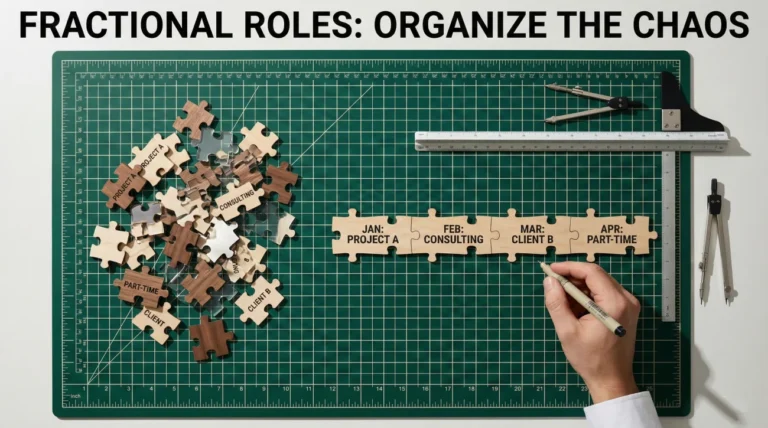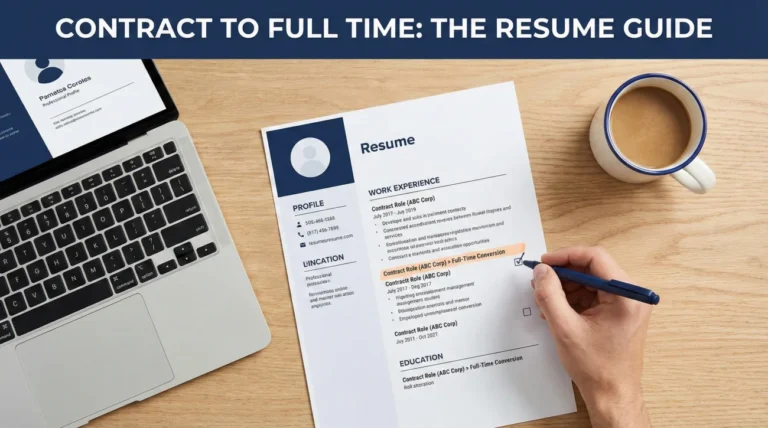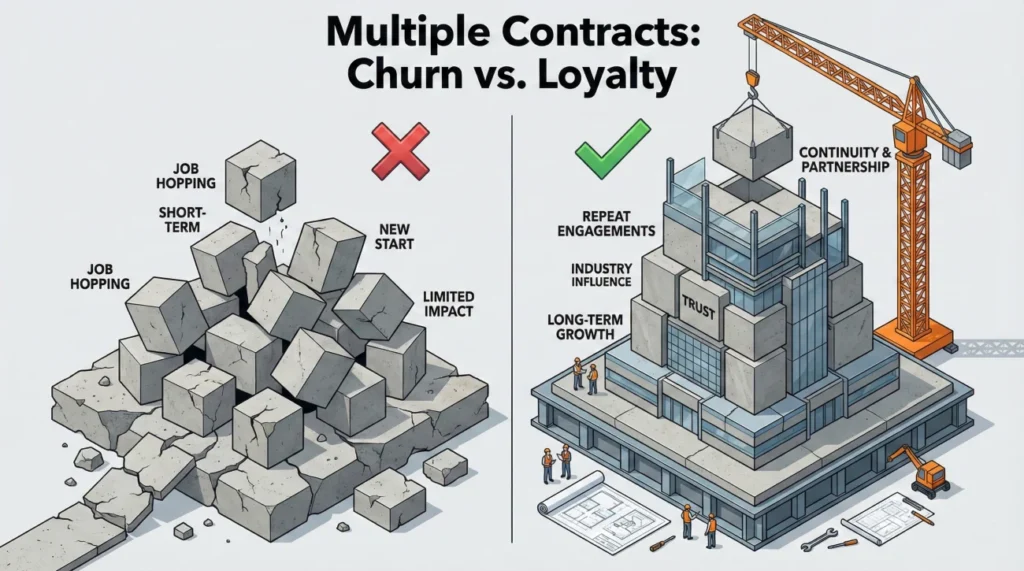
- If your resume shows repeated short stints, you need a format that signals continuity without hiding the contract nature.
- Pick one of three patterns based on who paid you (agency vs client), how similar the work was, and whether there were gaps between engagements.
- Use stable date logic, a clean labeling line, and proof-heavy bullets so recruiters see “trusted re-engagement” instead of churn.
When the Same Company Keeps Rehiring You, Your Resume Should Not Look Like You Kept Getting Fired
There’s a very specific kind of resume anxiety I see in contract-heavy careers: You did good work, the same company kept calling you back, and yet your timeline looks like a string of breakups.
The keyword people type into Google is blunt for a reason: multiple contracts same company resume. They are not asking for “general contract advice.” They are asking how to stop the churn vibe.
One candidate I worked with, Bethany, had four separate contracts with the same fintech over two years. Each contract was real, each ended cleanly, and every time the team asked her back. But her resume listed four separate entries with near-identical bullets. A recruiter told her, off the record, “It reads like they kept trying you out.” That was not the story at all.
In this guide, I’ll show you three patterns that make repeated engagements read like what they usually are: trust, continuity, and a proven track record.
Why Recruiters Misread Repeated Contracts at the Same Company
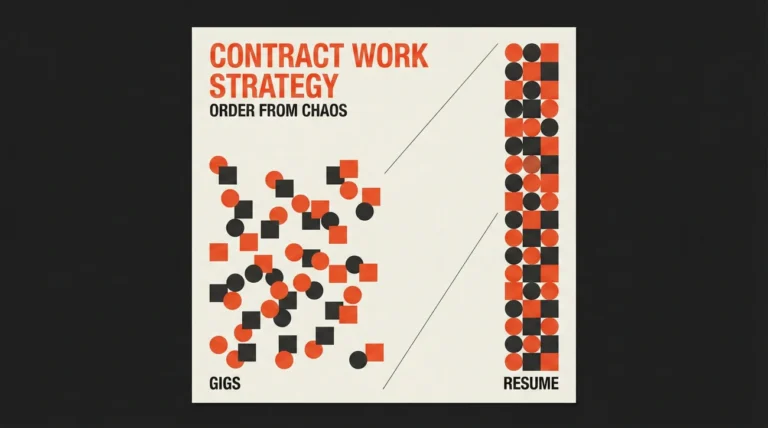
When recruiters scan fast, they do not run a full investigation. They match shapes. Multiple short entries at the same company creates a familiar shape: churn. Your job is to change the shape without changing the truth.
The 3 silent fears behind the churn reaction
Fear 1: You were not retained. If the same client appears repeatedly, some readers assume the team kept ending the relationship.
Fear 2: Your employer-of-record is unclear. If you were paid by an agency but you list the client as the employer, it can get messy later.
Fear 3: Your role scope looks unstable. Repeated titles with repeated bullets looks like padding, even if it was genuinely similar work.
Key Point: You do not “fix” this by adding more words. You fix it by choosing the right structure, then proving impact inside that structure.
The honesty line you should not cross
I’ve seen offers wobble at the end because a resume implied direct employment when the legal employer was a staffing firm. Oscar, a contractor in healthcare IT, listed only the hospital system name because he worked on-site and had a badge. During verification, the hospital could not confirm him as an employee, because payroll was through the vendor. It turned into a stressful “explain yourself” moment that did not need to exist.
⚠️ Warning: If an agency paid you, your resume can still spotlight the client. Just do it in a way that stays verifiable.
Pick the Right Format: 3 Patterns That Work in Real Hiring
You do not need a fancy template. You need a format that matches your reality. Below are three patterns I keep using because they survive both recruiter scanning and verification later.
| Pattern | Best when | Main benefit | Main risk if done wrong |
|---|---|---|---|
| Umbrella “Client Entry” with projects inside | You were re-engaged multiple times by the same client, similar scope | Looks stable and intentional | Can hide employer-of-record if you label it poorly |
| Single company entry with stacked engagement lines | You were hired directly as an independent contractor or fixed-term | Keeps dates clean and readable | Can still look like churn if the date logic is messy |
| Agency employer entry + “Client” sub-line | Agency paid you, client kept bringing you back | Verifiable, transparent, still tells continuity | Can look junior if you let the agency name dominate the story |
A quick rule that prevents 80% of mistakes
If payroll and tax forms came from the agency, list the agency as the employer. If you were paid directly by the company (1099 or fixed-term contract), list the company. Then, use the pattern to show continuity.
Pattern 1: One Umbrella Entry That Says “Multiple Engagements” (Cleanest for Repeat Projects)
This is the pattern I use when the work is essentially the same relationship, just broken into separate SOWs or budget windows. It also works nicely when the keyword in your head is multiple contracts same company, because the resume visually reads that way too.
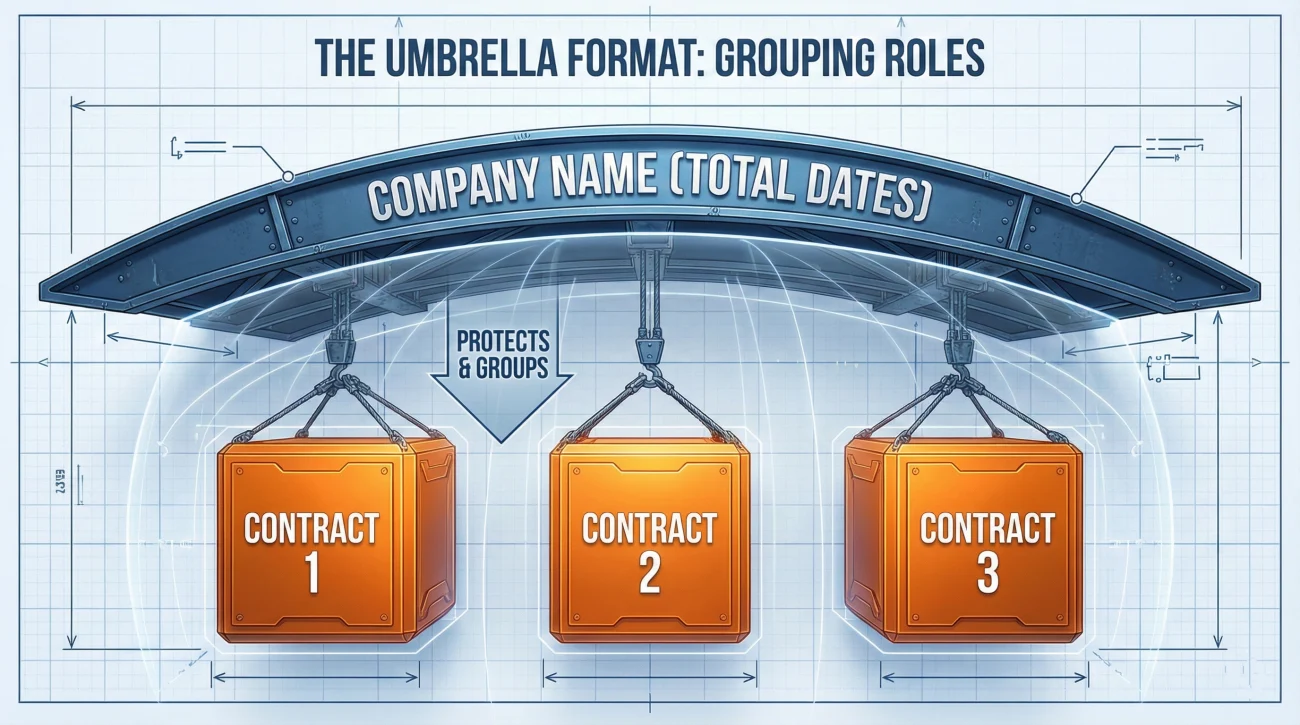
How it looks on the page
Jan 2023 – Oct 2025
– Owned release readiness across 6 launches, reducing post-release incidents by 28%
– Built weekly KPI dashboard for leadership, cutting reporting turnaround from 3 days to 1 day
– Coordinated cross-team handoffs for 3 squads across 2 time zones with documented decision logs
– Partnered with Compliance to operationalize new policy rollout without delaying roadmap
What to write in the label line so it feels normal
Your first line does the heavy lifting. Avoid dramatic language. Keep it boring and verifiable: “Multiple Contract Engagements,” “Repeated Engagements,” or “Contract Extensions.”
One clean way to integrate the long-tail people actually search is to keep it in your own notes, then write a simple version on the resume. If you want to echo it gently, your label can support contract extensions resume without sounding defensive.
When NOT to use this pattern
If you switched departments, had clearly different titles with different scope, or there is a compliance reason to separate each engagement, do not force the umbrella. In those cases, Pattern 2 is safer.
“I keep getting invited back, but my resume makes it look like I keep leaving. I don’t want to explain my whole contract history in the first 6 seconds.”
Pattern 2: Same Company, Stacked Engagement Lines (Best When Scope Shifted Slightly)
This pattern keeps the company as a single anchor, but acknowledges distinct contracts. It is perfect when there were meaningful shifts, but you still want one consolidated story.

How it looks on the page
Engagements: Mar 2022 – Sep 2022, Jan 2023 – Jun 2023, Oct 2023 – May 2024
– Rebuilt vendor intake workflow, reducing cycle time by 35%
– Created SOP library used by 20+ stakeholders across Operations and Finance
– Led post-mortems for recurring handoff failures and implemented prevention checks
Date logic that looks stable, not chaotic
Notice what we did not do: we did not list three separate job entries with three separate bullet lists. We kept one set of bullets, then used “Engagements:” to hold the truth.
If there was a one-month gap between engagements, do not try to disguise it. A short gap is normal in contract work. What matters is that your bullets show why they asked you back.
How to avoid repeated bullets across engagements
Your bullets should summarize the most credible work across the full relationship. If you need to clarify the evolution, add one bullet that signals progression, like: “Expanded scope from reporting to workflow redesign.” One is enough.
💡 Pro Tip: If you fear it still reads like churn, add a single, calm bullet: “Re-engaged for new phase of rollout based on prior delivery.” Not more than once.
Pattern 3: Agency as Employer, Client as Proof (Most Verifiable)
This is the pattern I recommend when a staffing agency paid you, but the same client kept requesting you. It is also the pattern that prevents the “verification mismatch” headache.
How it looks on the page
Client: Horizon Retail (Repeated Engagements) | Apr 2021 – Dec 2023
– Delivered inventory reconciliation improvement that reduced shrink variance by 18%
– Built forecasting spreadsheet model adopted by regional managers across 12 stores
– Coordinated weekly updates with Ops and Finance, keeping owners and deadlines visible
How to keep it from feeling “less than”
Agency naming only feels junior when the bullets are weak. Your bullets should scream “they trusted me repeatedly,” not “I was placed somewhere.” Make the client line a proof line, not a branding line.
What to do when an application form asks for “employer”
Match what will be verified. If the employer-of-record was the agency, use the agency name in the form. Your resume can still show the client relationship clearly in the experience section.
10 Bullet Examples That Make Repeated Engagements Look Like Trust
Below are bullets you can adapt. They are written to make repeated contracts feel like “repeatable delivery.” Use numbers when you have them, but do not force fake precision.
- Re-engaged for subsequent rollout phases after delivering the initial implementation on schedule
- Owned weekly stakeholder updates and decision logs, reducing repeated debates and rework
- Standardized handoff documentation across teams, cutting onboarding time for new contributors
- Built KPI reporting that leadership reused each quarter to track operational performance
- Resolved recurring process failures and introduced prevention checks to reduce incidents
- Expanded scope from execution support to workflow redesign based on prior delivery quality
- Partnered with Legal and Compliance to operationalize policy changes without delaying delivery
- Led post-project retrospectives and translated findings into SOP updates used across the org
- Improved cross-functional coordination across time zones with clear owners, dates, and status visibility
- Delivered project outcomes across multiple engagement windows with consistent stakeholder satisfaction
If your fear is that your history looks like job hopping, this is the exact moment to avoid defensive wording. The bullet style should quietly support repeated contracts resume without you needing to say “I promise I was not fired.”
Do-Not-Do List: The Mistakes That Create Red Flags
- ❌ Listing the client as your employer if an agency paid you, then hoping nobody checks
- ❌ Copy-pasting the same bullet list under three separate contract entries
- ❌ Writing “Contract renewed 5 times” as if you are arguing with the reader
- ❌ Using inconsistent date formats that make the timeline look broken
- ❌ Over-labeling everything with “short-term” language that triggers churn assumptions
- ❌ Hiding gaps by rounding dates in a way that creates overlap confusion
❌ Note: If your formatting makes a recruiter stop and calculate your dates, you already lost the scan. Your resume should be readable without math.
Mini Scripts for Interviews: Explain It Once, Then Move On
Even with a great resume format, you may get one question. The goal is to answer cleanly, then pivot back to impact.
Script for “Why so many stints at the same company?”
“It was a contract relationship with multiple engagement windows. They brought me back for new phases because the earlier work landed well. The scope stayed consistent, and I can walk you through the outcomes.”
Script for “Were you employed by the agency or the client?”
“Payroll was through the agency, and I was staffed with the client team. On my resume I show the client context because that’s where the work happened, but I keep it verifiable.”
Script for “What happened between engagements?”
“Between contracts I wrapped deliverables, stayed available for follow-up, and then re-engaged when the next project phase was approved. That gap was normal contract timing, not performance related.”
Final: Make “They Called Me Back” the First Impression
If the same company kept rehiring you, that is usually a good signal. Your resume just needs to present it as a relationship, not a series of endings.
The best resumes in this situation are calm. They use one of the three patterns, they keep dates readable, and they let proof-heavy bullets do the talking. No drama. No over-explaining.
When you format it correctly, multiple contracts same company resume stops being a problem you hide, and starts being a credibility signal: You delivered, so they asked for you again.
❓ FAQ
🎯 Should I list each contract separately if it was the same client?
If the scope and team were mostly consistent, grouping under one umbrella entry is usually clearer. List separately only when titles and responsibilities changed enough that a single bullet set would be misleading.
🧾 What if a staffing agency paid me but I worked inside the client company?
Use the agency as the employer-of-record, then add a “Client:” line for context. This keeps your resume verifiable while still showing the real environment where you delivered results.
🗓️ How do I show gaps between engagements without creating red flags?
Do not hide short gaps. Instead, keep engagement dates accurate and focus your bullets on outcomes that explain why you were re-engaged. Most recruiters accept normal contract timing when the impact is clear.
🧠 Will grouping contracts confuse ATS systems?
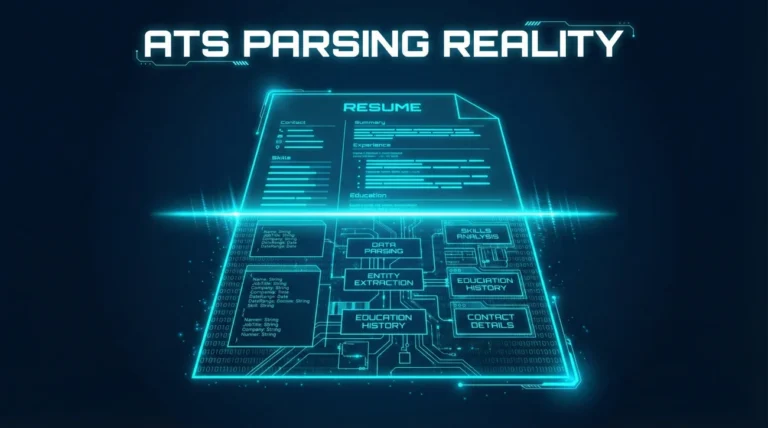
Most ATS tools handle a single consolidated entry well, especially if the company name, role, and date range are clear. Avoid overly creative formatting and keep the structure simple and scannable.
✅ What is the safest wording to signal repeat work without sounding defensive?
Use neutral labels like “Multiple Engagements,” “Repeated Engagements,” or “Engagements:” followed by date ranges. Let your bullets show the trust signal instead of claiming it.
⚠️ Disclaimer: ResumeSolving provides resume, cover letter, job search communication, and career transition guidance for informational purposes only. Hiring practices vary by employer, role, location, industry, and individual circumstances. We do not guarantee interviews, job offers, ATS results, or other outcomes. Verify employer requirements directly and follow applicable laws and workplace policies. For sensitive situations, use only information you are comfortable disclosing and keep all statements accurate.