- For most senior candidates, two pages is not “extra”, it is the minimum space needed to show scope, leadership, and outcomes without cramming.
- The real risk is not length. The risk is looking unedited. Page two must earn its keep with proof that changes a hiring decision.
- Use the decision rules and trimming checklist in this guide to choose the right length and tighten the story fast.
Why Resume Length Gets Weird at Senior Level
I have reviewed a lot of leadership resumes where the candidate was clearly strong, but the document quietly worked against them. The pattern was almost always the same: They had enough impact to deserve space, yet the resume read like a running diary.
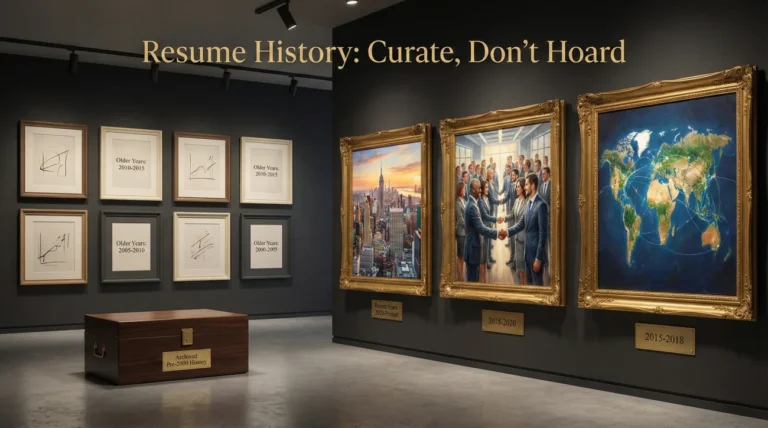
That is why resume length for senior professionals is not a “one page vs two page” argument. It is a density problem. If a hiring team can feel that you edited, prioritized, and made tradeoffs, they trust your judgment. If they feel you dumped everything, they worry you will do the same in the role.
💡 Pro Tip: Think of page two as a business case. If it does not change the decision, it should not exist.
What Actually Happens When Someone “Reads” a Senior Resume
Senior resumes are rarely read top to bottom on the first pass. In most companies, the first pass is a skim that answers four questions: What level are you really, what scale have you operated at, what outcomes did you drive, and does your recent work match the role they need filled.
Here is the uncomfortable part: If the first page looks like it is trying to squeeze 18 years into tiny text, the skim gets worse, not better. The reader assumes the resume is going to be hard work. They stop giving you benefit of the doubt.
Key Point: Two pages is often fine for senior roles, but only when page one stays scannable and page two adds proof instead of repeating history.
A colleague of mine, Victoria, runs recruiting for a mid sized SaaS company. She once told me she does not mind page two. She minds page two that starts a brand new story the reader did not agree to. That is the “second page contract”: The first page must set up why the second page is worth it.
Decision Rules to Pick 1 Page, 2 Pages, or a Clean Alternative
If you are searching how many pages should a senior resume be, you probably want a rule you can apply in five minutes. Use these six questions. Answer honestly, not aspirationally.
| Decision question | If “Yes” | If “No” |
|---|---|---|
| Do you have 10+ years of relevant leadership scope for this target role? | Two pages is a normal starting point. | One page is usually enough. |
| Does page two contain outcomes at scale, not older job descriptions? | Keep page two. | Collapse earlier roles and cut bullets. |
| Are your most impressive wins from the last 5 to 7 years? | Make them dominate page one. | Rewrite to show recent relevance or risk looking dated. |
| Do you need space for regulated, research, patents, publications, or complex deal sheets? | Consider a resume plus a separate addendum. | Do not use this as permission to go long. |
| Is your current role clearly aligned with the job you want next? | Two pages can work cleanly. | Long resumes amplify confusion, shorten and reframe. |
| Would a stranger understand your level in 15 seconds on page one? | You earned the right to page two. | Fix page one before touching length. |
⚠️ Warning: If your second page begins with low impact bullets from 12 years ago, you are not using two pages. You are using clutter.
When a Two Page Resume Is the Best Choice for Senior People
I have seen a two page resume for executives work beautifully when the candidate uses page two for proof that a hiring manager cares about: transformation, revenue, cost control, risk reduction, org design, and cross functional leadership.
One example: Hailey was a Director of Operations with 16 years in manufacturing and a recent pivot into automation. Her original resume was three pages because she listed every plant project she ever touched. We made a deal: Page one would sell her “today”, page two would support it with only the projects that proved scale and change leadership. Everything else went into one short “Selected Earlier Projects” line.
Three weeks later she told me the feedback she kept hearing in screens was: “Your resume made it easy to see your scope.” That is the goal. Not “fit everything”.
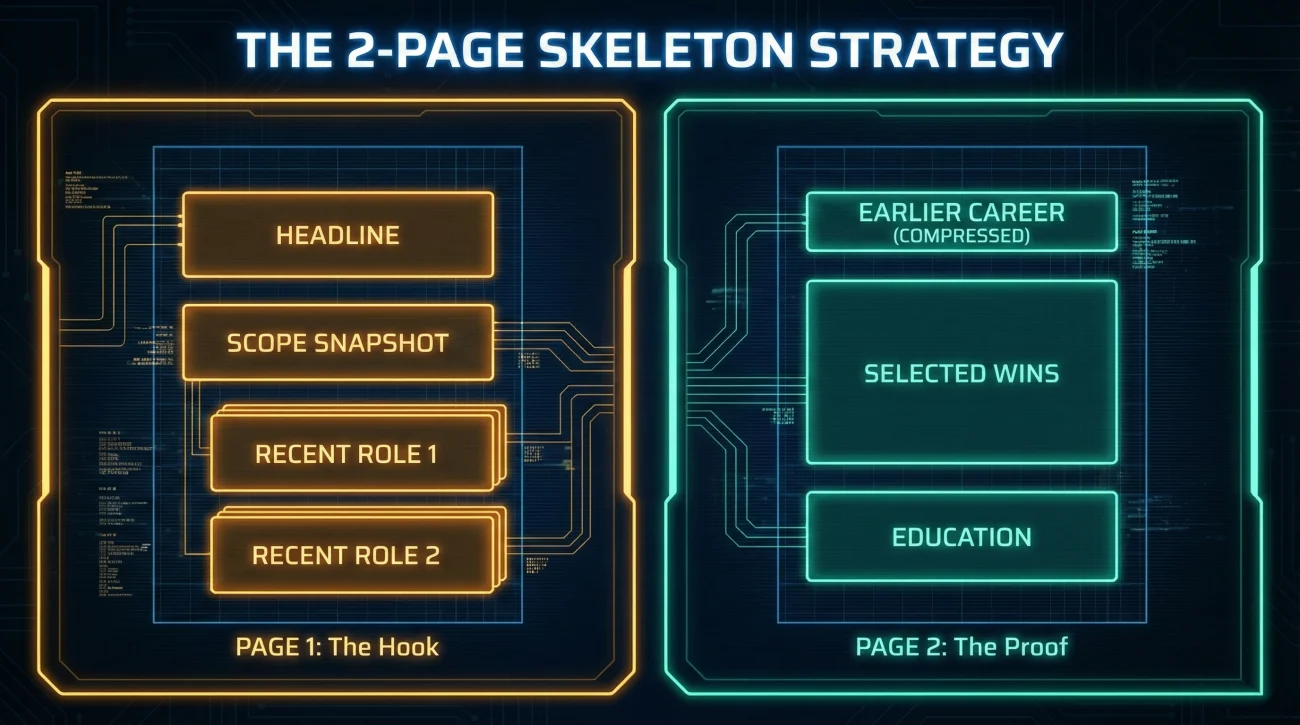
A Simple Page 1 vs Page 2 Split That Usually Works
Most senior resumes get cleaner when you give each page a job.
- Page 1: Identity, leadership scope, and your most recent 1 to 2 roles with your strongest outcomes.
- Page 2: Proof that backs up your leadership story: earlier roles compressed, one or two signature achievements, and only the credentials that truly matter.
Headline + 2 line positioning summary
Leadership scope snapshot (team size, budget, regions, stakeholders)
Role 1 (recent) with 4 to 6 impact bullets
Role 2 (recent) with 3 to 5 impact bullets
PAGE 2 SKELETON (Senior)
Earlier Career (compressed roles, 1 to 2 lines each)
Selected Achievements (2 to 3 bullets max, high signal only)
Education, certifications, boards, speaking (only if relevant)
When 3 Pages Can Be Justified and How to Avoid Looking Unedited
Most people asking about when to use a three page resume are not trying to be difficult. They are trying to be accurate. The problem is that accuracy is not the same as persuasion.
In general corporate hiring, three pages often underperform because the extra space gets filled with medium signal history. That said, I have seen three pages work when the content is truly unavoidable, like research heavy roles, complex deal sheets, or highly technical leadership where proof requires context.
Vincenzo, a VP Engineering candidate I worked with, insisted on three pages because his product migrations were legitimately complex. The compromise that saved him was structural: The resume stayed at two pages, and the detailed project list became a separate “Project Evidence” addendum he only shared when asked. His core resume stayed readable, and he still had depth when the panel wanted it.
💡 Pro Tip: If your third page is mostly “older responsibilities”, you probably do not need a third page. You need compression.
The Trimming Checklist That Works Specifically for Senior Resumes
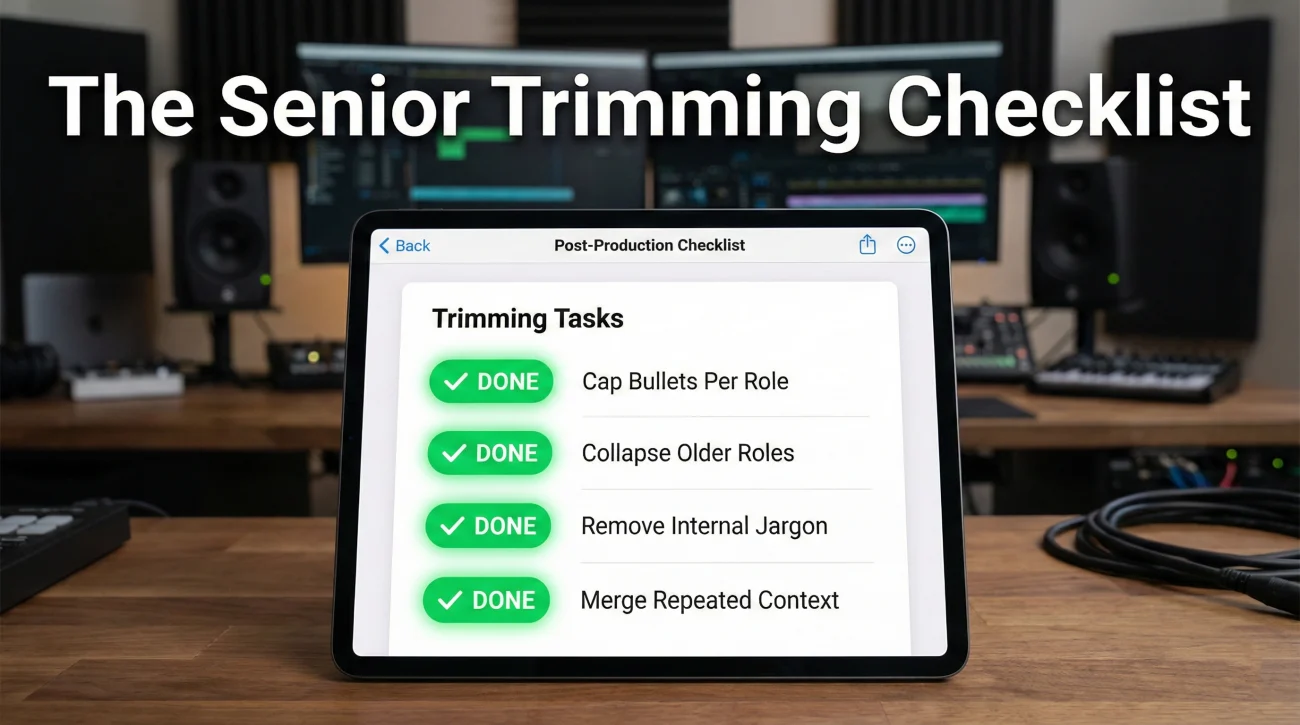
Senior resumes rarely need “more writing”. They need better editing. If you are trying to trim senior resume experience without losing credibility, run this checklist in order.
- ✅ Keep only the last 10 to 12 years in full detail. Older roles become one line each.
- ✅ For each role, cap bullets to the number you can defend in an interview. Quality beats quantity.
- ✅ Replace “responsible for” bullets with outcome bullets: What changed, by how much, and who it mattered to.
- ✅ Merge repeated bullets across roles. If you “led cross functional teams” five times, you only need it once.
- ✅ Remove tools and systems that date you unless the target role requires them.
- ✅ Delete internal jargon and acronyms that do not travel across companies.
- ✅ Move awards and community items to one tight line if they are not decision drivers.
The “Value Per Inch” Test
Here is a quick test I use when a resume feels long: I cover the left side of the page with my hand and scan only the first few words of each bullet. If the bullet starts with soft verbs like “worked”, “helped”, “assisted”, “supported”, it usually has low density. Senior bullets should start with action that implies ownership and scope.
Before and After Examples That Cut Length Without Cutting Authority
Below is a real pattern I see all the time. The “before” bullet is not wrong. It is just not doing senior work on the page.
Before: Led multiple cross functional projects to improve operational processes and drive efficiency across teams.
After: Led a 14 person cross functional program that reduced cycle time 22% and freed 1.8M in capacity across three regions.
One more trimming move that feels small but saves space fast is collapsing repeated context. Senior resumes often restate the same environment in every bullet. Put the environment once, then use bullets for outcomes.
“I thought the extra detail made me look experienced. It actually made me look unfocused. Once we cut it down, the interviews felt easier because the story was clearer.”
Final
If you are senior, the goal is not to prove you have been busy. The goal is to prove you have driven change at a level that matches the job you want next. That is why resume length for senior professionals is really a signal management problem.
Two pages is often the clean answer when the first page sells your current level and the second page backs it up with high signal proof. If you feel stuck, do not argue with page count. Argue with density, and cut anything that does not earn attention. That mindset is part of resume length for senior professionals in modern hiring, where clarity beats completeness.
❓ FAQ
📌 Is a two page resume okay for a senior professional?
Yes, it is often normal, as long as page one stays scannable and page two adds proof instead of repeating older job descriptions.
🧠 What is the biggest mistake on page two?
The biggest mistake is filling page two with low impact bullets from long ago. It signals “unedited” more than “experienced.”
🧾 How far back should a senior resume go?
Most senior resumes work best when the last 10 to 12 years are detailed, and earlier roles are compressed into one line each.
🧩 When is a third page acceptable?
A third page can work in specialized cases where proof requires context, but most candidates do better with a two page resume plus a separate addendum if needed.
✂️ What is the fastest way to shorten a long senior resume?
Cap bullets per role, collapse older roles, remove repeated “context” lines, and rewrite soft bullets into outcome bullets with scope.
⚠️ Disclaimer: ResumeSolving provides resume, cover letter, and job search communication guidance for informational purposes only. It is not legal, medical, financial, or professional counseling advice. Hiring decisions vary by company, role, location, and individual circumstances, so we do not guarantee interviews, offers, or outcomes. Always use your own judgment, verify requirements directly with the employer, and follow local laws and workplace policies. When a situation is sensitive, we prioritize privacy-safe, recruiter-appropriate wording, and you never need to share personal details you are not comfortable disclosing.