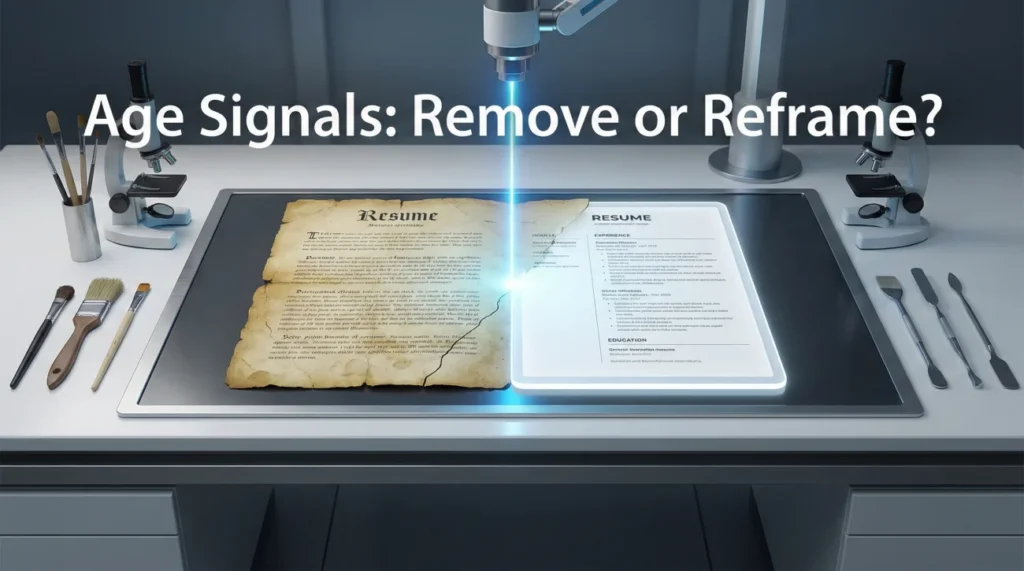
- Most “ageism tips” focus on dates. Recruiters also notice language, formatting, and outdated signals that read as “not current.”
- Use a remove vs reframe rule: Delete details that add no hiring value, rewrite the rest to show recent impact and adaptability.
- Run a 7-minute self-scan before you apply. Small edits can change the first impression without changing your truth.
Age signals are rarely about your age
I’m going to say this plainly because it matters: ageism on resume what not to do is not just “remove your graduation year.” The real problem is that resumes can accidentally broadcast a vibe of “I haven’t updated how I work,” even when the person is sharp, curious, and producing great results.
Recruiters skim fast. They’re pattern-matching. And unfortunately, age bias exists in the market, so “old-school cues” can become an easy shortcut in someone’s brain, even if they would never admit it out loud.
When I review senior resumes, I’m not trying to guess someone’s age. I’m asking one question: “Does this person look current for the role and the environment we’re hiring into right now?” If your resume answers that question quickly, you reduce the risk of bias without pretending you’re someone else.
💡 Pro Tip: The goal is not to erase your experience. The goal is to remove low-value details that create the wrong impression.
The remove vs reframe rule
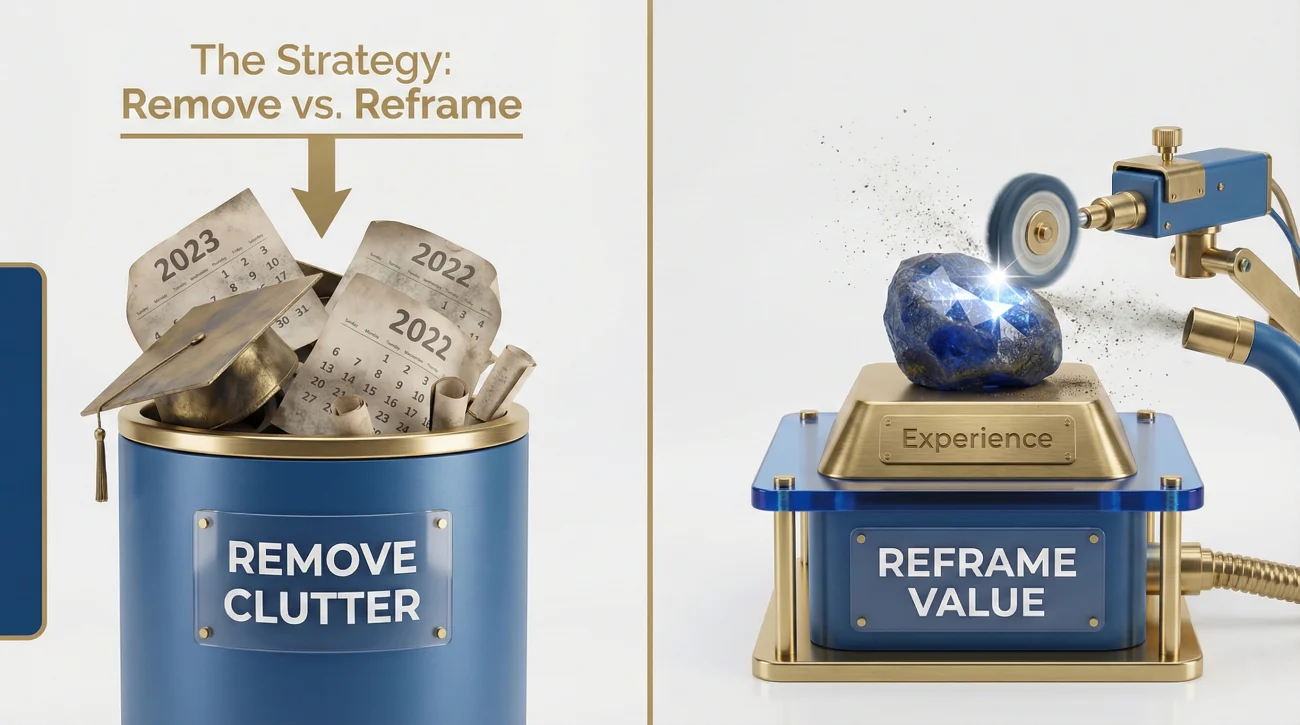
Here’s the rule I use with candidates (and with my own colleagues when they’re job hunting):
- Remove information that does not help a hiring decision today and only adds “timeline clues.”
- Reframe information that is valuable, but currently written in a way that screams “dated.”
One candidate I worked with, Vaughn, had a resume that was genuinely strong. He was leading teams, delivering results, handling messy stakeholders. But his first page opened with “Seasoned professional with 30+ years of experience.” He thought it sounded impressive. In practice, it created a mental label before anyone read his achievements.
We rewrote the same truth in a way that pointed to current outcomes instead of time served. The content did not become dishonest. It became more relevant.
🗝️ Key Point: Time is not your differentiator. Outcomes and current operating style are.
18 age signals to remove or reframe
This list is intentionally practical. Some items are obvious, but several are the quiet cues that show up again and again in “why am I not getting callbacks” stories.
| Age signal | Remove or reframe |
|---|---|
| Graduation year (especially decades ago) | Remove the year. Keep degree and school if relevant. |
| Date of birth or full mailing address | Remove DOB. Use city and state only. |
| Early career jobs with full bullets (20+ years back) | Collapse into “Earlier Career” with titles and employers only. |
| “30+ years,” “over 25 years,” “decades of experience” | Replace with role identity and outcomes: “Operations leader focused on cost and throughput.” |
| Objective statements | Replace with a tight summary focused on value and scope. |
| “References available upon request” | Remove. It wastes space and reads dated. |
| Outdated email domains (AOL, Hotmail, etc.) | Create a clean address on a modern provider. |
| Fax number or multiple phone numbers | Keep one phone. Remove fax. |
| Old-school fonts and heavy formatting (tables, borders, WordArt vibes) | Use clean headings, consistent spacing, and simple structure. |
| Long paragraphs in summary | Convert to 2 to 3 lines plus a few crisp bullets. |
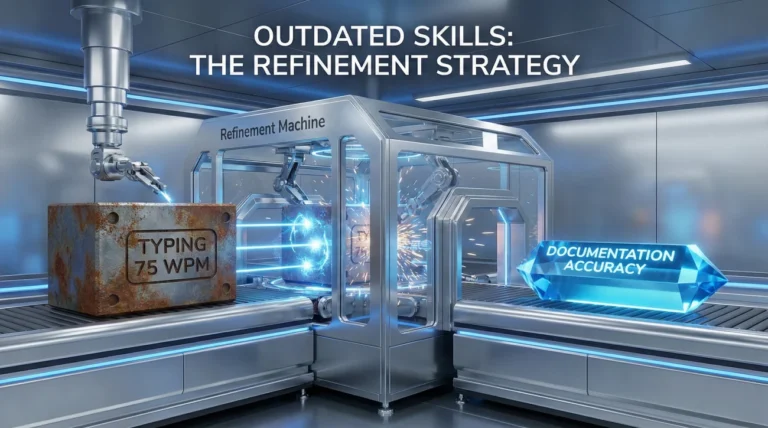
| Skills list packed with legacy tools | Archive irrelevant tools. Lead with current stack and workflow. |
| “Proficient in Microsoft Office” as a headline skill | Only include if the role is truly Office-heavy, otherwise downplay. |
| Certifications listed with very old dates | List the credential. Add “Active” or “Current” if applicable. |
| Training list that ends years ago | Add recent learning, even small: courses, internal programs, conferences. |
| Job history that reads like “one role per decade” | Add scope and change: transformations, new systems, new teams, growth phases. |
| Awards that are only from early career | Keep 1 highlight, then add recent recognition or impact proof. |
| Very long resume with low signal density | Cut repetition. Keep the strongest evidence. |
| Old jargon: “duties included,” “responsible for,” “utilized” everywhere | Rewrite into outcomes, decisions, and measurable impact. |
If you only do three fixes from the table, do these: remove education dates, delete timeline-only filler, and rewrite your summary so it does not lead with “how long,” but with “what you do now.” That combo shows up in most credible guidance on age-proofing a resume, for a reason.
The five signals recruiters notice first

1) Your summary gives them a label before your achievements do
I’ve seen this with smart people who have nothing to “hide.” They lead with identity lines like “Seasoned executive with 30+ years.” It feels safe because it’s true. But it also invites assumptions: expensive, rigid, close to retirement, not interested in learning. None of those may be true, but you just handed the reader the shortcut.
Instead, write a summary that points to what you build, fix, or lead. Think: scope, operating rhythm, and outcomes.
2) Your experience section looks like a museum instead of a story
One colleague, Daphne, had a resume that was basically a timeline archive. Every job since the 90s had bullets. The result was not “wow, experienced.” It was “I don’t know what matters here, so I included everything.”
We kept her credibility by preserving role titles and companies, but we moved older roles into an “Earlier Career” block with no bullets. Then we expanded her last two roles with strong metrics and modern responsibilities.
⚠️ Warning: Cutting older detail is not the same as deleting your past. You can keep the spine of your career while removing the low-value noise.
3) Your tools and skills read like you stopped updating
This is where age bias often hides behind “fit.” A resume that leads with legacy systems, generic Office claims, or old project tools can feel out of sync, even if the candidate is perfectly capable today.
Reframe by anchoring your skills in current workflows: cross-functional execution, decision logs, modern analytics, current collaboration tools, and learning habits. You do not need to name-drop every trendy platform. You just need to show you can operate in today’s environment.
4) Your formatting screams “I built this in 2009”
Heavy tables, thick borders, centered headings, multiple fonts, or decorative lines create an “old template” vibe. It also increases the risk of ATS parsing issues, which can make your resume look messy when it’s not. That is a double hit.
Keep structure simple: clear headings, consistent spacing, and clean bullets. If you want to show sophistication, do it with content quality, not decoration.
5) Your contact details create an unnecessary signal
This one feels petty, but it shows up constantly: outdated email domains. In some industries it won’t matter. In others, it quietly signals “not current,” before you even get to your work.
A clean email and a city and state location are enough. Save space for proof.
Quick rewrites that keep you honest
When people hear “age-proof,” they worry it means lying. It doesn’t. Most of the time, you are simply removing trivia and rewriting statements to match how hiring decisions are made today.
Rewrite pattern: From “time served” to “scope and outcomes”
Use this mental swap: replace “how long” with “what scale.”
Rewrite pattern: From “duties included” to “decisions made”
Older resumes often list tasks. Modern resumes show decisions and outcomes. That change alone makes you feel current.
Rewrite pattern: Show learning without sounding defensive
A small “recent learning” line can neutralize bias. It is not “look, I can still learn.” It is “I operate like someone who updates.”
Example line (Skills or Summary):
“I didn’t want my resume to look like I was pretending to be 28. I just wanted it to look like I belong in the 2026 version of this job.”
The 7-minute self-check before you apply
If you want a simple routine, do this right before you send applications. It’s fast, and it prevents the most common accidental signals.
- ✅ Page 1: Does it lead with outcomes, not years?
- ✅ Education: Are graduation years removed if they add no hiring value?
- ✅ Experience: Are older roles compressed into “Earlier Career” instead of full bullets?
- ✅ Skills: Are you leading with current tools, workflows, and relevant strengths?
- ✅ Formatting: Are fonts, spacing, and headings consistent and clean?
- ✅ Contact: Is email modern and location minimal?
- ✅ Signal density: Does every bullet earn its space?
❌ Note: If your first page reads like a biography, you will be judged like one. Make it read like a proof document.
Final
I’ll end with the situation I see most: a capable, experienced person gets stuck because their resume opens the door for assumptions. Not because they can’t do the work. Not because they’re “too old.” Because the document makes them look less current than they actually are.
When my friend Ruben was job searching after a re-org, he hated the idea of editing anything that felt like “proof of seniority.” What convinced him was this: the point of the resume is not to preserve history. It is to win the next conversation. We kept his credibility, removed the low-value timeline clues, and made his recent impact impossible to miss. He started getting interviews again.
If you want one clean north star for ageism on resume what not to do, it’s this: remove trivia, reframe value, and make “current operating style” obvious in the first 20 seconds of reading.
FAQ
🧠 Should I remove my graduation year from my resume?
If the year adds no hiring value (common for experienced professionals), removing it is a standard move. Keep the degree and school if relevant, but avoid giving easy timeline clues.
📄 How many years of experience should I show in detail?
There is no single rule, but many credible sources suggest focusing detail on recent, relevant years and compressing earlier roles. The key is relevance and signal density, not a hard cutoff.
🔍 Is removing older roles the same as lying?
No. You are curating, not inventing. Removing low-value detail is normal. If an older role matters for credibility, keep it as a title and employer line, then put your proof where it helps hiring decisions today.
💼 Do resume objectives still hurt candidates?
In most modern hiring contexts, objectives waste space and feel dated. A tight summary that states scope and outcomes is usually more effective.
⚙️ Will changing formatting really affect callbacks?
Formatting is not the only factor, but it shapes first impression and can affect readability and parsing. Clean structure helps your content land faster, which matters when recruiters skim.
⚠️ Disclaimer: ResumeSolving provides resume, cover letter, job search communication, and career transition guidance for informational purposes only. Hiring practices vary by employer, role, location, industry, and individual circumstances. We do not guarantee interviews, job offers, ATS results, or other outcomes. Verify employer requirements directly and follow applicable laws and workplace policies. For sensitive situations, use only information you are comfortable disclosing and keep all statements accurate.