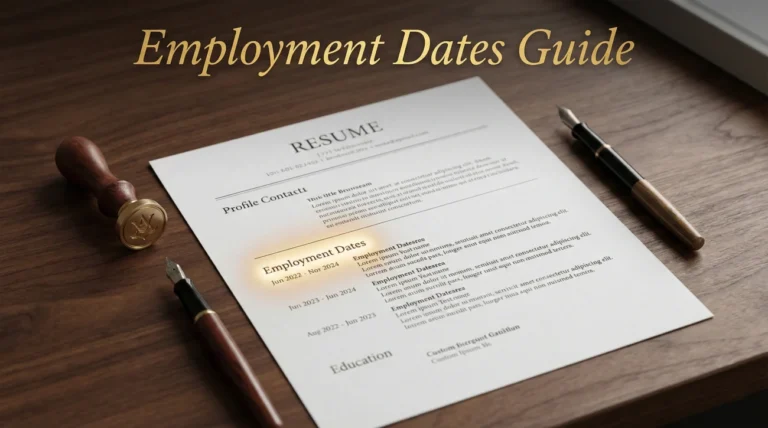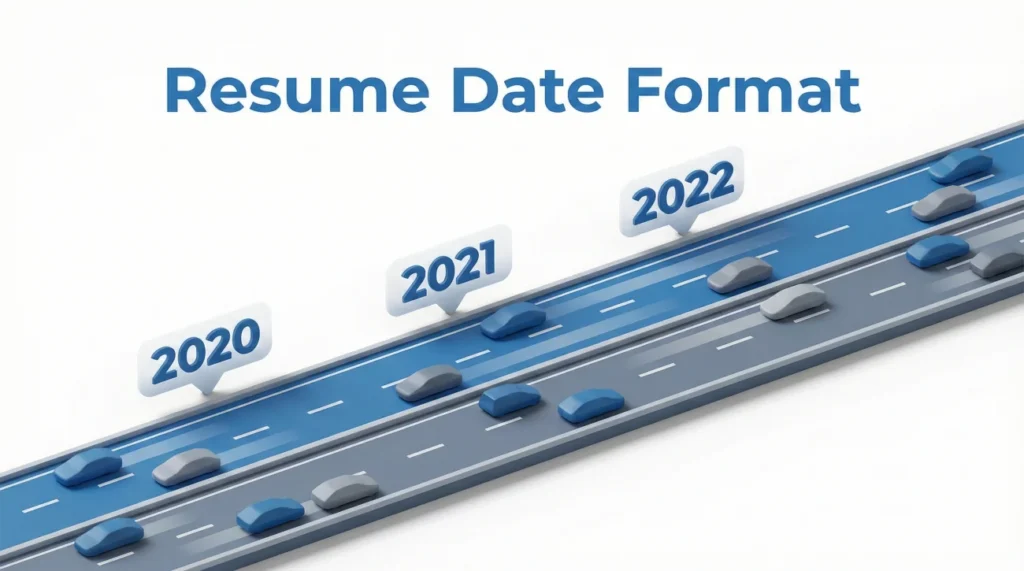
- Choose one resume date format (Month YYYY or MM/YYYY) and apply it across Experience, Education, and Certifications.
- Month-Year is the safest default, but year-only can work when you have long tenures and zero short stints to “hide”.
- Consistency is not just “same format”. It is also spacing, month abbreviations, punctuation, and how you write “Present”.
Why Date Formatting Gets You Judged Before Your Bullets Do
I have seen strong candidates lose credibility over something painfully small: inconsistent dates. Not because a recruiter is petty, but because dates are one of the fastest “trust checks” on a page.
When your timeline looks steady, the reader relaxes and actually reads your impact. When your timeline looks messy, the reader starts doing math, scanning for gaps, and wondering what you are not saying. That is why picking a clean resume date format matters more than people think.
One candidate, Talia, had a solid product background. Her resume had “2021 – 2022” for one role, “Feb 2020 – Nov 2021” for another, and “03/2019 – 12/2019” for a contract. The story was normal. The formatting made it look like she was hiding something. We fixed nothing about her experience, only the date system. Her next feedback from a hiring manager was: “This reads cleaner. I can follow her progression.”
Key Point: Dates are not decoration. They are a credibility layer. If they look inconsistent, your reader assumes your thinking is inconsistent too.
The Default Choice That Works in Most Industries
If you want the safest option that looks professional almost everywhere, use Month YYYY. It is readable, globally understandable, and it avoids regional confusion (for example, 03/04/2022 means different things in different places).
The two formats that rarely get you in trouble
You only need one of these. Pick one and commit.
| Format | Best for | What it signals | Watch-outs |
|---|---|---|---|
| Month YYYY – Month YYYY | Most candidates, most roles | Clear timeline, nothing hidden | Use the same month style everywhere (Jan vs January) |
| MM/YYYY – MM/YYYY | Very tight space, very dense experience | Structured, compact | Avoid mixing with Month YYYY in other sections |
💡 Pro Tip: If you are applying internationally, Month YYYY is usually safer because it is instantly human-readable without date-order ambiguity.
What “Be Consistent” Actually Means
Most advice stops at “pick a format and stick to it”. That is not where people fail. People fail on the micro-details that create a messy visual pattern.
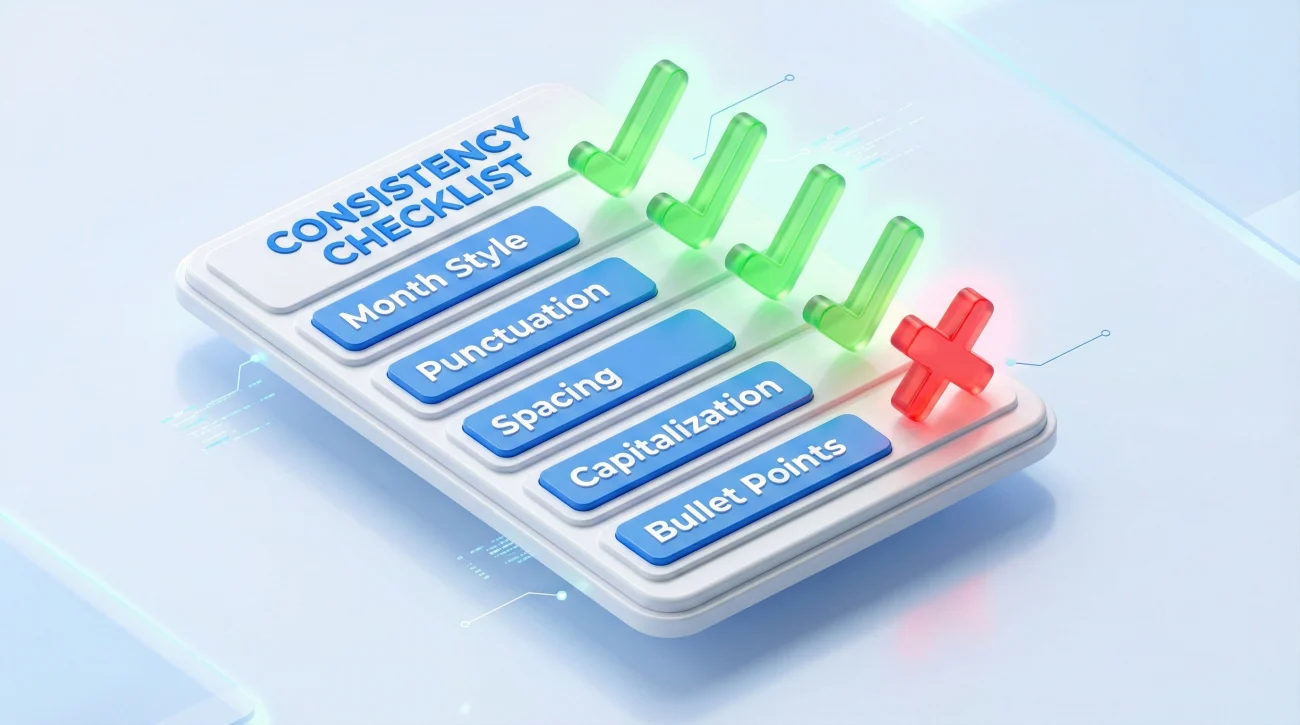
Consistency checklist (the stuff recruiters notice subconsciously)
- Month style: Jan 2022 or January 2022, do not mix.
- Month punctuation: If you use “Jun.” then every month should follow the same rule (yes, even May).
- Spacing: Always use space on both sides of the separator: “Jan 2022 – Mar 2023”, not “Jan 2022-Mar 2023”.
- Current role label: Choose “Present” and keep it identical in every current entry.
- Alignment: Dates should sit in the same place visually (right aligned or same column), so the eye can scan fast.
- Section parity: Your Experience dates should match your Education and Certifications style.
I once worked with Marcus, a finance ops lead, who had immaculate bullets but inconsistent month abbreviations: “Sept”, “Sep”, “September” across three lines. Nothing was “wrong”, but it looked unmanaged. The fix took five minutes and the resume instantly looked more senior.
Month-Year vs Year-Only: When Each One Helps or Hurts
This is where generic guides get lazy. They say “include months”. True most of the time. But there are legitimate cases where year-only is fine, and cases where it backfires hard.
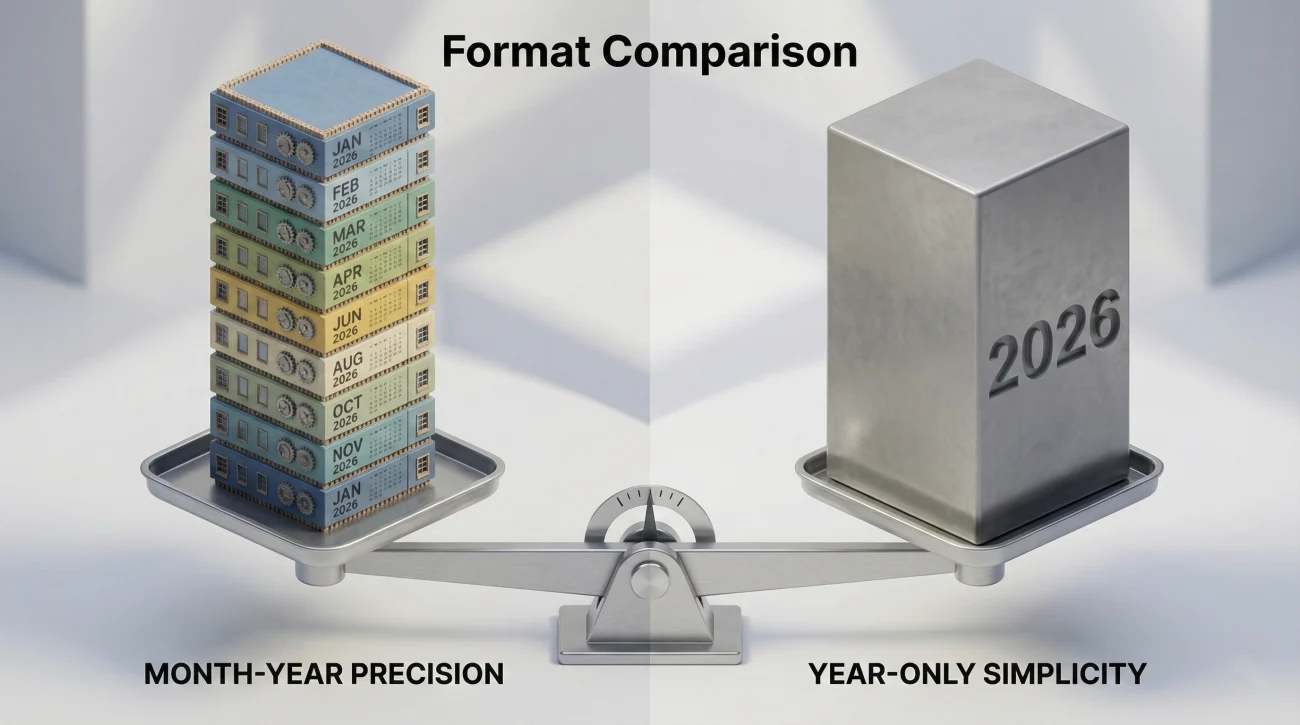
Use months when the reader might question duration
Include months if any of these are true:
- You have roles shorter than 18 months.
- You changed jobs frequently early in your career.
- You have contracting or temporary roles that could be misread as job-hopping.
- You are early-career and each internship length matters.
- You are trying to show “steady progression” and the months make that progression obvious.
Year-only can work when your timeline is boring (in a good way)
Year-only is safest when your last 8 to 12 years are basically long tenures. Think: three roles, each 3 to 5 years, no awkward short stops.
Here is the recruiter reality: year-only is often read as “they are simplifying” or “they are hiding”. The difference is context. If your work history screams stability already, it reads as simplification. If your history has any short stints, year-only reads like camouflage.
Key Point: Year-only is not a hack. It is a signal. Use it only when you can afford the signal.
Edge Cases Most Date Guides Ignore (But Recruiters See Daily)
Promotions inside one company
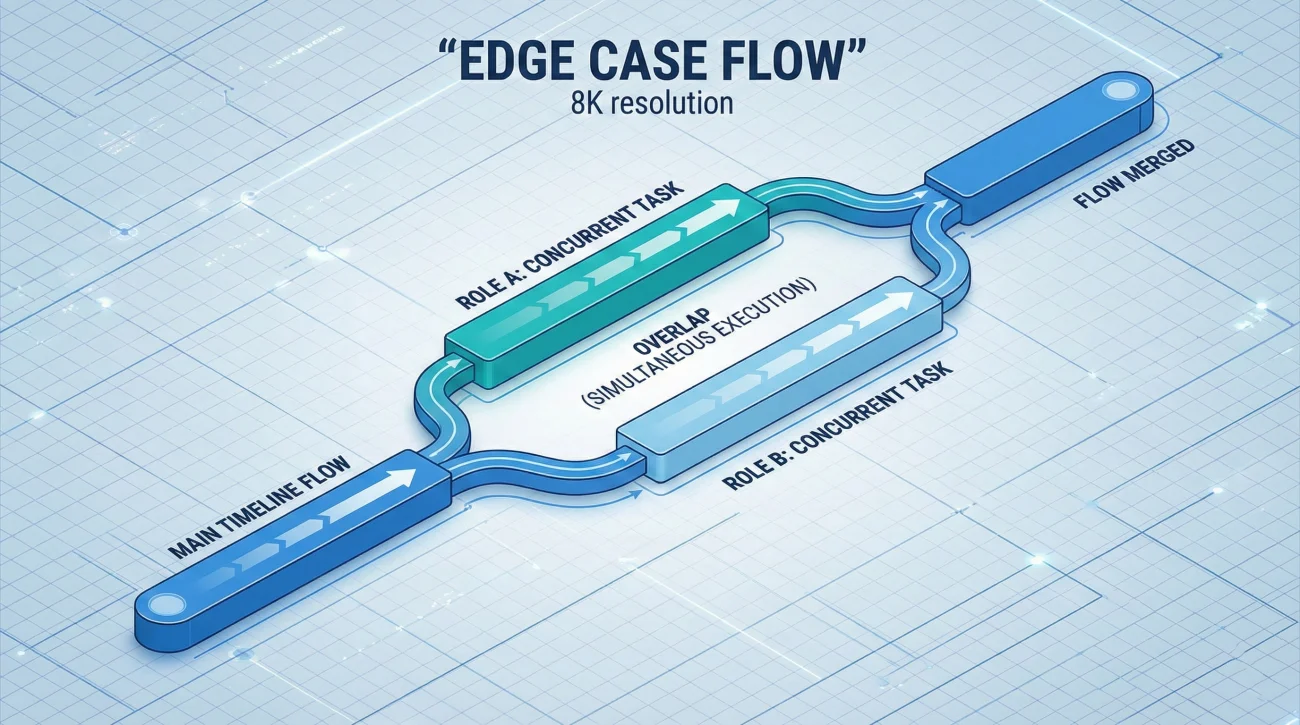
Promotions are where formatting can accidentally imply a gap. If you list the company once and then multiple roles under it, make sure the role date ranges sit cleanly and do not overlap in a confusing way.
A simple pattern is:
Company Name | City, ST
Role A | Jan 2021 – Apr 2022
Role B | Apr 2022 – Present
The repeated month creates a clean “handoff”. If you write “2021 – 2022” and “2022 – Present”, you remove clarity exactly where the reader wants clarity.
Overlapping freelance or side work
Overlapping dates are not automatically suspicious. What becomes suspicious is when overlaps are hidden and discovered later. If you did freelance while employed, list it as “Freelance” with its own dates and label it in a way that makes sense.
For example: “Freelance (Part-time)” or “Consulting Projects (Evenings/Weekends)”. You are not oversharing. You are preventing confusion.
Contract roles and temp work
Short contracts need months, because the contract length is the entire story. If you only show the year, a 3-month contract can look like a 1-year role, and that mismatch creates distrust when someone verifies later.
For contracts, keep the same format but add a label like “Contract” in the title line, not inside the date itself.
⚠️ Warning: Do not use seasons like “Fall 2022” for professional roles. It reads vague and often looks like you are rounding time.
Education and Certifications: Dates You Can Shorten Without Looking Shady
Not every date needs the same precision. Recruiters care most about employment timelines. Education and certifications are more flexible, but they still need to look consistent.
Education date rules that keep the page clean
- If you graduated long ago and it is not relevant, you can use year-only: “2012”.
- If you are early-career, include months for recent graduation if it helps clarify recency: “May 2024”.
- If you are currently studying, use “Expected” with a month-year, but do not over-explain: “Expected May 2026”.
Certifications and licenses (especially ones that expire)
If a cert expires, the date matters. Include month-year and, if needed, an expiration date in the same format. If it does not expire, year-only is often enough.
One of my friends, Jonah, had an expired certification sitting on his resume with no dates. A recruiter asked about it on a call, and the moment got awkward. We fixed it by adding “Issued” and “Expires” in a clean line. The resume did not get longer. It got safer.
Six Examples You Can Copy Without Breaking the Timeline
Below are examples that cover common real-life situations. The point is not the job title. The point is the date logic and the consistency.
Example 1 (Standard full-time role):
Jan 2022 – Present
– Built a weekly reporting system that reduced manual reconciliation time by 30%
– Partnered with Sales and Finance to fix recurring billing errors and stabilize forecasting
Example 2 (Promotion inside the same company):
Senior HR Generalist | Apr 2022 – Present
HR Generalist | Jun 2020 – Apr 2022
– Led manager coaching rollout across 6 teams and reduced repeat escalation cases
– Standardized onboarding steps and improved time-to-productivity for new hires
Example 3 (Contract role, short duration):
Sep 2023 – Dec 2023
– Delivered a pilot program across 3 partner sites and created a repeatable launch checklist
– Built stakeholder updates that improved response time and reduced last-minute changes
Example 4 (Overlapping freelance work):
Feb 2021 – Present
Freelance SEO Consultant (Part-time) | Self-employed
Jun 2022 – Present
– Built content systems for 4 small businesses and improved qualified inbound leads
– Documented processes so clients could maintain results without weekly support
Example 5 (Education in progress):
Expected May 2026
Relevant coursework: Workforce Analytics, Leadership Assessment, Change Management
Example 6 (Certification with expiry):
Google Data Analytics Certificate | Issued: 2022
Do-Not-Do List: The Date Habits That Trigger Doubt
These are the patterns that consistently create “wait, what?” moments during resume screens.
- Mixing formats: “Jan 2022 – Present” in one place and “2021/06 – 2022/08” in another.
- Switching month styles: “September” in one role and “Sep” in the next.
- Random punctuation: “Jun.” for some months but not others.
- Vague seasons for employment: “Spring 2021”.
- Using “Current” or “Now” instead of a stable label like “Present”.
- Hiding short roles with year-only while keeping months elsewhere (it reads intentional).
- Letting spacing drift: “Jan 2022- Mar 2023” on one line and “Jan 2022 -Mar 2023” on another.
❌ Note: A messy date system makes even a strong resume feel unpolished. The fix is boring, but the payoff is real.
Final
A clean date system is one of the cheapest credibility upgrades you can do. It does not require rewriting your accomplishments. It only requires choosing a standard and treating it like a design rule.
If you are not sure what to pick, default to Month YYYY, keep the spacing consistent, and make “Present” the only “current role” label you use. That single decision removes friction from the reader’s brain.
And if you want to tighten other sections with the same level of precision, the overall mindset is the same: treat each component like a credibility layer, not a decoration. That is the heart of resume date format work when you do it as part of a section-by-section cleanup.
❓ FAQ
🧭 Should I put months on my resume dates?
Yes in most cases, especially if you have any roles under 18 months, contract work, or early-career timelines where duration matters. Months reduce ambiguity and prevent “are they rounding?” doubts.
📅 Is MM/YYYY better than Month YYYY for ATS?
Both are commonly readable. The bigger risk is mixing formats across sections. If you choose MM/YYYY for compactness, commit to it everywhere and keep spacing consistent.
🔍 Can I use year-only to hide short jobs?
You can, but it often reads like you are trying to hide something, especially if other entries include months. If you have short stints, a cleaner approach is to format consistently and make the narrative stable through titles, scope, and outcomes.
🎓 Do education dates need months too?
Not always. Recent grads can include months for clarity, but mid-career candidates often use year-only for older degrees. If you are currently studying, “Expected Month YYYY” keeps it clear and professional.
🧩 What if my freelance work overlaps my full-time job?
Overlaps are fine if you label them clearly. Use the same date style and clarify “Part-time” or “Consulting Projects” so the reader does not assume you made a timeline error.
⚠️ Disclaimer: ResumeSolving provides resume, cover letter, job search communication, and career transition guidance for informational purposes only. Hiring practices vary by employer, role, location, industry, and individual circumstances. We do not guarantee interviews, job offers, ATS results, or other outcomes. Verify employer requirements directly and follow applicable laws and workplace policies. For sensitive situations, use only information you are comfortable disclosing and keep all statements accurate.