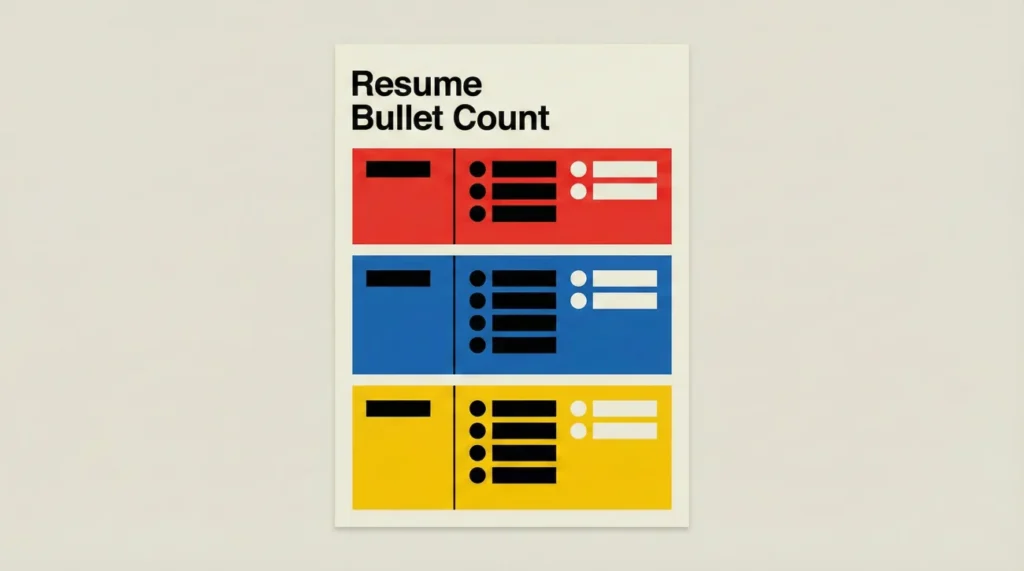
- Most resumes look “too long” because one job has too many bullets, not because the resume has too many jobs.
- Use a simple rule: Relevance + Recency + Responsibility decides whether a role needs 2, 3, 5, or 6 bullets.
- Put bullets under the job they belong to, then control the count so the role stays skimmable in 10 seconds.
A Bullet Count That Signals You Know What Matters
If you have ever stared at your experience section and thought, “This looks heavy,” you are not alone. I have watched strong candidates lose the reader simply because one job took up half a page.
One candidate, Jade, brought me a resume where her current role had 11 bullets. Every bullet was “fine.” The problem was the feeling. It looked like someone who did a lot of tasks, but could not choose what mattered. We cut it to 5 bullets, made each one carry proof, and suddenly the document felt calm, credible, and senior.
This guide answers two linked questions: where to put bullet points on resume entries, and how many to use so the role stays readable without looking thin.
What Recruiters Actually Read When They Scan Bullets

When someone opens a resume, they do not read it like a novel. They skim for signals: Role clarity, scope, outcomes, and whether the person can communicate like a professional.
Bullets work when they make scanning easy. Bullets fail when they become “inventory.”
Key Point: A long list of bullets does not look like “more experience.” It often looks like “I could not prioritize.”
That is why the best bullet rule is not a fixed number. It is a decision rule that protects skimmability while keeping proof where it counts.
The 3-Layer Rule That Decides Your Bullet Count
Here is the decision rule I use in real resume reviews. It keeps the logic consistent, even across different careers.
[Relevance] + [Recency] + [Responsibility] = Bullet Count
Layer 1: Relevance
If the job strongly supports the role you want now, it earns more bullets. If it is background, it earns fewer.
Layer 2: Recency
Recent roles shape your current identity. Older roles become supporting evidence. This is why a 2-year-old role can deserve 5 bullets, while a 9-year-old role might only need 2.
Layer 3: Responsibility
Higher scope needs slightly more proof, but only if the bullets show outcomes. Senior candidates often write fewer bullets, but each bullet carries weight.
| Role type | Typical bullet range | When to go higher | When to go lower |
|---|---|---|---|
| Entry-level or internship | 3 to 5 | Relevant projects, measurable outcomes, strong tools stack | Very short stint, repetitive tasks, older than 3 to 4 years |
| Mid-level individual contributor | 3 to 6 | Current role, promotion story, direct match to target role | Not relevant, older role, role overlaps with another job on the resume |
| Senior IC or lead | 3 to 5 | High-stakes work, cross-team impact, big metrics | Bullets start sounding like a job description |
| Manager or director | 4 to 6 | You must prove scale: budget, headcount, transformation | You list meetings, coordination, and “responsible for” items |
| Older role (7+ years back) | 1 to 3 | Directly relevant foundation to your current target | Pure history, outdated tools, low signal-to-noise |
💡 Pro Tip: If your bullet count feels “wrong,” it is usually because the job is not earning its space. Either reduce bullets or make each bullet carry proof.
Where Bullet Points Belong (And Where They Create Confusion)
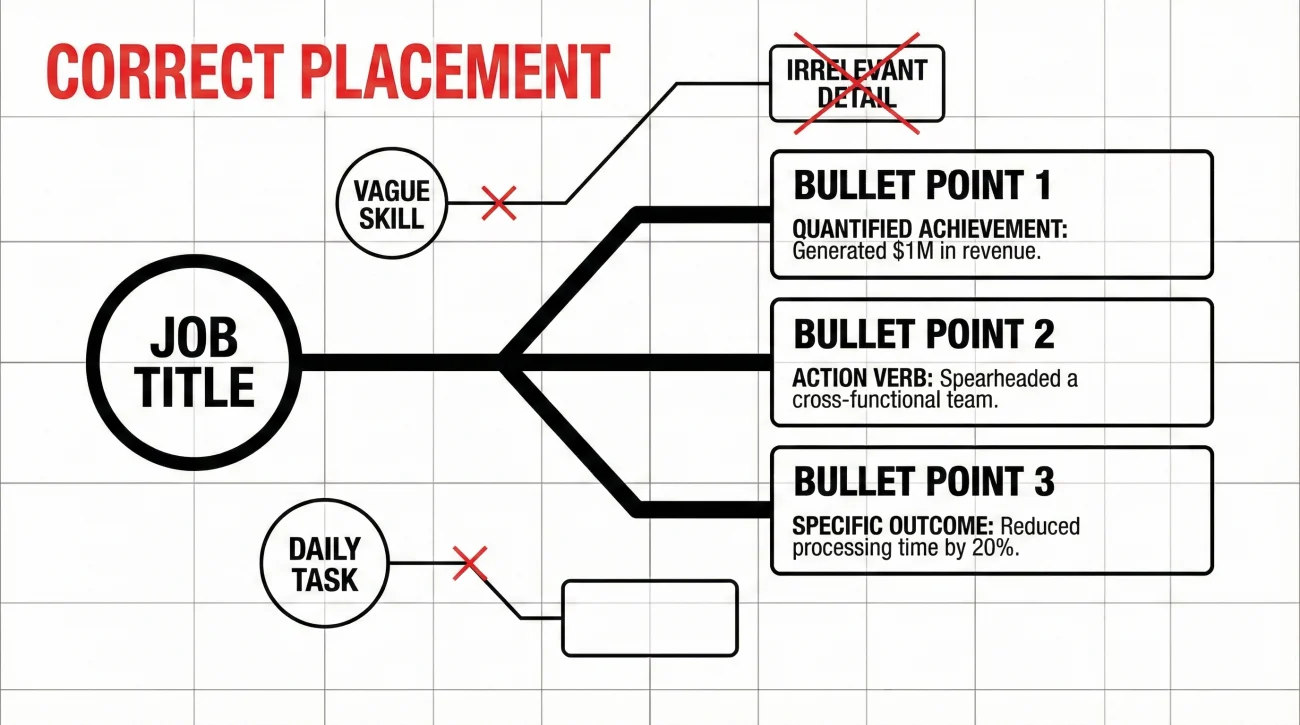
Let’s answer the placement question clearly. Most of the time, bullets belong directly under each job title in your experience section. That is the cleanest signal for a reader.
Here is the simple placement rule: Put proof under the role where that proof happened. Do not hide it in a separate place that forces the reader to connect the dots.
In other words, bullet points on resume placement should support the timeline, not fight it.
If you had promotions in the same company
Split the roles, even if the company is the same. Then put bullets under each role. Your bullet count becomes a story: Fewer bullets under the earliest role, more bullets under the latest role, because scope grew.
If you did contract or project-based work
Bullets still go under the contract entry, but the bullets should be outcome-driven. Contracts can look suspicious when they have long bullets that read like internal process notes.
If you want a “highlights” feel
Do it in your Summary, not by duplicating achievements in a separate section and repeating the same points twice. Repetition makes the resume feel padded.
How Many Bullets Per Job Without Looking Sparse or Bloated

If you came here for a number, here is the practical answer: Most roles land between 3 and 6 bullets. But the smarter move is to treat bullets like a budget.
Ask yourself: How many bullets can the reader absorb across the whole page without feeling flooded. When your bullet budget is controlled, every role looks intentional.
This is the moment to use the phrase people search for: how many bullet points per job depends on whether the role is doing “proof work” for you today.
A bullet budget that works in real resumes
For a one-page resume, I usually aim for something like 18 to 26 bullets total in the experience section. Not as a rigid rule, but as a sanity check. When someone has 40 bullets, they are forcing the reader to do unpaid labor.
Quick checks that catch clutter fast
- If one job entry is longer than the next two jobs combined, it is probably overweight.
- If your bullets are mostly tasks, reduce the count and rewrite the remaining bullets as outcomes.
- If your older job has more bullets than your recent job, your emphasis is backward.
⚠️ Warning: If you cut bullets without upgrading the remaining ones, your resume can look empty. The fix is not “fewer bullets.” The fix is “fewer, heavier bullets.”
Six Real Examples That Show the Same Rule in Different Careers
I am going to show six versions of the same logic. Notice how the bullet count changes because relevance, recency, and responsibility change.
Example 1 (Entry-level):
• Resolved 45 to 60 tickets per day while maintaining 96% CSAT across three product lines
• Built a tagged FAQ workflow that reduced repeat tickets by 18% in two months
• Escalated bug patterns with clear repro steps, improving engineering turnaround time on urgent issues
Three bullets works because the scope is narrow, and each bullet shows proof, not chores.
Example 2 (Mid-level marketing):
• Led paid search and landing page rebuild, improving qualified lead volume by 32% over two quarters
• Partnered with sales on pipeline attribution, aligning campaign goals to revenue stages and reducing wasted spend
• Built a weekly testing cadence for ads and pages, increasing conversion rate from 2.1% to 3.0%
• Mentored two coordinators and set review standards for copy and reporting quality
• Presented monthly performance narratives to leadership with decisions and next actions, not raw dashboards
This role earns five bullets because it is current and directly tied to performance outcomes.
Example 3 (Senior software engineer):
• Reduced checkout latency by 28% by refactoring critical services and tightening database queries
• Designed an incident playbook and alert thresholds that cut after-hours escalations by 40%
• Led migration planning for a major dependency upgrade with zero customer downtime
• Mentored three engineers through code review standards and pragmatic testing practices
Four bullets is enough. Senior resumes suffer when they list every tool they touched. The reader wants impact and scale.
Example 4 (Career change into project management):
• Owned cross-team scheduling for 14 to 18 weekly deliverables, reducing late handoffs by 22%
• Built a simple risk log and escalation rhythm that prevented repeat last-minute surprises
• Coordinated vendor timelines and internal approvals, keeping projects within agreed windows
• Trained new hires on workflow standards and quality checks, improving consistency across shifts
• Documented process changes and communicated updates in a way teams actually followed
This is five bullets because the person needs extra proof to make the target role feel believable. It is a controlled way to bridge the gap without writing a wall of text.
Example 5 (Founder translating to employee-style proof):
• Built and shipped 12 client projects from scope to delivery, maintaining 4.8 average rating across referrals
• Created pricing and proposal system that increased close rate from 22% to 35% within six months
• Set delivery checklists and handoff templates that reduced rework and improved turnaround time
• Managed contractor capacity and deadlines to keep delivery stable during peak demand
I have seen founders over-explain because they fear being misunderstood. Four strong bullets reads better than ten nervous ones.
Example 6 (Healthcare):
• Managed patient intake and care coordination across high-volume days while maintaining safety standards
• Improved medication documentation consistency by introducing a quick checklist used across the team
• Supported patient education and follow-up workflows, reducing missed appointments over one quarter
• Trained new staff on clinic routines and escalation criteria during onboarding
Four bullets keeps it readable while still showing reliability and process improvement.
Mistakes That Make Bullet Points Feel Like Noise

If your resume feels hard to read, it is rarely a formatting mystery. It is usually a signal problem caused by one of these patterns.
- Too many bullets that describe daily tasks, with no outcomes.
- Bullets that repeat the job description in different verbs.
- One job with 9 to 12 bullets because you are afraid to cut anything.
- Bullets that are all the same length and same structure, so nothing stands out.
- Older roles with long bullet lists that steal attention from your recent identity.
- Mixing unrelated accomplishments under one job, making the role feel messy.
When people ask me why their resume looks “dense,” I often point to one number: the resume bullet count for the biggest job entry. Fix that one entry and the whole document becomes more breathable.
“I thought more bullets meant I was showing more value. But the feedback I kept getting was: I look scattered. Once I cut it down, the same work suddenly looked more senior.”
Final: A Bullet Count That Makes Your Resume Easy to Trust
The goal is not to hit a magic number. The goal is to make each role earn its space. When your bullets are placed under the right job, and the count reflects relevance, recency, and responsibility, the resume reads like a confident professional document instead of a list of chores.
If you want one rule to remember, it is this: Your resume should feel skimmable even to someone who is tired. That is why controlling where to put bullet points on resume entries and how many to use is one of the cleanest “component strategy” upgrades you can make.
❓ FAQ
✅ Is 2 bullet points per job ever enough?
Yes, for older or less relevant roles. Two strong bullets that show outcomes can look better than five weak task bullets. The key is that the role is not doing heavy proof work for your current target.
🎯 What is the maximum number of bullets for a current job?
In most resumes, 6 is a practical ceiling. If you need more than that, it usually means you are listing too many responsibilities instead of selecting the few outcomes that actually sell you.
🧩 Should I use paragraphs instead of bullets for some roles?
Usually no. Paragraphs are harder to scan. If you want a short framing line, use one clean sentence, then bullets. Bullets are the readable format recruiters expect.
🔍 Should older roles have any bullets at all?
They can, but keep it minimal. If an older role does not support your current direction, it can be just title, company, dates. If it supports your target role, add 1 to 3 bullets with high-signal achievements.
🛠️ What if one job really included many different responsibilities?
That is normal. Your resume is not a complete record. Choose the responsibilities that connect to outcomes and to the job you want next. Variety does not require volume.
⚠️ Disclaimer: ResumeSolving provides resume, cover letter, job search communication, and career transition guidance for informational purposes only. Hiring practices vary by employer, role, location, industry, and individual circumstances. We do not guarantee interviews, job offers, ATS results, or other outcomes. Verify employer requirements directly and follow applicable laws and workplace policies. For sensitive situations, use only information you are comfortable disclosing and keep all statements accurate.