- Your titles may look fine, but your bullets can still scream senior scope.
- Downleveling is not deleting impact. It is dialing down ownership, scope, and stakeholder signals while keeping proof.
- Use the tables and red-flag list below to rewrite fast, without sounding evasive or fake.
When Your Bullets Are The Thing That Makes You Look Overqualified
I have seen a weird pattern over and over: Someone changes the job title line, trims a few old roles, even removes a “Director” word from the summary. Then they still get filtered out. Not because the recruiter is psychic. Because the bullet points still broadcast seniority like a loudspeaker.
Resume bullet points for overqualified candidates is a very specific problem. You are not trying to look smaller as a person. You are trying to look correctly sized for the role you want, so the hiring team does not imagine boredom, quick exit, or “This person will try to run the place.”
One candidate I worked with, Derek, had been a senior program manager. He wanted an individual contributor role after a burnout year. He did the obvious edits, but his bullets still had phrases like “enterprise governance” and “executive steering.” He kept getting polite rejections. When we rewrote only the bullets, interviews started showing up again.
Why Bullet Points Trigger “Overqualified” Faster Than Titles
Recruiters scan nonlinearly. They look for quick pattern matches: Level, scope, and the kind of problems you typically own. Titles can be misleading across companies. Bullets are harder to hide behind, because they reveal what you actually did.
Here is what bullets communicate in a split second:
- Ownership: Did you own the outcome, or support it?
- Scope: Was it team-level, multi-team, region-level, enterprise-wide?
- Stakeholders: Were you working with managers, directors, executives, boards?
- Risk: Are you dealing with high-stakes decisions, compliance, governance, reorganizations?
When those signals look too large for the job posting, the reader does not think “Wow, bargain.” They think: “Flight risk” or “Mismatch.” That reaction is human, not evil.
“Your resume reads like you will get bored in three weeks. The role is execution-heavy, and your bullets look like strategy and steering committees.”
That line came from a hiring manager I worked with years ago. He was not insulting the candidate. He was describing the story the bullets told.
The 4 Dials: How To Downlevel Bullets Without Lying
Downleveling is not “dumbing down.” It is editing the signals. Think of it like adjusting four dials while keeping the proof intact.
Dial 1: Scope Words
Senior bullets often include scope markers by default: enterprise, global, portfolio, org-wide. If the target role is narrower, you can keep the impact but describe it at the right altitude.
Dial 2: Ownership Language
Words like owned, led, drove, set strategy, defined roadmap are not “bad.” They are just level signals. For a lower-level role, you often want “built, executed, implemented, delivered, partnered, supported.”
Dial 3: Stakeholder Level
Executive-facing is a neon sign. Sometimes it is true and relevant. Sometimes it is a flex that creates fear. You can keep credibility by naming the function, not the rank, when rank is not essential.
Dial 4: Risk And Volatility
Bullets about layoffs, governance, compliance, and reorganizations scream senior context. If the job is operational, keep the “what changed” and “results” without centering the high-stakes framing.
| Seniority Signal | What It Implies | Safer Downlevel Option |
|---|---|---|
| Enterprise-wide, org-wide, global | Portfolio scope | Multi-team, cross-functional, company-wide (only if true) |
| Executive steering committee, board updates | Top-level stakeholders | Leadership updates, stakeholder reviews, monthly business review |
| Set strategy, defined roadmap | Direction-setting | Translated goals into plan, executed roadmap, delivered milestones |
| Owned budget, headcount, hiring plan | Manager authority | Managed spend within team plan, supported staffing plan, forecasted resourcing |
| Governance, compliance, risk framework | High-stakes control | Maintained documentation, ensured adherence to process, improved audit readiness |
If you are writing bullet points for lower position resume, this table is the quickest way to spot what is broadcasting the wrong level.
Edit Rules That Keep Your Credibility Intact
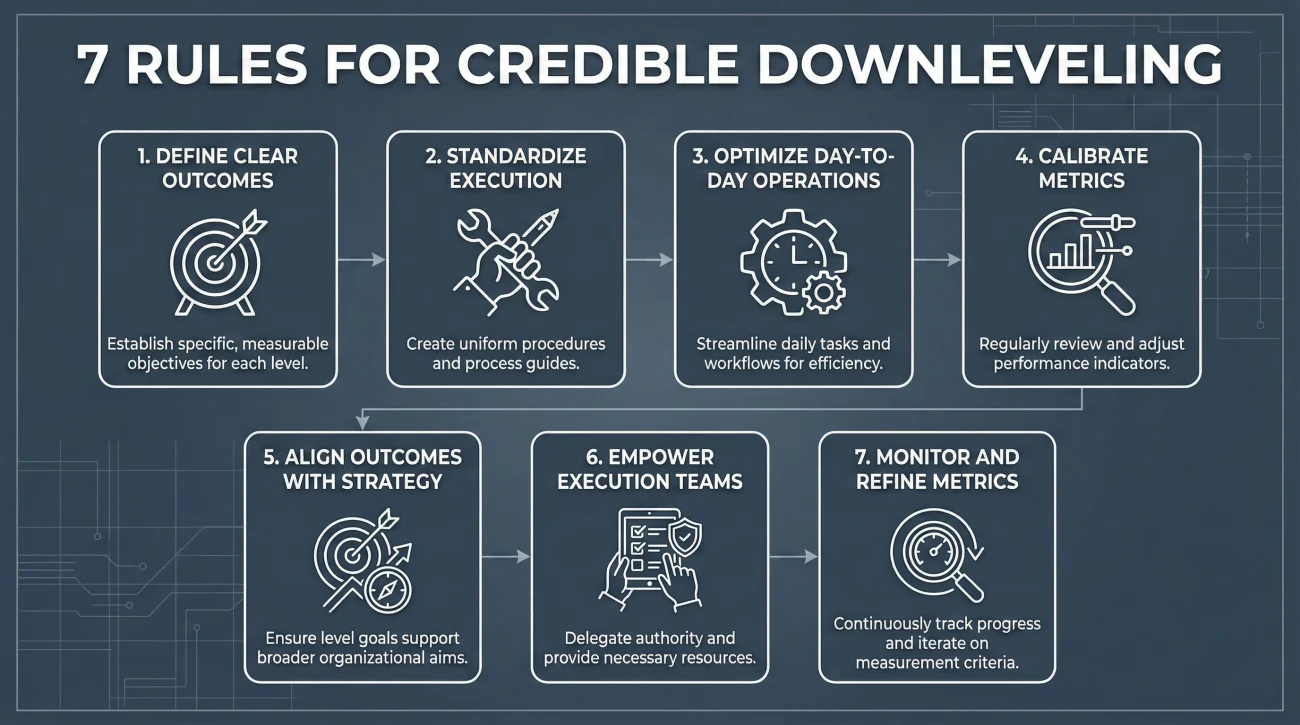
These are the rules I use when someone wants to go “one or two levels down” without sounding like they are hiding something.
Rule 1: Keep Outcomes, Edit The Story Of Control
You can keep the result. You just change how the reader imagines your authority. “Delivered X” is often safer than “Owned X,” unless ownership is required by the job.
Rule 2: Replace “Vision” Bullets With “Execution” Bullets
Senior resumes lean strategic by default. A downlevel resume should feel like hands-on delivery. This is what most people miss when they rewrite downlevel resume bullets.
Rule 3: Make One Bullet A “Day-To-Day” Anchor
Overqualified candidates often look like they only do big initiatives. Add one bullet that proves you can operate in the daily rhythm of the target role: handling tickets, shipping iterations, running routines, supporting stakeholders.
Rule 4: Use Smaller, Role-Normal Metrics
If every bullet has a massive number, the reader assumes massive scope. Sometimes the fix is not deleting metrics, but choosing metrics that match the role. Time saved, cycle time, error rate, throughput, CSAT are often more “IC-normal” than annual budget size.
Rule 5: Avoid “Built The Department” Language
“Built from scratch” sounds like you need a playground. If it is true and relevant, keep it in one place only. Otherwise, focus on improvements and delivery inside an existing system.
Rule 6: Move Mentoring To The Side, Not The Center
Mentoring is great. But if mentoring dominates your bullets, you look like a manager hunting for a team. Mention it once, lightly, and keep the rest about work output.
Rule 7: Do Not Rewrite Into Vagueness
Some people downlevel by deleting specifics. That backfires. The resume reads evasive, or worse, AI-generated. Keep concrete actions, tools, and results. Just calibrate the level signals.
💡 Pro Tip: If a bullet reads like a performance review headline, it is probably too senior in tone. Make it read like shipped work.
Before And After: Realistic Bullet Edits That Downlevel Cleanly
Below are examples that keep truth and proof, but change the reader’s mental image of scope and authority.
| Context | Before | After |
|---|---|---|
| Program Manager applying for Project Coordinator | Led enterprise-wide governance to realign portfolio priorities across 12 workstreams. | Coordinated cross-functional timelines across 12 workstreams, improving on-time delivery by 18% through tighter tracking and follow-ups. |
| Director-level operator applying for Operations Specialist | Owned strategic roadmap and executive reporting for operational transformation initiatives. | Built weekly reporting and tracking that surfaced bottlenecks early, reducing rework by 22% across core operational workflows. |
| Senior Manager applying for Individual Contributor Analyst | Managed a team of 9 and drove org-wide performance improvements through KPI governance. | Analyzed KPI trends and created a weekly insights pack that helped teams prioritize fixes, improving SLA adherence from 86% to 94%. |
| Head of Marketing applying for Marketing Specialist | Defined go-to-market strategy and led leadership alignment across product, sales, and finance. | Executed campaign planning with product and sales partners, increasing qualified leads by 31% through sharper targeting and landing page tests. |
| Senior Engineer applying for Mid-level Engineer role | Architected platform strategy and influenced executive roadmap decisions for modernization. | Implemented key platform improvements that cut deployment failures by 40% and reduced incident response time by 25%. |
Notice what changed: Not the competence. The implied level of control.
Red Flags: Phrases That Quietly Scream “This Person Is Too Senior”

These phrases are not wrong. They are just loud. If the role you want is smaller, treat these as “use sparingly” words.
- Enterprise-wide, global, org-wide, portfolio
- Executive steering committee, board reporting, C-suite alignment
- Set strategy, defined vision, owned roadmap
- Governance model, compliance framework, risk management
- Built the function, created the department, led org redesign
- Oversaw budget, headcount planning, hiring plan
⚠️ Warning: If you keep these signals, make sure the job posting actually asks for them. Otherwise you are creating a mismatch in the first 6 seconds.
One more real-world detail: A colleague of mine, Yoshie, recruits for a small operations team. She told me she filters out “portfolio strategy” resumes fast, not because she dislikes them, but because her roles are execution-heavy and she assumes those candidates will leave.
A Fast Self-Check Before You Apply

Do this once, and you will catch 80% of the “overqualified” signals without rewriting your entire resume.
- ✅ Each role has at least one “hands-on delivery” bullet.
- ✅ No more than 1 bullet per role mentions executive-level stakeholders.
- ✅ Metrics match the target job’s world, not your biggest historical scope.
- ✅ Ownership verbs are calibrated: Delivered and implemented show fit better than owned and defined.
- ✅ Nothing reads like you need authority to be happy.
❌ Note: Do not downlevel by changing titles, dates, or scope into something untrue. The goal is calibration, not disguise.
Final: The Goal Is To Look Stable, Not Smaller
When you are overqualified, the hiring team is usually reacting to a fear, not judging your value. Your bullets can either feed that fear or calm it. Calm comes from the right level signals: Clear execution, role-sized scope, and proof that you can do the work without needing to run everything.
If you want to keep refining this as part of a broader component-focused resume rebuild, start with resume bullet points for overqualified candidates as a standalone “component” and make sure it matches the level of the role before you touch anything else.
❓ FAQ
🎯 Should I remove my biggest achievements to avoid looking overqualified?
No. Remove is usually the wrong move. Keep proof, but edit the seniority signals around ownership, scope, and stakeholder level so the achievement reads “role-fit” instead of “role-mismatch.”
🧩 Can I downlevel bullets without changing my job titles?
Yes. Titles are often inconsistent across companies anyway. Bullets are what create the strongest mental image. If your bullets read execution-focused and level-appropriate, the title becomes less alarming.
🔍 What is the fastest way to spot overqualified signals in bullets?
Circle scope words (enterprise, global), authority verbs (owned, defined strategy), and stakeholder rank (executive, board). If you see them in multiple bullets per role, you are probably broadcasting a higher level than the job wants.
🛠️ Is it okay to keep one “strategy” bullet?
Usually yes, if the job still benefits from structured thinking. The key is balance. One strategy bullet is flavor. Three strategy bullets is a warning label.
📌 What if the role is lower level but still wants leadership?
Show leadership through execution: Mentoring, improving process, coordinating stakeholders, and shipping outcomes. That reads as practical leadership, not hierarchy-driven leadership.
⚠️ Disclaimer: ResumeSolving provides resume, cover letter, job search communication, and career transition guidance for informational purposes only. Hiring practices vary by employer, role, location, industry, and individual circumstances. We do not guarantee interviews, job offers, ATS results, or other outcomes. Verify employer requirements directly and follow applicable laws and workplace policies. For sensitive situations, use only information you are comfortable disclosing and keep all statements accurate.