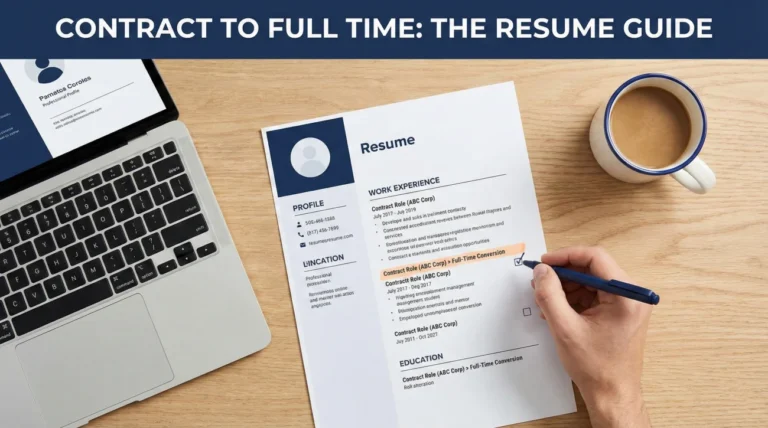
- You do not “claim” transferable skills in a career change. You translate old work into new-role proof using outcomes and artifacts.
- Build a one-page translation map: Old verbs, old nouns, old proof. Then swap nouns to match the target role while keeping the proof honest.
- Use routing rules: If a bullet sounds like a different profession, move it to Projects or Training and keep Experience bullets readable for the target hiring manager.
The real reason career-change bullets get ignored
I have seen a lot of career changers do the hard part: They actually have relevant proof. Then they lose the reader with bullets that sound like a different planet.
One candidate, Freyja, was moving from retail operations into customer success. Her resume said she had “strong stakeholder management.” That is a claim. Her bullets were all inventory and scheduling language. The hiring manager never got to the transferable part because the nouns never switched.
This article is about writing resume bullet points for career change that feel obvious, not hopeful. We will translate your past work into proof that matches the target role’s reality: The tools, the deliverables, the decisions, and the outcomes.
A simple translation method that does not require “making things up”
When someone says “transferable skills,” most candidates hear: Communication, teamwork, leadership. That is not wrong, but it is not helpful for bullets. Bullets need evidence.
Here is the method I use with career changers in practice. It works because it respects what you actually did, while changing how the reader interprets it.
Key Point: A career-change bullet is not a new story. It is the same story told with the target role’s nouns.
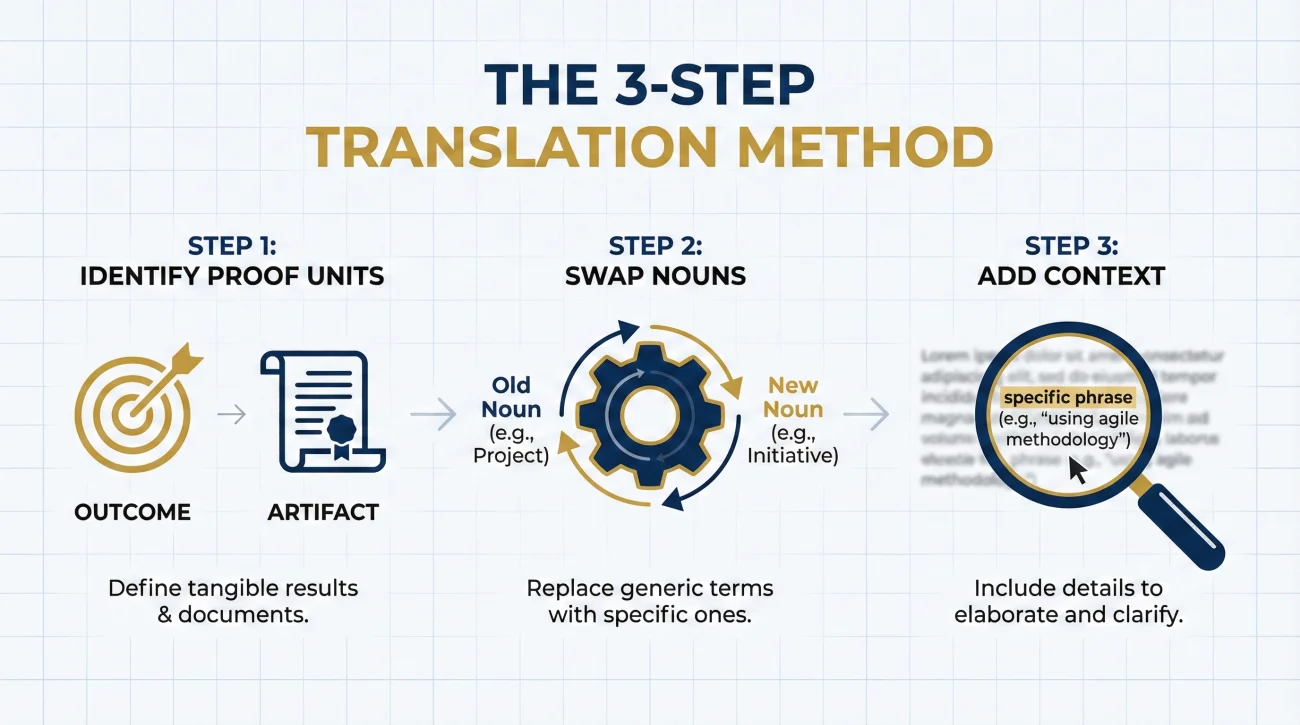
Step 1: Start with “proof units,” not “skills”
Pick a bullet from your current resume. Now underline anything that is proof. Proof usually falls into one of these “units”:
- Outcome: Revenue, retention, time saved, error rate, customer satisfaction, cycle time, cost reduced.
- Artifact: Dashboard, report, SOP, script, workflow, QA checklist, training deck, backlog, requirements doc.
- Decision: Prioritized, evaluated, negotiated, redesigned, approved, escalated, de-risked.
- Constraint: Limited budget, unclear requirements, tight deadline, compliance, cross-team dependencies.
If your bullet has no proof unit, it will read like a task list. That is where career changers get punished.
Step 2: Swap the nouns, keep the proof
The mistake is swapping verbs. Everyone swaps verbs. The real swap is nouns.
Example: “Managed store operations” is not wrong, but it is not a noun set that a customer success manager recognizes. The proof might be: Reduced escalations, improved onboarding, standardized playbooks, trained new hires, built a tracker.
💡 Pro Tip: If you can name the artifact, you can usually make the bullet feel “real” in the new field without inflating anything.
Step 3: Add one line of context only when the reader needs it
Career changers often want to explain everything. You do not need a paragraph. You need one clarifying fragment that helps the new hiring manager map your work.
Think: “High-volume environment,” “Regulated workflow,” “Cross-functional handoffs,” “Client-facing escalation,” “Weekly reporting cadence.”
Translation map: Old role to target role without pretending
This is the deliverable most articles skip. So here it is: A translation map you can reuse for any career change.
| What you did before | What it translates to in the new role | Proof to show in a bullet |
|---|---|---|
| Handled customer issues and escalations | Case management and risk triage | Escalation rate trend, resolution time, documented playbook |
| Trained new hires | Enablement and onboarding design | Training deck, checklist, ramp-time improvement |
| Built weekly reports | Operational metrics and stakeholder reporting | Dashboard, KPI definitions, cadence, decisions taken |
| Coordinated schedules and staffing | Capacity planning and prioritization | Coverage model, backlog reduction, forecast accuracy |
| Standardized a process | Workflow design and documentation | SOP, QA checklist, defect reduction, time saved |
| Worked with vendors | Partner management | SLA, renewal terms, performance scorecard |
If you are stuck, start by listing your artifacts. Most career changers have more artifacts than they think, they just never named them.
Routing rules: Where each translated bullet should live
Not every good bullet belongs in Experience. This is another place where career-change resumes fall apart: You cram everything into Work History and the reader thinks you are confused about your own target role.
| If your bullet sounds like | Put it here | How to label it so it reads clean |
|---|---|---|
| Direct match to target role outcomes | Experience | Keep nouns aligned to the target role |
| A “bridge” activity outside your job title | Projects | “Selected Projects” with 2 to 4 bullets |
| Learning, certification, coursework output | Training | Show deliverables: capstone, case study, portfolio |
| Volunteer, community, side work | Additional Experience | Use the same bullet style as Work History |
| Purely internal jargon from the old industry | Do not use as-is | Translate or cut, do not force the reader to decode |
⚠️ Warning: If more than half your Experience bullets require “translation” in the reader’s head, your resume will feel like a gamble. Move the best translated proof up, and quarantine the rest into Projects or Training.
Before and after: Bullet rewrites that keep the truth, change the read
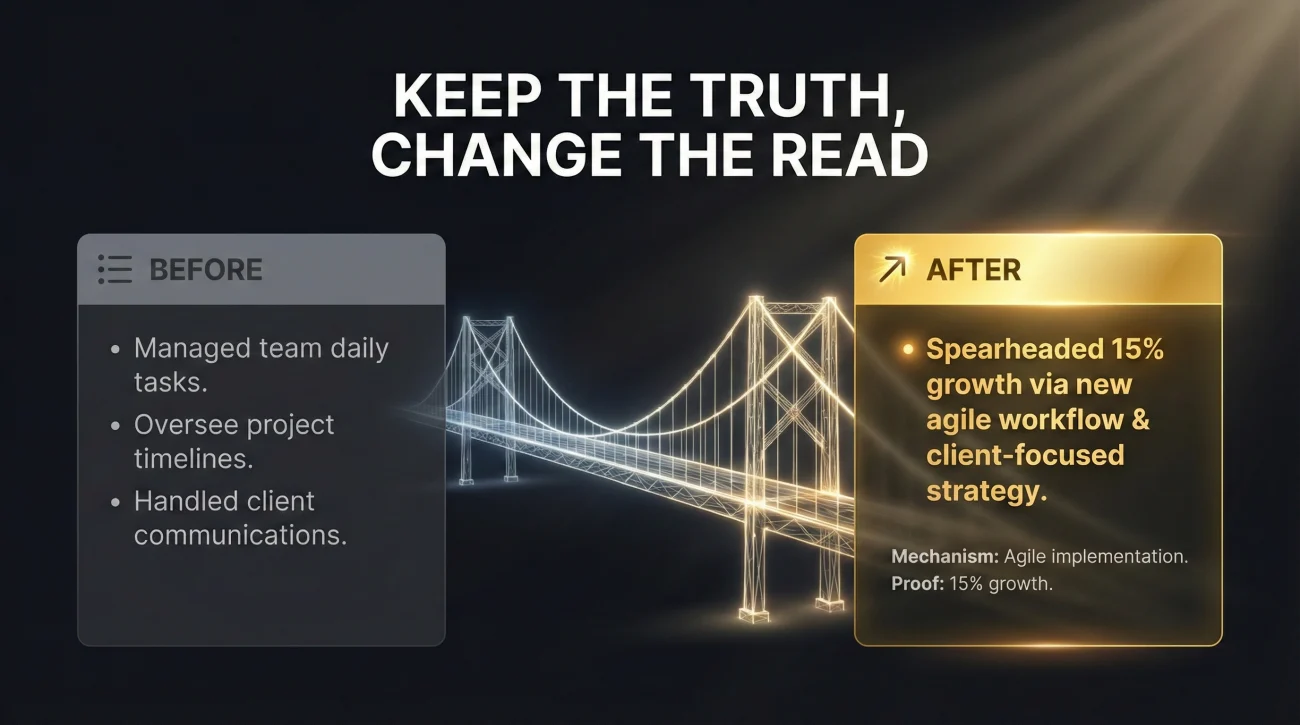
I will show you the exact rewrite pattern I use. Same work. Different interpretation.
What does a good career-change rewrite actually change?
It changes the nouns and the proof unit, not the story. Your reader should think: “That is basically my job,” even if your job title was different.
Notice what happened. The “after” version names a mechanism: A resolution flow. It suggests a measurable direction: Reduced escalation volume. It also shows behavior that maps to many roles: triage, documentation, coaching.
“I know my experience is different, but I promise I learn fast.”
I have heard that line in real conversations. It is honest, but it is not proof. Your bullets are where you replace “promise” with “evidence.”
20 translated bullet examples you can adapt
These are written to be “portable.” You can plug in your context, tool, and metric. Do not copy blindly. Copy the shape.
Group 1: Operations to project management
- Built a weekly capacity tracker to forecast workload and rebalance staffing, improving on-time completion during peak periods.
- Standardized handoffs across two teams by writing a simple SOP and checklist, reducing rework caused by missing inputs.
- Coordinated cross-team timelines for a multi-location rollout, tracking risks and dependencies to prevent last-minute delays.
- Turned recurring “urgent” requests into a prioritized queue with clear criteria, improving stakeholder trust and response consistency.
- Created a lightweight post-incident review note after major issues, capturing root causes and action items to prevent repeats.
Group 2: Teaching or training to L&D or enablement
- Designed an onboarding plan with weekly checkpoints and practice scenarios, helping new hires reach independent performance faster.
- Converted complex topics into a short guide and job aids, reducing repeated questions and improving consistency across the team.
- Facilitated skills coaching using observation notes and targeted drills, improving accuracy on core tasks over a 4-week cycle.
- Built a feedback loop by collecting learner questions and updating materials monthly, keeping training aligned to real gaps.
- Created a “common mistakes” reference and QA checklist that improved first-pass quality on graded or reviewed work.
Group 3: Customer-facing roles to customer success
- Owned escalation triage for high-impact issues, coordinating internal handoffs and keeping customers updated until resolution.
- Reduced repeat contacts by documenting top issue patterns and building quick scripts that improved first-response accuracy.
- Proactively identified at-risk accounts using simple usage and sentiment signals, initiating outreach before churn events.
- Built a short “getting started” guide for frequent requests, lowering onboarding friction and improving early customer confidence.
- Partnered with product or operations teams to relay recurring customer pain points, translating anecdotes into clear themes.
Group 4: Admin or coordination to analyst work
- Created a recurring report that tracked volume, cycle time, and error types, helping leaders spot bottlenecks in weekly reviews.
- Cleaned and standardized spreadsheet inputs to reduce reporting errors, improving data reliability for monthly decision-making.
- Mapped a process with timestamps and failure points, then recommended changes that reduced waiting time between steps.
- Built a simple dashboard view for stakeholders, aligning on definitions so decisions were based on the same metrics.
- Investigated unusual spikes by tracing inputs back to source, documenting findings and suggested fixes to prevent recurrence.
The mistakes that make a career change look like a risk

I want to call out the patterns that trigger doubt, because I have watched hiring managers react to them in real time.
Mistake 1: You keep the old industry nouns and hope the reader “gets it”
If your bullets are packed with internal terms, your resume feels like a translation task. Most readers will not do extra work when they have other candidates.
Mistake 2: You replace proof with personality
“Fast learner,” “self-starter,” “hard-working,” “passionate.” These might be true, but they are not proof units.
Mistake 3: You write “responsible for” bullets
“Responsible for” is the fastest way to make a career change sound like you did tasks, not outcomes. Even when you cannot quantify, you can still show mechanism: Built, simplified, documented, trained, reduced, prevented.
❌ Note: If you feel tempted to write “responsible for,” stop and ask: “What changed because I did that?” Then write that.
Final
Career changes feel hard on paper because resumes are built for linear stories. The fix is not more confidence language. The fix is translation.
If you take nothing else from this, take the translation map: Outcome, artifact, decision, constraint. When you can name those, you can rewrite almost any past job into bullets that make sense for the next one.
And if your resume is full of the old industry nouns, do not panic. You are not behind. You just have a language problem, and language problems are solvable, one bullet at a time. That is the heart of resume bullet points for career change when you want to look intentional without pretending you have lived the new job already.
❓ FAQ
🧭 How many bullets should I rewrite for a career change?
Rewrite the top 6 to 10 bullets that will be scanned first. Prioritize bullets that match the target role’s outcomes, not the oldest job on your resume.
🧩 What if I do not have numbers or metrics?
You can still show proof by naming artifacts and mechanisms. A playbook, a dashboard, a checklist, a training plan, a triage flow. Those are tangible and believable even without numbers.
🛠️ Should I copy keywords from the job description into bullets?
Mirror nouns that describe real work you actually did, but do not paste keyword clusters. If you cannot connect a keyword to a proof unit, it will read like padding.
🎒 Where do I put “bridge” experience like courses or side projects?
Put it in Projects or Training, and write bullets the same way you would in Experience. Show deliverables and outcomes so it does not look like hobby content.
🧠 How do I know if my translated bullet sounds honest?
Ask two questions: Could I explain the artifact in an interview? Could a coworker recognize the work from this sentence? If yes, it is usually honest and safe.
⚠️ Disclaimer: ResumeSolving provides resume, cover letter, job search communication, and career transition guidance for informational purposes only. Hiring practices vary by employer, role, location, industry, and individual circumstances. We do not guarantee interviews, job offers, ATS results, or other outcomes. Verify employer requirements directly and follow applicable laws and workplace policies. For sensitive situations, use only information you are comfortable disclosing and keep all statements accurate.