- Most bullet problems are not “writing” problems. They are trust problems.
- If you cannot use metrics, you can still show evidence through scope, constraints, artifacts, frequency, and decision points.
- Use the 18 red flags as a quick QA pass, then run the 12-minute self-check before you submit.
Why One Weak Bullet Can Poison an Entire Job Entry
Tiffany sent me a resume that looked “fine” at first glance. Strong title. Solid companies. Clean layout. Then I started reading the bullets, and something felt off. Not because the work was bad, but because the writing made it sound like she was hiding behind polished language.
When I asked what she actually did, the answers were specific and impressive. On paper, though, the bullets were foggy. A recruiter skimming fast would not stop to decode them. They would just move on.
That is the real cost of resume bullet points mistakes. They do not merely make you look less skilled. They make your story harder to believe. And once a reader feels doubt, they start reading your next bullets like a prosecutor, not a supporter.
In this guide, we focus on bullets only. Not formatting. Not ATS hacks. Not “power words.” Just the credibility red flags recruiters notice, and the fixes that make your work sound real without oversharing.
Key Point: A bullet is a tiny trust contract. If the reader cannot test it in their head, they assume it is inflated.
How Recruiters Actually Scan Bullets in Under a Minute
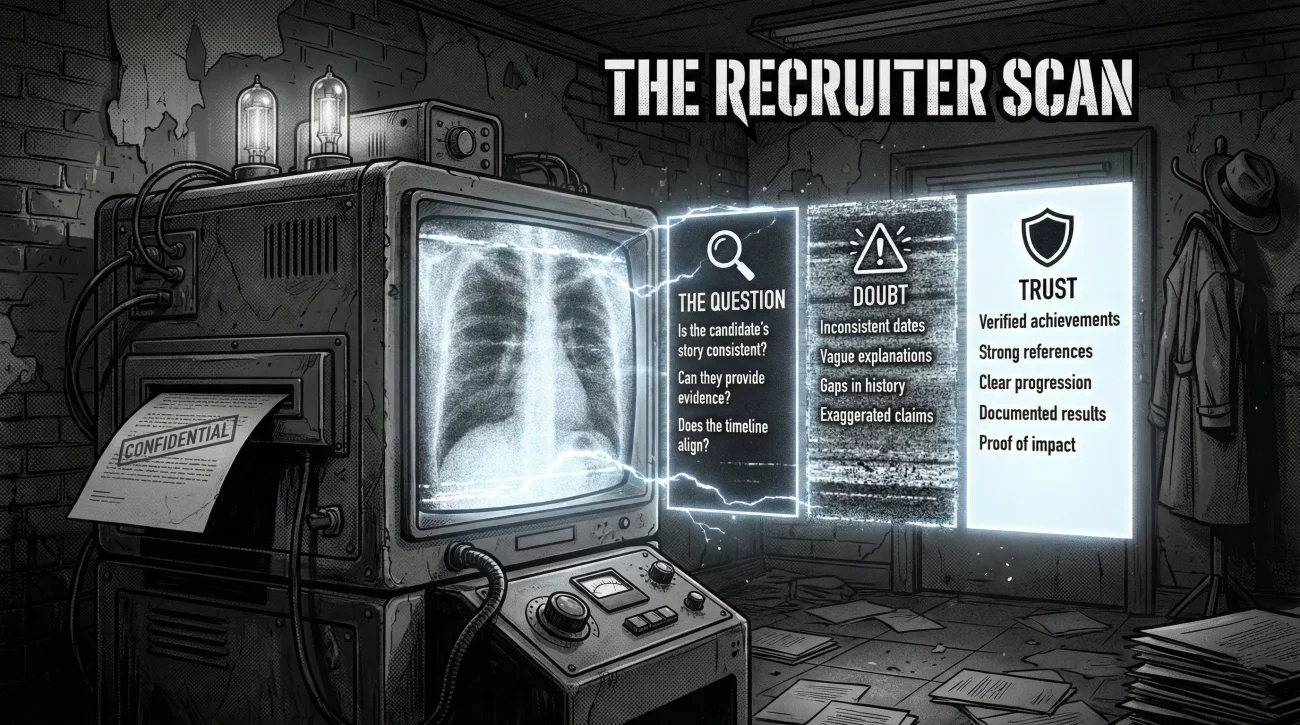
A lot of advice online repeats the same three lines: Use action verbs. Quantify. Keep it short. That is not wrong, but it is incomplete. The real filter is simpler and harsher: “Do I trust this person enough to spend another 30 seconds?”
A recruiter friend of mine, Lina, put it bluntly after a long day of screening: “If the bullets read like they could be copied into anyone’s resume, I assume the candidate is protecting themselves with language.” You can be honest and still trigger that reaction by accident.
| Silent question | What triggers doubt | What restores trust |
|---|---|---|
| Did you do the work this job needs? | Generic tasks, unclear scope, vague tools | Role-specific context, one clear mechanism, one boundary |
| Do you own the result or just touch it? | Soft verbs, passive voice, “involved in” language | Ownership, decision points, what you controlled |
| Can I picture what happened? | Buzzwords, abstract nouns, missing “after” | Concrete artifacts, constraints, what changed afterward |
So the goal is not to sound impressive. The goal is to make belief easy. Next, let’s walk through the red flags that quietly destroy that belief.
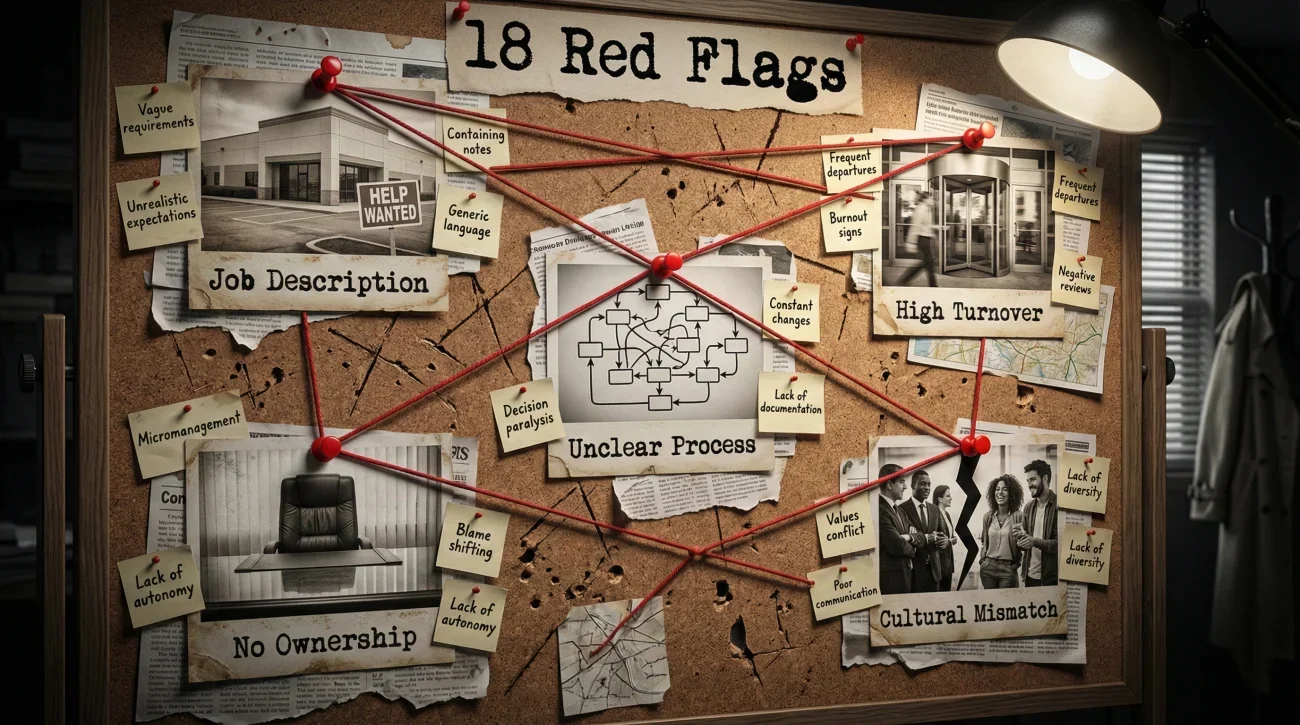
18 Red Flags That Make Your Bullets Feel Untrustworthy
Below are 18 patterns I see repeatedly in real resumes. Some are obvious. Some are subtle. Many come from good intentions: you are trying to be professional, you are trying not to brag, you are trying to keep it short. Unfortunately, the result can read as “vague on purpose.”
Instead of a robotic “red flag then fix” list, I grouped them by the type of doubt they trigger. That makes the rewrite faster because you can diagnose the problem in your own words.
Doubt Type 1: “This is a job description, not evidence”
These bullets often describe what the role is supposed to do. They sound normal, but they fail because they do not show what you changed, solved, improved, prevented, or delivered. They tell me you had a job, not that you did it well.
1) “Responsible for” openers. The reader learns your duties but not your contribution. Rewrite by starting with the action you took and the thing it affected.
2) Routine-only bullets. If every bullet is “handled, managed, maintained,” the role reads flat. Keep one routine line at most, then include at least one bullet that shows a shift: a fix, a recovery, a build, a decision, a launch.
3) “Worked on” bullets with no visible outcome. You can work on ten things and deliver nothing. Add the “after” in plain language.
4) Tool lists disguised as achievements. Tools are not impact. If a bullet is mostly software names, the reader still cannot picture value.
💡 Pro Tip: If you can replace the entire bullet with a job posting line and nothing changes, it is not doing its job.
Doubt Type 2: “I cannot tell what you actually owned”
This is where the resume starts to feel slippery. The candidate might be modest, but the reader interprets it as uncertainty. Ownership does not mean you were a manager. It means the reader understands your piece of the work.
5) Soft verbs that hide your contribution. Words like “assisted,” “helped,” and “supported” are not forbidden. They just need a boundary: What did you own inside that assistance?
6) Passive voice. “Was tasked with” or “was involved in” reads like someone else directed everything. Swap to active voice, even if the scope is small.
7) Leadership claims with no leadership behavior. Saying “led” is not enough. Show the behavior: prioritizing, unblocking, coaching, aligning stakeholders, resolving conflict, choosing tradeoffs.
8) Collaboration claims that never name a counterpart. “Worked cross-functionally” is empty without the who and why. Mention the partner team and the friction you solved.
“I can’t tell if you owned this or if you were in the room while it happened.”
That line is almost word-for-word from a hiring manager I know who reviews resumes between meetings. It is not cruel. It is practical. They need to reduce risk quickly.
Doubt Type 3: “This sounds impressive, but I do not believe the scale”
Sometimes the bullet is polished and confident, but the scope is floating in space. Big claims can be real, but if you do not include boundaries, the reader’s brain fills the gap with skepticism.
9) Unrealistic scope for your level. If you were an analyst but your bullet reads like you ran a department, add the boundary: one region, one product line, one quarter, one workflow, one portfolio.
10) Borrowed impact. “Grew revenue by 29%” can be true, but it often reads like you are claiming the company’s performance as your own. Tie it to the lever you controlled.
11) “Strategic” with no decision point. Strategy is a choice. Add the choice. What did you stop, start, or prioritize? What tradeoff did you manage?
12) Outcomes that stop one sentence too early. “Improved process efficiency” is a teaser. Even without numbers, you can describe the observable change: fewer handoffs, fewer escalations, faster turnaround, fewer errors, smoother onboarding.
Notice the “better” version does not scream. It simply becomes testable. The reader can imagine what changed.
Doubt Type 4: “This is too foggy to understand in one pass”
Recruiters do not read like a patient editor. They read like someone who is late to a meeting. If a bullet requires translation, it loses momentum.
13) Abstract nouns instead of plain objects. “Process improvements” and “stakeholder management” can mean anything. Name the process. Name the stakeholders. Describe the friction.
14) Buzzword stacking. If a bullet has three trendy phrases but no concrete object, it feels like a performance. Replace one buzzword with one real artifact: a playbook, dashboard, checklist, workflow, template, runbook.
15) Acronyms with no translation. Some acronyms are universal. Many are not. Keep the acronym, add a short translation once, then move on.
⚠️ Warning: If a bullet makes you sound smarter but makes the reader work harder, you are losing.
Doubt Type 5: “This looks careless, so I assume the work is careless”
Even strong content can get discounted by sloppy consistency. Hiring teams treat presentation as a proxy for attention to detail. That may not be fair, but it is common.
16) Mixed verb tense inside the same role. Past roles should read in past tense. Current roles can use present tense. Pick a rule and keep it consistent.
17) Punctuation and formatting chaos. Some bullets end with periods, some do not. Some have extra spaces. Some include random semicolons. These little things create a “messy” feeling.
18) Confidential details that create discomfort. Naming a sensitive client, exposing internal numbers, or revealing proprietary systems can backfire. You can keep credibility without leaking data by using ranges, relative change, or non-sensitive boundaries.
When Marcus, a compliance specialist, asked me how to keep bullets credible without risking confidentiality, we stopped chasing numbers and started adding context: frequency, constraints, and artifacts. The resume felt safer and more believable at the same time.
Rewrite Clinic: Turn Vague Bullets Into “I Can Picture It” Bullets
If you only take one section seriously, take this one. Most candidates do not need a full resume rewrite. They need a bullet rewrite that adds one visible anchor per line. Not ten anchors, just one.
Here are three common contexts, with a before and after that shows the same work in a more credible shape.
| Context | Before | After |
|---|---|---|
| Support role in a high-volume queue | Handled customer issues and improved satisfaction. | Cut repeat tickets by building a triage guide for the top issue types and coaching agents on escalation rules, reducing back-and-forth for the queue. |
| Analyst role with limited access to metrics | Provided insights to leadership using data. | Built a weekly performance dashboard that replaced manual reporting and made updates usable by the next morning for leadership check-ins. |
| Coordinator role across multiple teams | Worked cross-functionally to keep projects on track. | Kept parallel workstreams moving by running dependency check-ins, surfacing blockers early, and resetting priorities when scope shifted mid-sprint. |
What changed in the “after” versions is not vocabulary. It is the presence of something you can verify: a mechanism, a routine, a boundary, a visible change. That is how you avoid the common trap where advice online pushes you to “sound stronger” but accidentally makes you sound less believable.
If You Have No Metrics, Use Proof Substitutes That Still Feel Real

A lot of mainstream advice insists on quantifying everything. In reality, many people cannot. Sometimes the data is not shared. Sometimes the impact is indirect. Sometimes the industry is sensitive. The fix is not to invent numbers. The fix is to make the claim testable without numbers.
| Proof substitute | What it communicates | How it looks inside a bullet |
|---|---|---|
| Scope | Your work had a real surface area | “for 12 accounts”, “across 3 regions”, “supporting 40 locations” |
| Constraint | This was not generic work | “during a system migration”, “under strict compliance rules”, “with limited headcount” |
| Artifact | You produced something concrete | “playbook”, “runbook”, “dashboard”, “QA checklist”, “training guide” |
| Frequency | This was repeatable, not a one-off | “weekly”, “per release”, “daily queue”, “monthly close” |
| Decision point | You had ownership, not proximity | “set priorities”, “chose approach”, “approved changes”, “resolved tradeoffs” |
When you use one of these substitutes, you are giving the reader a handle. They can grab it and say, “Okay, I get what this person did.” That is the opposite of vague confidence.
The 12-Minute Bullet Self-Check Before You Hit Submit
Here is a quick routine I use when I am reviewing a resume that already has decent content but still feels “slippery.” It is fast because it does not require creativity. It requires honesty and small edits.
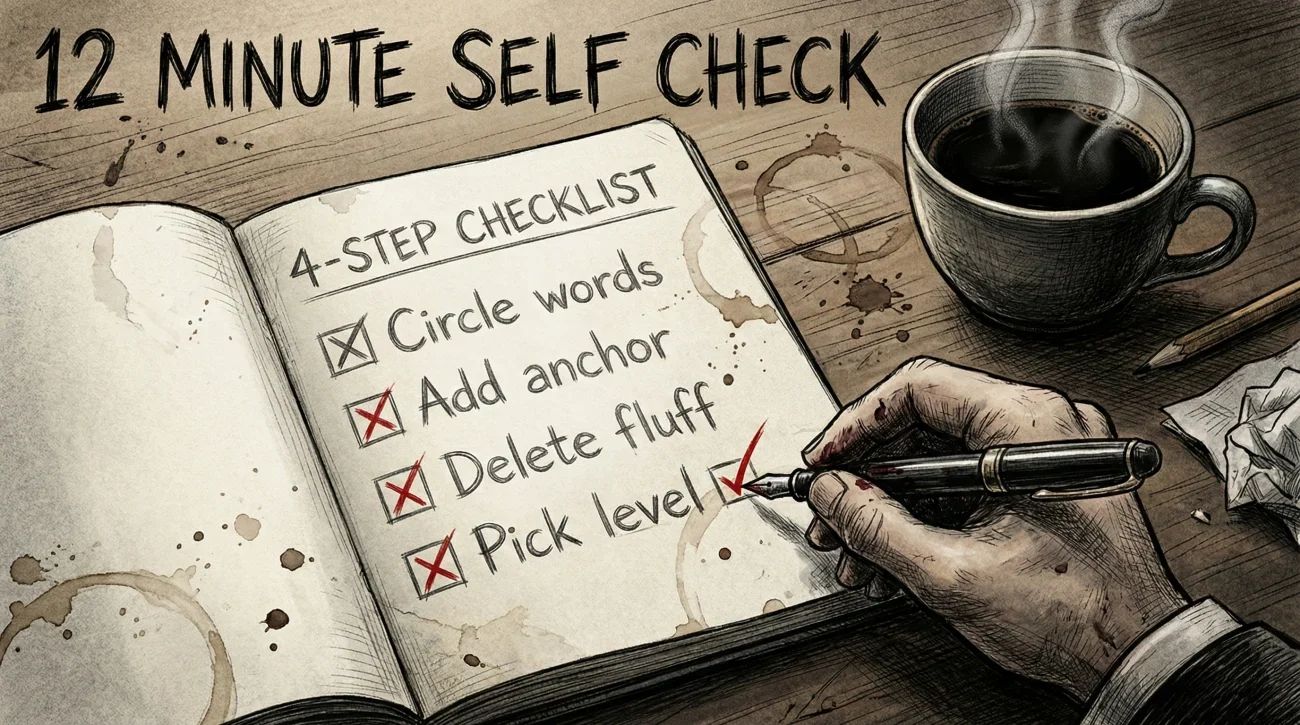
Step-by-step edit routine
Step 1: Circle your “claim words.” These are words like improved, optimized, streamlined, led, managed, strategic. They are fine, but they need grounding.
Step 2: For each circled claim, add one anchor. Pick one: scope, constraint, artifact, frequency, or decision point.
Step 3: Delete any bullet that could fit three different roles without changing a word. Replace it with a specific mechanism or event.
Step 4: Choose one anchor bullet per job entry. Make it the bullet that proves your level, not your busyness.
- ✅ Each bullet contains one clear action.
- ✅ Each bullet contains at least one anchor the reader can test.
- ✅ Each job entry has one “anchor bullet” that proves level.
- ✅ Tense is consistent within the job entry.
- ✅ No bullet relies on buzzwords as the main content.
If you do this honestly, the resume starts to read like a record of real work, not a collection of professional-sounding phrases. That is the line between “fine” and “I trust this.”
Final: What Credible Bullets Sound Like
Credible bullets are rarely dramatic. They are specific, bounded, and easy to picture. They do not try to win with intensity. They win with clarity and traceable detail.
If you want a simple mental rule: write bullets like you expect a follow-up question, and you want to answer it without scrambling. That pushes you toward real anchors and away from fog.
Fixing resume bullet points mistakes is not about polishing. It is about removing the tiny signals that make a reader hesitate.
❓ FAQ
🎯 How many bullet points should I include per job?
For recent roles, 3 to 6 bullets is a practical range. Older or less relevant roles can be shorter. The better rule is: keep enough bullets to prove level, then stop before you bury the strongest one.
🧠 Do I need numbers in every bullet?
No. Numbers help, but they are not the only way to show impact. If metrics are unavailable, add proof substitutes like scope, constraints, artifacts, frequency, and decision points.
🧩 Is “assisted” always a bad word on a resume?
Not always. It becomes a problem when it hides what you actually owned. If you assisted, specify your piece: built the tracker, wrote the playbook, handled escalations, created the checklist, trained the team.
🔍 What is the fastest credibility killer in bullets?
Bullets that read like a job posting. They tell the reader you had duties, but they do not show outcomes, mechanisms, or boundaries. That makes the entry feel generic.
🔒 What if my work is confidential or under NDA?
Keep credibility without exposing sensitive details. Use ranges, relative change, or non-sensitive anchors like “weekly dashboard,” “runbook,” “triage guide,” and “escalation rules.”
✅ How do I know my bullets feel believable?
Ask yourself: Could I answer a follow-up question on this bullet in 10 seconds? If yes, it usually reads credible. If no, add one anchor so the reader can picture the work.
⚠️ Disclaimer: ResumeSolving provides resume, cover letter, job search communication, and career transition guidance for informational purposes only. Hiring practices vary by employer, role, location, industry, and individual circumstances. We do not guarantee interviews, job offers, ATS results, or other outcomes. Verify employer requirements directly and follow applicable laws and workplace policies. For sensitive situations, use only information you are comfortable disclosing and keep all statements accurate.