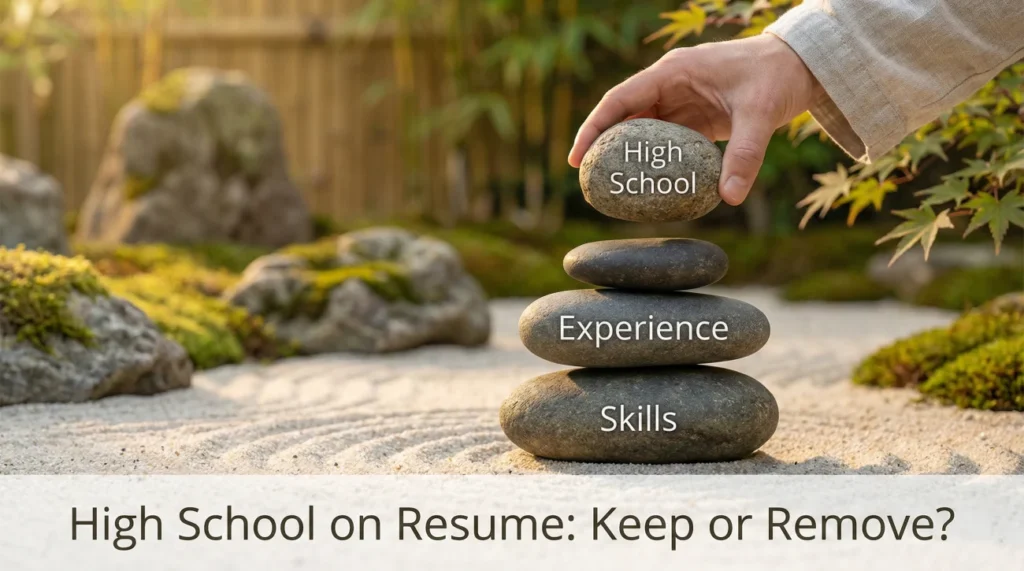
- If you have a college degree, high school usually adds zero value and can quietly age you.
- If high school (or GED) is your highest credential, keep it, but tighten the wording and remove dates that invite assumptions.
- The goal is not to hide the truth. It is to stop Education from stealing space and sending the wrong “career stage” signal.
High School on a Resume: When to Remove It and What to Use Instead
I once reviewed a resume for a candidate named Fiona who had fifteen years of operations experience. Her bullets were solid. Her scope was real. But the top third of the page screamed “early career” because her Education led with a high school entry, complete with a graduation year from the early 2000s.
Nothing about her work suggested she was out of date. The resume just made it easy for a tired reader to make lazy assumptions. That is why people ask about remove high school from resume rules in the first place. They are not trying to erase their past. They are trying to keep the document from telling the wrong story.
This guide is a decision map, not a motivational speech. I will show you when high school belongs, when it should disappear, and what to put in its place so your resume reads modern, clean, and credible.
What “High School” Accidentally Signals in Modern Screening
Recruiters do not consciously “grade” your high school. They interpret it as a clue. That clue can be harmless, or it can trigger a fast mental shortcut.
| What you meant | What it can signal | How to neutralize it |
|---|---|---|
| Baseline education | You do not have anything more recent | Replace space with training, certifications, or current tools |
| Completion and stability | Your timeline is easy to “age” by dates | Remove graduation years unless you are a true recent grad |
| Local credibility | You are anchoring to the past instead of recent results | Move Education below experience and keep it minimal |
💡 Pro Tip: Education is not a biography. It is evidence. If a line does not help a hiring manager say “Yes,” it is just noise.
When people search high school on resume advice, they are usually dealing with one of two problems: space is tight, or the resume is accidentally broadcasting career stage.
Decision Rules: When to Remove High School From Your Resume
Here is the simplest way I teach this to candidates: your resume should show your highest, most relevant credential, then get out of its own way.

Keep high school if it is your highest completed education
If you do not have a college degree, high school (or GED) is still a valid credential. In many industries, it is the gatekeeper requirement.
In that situation, the question is not “Should I delete it?” The real question is: “How do I list it without letting it dominate the page?” We will cover examples in a later section.
Remove high school once you have a higher credential and real experience
If you completed a college degree, your high school entry rarely improves your candidacy. It often does the opposite: it adds a date anchor, and it consumes space that could be used for measurable work outcomes.
This is the moment most people mean when they ask do i need to list high school on resume. In most cases, the answer becomes “No,” not because high school is shameful, but because it is no longer useful.
Exceptions where a high school line can still make sense
There are a few cases where keeping it is reasonable:
- ✅ You are still in college and high school is your only completed education.
- ✅ The role explicitly requires a diploma and you want to avoid any doubt.
- ✅ Your high school credential is tied to a trade pathway, apprenticeship, or licensing track.
- ✅ You are changing countries and the employer may not recognize the naming of your secondary credential.
⚠️ Warning: “It was a prestigious school” is not a strong exception unless it is directly relevant to the role or network. On a resume, prestige that does not translate into job proof often reads like filler.
Common Scenarios and the Cleanest Way to Handle Each
Scenario 1: High school (or GED) is your highest credential
I worked with a warehouse lead named Kobe who had grown into a supervisor role without formal college. His resume kept getting filtered out because his Education looked thin and his skills section was generic.
We kept the high school credential, but we made it small, date-light, and we used the saved space to show current training and measurable results. His Education became a checkbox, not the headline.
If you are in this scenario, you can absolutely list a high school diploma on resume. Just do it in a way that does not invite a timeline audit.
Scenario 2: Some college, no degree completed
This is where many resumes become messy. People list high school, then list college, then add dates for both, and the reader starts doing math.
A cleaner approach is to emphasize the highest completed credential (high school or GED) and then list college as “Coursework” or “Studies,” without framing it as a finished degree. That prevents the “unfinished story” feeling.
Scenario 3: Trade, certifications, or licensing matter more than school
In skilled trades, healthcare support roles, and many operations jobs, certifications and licenses are more predictive than where you went to school.
In those roles, Education should be short, and your certifications should be easier to find than your high school entry. If your page still leads with high school, you are not helping the reader.
Scenario 4: International education naming causes confusion
A colleague of mine in HR once rejected a candidate by mistake because the education label looked unfamiliar. The candidate had a valid secondary credential, but it was presented in a way that sounded like incomplete schooling.
If you are in a cross-country context, the goal is clarity. You can keep the credential, but label it in employer-friendly terms and remove unnecessary year markers.
What to Put Instead of High School (So the Space Still Works for You)

When you remove a high school line, you are not just deleting text. You are reclaiming space. That space should become proof that you are current.
High-value replacements that read “modern”
- 📌 Recent certifications (even short ones) tied to the role
- 🧠 Tools or systems training that matches the job environment
- 🧾 Compliance, safety, or industry credentials that reduce risk
- 📈 A stronger project or achievement bullet that shows impact
💡 Pro Tip: If you want a “current signal,” list something from the last 12 to 24 months. It can be a course, a certification, or a work achievement. The point is recency.
Examples: Clean Education Sections With and Without High School
Below are practical examples you can copy and adapt. Notice the pattern: short, clear, and no extra math for the reader.
If you have a college degree: Remove high school entirely
Relevant Coursework: Digital Marketing, Research Methods
Certifications: CompTIA A+ (2024)
If high school is your highest credential: Keep it, but compress it
(No graduation year listed)
Safety Training: OSHA 10 (2025)
If you have some college: Be honest, but do not frame it as a degree
Focus: Accounting fundamentals, Excel reporting
❌ Note: Avoid “Expected graduation” unless you are actively enrolled and it is true. Screening teams do verify.
Mistakes That Make Recruiters Worry You Are Not “Current”
Most candidates do not lose interviews because of high school itself. They lose them because high school is packaged in a way that signals outdatedness, uncertainty, or an easy age calculation.
Mistake 1: Leaving graduation years that invite age assumptions
If you are not a recent graduate, dates in Education are rarely needed. They often create bias, even when the rest of the resume is strong. If you are deciding whether to remove dates, this question helps: “Does the year increase trust, or does it increase guessing?”
Many people ask about remove graduation year from resume education because they have felt this bias firsthand. The fix is simple, and it is usually safe: remove the year unless it is genuinely relevant for entry-level hiring.
Mistake 2: Filling Education with old awards and activities
Scholarships from high school, clubs, and sports can be meaningful personally, but on a professional resume they often read like you ran out of recent proof.
If you want to keep one item, keep only what is still recognized widely and genuinely relevant. Otherwise, swap it for recent training or outcomes.
Mistake 3: Putting Education above experience when experience is your strength
If you have years of experience, your resume should lead with what you have done, not where you went to school. Education can sit below experience without hurting you.
💡 Pro Tip: When experience is strong, place Education after Work Experience. It reduces “career stage” bias in the first scan.
A Quick Checklist Before You Delete Anything
This is how I keep candidates from making “cleanups” that create new problems.
- 🧾 Does the job explicitly require a high school diploma or GED?
- 📚 Do you have a higher completed credential that already covers that requirement?
- 🧠 If you remove high school, what recent proof will replace the space?
- 🧩 Is your Education section free of dates that invite timeline math?
- 📌 Is the section placed where it supports your story, not where it distracts from it?
Final
Most people do not need to “protect” their high school entry. They need to protect the story their resume tells in the first ten seconds. If you have a higher credential or substantial experience, high school usually becomes clutter. If high school is your highest credential, it still belongs, but it should be small, clear, and date-light.
The best rule is this: make Education a proof section, not a timeline. That mindset alone solves most of the anxiety behind remove high school from resume decisions, especially when you are trying to avoid age signals without creating credibility gaps.
❓ FAQ
🎯 Should I put my high school on my resume if I have a college degree?
Usually no. Your college degree is the higher credential, and high school rarely adds value. Removing it also reduces the chance of age assumptions based on dates.
🧾 What if the job posting says “high school diploma required”?
If you have a higher credential, that requirement is already covered. You do not need to list high school to prove you meet it. If high school or GED is your highest credential, keep it, but keep it compact.
🧠 Do I need to list high school on resume if I have some college but no degree?
List your highest completed credential, then describe college as coursework or studies without implying a completed degree. This keeps you honest while avoiding a confusing Education story.
📌 Should I include my high school graduation year?
If you are not a recent graduate, you can usually remove the year. Dates often create unnecessary assumptions and do not improve your qualification signal.
✅ I removed high school. What should replace it so my resume still feels complete?
Add something current: a certification, role-relevant training, tools knowledge tied to the job, or an additional achievement bullet. The goal is for the top half of the resume to read “present-day capable.”
⚠️ Disclaimer: ResumeSolving provides resume, cover letter, job search communication, and career transition guidance for informational purposes only. Hiring practices vary by employer, role, location, industry, and individual circumstances. We do not guarantee interviews, job offers, ATS results, or other outcomes. Verify employer requirements directly and follow applicable laws and workplace policies. For sensitive situations, use only information you are comfortable disclosing and keep all statements accurate.