- The “10 to 15 years” rule is a starting point, not a strategy.
- Your real job is to balance relevance, credibility, and age-signal risk.
- Use an “Earlier Experience” block so you can keep continuity without turning your resume into a biography.
Why This Question Gets People Rejected for the Wrong Reason
I once worked with a candidate named Molly who did everything “right” according to common advice. She cut her resume to the last 10 years, kept it clean, and removed anything that looked dated. She also kept getting the same vague feedback: “Strong background, but not quite what we need.”
The problem was not her experience. The problem was the story her timeline accidentally told. By trimming too aggressively, she erased the proof that she had done the kind of large-scope work her target roles quietly required.
That is why how far back should a resume go is not a formatting question. It is a risk-control question. You are deciding what the reader is allowed to assume about you, based on what you left in and what you left out.
Key Point: A resume is an evidence file. If you remove the evidence, the reader fills the gap with assumptions.
Two Decisions Hiding Inside One Simple Question
Decision 1: How much history proves you are qualified right now?
Most articles repeat the same guidance: Focus on roughly 10 to 15 years, unless older experience is unusually relevant.
That guidance is not useless. It is just incomplete. Because “qualified right now” depends on your target role. Some roles reward recency above all. Others reward pattern depth, meaning the same type of problem solved repeatedly over time.
If you are applying for roles where the job description implies scope and repetition, cutting too far back can make you look like a fast riser with thin proof, even if your career is actually solid.
Decision 2: How much history creates age-signal risk or scope noise?
The older your timeline looks, the more likely the reader starts doing math. That is not fair, but it is common. This is why “older worker” advice often recommends removing graduation dates or compressing early roles.
At the same time, if you remove too much, you can trigger a different kind of doubt: “Why is their history so short?” or “Are they hiding something?” The goal is not to look younger. The goal is to look current, credible, and easy to place.
💡 Pro Tip: Your “range” is not one number. It is a shape: Detailed recent roles, lighter mid-career, compressed early career.
A Practical Range Rule That Survives 2026 Hiring
If you want a baseline, a detailed 10 to 15 year window is a reasonable starting point for many roles. The mistake is treating it like a universal law.
Now here is the upgrade: Instead of asking “How many years?”, ask “How many proof cycles?” A proof cycle is one full loop of doing the work, scaling it, and being accountable for outcomes. Senior roles often require more cycles than junior roles.
To make this concrete, use the table below as a starting framework. Then adjust based on your scenario in the next section.
| Career level and hiring context | Recommended detail range | How to show earlier years without clutter |
|---|---|---|
| Early career (0 to 5 years) | List everything relevant, even if it is only a few roles | Keep bullets tight, show outcomes, avoid filler duties |
| Mid-career (6 to 12 years) | Usually 8 to 12 years in full detail | Add one compressed “Earlier Experience” line if it strengthens the story |
| Senior (13 to 20+ years) | Often 10 to 15 years in full detail, plus a compressed earlier block | Use a short list of earlier roles, titles, and companies with minimal bullets |
| Executive or division-level scope | Enough history to prove repeated leadership at scale | Keep early roles as “Selected Earlier Leadership” with one proof line |
| Regulated or credential-heavy fields | Range depends on licensing and continuity expectations | Prioritize compliance, audits, safety records, or credential-relevant roles |
Notice the pattern: Even when you cut detail, you do not erase your career. You control the level of detail.
If you are early in your career, treat the early career section on resume like your proof engine. The goal is not to look “experienced.” The goal is to look solid, current, and clearly progressing.
Also, if you are explicitly worried about age optics, you are not alone. The most reliable approach is not “hiding.” It is building a timeline that reads modern and relevant, without inviting unnecessary math.
How to Cut Years Without Cutting Your Credibility
Here is the move I see work best in real hiring loops: Keep recent roles detailed, then create a deliberately boring, compressed block for older roles. Boring is good here. It signals closure and avoids accidental rabbit holes.
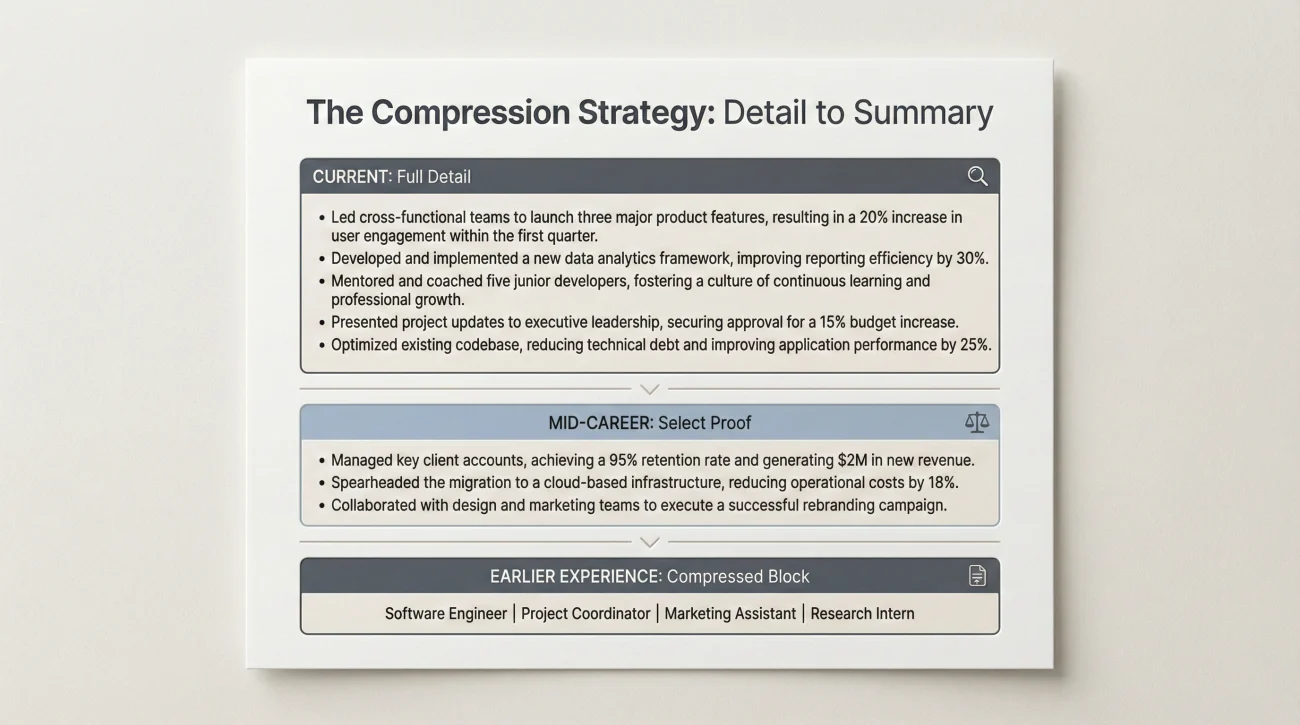
Use an “Earlier Experience” section that does not invite debate
This is where you can safely include resume how far back information without turning your resume into a timeline dump. You are giving the reader continuity, not extra homework.
Director of Operations, Delta Systems (Earlier Career)
Operations Manager, Northlake Manufacturing
Team Lead, Supply Chain Analytics
⚠️ Warning: If you compress older roles, do it consistently. Randomly compressing one job but detailing the next older job can look like you are hiding something.
Make bullets fade with time, not disappear
A common mistake is deleting older achievements entirely. The better approach is to keep one proof bullet for the oldest role you still want to “count,” then fade everything earlier into titles only.
– Reduced churn from 7.2% to 4.8% by rebuilding onboarding and renewal motions
– Led a 22-person team across AMER and EMEA with quarterly performance planningDirector, Customer Success | Brightline SaaS | 2016 to 2019
– Built the first scaled CSM playbook and health scoring modelEarlier Experience: Account Management, Client Services Leadership (details available on request)
This approach supports resume years of experience credibility while protecting you from irrelevant detail that drags the reader backward.
“I can’t tell if this person is still doing modern work, or if they peaked a decade ago.”
That is a line I have heard, almost word-for-word, in debrief conversations. It is not always said with cruelty. It is often said because the resume made it hard to see current proof fast.
Scenarios That Change the Cutoff, and Exactly What to Do
If you are executive-level, “10 years” can backfire
An executive resume is not judged like an individual contributor resume. The reader is scanning for repeatable leadership patterns: Scale, complexity, accountability, and resilience. In that world, “how far back should a resume go for executive” often means “how many big cycles have you led?”
I worked with a VP named Dawson who kept cutting his older work because it felt “too old.” The twist: His best proof of transformation work was 16 years back, and it matched the exact transformation language in the new role. We kept it, but we compressed it into one line under a “Selected Transformation Work” block. He stopped getting screened out as “too narrow.”
If you are changing careers, go back far enough to prove the bridge
Career change resumes often fail because the candidate only shows the last few years, and those years look “off target.” If the bridge experience is older, you may need to reach back. The trick is to pull the bridge forward using a summary line, not to rebuild your entire timeline.
Example: A former project manager moving into HR operations might need one older program leadership role to prove cross-functional influence. Add it as a single compressed proof line, and keep the rest minimal.
If you have lots of short contracts, stop counting by years
For contractors, how many years on resume is the wrong unit. The reader cares about project types and outcomes. If you list 18 short roles, the resume becomes unreadable fast.
Instead, group by theme: “Selected Engagements” or “Representative Projects,” and then include only the last few years of individual entries. Everything older becomes a short proof list.
If your field is regulated, continuity matters more than freshness
In regulated environments, older experience can still carry weight because it proves you have lived through audits, compliance cycles, or operational risk events. In those cases, trimming too aggressively can make you look untested.
Keep the roles that prove continuity and responsibility, then compress the rest. The resume should still feel modern in format and language, but not amputated.
❌ Note: This article is not legal advice. If you are dealing with a highly regulated hiring process with strict disclosure rules, follow the employer’s requirements first.
A Simple Checklist to Decide Your Resume Experience Range
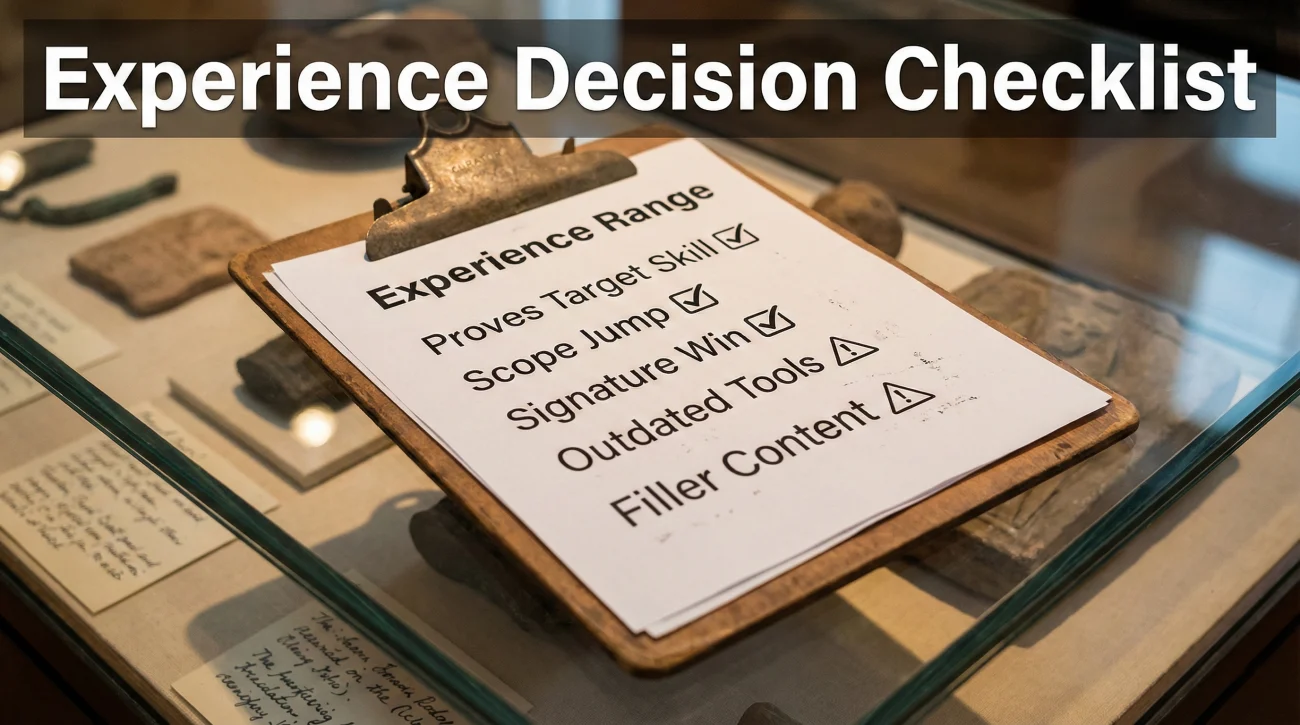
Use this as a quick decision tool when you are stuck in “cut or keep” mode. It helps you define your resume experience range without guessing.
- ✅ Does this role prove a skill the target job explicitly demands?
- ✅ Does it show a scope jump that makes your current level believable?
- ✅ Does it contain a “signature win” you can summarize in one line?
- ⚠️ Does it introduce outdated tools, outdated titles, or older terminology?
- ⚠️ Does keeping it create an extra page with low-value detail?
- ❌ Would the reader learn more from one additional recent bullet instead?
One overlooked reality: applications can require more than your resume
Some companies will ask for a fuller work history in the application form, even if your resume is compressed. Candidates run into this often and think they have done something wrong.
The practical fix is simple: Keep a master document with full history, then build a targeted resume from it. Your resume stays readable, and you can still complete forms accurately when needed.
Final
If you take nothing else from this, take this: The best answer to “how far back” is the one that preserves proof, reduces noise, and avoids inviting the reader to do math in the margins. When you control detail by time, you stop arguing with rules of thumb and start building a timeline that reads like confidence.
In modern screening, the cleanest approach is usually a detailed recent decade, a lighter mid-career fade, and a calm compressed block for earlier roles. If you want to align that approach with the broader expectations of how far back should a resume go, treat your timeline like a product: Keep what helps the buyer decide, and remove what only proves you have been around.
❓ FAQ
🧭 Is it wrong to include more than 15 years of experience?
No. It is only wrong if those older years add noise, trigger outdated impressions, or crowd out your most relevant proof. For senior roles, a compressed earlier block often improves credibility.
📌 What if the job requires “20+ years” experience?
Then you should show enough history to make that requirement believable. You do not need 20 years of detailed bullets, but you likely need visible continuity plus a few leadership cycles that support the claim.
🧩 Should I remove my graduation year to avoid age bias?
If it is not recent and not required for your field, removing the year is common. The bigger win is controlling how much older timeline detail you display, so the resume stays current and easy to place.
🛠️ How do I handle lots of short jobs without looking unstable?
Group work by theme or engagement type and show representative projects. Keep the most recent roles clearer, and compress older contracts into a single “Selected Engagements” block.
🧾 If an application asks for full history, should my resume match it?
No. Your resume is a marketing document. The application form is a record. Keep a master history file for forms, and keep your resume targeted and readable.
⚠️ Disclaimer: ResumeSolving provides resume, cover letter, and job search communication guidance for informational purposes only. It is not legal, medical, financial, or professional counseling advice. Hiring decisions vary by company, role, location, and individual circumstances, so we do not guarantee interviews, offers, or outcomes. Always use your own judgment, verify requirements directly with the employer, and follow local laws and workplace policies. When a situation is sensitive, we prioritize privacy-safe, recruiter-appropriate wording, and you never need to share personal details you are not comfortable disclosing.