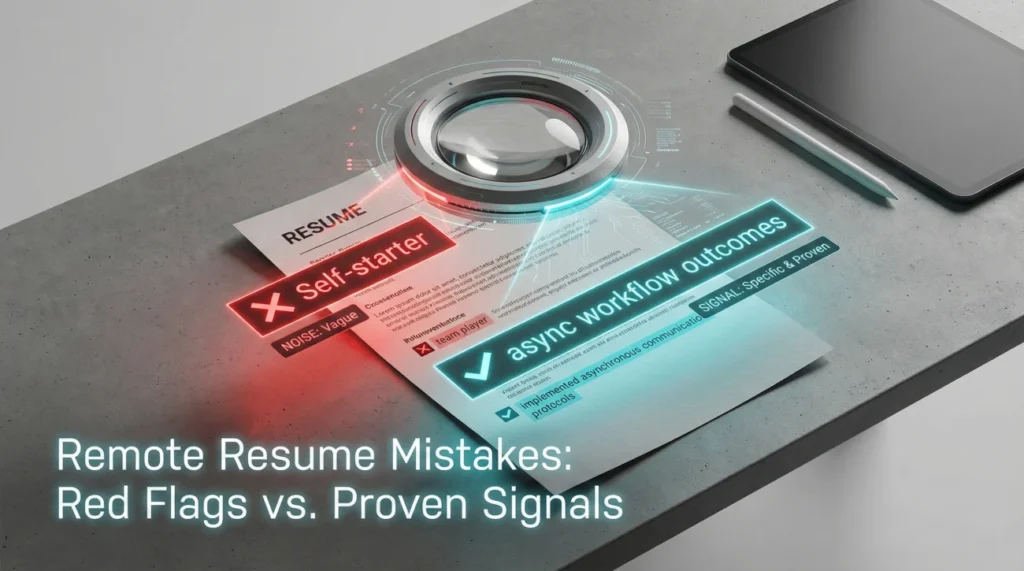
- Most “remote” resumes fail because they claim independence but don’t prove it with outcomes, artifacts, or workflow signals.
- These 15 remote red flags are less about tools and more about credibility, ownership, and how you work when nobody is watching.
- You can fix nearly all of them with proof-based bullets and a 5-minute self-audit before you apply.
Remote Resume Mistakes Are Usually Signal Mistakes, Not Skill Mistakes
I once screened two candidates for the same fully remote ops role. Both were qualified. Both had similar titles. One got an interview the same afternoon. The other didn’t make it past the first skim.
The difference was not “more experience.” It was proof. The stronger resume quietly answered the recruiter’s unspoken question: “If I leave you alone for eight hours, will work still move forward?”
If your resume is drifting into vague claims, tool dumping, or mixed signals, recruiters translate that into risk. This guide breaks down remote work resume mistakes the way a hiring team actually reads them, then shows how to fix each one without sounding rehearsed.
What Recruiters Are Really Testing in a Remote Resume
Remote screening is less forgiving because the downside feels bigger. In an office, a manager can course-correct you quickly. In remote work, drift can last days. So recruiters scan for signals that reduce uncertainty.
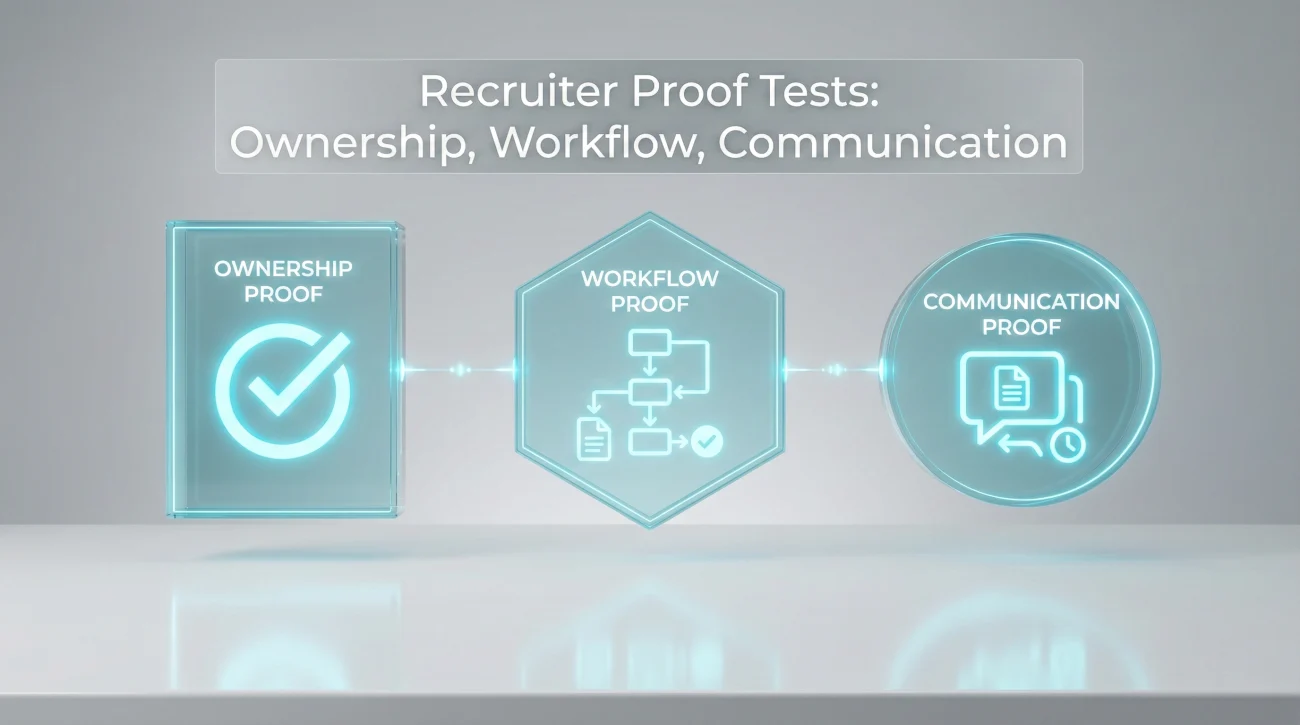
In practice, they look for three categories of proof:
- Ownership proof: You close loops, not just “support projects.”
- Workflow proof: Your work travels through systems, documentation, and predictable updates.
- Communication proof: You communicate clearly in writing, especially when things go wrong.
💡 Pro Tip: If you can attach a measurable outcome to a remote behavior, it stops being a “trait” and becomes evidence.
15 Remote Resume Red Flags and Exactly How to Fix Them
I’m going to be blunt here because it helps. Recruiters don’t reject you for using the word “self-starter.” They reject you because it often shows up when the resume has no proof of independent execution.
| Red flag | What it signals | Fix that works |
|---|---|---|
| “Self-starter” with no examples | Claims without evidence | Add one bullet showing you shipped outcomes without constant check-ins |
| Tools listed like a shopping receipt | You rely on tools to sound remote-ready | Mention tools only inside achievements or workflow context |
| “Excellent communication” but bullets are vague | Talking about communication instead of doing it | Show written update cadence, documentation, or decision clarity |
| Remote roles not labeled as Remote or Hybrid | Recruiter can’t confirm remote exposure quickly | Tag the job line clearly, then prove remote behaviors in bullets |
| All bullets are meetings and coordination | You might be a passenger, not an owner | Replace “attended” bullets with outcomes, decisions, and closures |
| Heavy collaboration language, zero async proof | You may require synchronous time to function | Add one bullet on async updates, decision logs, or handoffs |
| No metrics anywhere | Hard to trust impact when remote | Use small metrics: cycle time, backlog, response time, error rate |
| “Managed distributed team” but no details | Possibly inflated leadership claim | Specify time zones, team size, cadence, and outcome |
| Inconsistent timeline or unclear overlaps | Risk of confusion, poor attention to detail | Fix chronology and keep dates clean and consistent |
| Too much personality, not enough signal | Reads like a bio, not a work record | Move “traits” into proof bullets and outcomes |
| Remote experience buried under unrelated bullets | Recruiter misses the remote fit | Put remote proof in the first 2 bullets of each relevant role |
| “Fast-paced startup” everywhere | Buzzwords, not clarity | Translate buzzwords into constraints you handled and results you got |
| Overclaiming availability or “24/7” energy | Boundary issues, burnout risk | Use reliability language: SLA, response windows, clear handoffs |
| No documentation footprint | Harder to trust async collaboration | Add proof: playbooks, SOPs, knowledge base, runbooks |
| Generic summary that fits any job | Low intent, low match | Write a summary that mirrors the role’s remote reality |
🗝️ Key Point: Remote resumes get rejected when they read like “trust me.” They get interviews when they read like “here’s how work moved because of me.”
Before and After Bullets That Remove Remote Doubt
A colleague of mine, Yoshie, hires for remote customer operations. She told me something that stuck: “If I can’t tell how you communicate and close loops, I assume you don’t.” That’s why wording matters.
Example 1: Replace “Meetings” With Outcomes
Example 2: Turn “Self-Starter” Into Proof
Example 3: Mention Tools Only When They Explain Workflow
⚠️ Warning: If you add metrics that you cannot explain in an interview, the resume becomes a liability. Use small, defensible numbers you can walk through.
A 5-Minute Self-Audit Recruiters Won’t Do for You
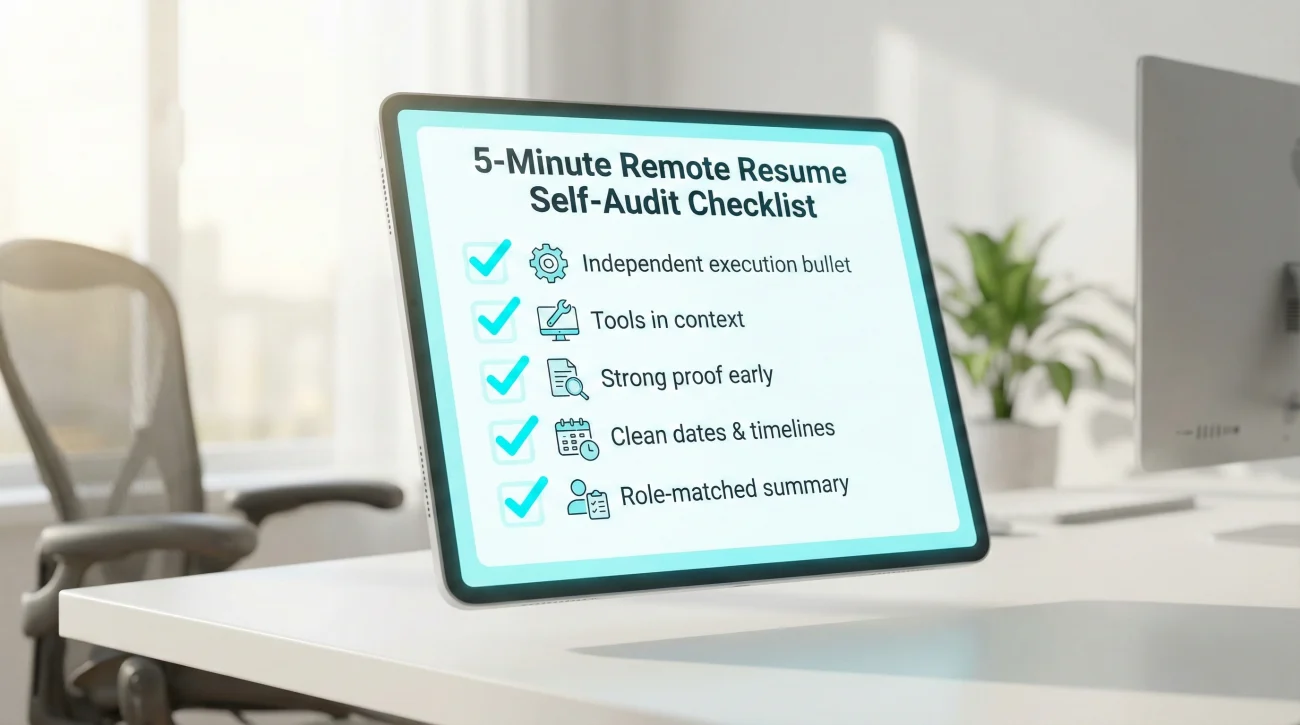
When I review a remote resume, I ask a few quick questions that sound simple but expose most of the problems fast. You can run the same test on yourself.
Can a recruiter spot your remote exposure in 7 seconds?
If not, label remote or hybrid roles clearly on the job line, then put one remote proof bullet in the top two bullets of that role.
Do your bullets show loop-closing, or just participation?
Swap “supported, assisted, participated” for outcomes like shipped, reduced, clarified, documented, resolved, standardized.
Is there at least one async signal on the page?
Even one bullet about written updates, documentation, decision logs, or handoffs can change how your resume is read.
Does your resume accidentally describe an office worker?
If your language is mostly meetings, in-person coordination, and “worked closely,” add remote reality words like handoff, timezone coverage, written updates, documentation, response windows.
- Check 1: Each relevant role has at least one bullet tied to independent execution.
- Check 2: Tools appear inside context, not as a long list.
- Check 3: Your strongest remote proof appears early, not buried.
- Check 4: Dates and timelines are clean and consistent.
- Check 5: Your summary matches the role, not a generic career bio.
Final
Most candidates don’t lose remote roles because they lack skill. They lose them because their resume leaves too much unanswered, and remote hiring punishes uncertainty.
If you fix only one thing, fix this: stop describing traits and start showing evidence. When your bullets prove ownership, workflow, and communication, your resume reads calmer, safer, and easier to trust.
That’s the real upgrade behind remote work resume mistakes: You’re not “trying to sound remote-ready.” You’re showing how work moved when nobody hovered over you.
❓ FAQ
🎯 Should I label my job as Remote on the resume?
Yes, if it was fully remote or meaningfully hybrid. Put it on the job line so the recruiter doesn’t have to guess, then back it up with one or two proof bullets that show how you operated remotely.
🧩 Is listing Slack, Zoom, and Notion enough to prove remote readiness?
No. Tools are common. What matters is what you produced with them: documentation, workflows, handoffs, decision clarity, response windows, and measurable outcomes.
🚦What’s the biggest remote red flag recruiters notice fast?
Vague claims without evidence. “Self-starter” and “excellent communication” are harmless words, but they often appear when the resume lacks ownership proof and loop-closing outcomes.
🛠️ How many remote proof bullets do I need per role?
Usually one strong bullet is enough to change how the role is read, especially if it includes an async behavior and a measurable result. Add a second only if it’s genuinely distinct.
📌 What if I have no official remote job title but I worked remotely sometimes?
You can still show remote behaviors. Highlight documentation, async updates, timezone handoffs, and independent delivery. Just avoid overstating it as “fully remote” if it wasn’t.
⚠️ Disclaimer: ResumeSolving provides resume, cover letter, and job search communication guidance for informational purposes only. It is not legal, medical, financial, or professional counseling advice. Hiring decisions vary by company, role, location, and individual circumstances, so we do not guarantee interviews, offers, or outcomes. Always use your own judgment, verify requirements directly with the employer, and follow local laws and workplace policies. When a situation is sensitive, we prioritize privacy-safe, recruiter-appropriate wording, and you never need to share personal details you are not comfortable disclosing.