- Time zones are a trust problem first: Recruiters read your wording as a clue about overlap, responsiveness, and meeting risk.
- Say “overlap window” and “handoff rhythm”, not “any time zone” or “always online”. Those phrases can quietly push you into a “high friction” pile.
- Use one clean scope cue in the right place (header, location line, or a bullet) and back it with a measurable example.
Why Time Zones Become a Resume Problem Before They Become a Job Problem
I once screened a candidate named Diego for a fully remote role. His skills were strong, his portfolio was real, and his references checked out. But one line near the top of his resume created instant confusion: “Available in any time zone.” The hiring manager read it as: “This person might be working odd hours, might be traveling constantly, and might not have stable overlap.” Diego meant “I’m flexible.” The resume accidentally said “I’m unpredictable.”
This is the trap with a timezone collaboration resume. You are not trying to prove that you can survive chaos. You are trying to prove that you can collaborate inside constraints: meetings, handoffs, response times, and deadlines. In modern remote hiring, time zone wording works like a scope cue. It tells people whether they can schedule you, rely on you, and keep projects moving without friction.
Done well, time zones become a quiet advantage. Done poorly, they create a subtle availability red flag that recruiters do not always explain.
Key Point: Your resume should communicate “reliable overlap and clean handoffs”, not “I will bend my life around meetings.”
What Recruiters Infer When You Mention Time Zones
A recruiter is not judging your geography. They are estimating operational risk. They want to know whether your day will collide with their team’s day, and whether you understand how remote work actually runs when people are asleep on different continents.
I learned this the hard way from a colleague, Mercedees, who leads hiring for a distributed product team. She told me: “I don’t care where someone is. I care if we can get two hours of real overlap when something breaks.” That sentence changed how I coach candidates on remote proof language.
| What you write | What they may infer |
|---|---|
| “Any time zone” | Unclear boundaries, unstable schedule, or trying to sound impressive without a real system |
| “Worked across 6 time zones” | Potentially true, but missing the detail that makes it believable: overlap, handoffs, or async rhythm |
| “3-hour overlap with EST team” | Operational clarity: scheduling is possible, team cadence is realistic |
| “Follow-the-sun handoffs” | Process maturity: you know how work continues while people sleep |
| “Always online” | Burnout risk, boundary risk, and in some industries: compliance concern |
💡 Pro Tip: The strongest cue is not the number of time zones. It is the way you reduce coordination cost.
The Three Safe Places to Mention Distributed Time Zone Collaboration
Most resumes fail here because they treat time zones like a personality trait. Time zones are not a trait. They are a constraint you manage. The placement should match the role’s need.
1) Header or summary: Only when the job is truly global
If the role requires cross-region coordination, one short line in the header can remove doubt early. Keep it neutral and specific. Avoid dramatic phrasing.
⚠️ Warning: If you add time zone detail in the header for a job that is not global, it can look like you are trying to explain a problem nobody asked about.
2) Location line: The cleanest option for most remote roles
For many remote jobs, the most practical place is your location line. This is where the recruiter expects to read scheduling constraints. If you want to hint at overlap, you can do it in one clause.
Example logic: city + region + a simple overlap cue. The cue matters more than the abbreviation.
3) A bullet inside relevant experience: Best proof, lowest drama
If you have real examples of handoffs, async updates, or overlap windows, put time zone collaboration inside a bullet under the role where it happened. This is the strongest “distributed team resume” approach because it is tied to work, not identity.
“I’m not worried about distance. I’m worried about silence. Show me how you kept things moving when half the team was offline.”
How to Describe Overlap Without Sounding Like You Work 24/7
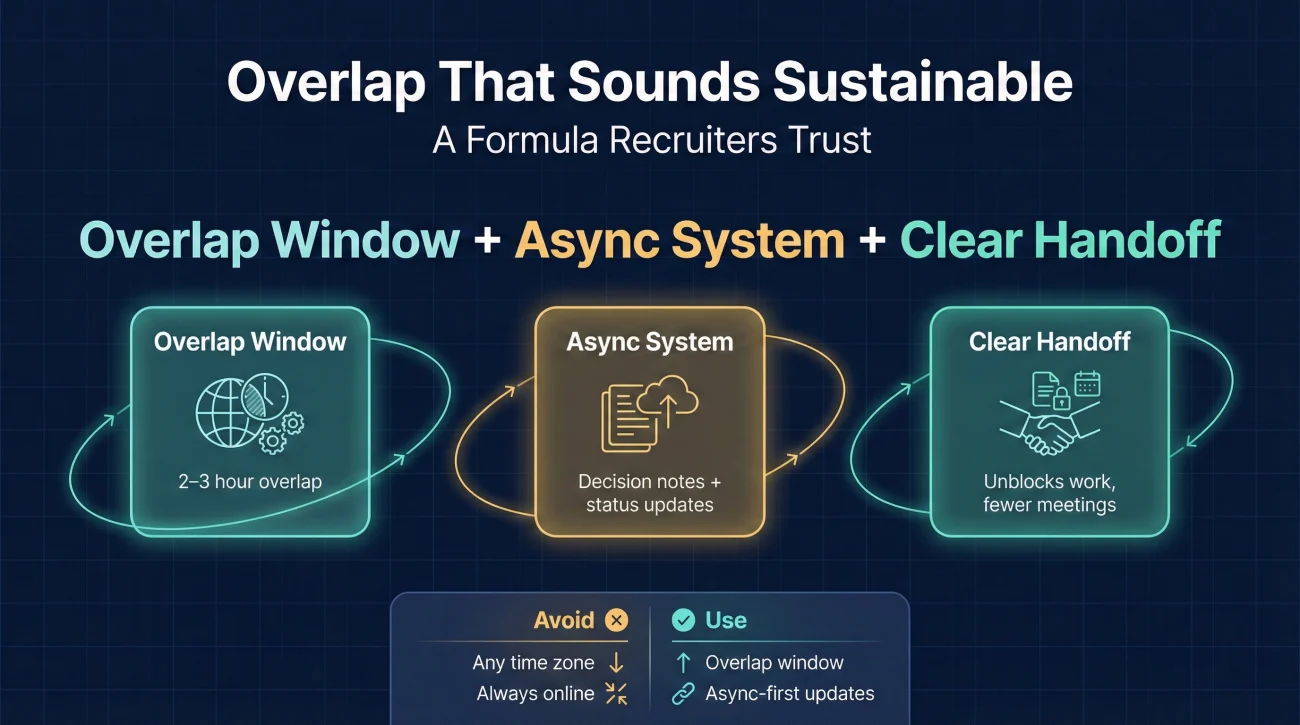
There is a difference between flexibility and availability panic. Recruiters do want flexibility. They do not want ambiguity. The best phrasing uses three ingredients: a realistic overlap window, a system for async continuity, and a boundary that signals sustainability.
[Overlap Window] + [Async System] + [Handoff or Outcome]
Here is how that sounds in human language:
- “Maintained a 2 to 3 hour overlap window with EST stakeholders and ran async status updates to keep decisions unblocked.”
- “Coordinated releases with APAC and EU teams using handoff notes and decision logs to reduce rework.”
- “Scheduled high-stakes calls inside overlap hours; handled the rest through documented updates and clear owners.”
This is also where the keyword timezone collaboration belongs: inside a concrete pattern, not as a vague claim.
Eight Resume Examples You Can Copy and Adapt
I am going to show eight options across different sections of the resume. Pick the one that matches your role. Do not stack multiple versions in the same resume. One good cue beats three noisy cues.
Example 1: Header for global roles
Product Operations | Distributed Team Collaboration (US, EU, APAC)
Built routines for overlap meetings, async updates, and follow-the-sun handoffs
Example 2: Location line with overlap cue
Bangkok, TH (Overlaps 2 to 4 hours with SG and AU teams)
Open to remote roles with structured async workflows
Example 3: Summary line that reduces scheduling doubt
Known for keeping cross-region work moving: overlap planning, decision notes, and clean handoffs across 3 time zones
Example 4: Bullet focused on overlap window
Coordinated sprint planning across 3 time zones by anchoring a 2-hour overlap window and moving status updates async (cut meeting load by 30%)
Example 5: Bullet focused on handoffs
Ran follow-the-sun handoffs for incidents: created a handoff template and owner tags, reducing repeat investigations and improving response consistency
Example 6: Bullet focused on decision clarity
Maintained decision logs for cross-time-zone stakeholders to prevent “re-opened debates” and keep approvals moving without extra calls
Example 7: Project line for global collaboration
Global Launch Project (US, UK, SG): Managed timeline visibility and async reviews to deliver on schedule with minimal overlap hours
Example 8: Clean “global team experience resume” proof
Partnered with teams in Europe and Asia on weekly deliverables; used written weekly plans and end-of-day handoffs to keep throughput steady
💡 Pro Tip: If you want your global team experience resume line to feel real, attach it to an outcome: cycle time, meeting reduction, fewer escalations, cleaner delivery dates.
Do-Not-Do List: Phrases That Quietly Trigger Availability Red Flags
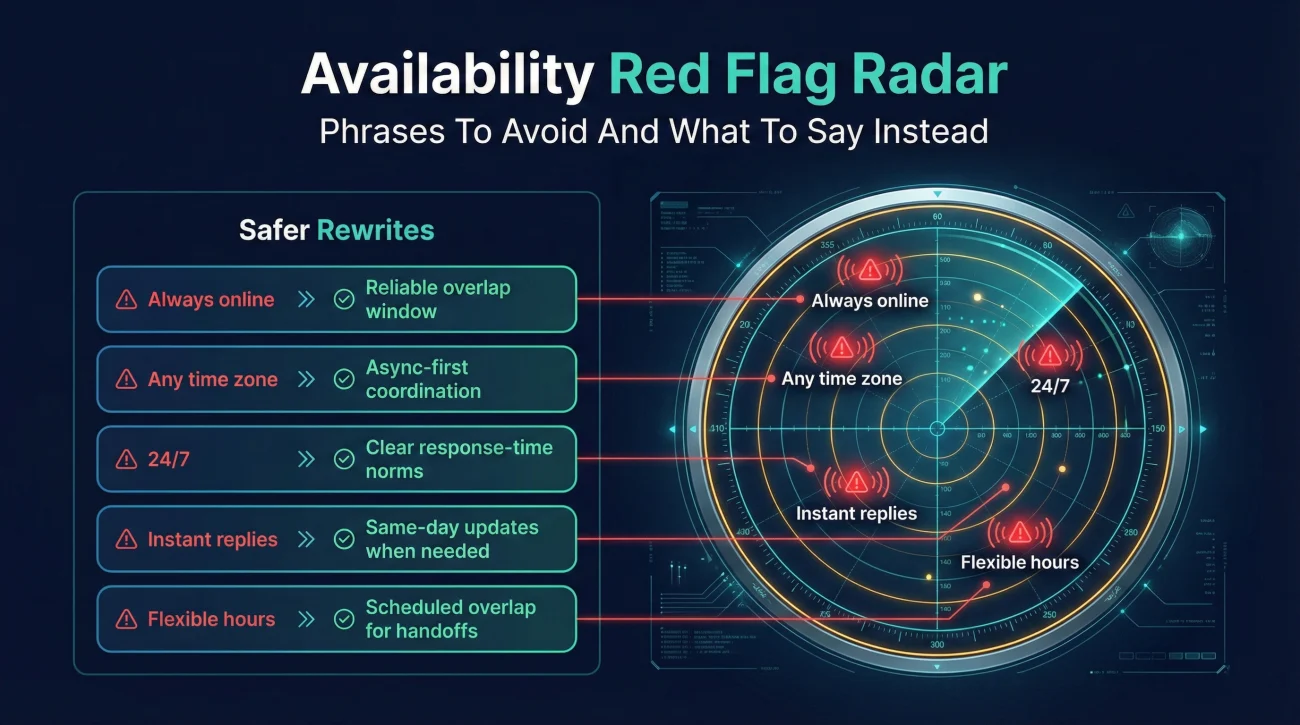
Here are phrases I have seen backfire, especially in early screening. The problem is not that you are flexible. The problem is that the phrasing invites doubt about boundaries, stability, or even legitimacy.
- “Available 24/7”
- “Any time zone works”
- “Always online”
- “I can attend meetings at any hour”
- “No constraints”
Replace them with calm, operational cues:
- “2 to 3 hour overlap window with core team”
- “Async-first updates with documented decisions”
- “Handoffs and owners defined for continuity”
⚠️ Warning: If your resume sounds like you have no boundaries, some teams will assume you will burn out, then disappear. Sustainable beats heroic.
Final
The best resumes do not brag about “working across time zones.” They show how collaboration stayed reliable anyway. When you treat time zones as a scope cue, you stop sounding like a traveler and start sounding like a teammate: predictable overlap, clean handoffs, and calm communication.
If you only change one thing today, change the line that creates uncertainty. Replace vague flexibility with one measurable cue. That is how a timezone collaboration resume becomes proof, not a question mark.
❓ FAQ
🕒 Should I put my exact time zone on a remote resume?
If the job is region-sensitive, yes. Put it in the location line or a single header cue. If the job is fully async and global, you can skip the exact label and show overlap or handoff proof instead.
🌍 Is “worked across multiple time zones” enough?
Not by itself. Add one operational detail: overlap window, async update rhythm, or handoff system. That is what makes the claim credible.
🧩 How do I write “overlap hours” without sounding needy?
Keep it neutral and short: “2-hour overlap window with EST stakeholders.” Then back it with a bullet that shows what you achieved inside that constraint.
🚫 Why is “any time zone” a bad idea on a resume?
Because it can imply unstable schedules, weak boundaries, or vague storytelling. You can be flexible without sounding unlimited. Recruiters prefer clarity over hero claims.
🧠 What is the best proof for a distributed team resume?
A bullet with a system plus outcome: overlap planning, async status updates, decision logs, and a measurable impact like fewer meetings or faster approvals.
📌 Where should I place this if I only have one line to spare?
Put it in an experience bullet tied to a real project. That placement feels like proof, not a disclaimer.
⚠️ Disclaimer: ResumeSolving provides resume, cover letter, job search communication, and career transition guidance for informational purposes only. Hiring practices vary by employer, role, location, industry, and individual circumstances. We do not guarantee interviews, job offers, ATS results, or other outcomes. Verify employer requirements directly and follow applicable laws and workplace policies. For sensitive situations, use only information you are comfortable disclosing and keep all statements accurate.