- If you want to mention async work on a resume, lead with proof nouns: Decision logs, handoffs, written updates, and documented decisions.
- Use one of 6 patterns to turn “I communicate well” into outcomes a recruiter can picture without guessing.
- Steer clear of buzzword phrasing, and borrow from the 18 resume-ready examples to make your async story believable.
Async Communication Examples: What to Mention Without Sounding Like a Buzzword
I once screened two candidates for the same remote role. Both wrote “excellent communicator.” One got moved forward. One didn’t.
The difference was not charisma. It was evidence. The stronger candidate gave me async communication examples that felt concrete: A decision log they maintained, weekly written updates they ran, and the handoff notes that kept projects alive across time zones.
In modern remote hiring, “async” is not a personality trait. It’s a work system. Your resume has to show you already operate that way, without turning into a tools list or a self-review.
Key Point: Recruiters trust nouns and outcomes more than adjectives. “Decision log” beats “great async communicator” every time.
What recruiters actually mean when they say “async”
When I see “async-friendly” in a job post, I translate it into three screening questions:
- Can you move work forward without real-time supervision?
- Can others pick up your work without a meeting?
- Can you prevent rework by documenting decisions and context?
The signals that make those questions easy to answer
These are the signals I look for because they imply a repeatable system, not a one-off good day:
- ✅ Written updates with owners, timelines, and risks
- ✅ Decision logs that show what changed and why
- ✅ Handoff notes that prevent “starting over”
- ✅ Comment-first collaboration (reviews, async feedback loops)
- ✅ Documentation that reduces Slack back-and-forth
💡 Pro Tip: Your resume does not need to say “async” often. It needs to show the artifacts of async work.
6 proof patterns you can reuse (Instead of claiming “great communication”)
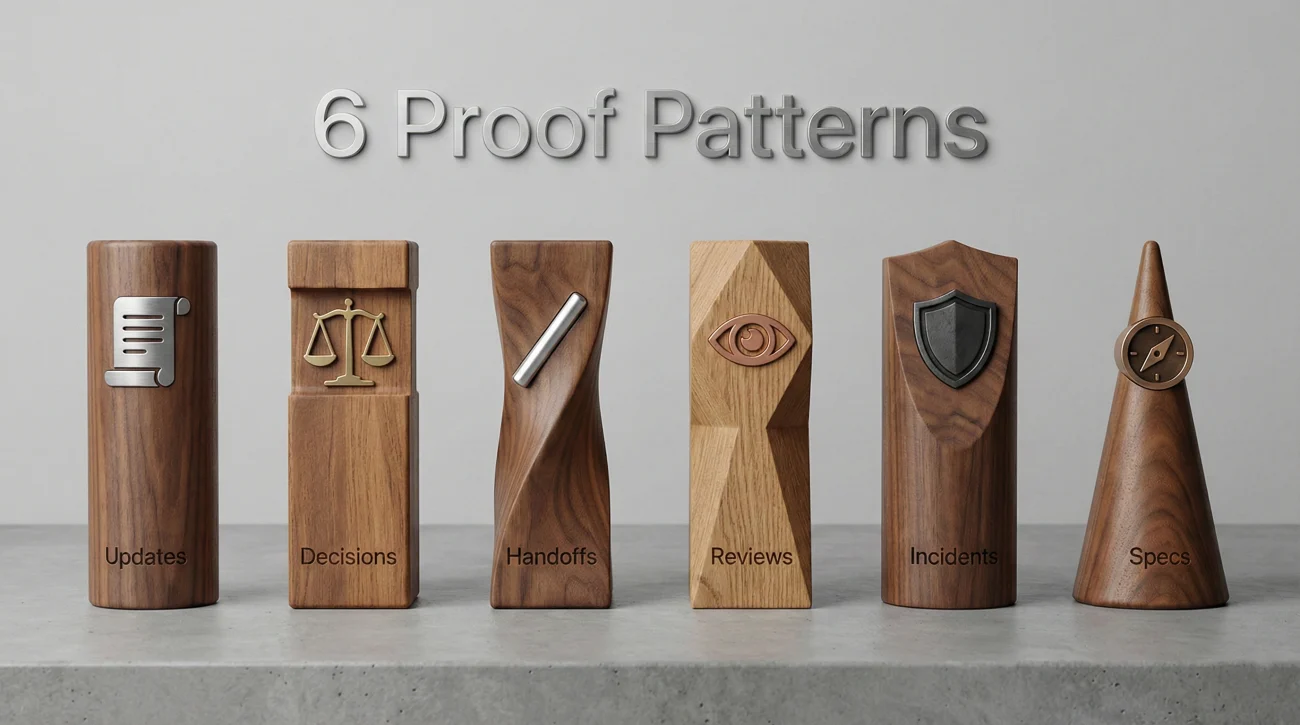
Below are six patterns I’ve used with candidates, plus how each pattern reads to a recruiter. Pick 1 to 2 patterns that match your job. If you use all six, it starts to look rehearsed.
| Pattern | What it proves | What to write on a resume |
|---|---|---|
| Written Updates | Clarity, ownership, and momentum | “Published weekly status updates with owners, risks, and next actions across time zones.” |
| Decision Logs | Sound judgment and traceability | “Maintained a decision log documenting tradeoffs, approvals, and impact.” |
| Handoff Notes | Continuity and low-friction collaboration | “Built handoff notes that reduced ramp-up time for cross-region partners.” |
| Async Reviews | High quality feedback without meetings | “Ran async review cycles using written feedback and tracked revisions to completion.” |
| Incident Recaps | Accountability and learning culture | “Wrote incident recaps with root causes, fixes, and prevention steps.” |
| Requirements Docs | Fewer misunderstandings and rework | “Created lightweight specs that aligned stakeholders before execution.” |
Why these patterns work better than “communication skills”
Because they contain “observable artifacts.” A hiring manager can imagine what your day-to-day looks like. That’s exactly what remote teams want: Predictability.
One candidate, Alexandra, told me she was “strong at async work communication.” It landed flat. We replaced it with: She published a weekly update with owners, dates, blockers, and decisions. That single change made her resume feel like it belonged to a remote-first environment.
18 resume-ready async communication examples (Across roles)
Use these as templates. Swap in your numbers, scope, and tools only where they genuinely matter.
– Published weekly operational updates with owners, deadlines, and risk flags for a distributed team of 18
– Built handoff notes that reduced follow-up questions during cross-region transitions
– Maintained a decision log to document policy changes and prevent repeat disputes
Examples you can copy and adapt
- Asynchronous communication examples for Product: “Wrote decision logs capturing tradeoffs and approvals, reducing rework during build cycles.”
- Engineering: “Ran async code reviews with clear acceptance criteria and tracked changes to merge.”
- Design: “Delivered async feedback using annotated comments and versioned iterations to final approval.”
- Marketing: “Shared weekly campaign updates with performance context, next tests, and owner assignments.”
- Customer Support: “Created internal troubleshooting notes that reduced escalations and repeated questions.”
- Data/Analytics: “Documented metric definitions and update cadence so stakeholders stopped requesting one-off clarifications.”
- Project Management: “Replaced two recurring meetings with written updates and decision summaries, keeping timelines intact.”
- Operations: “Built handoff templates for on-call rotations to keep incidents moving without synchronous calls.”
- HR/People Ops: “Documented process changes and created a living FAQ that reduced repetitive questions from managers.”
- Sales Ops: “Maintained deal desk decision notes and approval records to shorten turnaround time.”
- Finance: “Summarized monthly close status in written updates with blockers and action owners.”
- Recruiting: “Sent structured candidate update notes that aligned interviewers and reduced duplicated evaluation questions.”
- Product (stakeholder alignment): “Wrote lightweight specs to align stakeholders before execution and prevent late pivots.”
- Engineering (handoffs): “Created handoff notes for cross-time-zone ownership transfers, cutting ramp-up friction.”
- Design (collaboration): “Used comment-first reviews to consolidate feedback and prevent conflicting requests.”
- Marketing (execution): “Logged decisions on audience targeting and creative direction to reduce debate cycles.”
- Support (incident learning): “Wrote incident recaps with root cause and prevention steps, improving repeat resolution.”
- Ops (clarity): “Published weekly ops dashboards with context notes to reduce ‘what changed’ questions.”
⚠️ Warning: If your bullet sounds like a slogan, it will be read as a slogan. Make it an artifact plus outcome.
Where to mention async on your resume (So it feels natural)
Most candidates try to force “async” into the summary. That usually reads like self-rating. I prefer two cleaner placements.
Placement option 1: Inside your experience bullets
This is the safest. It anchors proof where the reader expects impact. If you have a real artifact (decision log, weekly update, handoff note), use it there.
Placement option 2: A micro “work style proof” line
This works when the role is remote-first and the hiring team cares about process maturity. Keep it to one line, and make sure it is still factual.
Work Style Proof:
That line quietly signals async communication resume maturity without declaring “I’m amazing at async.”
Tools are not proof (But they can support proof)
A common low-quality internet move is turning async into a tool list. Tools are context. Proof is what you shipped and how you kept others unblocked.
If you mention tools, do it as a supporting detail inside an outcome bullet. Think of it as: “system” first, “platform” second.
One candidate, Omar, wrote a full line of apps in his resume summary. It sounded like a shopping list. We rebuilt it into a bullet about documented handoffs and decision notes, then tucked the tool reference inside the bullet only where it clarified the workflow.
When you do want to mention it, aim for this kind of framing: “Used written updates and decision summaries to keep work moving,” not “Expert in tools.” That’s the difference between async work communication and “I used Slack.”
Do-not-say list (Phrases that sound like buzzwords)

I’m not saying these are “wrong.” I’m saying they trigger skepticism because they don’t describe anything observable.
- “Excellent asynchronous communicator”
- “Strong async collaboration skills”
- “Great at remote communication”
- “Highly organized and proactive” (Without proof)
- “Self-starter who thrives remotely” (Without artifacts)
- “Async-first mindset”
What to say instead
Swap vague adjectives for a concrete artifact plus result. These swaps are small, but they change how a resume feels in the first scan.
| Instead of | Write |
|---|---|
| “Great remote communicator” | “Published written updates with owners, risks, and next actions to keep work unblocked.” |
| “Async-first mindset” | “Maintained decision summaries so stakeholders could track what changed and why.” |
| “Highly proactive” | “Flagged risks early in weekly updates and proposed next steps before escalation.” |
| “Strong collaborator” | “Ran async review cycles with consolidated feedback to avoid conflicting directions.” |
How to choose the right pattern for your role (So it does not feel forced)
If you’re unsure what to use, start with the work you do that most often creates confusion for others. Then choose the pattern that reduces that confusion.
Choose based on the friction you solve
Here’s a simple mapping I use in resume reviews:
- Status confusion: Replace vague check-ins with async updates examples, so owners, deadlines, and risks stay visible without chasing people.
- Repeated debates: Use decision logs to capture tradeoffs, approvals, and what changed, so the same arguments don’t restart every week.
- Handoff chaos: Build handoff notes that preserve context across time zones, so the next person can continue work without a meeting.
- Feedback spirals: Run async review cycles with consolidated written feedback, so iterations stay clean instead of bouncing between opinions.
- Recurring incidents: Write incident recaps that turn failures into prevention steps, not just a “we fixed it” message.
- Scope misunderstandings: Start with lightweight requirements docs that align expectations early, before execution locks in the wrong direction.
Mai, a designer I coached, assumed she had “no async proof” because she didn’t work in tech. She actually had plenty: Her comment-first review process prevented conflicting stakeholder feedback. Once we wrote it as an artifact plus result, it stopped sounding like an opinion.
💡 Pro Tip: Use one clean proof line. Then let your achievements do the talking. That’s how remote async collaboration reads as real, not trendy.
Final
If you want to stand out in remote screening, treat async as a set of artifacts you create for other people: Updates, decisions, handoffs, reviews, and recaps. That’s the language hiring teams trust because it describes how work continues when nobody is in the same room or the same time zone.
When your resume uses evidence-led wording, async communication examples stop sounding like a buzzword and start sounding like a work system you already run.
❓ FAQ
🎯 Should I literally write the word “async” on my resume?
You can, but you do not have to. A better approach is showing the artifacts of async work: Decision logs, written updates, handoff notes, and documented decisions.
🧩 What if I have never worked a remote job before?
You can still show async behavior through documentation habits. Use examples like written project updates, documented requirements, or structured handoffs even if the team was in-office.
🛠️ Is it okay to list tools like Notion or Slack?
Yes, if the tools support a workflow and are attached to an outcome. Avoid making tools the headline. Make the proof artifact the headline.
📌 Where is the best place to add async proof?
The experience section is best because it pairs proof with impact. A single “work style proof” line can work as a secondary support, but keep it factual and short.
🚫 What is the biggest red flag phrasing?
Anything that sounds like self-rating without evidence, like “excellent asynchronous communicator.” Replace it with an observable artifact plus result.
⚠️ Disclaimer: ResumeSolving provides resume, cover letter, job search communication, and career transition guidance for informational purposes only. Hiring practices vary by employer, role, location, industry, and individual circumstances. We do not guarantee interviews, job offers, ATS results, or other outcomes. Verify employer requirements directly and follow applicable laws and workplace policies. For sensitive situations, use only information you are comfortable disclosing and keep all statements accurate.