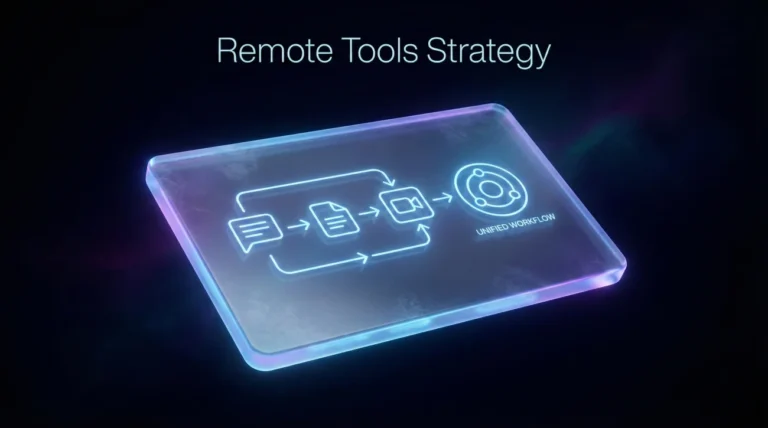
- A strong remote answer is not a personality pitch. It is a systems pitch: routines, visibility, and risk control.
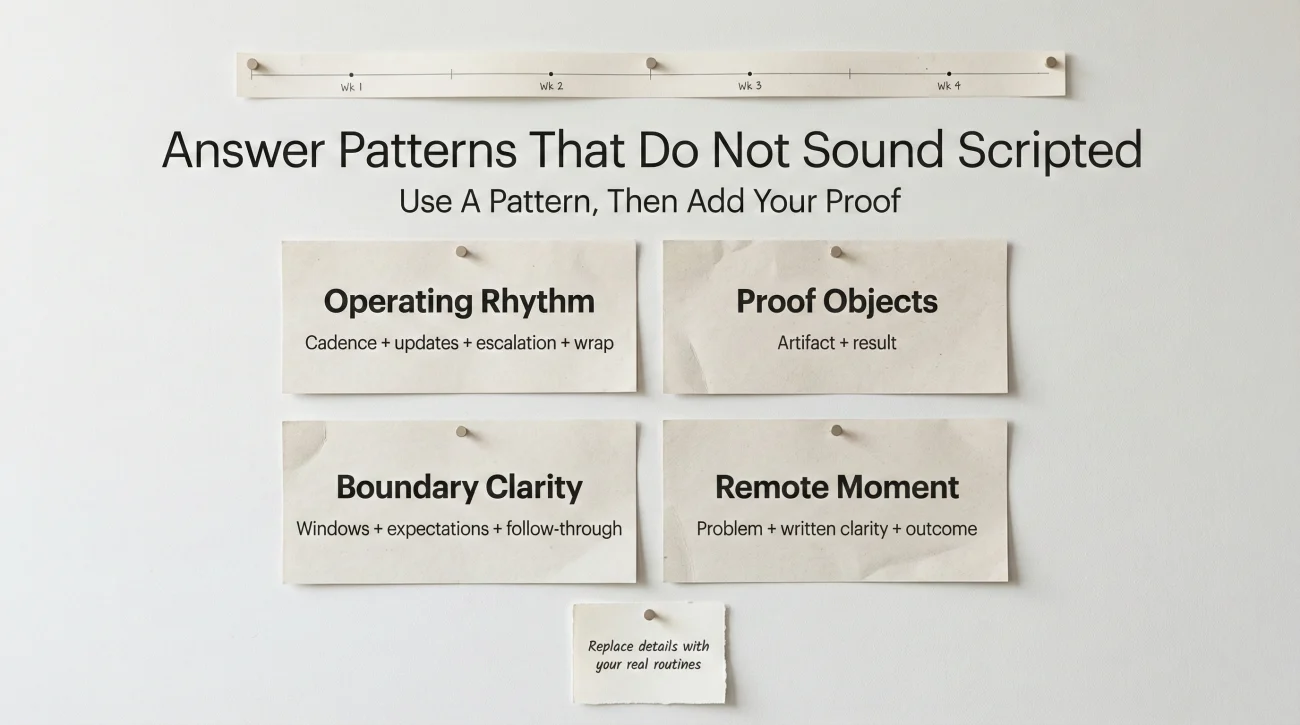
- Use one of four patterns depending on your background: Operating System, Proof Objects, Boundary Control, or “No-Remote-Experience” Pivot.
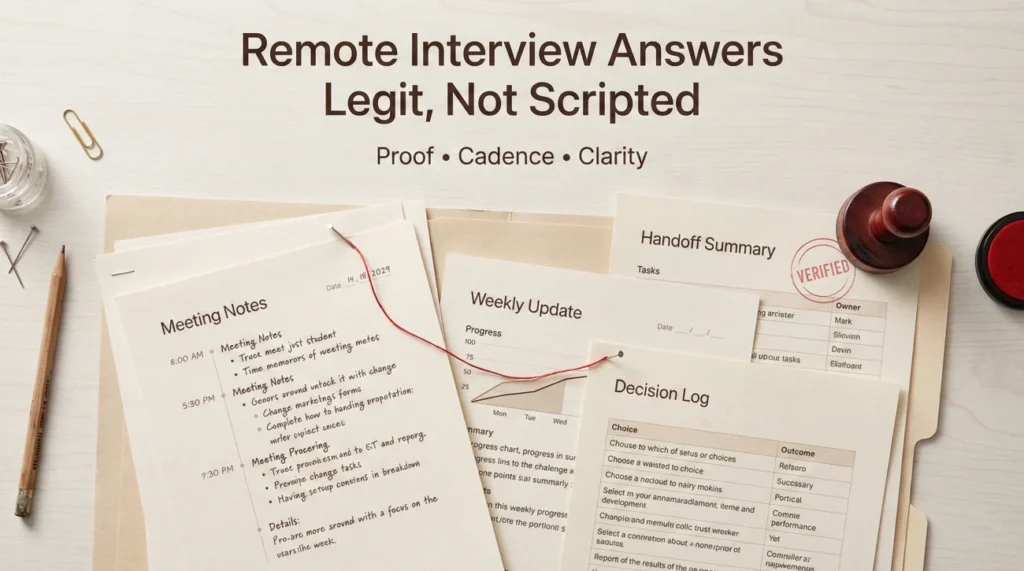
- Bring tiny “proof objects” into your answer: update cadence, decision logs, escalation rules, and how you close loops.
What interviewers are really testing when they ask about remote work
I once watched a hiring manager ask a candidate, “How do you feel about working remotely?” The candidate smiled and said they loved it because they were “more productive at home” and “didn’t miss commuting.” The manager nodded politely, then later told me: “I still don’t know how I’ll get updates without chasing them.”
That is the hidden point of most remote questions. A remote work interview answer is not about your home office setup. It is about whether you can be trusted when nobody is watching, and whether your team will feel clarity instead of anxiety.
So when you hear questions like how do you work remotely interview prompts, do not treat them as small talk. Treat them as a mini audit. Interviewers are quietly scoring you on three things:
- Self-management: Can you plan your day, prioritize, and keep momentum without external pressure?
- Visibility: Will your manager know what is happening without guessing or interrupting you?
- Communication hygiene: Do you prevent confusion, repeated debates, and silent blockers?
💡 Pro Tip: If you answer remote questions like a “system builder” instead of a “remote fan,” you instantly sound more senior, even if you are not applying for a senior title.
Four answer patterns that make you sound remote-ready
Below are four patterns I have used with candidates over the years. We never memorized a script. We picked a pattern that matched their reality, then filled it with their own details so it stayed human.
Pattern 1: The “Remote Operating System” answer
This pattern works when you have remote experience, or when your role naturally required independent execution. You describe your routine in a way that signals stability: how you start, how you stay visible, how you close loops.
Use this simple structure:
[Daily Rhythm] + [Visibility Cadence] + [Risk Escalation Rule] + [Closure Habit]
| What they worry about | What you say | The “proof object” you reference |
|---|---|---|
| “Will I have to chase updates?” | “I send a short update at a consistent cadence.” | Weekly update template: goals, progress, blockers, next steps |
| “Will work disappear into silence?” | “I surface blockers early with options, not complaints.” | Escalation rule: 24-hour stuck threshold, propose 2 paths |
| “Will decisions get messy?” | “I close meetings with written decisions and owners.” | Decision log habit: what we decided, why, who owns what |
| “Will time zones break collaboration?” | “I design handoffs so the next person wakes up to clarity.” | Handoff note format: status, what changed, what I need from you |
⚠️ Warning: Do not list tools as your “system.” Tools are not a system. Your habits are the system. Tools are just where your habits live.
Pattern 2: The “Proof Objects” answer
This is my favorite pattern because it feels concrete fast. Instead of talking about being “organized,” you mention the small artifacts you naturally produce when working remotely.
Pick two proof objects, then tie each to a result:
- Async updates: “My updates reduce interruptions and keep owners aligned.”
- Decision logs: “We avoid re-litigating the same debate.”
- Clear handoffs: “Time zones stop being a delay.”
- Definition of done: “Fewer last-minute misunderstandings.”
“When I work remotely, I assume silence creates stress. So I make progress visible on purpose, even when everything is going fine.”
One candidate I coached, Eleanor, was switching from office-based operations to a remote coordinator role. She was nervous because she had only done “remote Fridays.” We built her answer around proof objects she already had: shift handoff notes, exception logs, and a habit of summarizing decisions after a call. She did not pretend she was a remote veteran. She sounded trustworthy anyway.
Pattern 3: The “Boundary and Focus Control” answer
Remote hiring managers worry about two opposite problems: someone who vanishes, and someone who never stops working. The best answers show you can manage focus and boundaries like an adult.
If you get “How do you stay productive remotely?” or the classic remote work interview questions around motivation and distractions, use this structure:
[Deep Work Setup] + [Communication Windows] + [Interrupt Handling] + [End-of-day Wrap]
Here is an example you can adapt:
Notice what is missing: no bragging, no “I’m super disciplined,” no productivity theater. Just behaviors.
Pattern 4: The “No Remote Experience” pivot
Sometimes the truth is simple: you have not held a fully remote job. That is fine. What matters is whether you can translate your existing habits into remote signals.
Here are three pivots that work without lying:
- From “remote job” to “remote moments”: cross-site collaboration, vendors, distributed stakeholders, after-hours escalations.
- From “remote tools” to “written clarity”: summaries, checklists, handoff notes, documented decisions.
- From “being managed” to “managing yourself”: planning, prioritization, proactive risk flags.
My friend Adrian (a recruiter on a distributed engineering team) once told me he prefers honest candidates who can explain their working style, over candidates who claim years of remote experience but cannot describe any routine. If you can describe your remote work style in behaviors, you can compete.
A STAR example that actually fits remote interviews
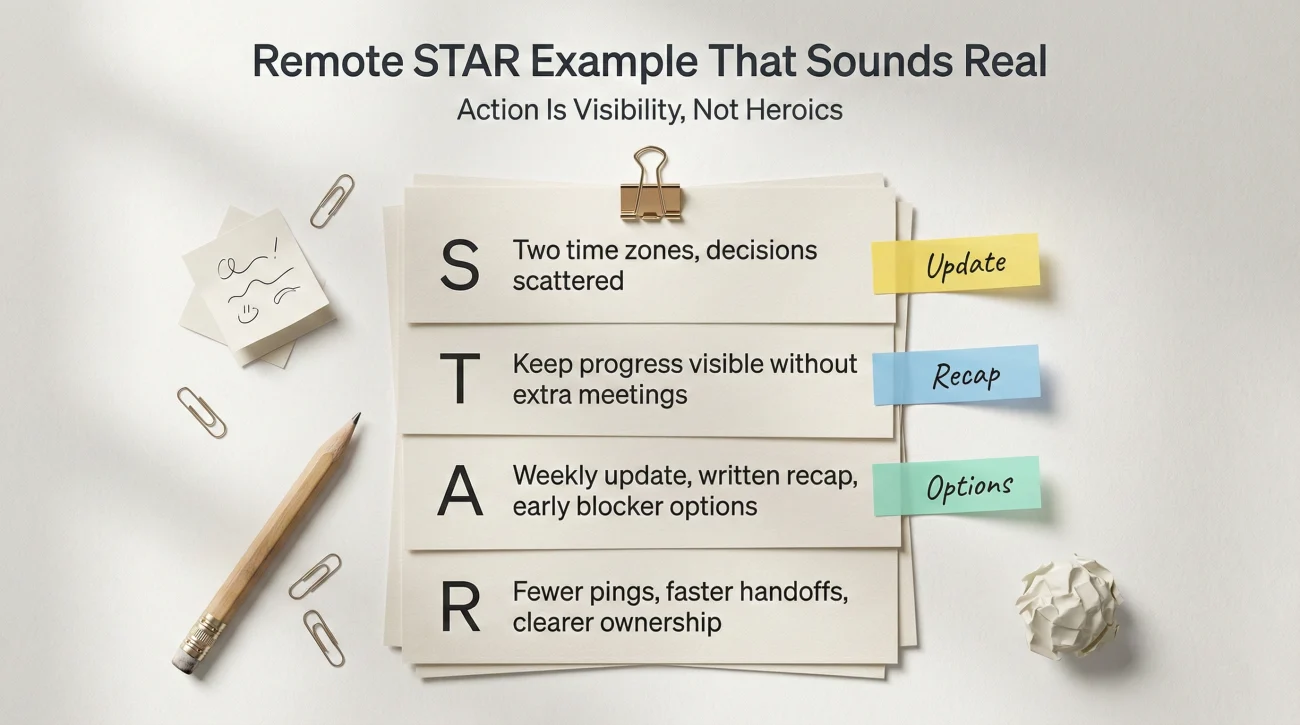
STAR is often taught in a generic way. For remote interviews, I like a twist: make the “Action” section about communication and visibility, not heroics.
Situation
My team had a cross-functional project with stakeholders in two time zones, and we kept losing momentum because decisions lived in scattered chat threads.
Task
I needed to keep progress visible and prevent the same questions from repeating every few days, without adding more meetings.
Action
I started sending a short weekly update with three headings: progress, decisions, and blockers. After every meeting I posted a two-minute recap with owners and dates.
When a blocker appeared, I flagged it early with two options so the team could choose quickly instead of debating in circles.
Result
We reduced follow-up pings, decisions stopped drifting, and stakeholders in the other time zone could pick up work without waiting for a meeting.
💡 Pro Tip: In remote STAR stories, “Result” can be clarity, speed, fewer interruptions, fewer misunderstandings. That is real impact in distributed work.
10 interview answer scripts you can adapt in minutes
These are not meant to be memorized. Think of them as starting points. Pick one, then replace the details with your real routines and artifacts so you do not sound rehearsed.
Core remote questions
“How do you stay productive when working remotely?”
I structure my day around outcomes, not hours. I plan priorities upfront, block deep-work windows for the hardest tasks, and batch communication so I am responsive without constant context switching. I also leave a short end-of-day wrap so progress stays visible.
“How do you communicate with a remote team?”
I assume clarity needs to be written down. I keep updates short but consistent, summarize decisions with owners, and flag blockers early with options. If something is urgent, I use a clear escalation path so we do not rely on guesswork.
“Tell me about a time you had to collaborate across time zones.”
I treat time zones like a workflow design problem. I create handoff notes so the next person wakes up to context, I keep decision points explicit, and I use async updates to prevent delays between meetings.
“How do you handle distractions at home?”
I plan for them instead of pretending they do not exist. I protect deep-work time, set communication windows, and use a simple rule: if I cannot make progress for 24 hours, I escalate with a clear question and two suggested paths.
“How do you build trust with a manager you rarely see?”
I do it through predictability. My manager knows when they will get updates, what I consider a blocker, and how I close loops after decisions. Trust comes from being easy to manage, not from being “always online.”
Working style questions that trip people up
“Describe your remote work style.”
I work best with clear outcomes and fast feedback loops. I like to clarify success criteria early, make progress visible through brief written updates, and keep collaboration efficient by documenting decisions instead of relying on memory.
“What do you do when priorities change mid-week?”
I re-anchor on outcomes. I confirm what moved and why, update my plan, and communicate the tradeoff clearly: what will be delayed, what stays on track, and what support I need. That keeps change from turning into chaos.
“How do you avoid miscommunication remotely?”
I avoid assumptions. I restate decisions in writing, confirm owners and dates, and ask one clarifying question before moving forward if something feels ambiguous. That habit prevents rework far more than extra meetings.
“What if you have not worked fully remote before?”
I have not had a fully remote title, but I have done remote-style work: cross-site collaboration, written handoffs, and independent execution without constant supervision. My approach is the same: clear priorities, visible progress, early blocker flags, and documented decisions.
“Why do you want to work remotely?”
I am looking for a setup where outcomes and communication matter more than presence. I work well when expectations are clear and progress is visible. Remote work fits that style because it rewards proactive updates, clean handoffs, and focused execution.
⚠️ Warning: If your only reason is “flexibility,” it can sound like you are optimizing comfort over accountability. You can mention flexibility, but anchor it to outcomes and reliability.
What to avoid saying in remote interviews
Most weak remote answers have the same smell: they are about preference, not proof. Here are common lines I would remove or reframe.
- “I just work better alone.”
- “I’m always online, you can message me anytime.”
- “I hate commuting.”
- “I’m very organized and self-motivated.” (Without any behaviors attached.)
- “I use Slack, Zoom, Trello…” (Tool shopping list with no routine.)
Instead, swap preference statements for behaviors:
| Sounds weak | Sounds credible |
|---|---|
| “I’m self-motivated.” | “I plan priorities upfront, share updates on a cadence, and escalate blockers early.” |
| “I’m always available.” | “I batch communication windows and use an escalation rule for urgent issues.” |
| “Remote makes me productive.” | “Here is the routine that keeps my output predictable.” |
❌ Note: Do not over-correct by sounding robotic. One real detail beats ten polished adjectives.
A remote answer that hiring managers can relax into
If you remember one thing, make it this: remote interviews are a trust test. Your goal is not to “sound like a remote person.” Your goal is to make your future manager feel they will not have to chase you, guess your status, or clean up confusion behind you.
When you build your answer around routines, visibility, and risk control, you stop competing with generic scripts. You start sounding like someone who already understands modern work. That is what a strong remote work interview answer really does.
❓ FAQ
🎯 Should I mention specific tools in a remote interview?
You can, but only after you describe the habit. A tool list without a routine sounds shallow. Lead with your system, then mention tools as supporting evidence.
🧠 What if I have never worked fully remote?
Be honest and pivot to remote-style signals you already have: independent execution, written clarity, cross-site collaboration, handoffs, and proactive updates. Interviewers want predictability more than a remote job title.
⏳ How long should my remote work answer be?
Aim for 45 to 75 seconds. Enough to show a routine and one proof object, not so long that you turn it into a speech. If they want more, they will drill down.
🛠️ What is the fastest way to sound credible in remote interviews?
Mention one cadence and one closure habit. For example: “I send a weekly update with blockers and next steps,” plus “I summarize decisions with owners after meetings.” Those two details remove a lot of hidden fear.
📌 Is it bad to say I want remote for flexibility?
Not automatically. It becomes risky when flexibility is your whole story. Anchor it to outcomes: focus, predictable delivery, and clear communication. That keeps it professional.
⚠️ Disclaimer: ResumeSolving provides resume, cover letter, job search communication, and career transition guidance for informational purposes only. Hiring practices vary by employer, role, location, industry, and individual circumstances. We do not guarantee interviews, job offers, ATS results, or other outcomes. Verify employer requirements directly and follow applicable laws and workplace policies. For sensitive situations, use only information you are comfortable disclosing and keep all statements accurate.