- A hybrid role can still sell remote readiness if you show how work moved when people were not in the same room.
- Do not label yourself “fully remote” if it was not true. Instead, surface remote behaviors: async updates, decision trails, and clean handoffs.
- This hybrid to remote resume approach uses 3 proof patterns and a bullet bank so recruiters can picture you working without proximity.
Why Hybrid Experience Can Still Read as Remote-Ready
I have reviewed a lot of resumes where candidates clearly did the job well, but the hiring manager still hesitated on remote roles. Not because the person lacked skill, but because the resume failed to show how they worked when teammates were not physically present.
That is the problem a hybrid to remote resume must solve. Hybrid work is not “half remote, half office” in the way recruiters imagine. In many teams, the real work already happens in writing, in tools, and across time windows. Your job is to make that visible.
One candidate, Wendy, worked three days in office and two days at home. She assumed that was “not remote enough” to mention. When we rewrote her bullets around decision docs, async stakeholder updates, and handoffs between office days and home days, the remote objections stopped showing up in feedback.
What Recruiters Are Actually Trying to Verify
When a remote role is on the table, most reviewers are quietly checking three things: Trust, clarity, and continuity. They want to know you can deliver without hallway reminders, that your communication travels well, and that projects do not stall when schedules shift.
🗝️ Key Point: Remote readiness is not a location label. It is proof that work still moves when people cannot rely on proximity.
| What they worry about | Hybrid proof that calms it | How to show it on the resume | Risky wording to avoid |
|---|---|---|---|
| “They need supervision.” | Self-driven cadence and visible owners | Weekly status updates, clear milestones, measurable outcomes | “Worked independently” with no results |
| “They will disappear.” | Predictable response windows | Overlap hours, escalation paths, service-level response metrics | “Always available” (sounds fake) |
| “They cannot collaborate remotely.” | Artifacts that replaced meetings | Decision logs, specs, async reviews, recorded demos | Tool lists with no context |
| “Handoffs will be messy.” | Continuity across office and home days | Handoff notes, runbooks, documented workflows | “Helped with handoffs” (too vague) |
⚠️ Warning: If your schedule was hybrid, do not rewrite history and call it fully remote. The goal is to show remote behaviors, not invent a remote title.
Three Patterns That Make Hybrid Read as Remote Proof
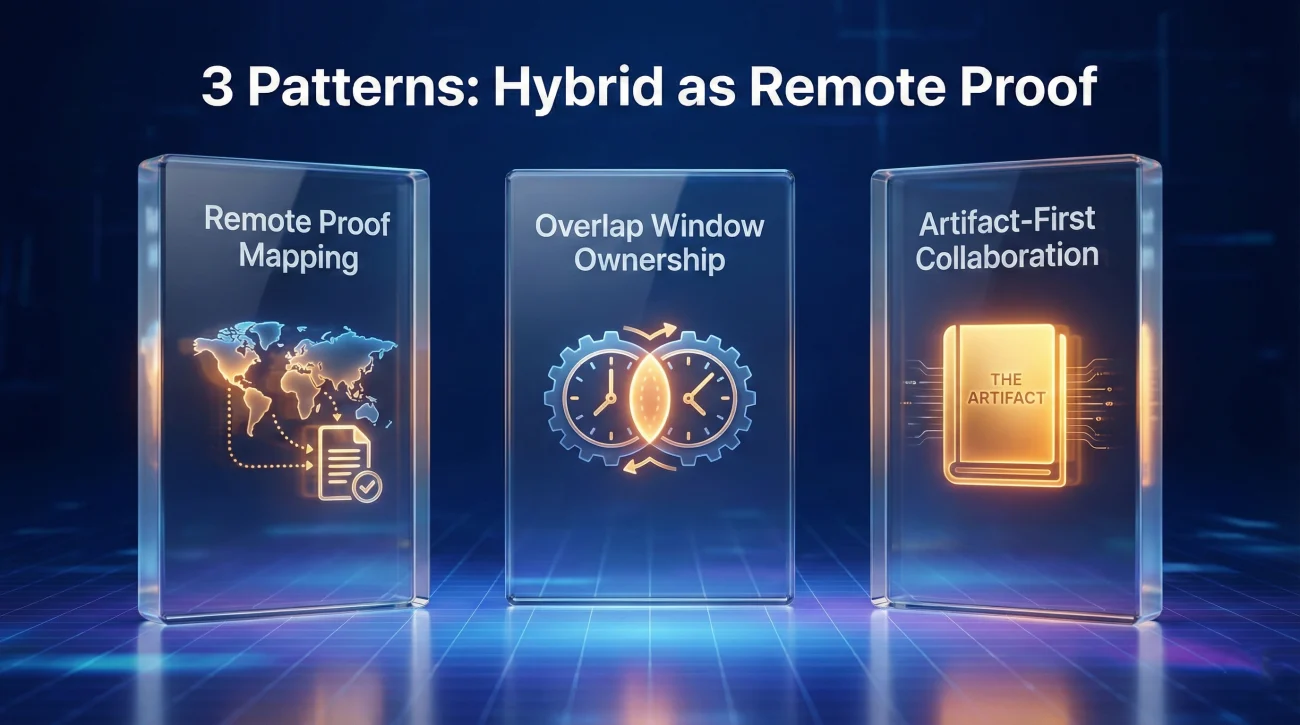
Pattern 1: Remote Proof Mapping
Start by mapping your real hybrid workflow into remote signals. If the team used docs, tickets, shared boards, recorded demos, or written updates to keep work moving, that is remote evidence even if you were in the office some days.
Antoine, a product analyst I worked with, did most stakeholder alignment on office days. But the actual decisions lived in a shared doc and the rollout happened through async updates to regional teams. Once we reframed his bullets around the decision trail and rollout mechanics, his experience sounded remote-first without claiming it was.
Use this simple translation rule: If it could be understood without being in the room, it counts as remote proof.
Pattern 2: Overlap Window Ownership
Remote teams live on overlap windows. Hybrid workers often do this naturally: they schedule the highest-collaboration tasks during shared hours, then execute deep work asynchronously.
If you have ever owned the “thin slice” of overlap time, that is a strong signal. Examples include: setting meeting agendas that make async follow-up easy, sending recap notes that remove confusion, or coordinating with people in different time zones.
Work this in naturally as hybrid experience remote job proof: Not “I worked hybrid,” but “I kept cross-site work aligned when not everyone was online at once.”
Pattern 3: Artifact-First Collaboration
This is the pattern most generic resume advice misses. Remote-ready candidates do not just “communicate well.” They create artifacts that make communication durable: A short spec, a decision log, a test plan, a handoff note, a release checklist, a runbook.
One of my colleagues, Katie, led a hybrid customer success team. The office days were noisy and reactive. The breakthrough was building a lightweight playbook: recurring issues, response templates, escalation rules, and a weekly async “wins and risks” update. Her resume stopped sounding like “managed accounts” and started sounding like “built systems.”
Customer Success Lead | Nimbus SaaS | 2022 – 2025 (Hybrid)
Built an artifact-first support workflow: weekly async risk updates, escalation rules, and a shared playbook that reduced repeat escalations by 28%.
10 Resume Bullets That Signal Remote Readiness (Without Overclaiming)
These are written to be copy-adaptable. Replace the nouns with your tools and outcomes. Keep the structure: Artifact, behavior, result.
- Ran weekly async status updates across hybrid stakeholders, keeping owners and timelines visible and reducing follow-up churn by 30%.
- Created decision notes after cross-site meetings and tracked approvals in a shared log, cutting repeat debates and rework.
- Owned overlap-window planning for a hybrid team, batching collaboration into clear agendas and leaving documented next steps for offline execution.
- Built handoff notes for office-to-home transitions, improving continuity and reducing “Who owns this?” confusion during schedule changes.
- Led async reviews of deliverables (docs, designs, or demos), shortening iteration cycles while maintaining quality standards.
- Coordinated work with teammates in different time zones using documented requirements and checkpoint updates, preventing late-stage surprises.
- Standardized a runbook for recurring incidents, improving response consistency and lowering repeat issues over the next quarter.
- Replaced status meetings with structured written updates and a lightweight tracking board, freeing time for execution while preserving visibility.
- Documented onboarding steps for new joiners in a hybrid environment, reducing ramp time and lowering manager dependency.
- Maintained a weekly “risks and mitigations” note for leadership, supporting a smoother transition to remote job responsibilities without loss of alignment.
💡 Pro Tip: Notice that none of these bullets say “I am great at remote work.” They show what you did that only works when you can operate without proximity.
A Quick Self-Check to Stay Honest and Still Stand Out
Hybrid candidates get stuck between two fears: “If I say hybrid, I look less qualified,” and “If I say remote, it is a lie.” You do not need either extreme. You need precise wording that matches reality.
What counts as safe “remote-ready” proof?
Anything you can point to as a repeatable practice: Written updates, documentation habits, clear ownership, measurable outcomes, and cross-site coordination that did not rely on being in the same room.
What wording usually triggers skepticism?
Big claims with no mechanism: “Highly self-motivated,” “Excellent communicator,” “Thrives remotely,” plus tool dumps that look like keyword stuffing.
What is the simplest honesty filter?
If a past manager asked, “Show me where that happened,” could you point to a real artifact or outcome? If yes, keep it. If not, rewrite it.
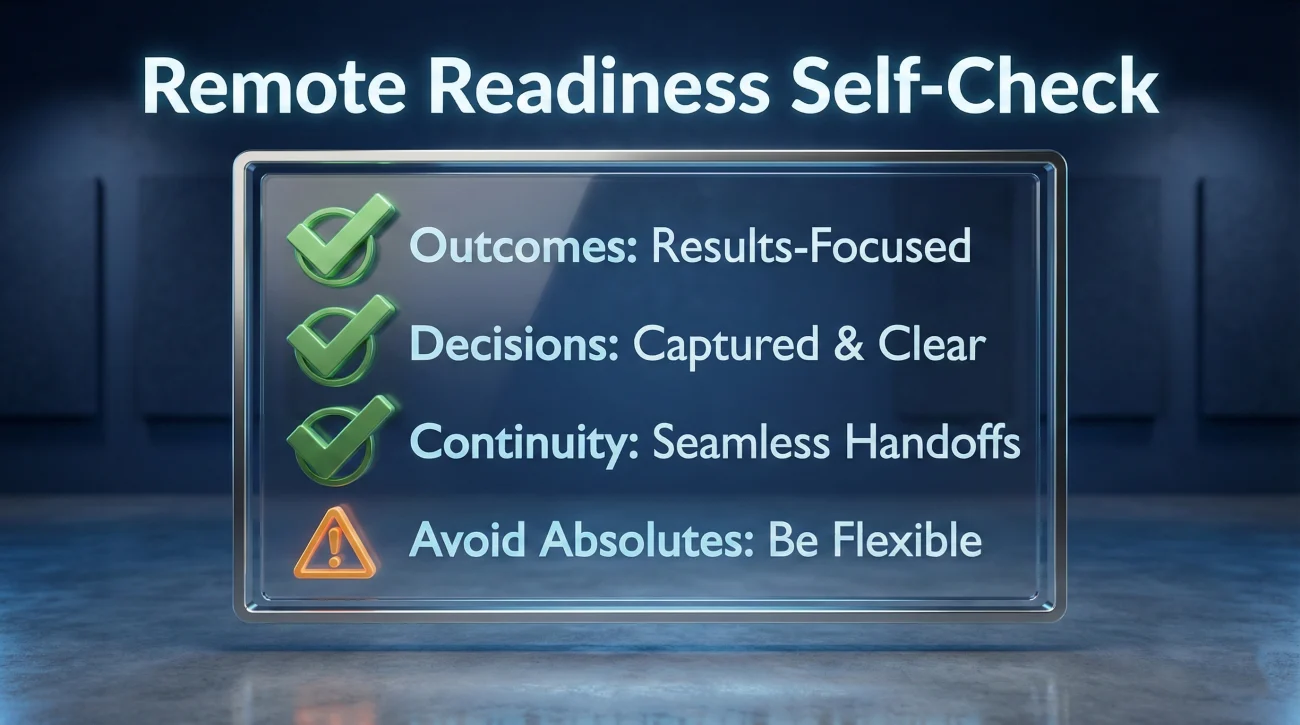
- ✅ Your bullets mention outcomes that happened on remote days, not only in-office wins.
- ✅ You show how decisions were captured and shared, not just that you attended meetings.
- ✅ You describe continuity across days and locations, not a vague “worked hybrid.”
- ⚠️ You avoid absolutes like “always available” or “fully remote” if it was not true.
- ✅ You keep one or two collaboration tools, only when tied to an outcome.
Final
A strong hybrid story is not about convincing people you were remote. It is about proving you already work in a way that remote teams recognize: Clear artifacts, predictable coordination, and outcomes that do not depend on proximity.
If you are building a resume for modern hiring, treat your hybrid to remote resume as an evidence file. Keep it true, keep it concrete, and let the proof do the persuasion.
❓ FAQ
🎯 Should I write “Hybrid” on my resume?
If the role you are applying for emphasizes remote or hybrid logistics, labeling the arrangement can help. If it does not, you can keep the label minimal and let your bullets carry the proof.
🧭 Can I say “remote-ready” if I was not fully remote?
Yes, if you back it up with behaviors and outcomes that show remote execution. Avoid turning it into a headline claim without evidence.
🛠️ Do I need to list a lot of remote tools?
No. Mention tools only when they explain how work moved. Two well-placed examples beat a long tool inventory.
📍 Where do I note hybrid or remote, in the title or location line?
Most candidates place it near the company location line, for example “City, State (Hybrid).” Keep it consistent and understated.
🧾 What is the fastest way to make hybrid sound credible for remote roles?
Show artifacts: Decision notes, status updates, handoff docs, runbooks, and async review loops. Hiring managers trust what they can picture.
🔍 What is one red flag I should remove immediately?
Any absolute statement that cannot be verified, like “always available” or “fully remote” when it was not. Replace it with a concrete practice and result.
⚠️ Disclaimer: ResumeSolving provides resume, cover letter, job search communication, and career transition guidance for informational purposes only. Hiring practices vary by employer, role, location, industry, and individual circumstances. We do not guarantee interviews, job offers, ATS results, or other outcomes. Verify employer requirements directly and follow applicable laws and workplace policies. For sensitive situations, use only information you are comfortable disclosing and keep all statements accurate.