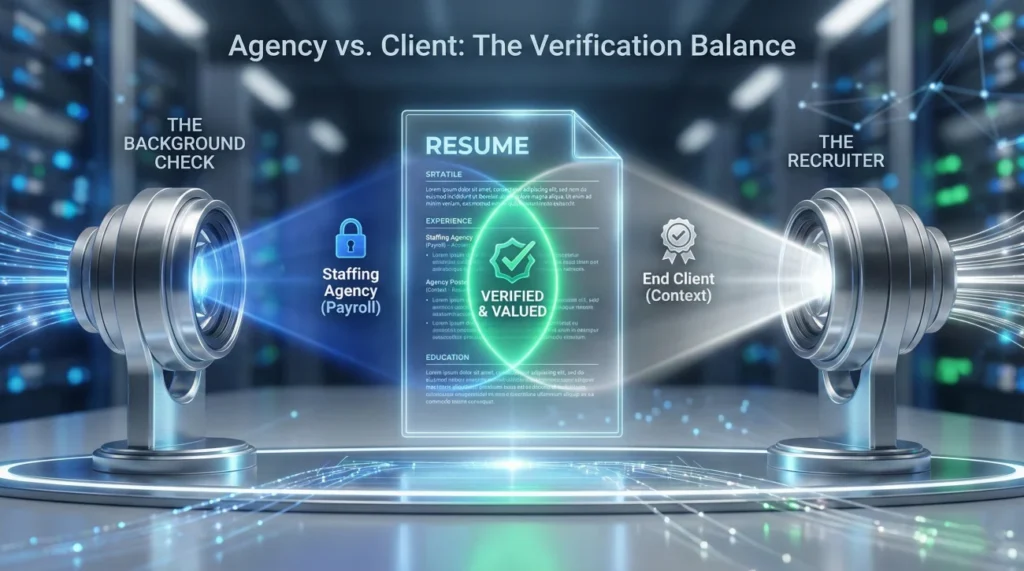
- If you were paid by the agency, treat it as the employer of record. Then add the client as context, not as your legal employer.
- The safest format is: Agency (Employer of Record) + Client (Contract Assignment). It reads clean and matches verification.
- If the client name is sensitive, you can still show credibility with a neutral descriptor, scope, and outcomes.
Why This Question Keeps Getting People Burned
I once worked with a developer named Samira who had a strong interview loop and a verbal offer that felt “done.” Then the background check vendor asked for employment verification, and the end client had no record of her as an employee. The agency did, but her resume listed the client as the employer. It did not kill the offer, but it delayed it, created awkward back-and-forth, and made her feel like she had to defend her integrity.
This is why the “staffing agency vs end client” question is not cosmetic. It is a trust question. You are trying to do two things at once: Show recognizable work, and keep the paperwork consistent.
Here is the core idea I teach contractors: staffing agency on resume is not about giving the agency more credit. It is about matching how employment gets verified, while still giving recruiters the client context they actually care about.
Key Point: The resume should reflect what you did and where you did it. Verification cares who employed you. Your format has to satisfy both.
Two Systems Are Looking at Your Resume, and They Want Different Truths
Recruiters and hiring managers scan for recognizable environments: Brand names, complex teams, modern stacks, regulated domains, high-stakes deadlines. That is why people feel tempted to put the end client as the employer.
Background checks are different. They are typically verifying the entity that issued your pay, held your HR file, and can confirm dates and status. If your resume and verification paperwork disagree, it can look like you are inflating, even when you did nothing wrong.
What Recruiters Actually Want When They Ask “Where Did You Work?”
Most of the time they are asking about the operating environment, not your payroll entity. They want to understand your exposure: Which scale, which stakeholders, which constraints, and whether you have navigated real-world delivery pressure.
This is good news. It means you can show the client context without pretending the client employed you.
What Verification Wants When They Ask “Who Employed You?”
Verification is closer to accounting than storytelling. If the client does not have you in their HR system, they may be unable to confirm anything. When that happens, the vendor will fall back to whatever entity can confirm employment: Usually the staffing agency, or your employer of record.
So the resume format should not force a contradiction. It should quietly align with how records exist.
⚠️ Warning: If you list the end client as the employer and the agency as “recruiter,” you may create a mismatch that triggers extra verification steps.
Decision Rules: Agency, Client, or Both
If you remember only one rule, make it this: The entity that paid you is the entity most likely to verify you.
Now let’s turn that into a decision you can apply in 60 seconds.
| Option | When It Works | Hidden Risk | Best Format |
|---|---|---|---|
| List staffing agency only | Many short assignments, client names add noise | Looks weaker if you never show real environments | Agency headline + bullets that show outcomes and scope |
| List end client only | You were a direct contractor with client-issued verification pathways | Client HR may not confirm you, delay or mismatch can happen | Only if you can verify client confirmation in advance |
| List both (recommended) | You want credibility plus verification safety | Needs clean wording to avoid “fake employer” vibes | Agency as employer, client as contract assignment |
| Client masked or generic | NDA, policy, sensitive client, stealth projects | Recruiter doubts credibility if it feels vague | Industry descriptor + scale + outcomes |
The Quick Check That Prevents 80% of Mistakes
- What name was on your paycheck or invoice payer?
- Who issued your tax documents or contract paperwork?
- If a verification vendor calls HR, who actually has your file?
- Do you have restrictions on naming the client publicly?
💡 Pro Tip: If you are unsure, default to the format that cannot be “disproven”: Agency as employer, client as context.
Where People Get Tripped Up by Wording
Most resume advice treats this as formatting. It is really a labeling problem. If your label implies “employment,” but your reality was “assignment,” you create distrust. That is why phrases like agency vs client on resume are not just SEO phrases. They describe a real trust boundary.
Safe Formats You Can Copy Without Looking Shady
When candidates tell me, “But recruiters like the brand name,” I agree. The point is to place the brand name in the right position. Context, not employer.
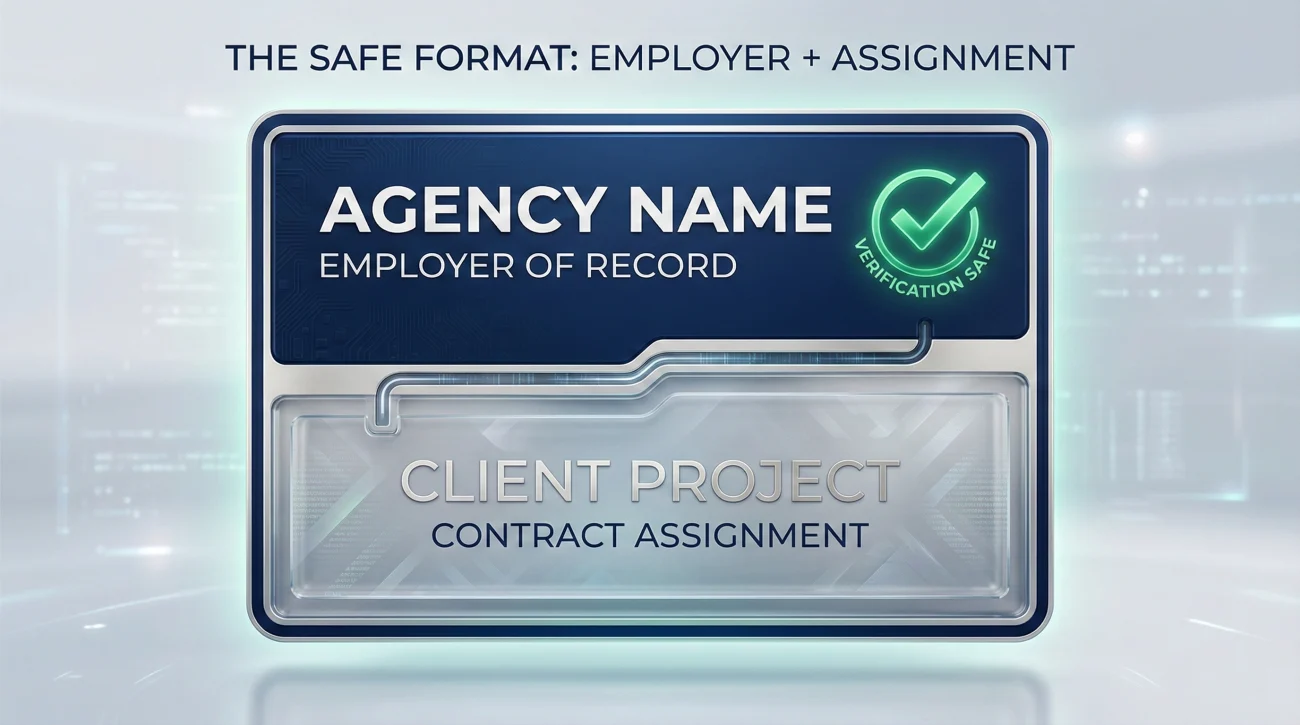
Format 1: Agency as Employer of Record, Client as Assignment
Contract Assignment: NorthBridge Payments (End Client)
Senior Data Analyst
– Built weekly KPI pipeline that reduced manual reporting time by 60% and improved forecast accuracy
– Partnered with Product and Finance to define metrics, align definitions, and prevent duplicate dashboards
– Presented insights to cross-functional stakeholders and documented decisions for audit readiness
This format signals the truth clearly: The agency employed you, the client is where you delivered. It also helps if you later need to fill forms for verification.
Format 2: Umbrella Agency, Multiple Clients (Cleaner for Many Short Contracts)
Client: NorthBridge Payments | BI Analyst | Jan 2022 – Sep 2022
– Standardized reporting logic across 3 teams and reduced metric disputes during weekly reviews
Client: GreenHarbor Health | Data Analyst | Oct 2022 – Apr 2023
– Automated claims trend analysis and improved turnaround time for executive reporting
Client: Lumen Freight Systems | Analytics Consultant | May 2023 – Present
– Built operational dashboards that improved on-time performance tracking and escalation speed
Notice what we did not do: We did not pretend you were an employee of three companies. We showed assignments under a single employer of record.
Format 3: When You Cannot Name the Client
If you are under NDA, you can still make the experience feel real. You replace brand name with a descriptor that signals scale and domain, then you anchor credibility with outcomes.
Contract Assignment: Confidential Fortune 100 Fintech (Payments Platform)
Product Operations Specialist
– Led process redesign that reduced onboarding cycle time by 25% across a distributed team
– Maintained decision log to prevent rework and align stakeholders on tradeoffs and approvals
This is where end client name on resume becomes optional. You can still make the environment legible without exposing the name.
How to Explain It in Interviews Without Sounding Defensive
When interviewers ask, they are often testing honesty. If you sound like you are hiding, they get nervous. If you sound matter-of-fact, they move on.
“Just to clarify: My employer of record was Apex Talent Solutions, and my day-to-day work was with NorthBridge Payments on a contract assignment. I list both so the work context is clear and verification stays consistent.”
I like this script because it is short, neutral, and it does not over-explain. It also signals you have been through modern screening flows before.
What If They Push: “So Were You Their Employee or Not?”
Do not get philosophical. Keep it administrative. You can say you were contracted through an agency, assigned to the client team, and accountable for deliverables like any internal employee. That framing respects reality without diminishing your impact.
Verification Notes: Keep Your Story Consistent Across Forms
The easiest way to lose credibility is not a skills gap. It is inconsistency. Your resume says one thing, your background check form says another, and now someone has to decide whether you were embellishing.
Match the Entity, Then Add Context
On background check forms, list the staffing agency as the employer if that is who can verify dates and status. Then, if the form has a notes field, you can add the client as the assignment context.
❌ Note: Do not “fix” verification by inventing an employment relationship with the end client. A mismatch rarely improves your odds, and it can create avoidable delays.
If You Worked Under an Employer of Record
Some modern arrangements involve EOR providers or umbrella entities. In that case, the safest wording is to reflect the payer and verification holder, then clarify context. That is exactly what contractor resume employer of record formatting is designed to do.
- ✅ Use the verification entity as the “Company” line
- 📌 Use “Contract Assignment” to introduce the client context
- 🧾 Keep dates aligned across resume, LinkedIn, and forms
Final
If you are stuck between “I want the brand name” and “I want the offer to clear,” you do not have to choose. Use a format that tells the administrative truth and still sells the work context.
The cleanest solution for most contractors is simple: Agency as employer of record, client as assignment. It reads like grown-up modern work, not like a loophole. And it keeps your staffing agency on resume story consistent when the paperwork catches up.
❓ FAQ
🧠 Will listing the agency make my experience look weaker?
Not if you add the client as context and write outcome-based bullets. Recruiters care about environment and impact. You can show both without mislabeling the employer.
🔍 Can I list the end client as the company if everyone recognizes the brand?
Only do this if the end client can actually verify your work history in a way that matches typical screening. If they cannot, the safer approach is listing the agency and adding the client as an assignment.
🧾 What should I put on background check forms if my resume shows both?
Use the employer of record as the employer line, because that is who can confirm dates and status. If there is a notes field, add the client as assignment context so the reviewer understands the structure.
🛡️ What if I signed an NDA and cannot name the client?
Use a neutral descriptor that signals industry and scale, then anchor credibility with deliverables and results. Your bullets can still make the work feel real without exposing the client name.
🧩 I had multiple agencies. Should I group them or list them separately?
If the contracts are short and similar, grouping by agency can reduce clutter. If the agency changes reflect a real shift in role level, industry, or scope, listing them separately can help your narrative stay clear.
📌 What is the simplest wording that keeps me honest and still readable?
Try: “Staffing Agency (Employer of Record)” on the company line, then “Contract Assignment: Client Name” on the next line. It is clean, transparent, and easy to defend.
⚠️ Disclaimer: ResumeSolving provides resume, cover letter, job search communication, and career transition guidance for informational purposes only. Hiring practices vary by employer, role, location, industry, and individual circumstances. We do not guarantee interviews, job offers, ATS results, or other outcomes. Verify employer requirements directly and follow applicable laws and workplace policies. For sensitive situations, use only information you are comfortable disclosing and keep all statements accurate.