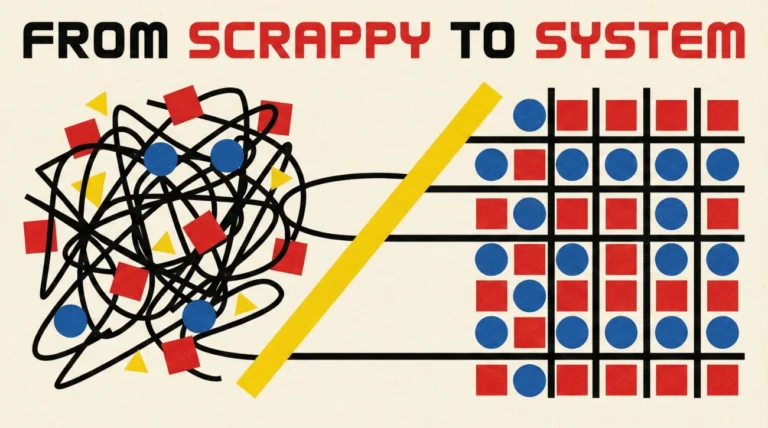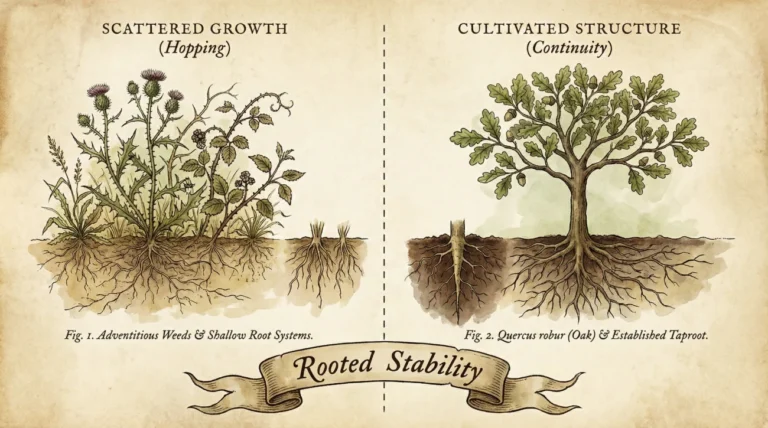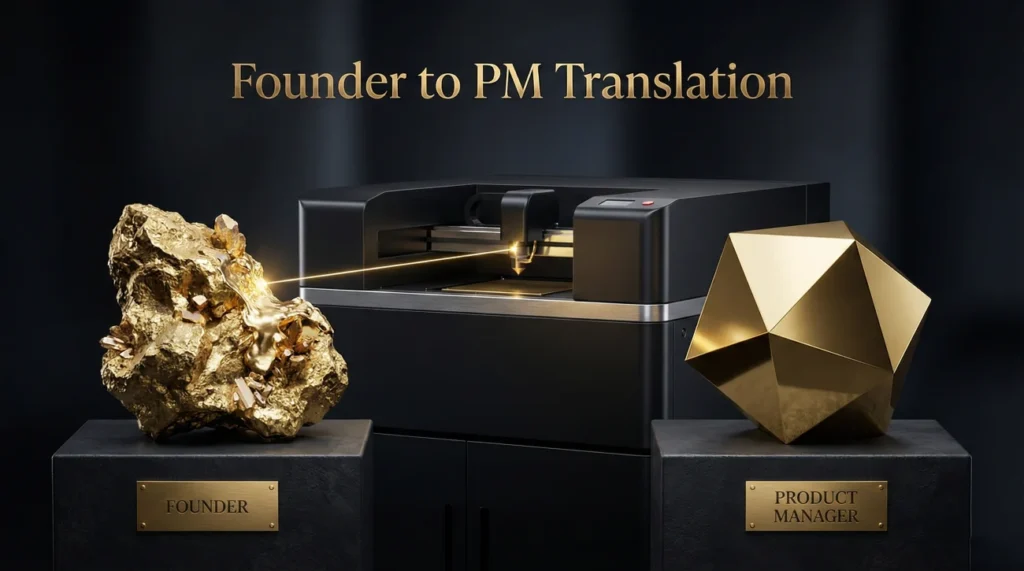
- You do not need to hide being a founder. You need to translate it into recognizable PM signals: Discovery, prioritization, delivery, and outcomes.
- Your resume should read like: Problem, decision, trade off, shipped result. Not: “Did everything.”
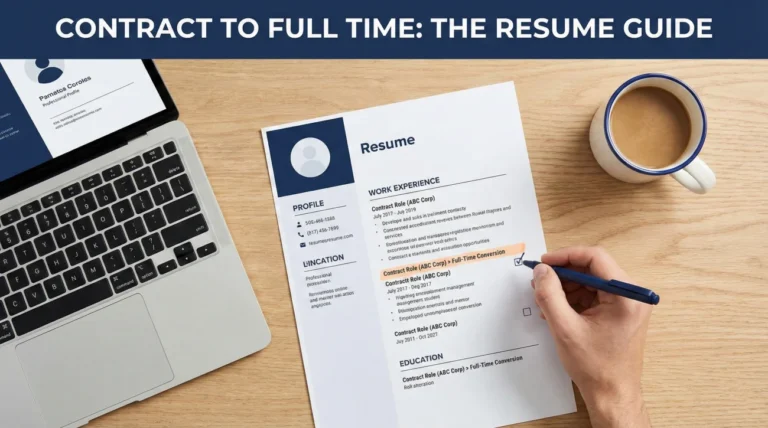
- Use a simple structure: One line context, then bullets that prove PM judgment with metrics or clear proxies.
- Handle the two awkward questions early: Why you left, and who owned the roadmap. Do it in one neutral sentence, not a confession.
- Steal the bullet bank and the before-after swaps below. They are built specifically for founder to PM pivots.
Founder to Product Manager Resume: The Translation Most People Skip
I have seen this pattern a lot in the last decade: A smart founder applies for Product Manager roles and gets filtered out before a human even has a chance to be curious. The painful part is that the founder often did real product management, sometimes more of it than the average PM. The resume just does not look like PM work.
The goal of how to write a founder resume for product manager is not to downplay leadership or pretend you were “just an IC.” It is to make your founder experience legible to a hiring manager who is scanning for familiar PM signals: Discovery, prioritization, cross functional execution, and measurable outcomes.
One quick story to ground this. Ava built a small B2B tool after leaving agency life. She shipped fast, talked to customers weekly, and iterated pricing three times. But her resume read like a founder diary: “Built product, built team, built partnerships.” Once we rewrote it in PM language, she stopped getting the “Interesting background, but not quite PM” rejection and started getting real screens.
💡 Pro Tip: Your resume does not need to prove you can start a company. It needs to prove you can make product decisions inside someone else’s constraints.
The PM Signal Map: Translate Founder Work Into What PM Hiring Managers Recognize
Most founder resumes fail for one reason: They describe responsibilities instead of decision signals. Product hiring managers are trained to look for evidence of judgment. That evidence usually shows up as trade offs, sequencing, metrics, and customer driven reasoning.
Here is the translation map I use when helping founders pivot into PM. Read it as: “What I did” becomes “What signal it sends” becomes “How to write it in one bullet.”
| Founder Activity | PM Signal It Proves | How To Phrase It On A Resume |
|---|---|---|
| Customer calls, demos, support, churn follow ups | Problem discovery and insight quality | “Ran weekly discovery across X segments, identified top Y pain points, and drove roadmap changes that improved Z.” |
| Deciding what to build next with limited resources | Prioritization and trade off discipline | “Built a prioritization model (impact, effort, risk) and shipped top initiatives in N week cycles.” |
| Working with dev, design, sales, marketing | Cross functional leadership without authority | “Aligned engineering, design, and GTM on scope and acceptance criteria; reduced rework by X.” |
| Shipping experiments, pricing tests, onboarding tweaks | Experimentation and metrics ownership | “Designed and shipped experiments that moved activation from A to B or improved retention by C.” |
| Handling investors, partnerships, and “big meetings” | Stakeholder management and narrative clarity | “Created exec ready product narratives and decision docs that unlocked approvals and faster delivery.” |
| Building MVP, iterating, finding product market fit | End to end product thinking | “Took product from concept to MVP to iteration, based on customer insights and funnel data.” |
Notice what is missing: The word “hustle.” The word “visionary.” The phrase “wore many hats.” Those are not PM signals. They are founder signals, and they often trigger fear: “Will this person get bored, disagree with leadership, or resist process?”
A Resume Structure That Makes Founder Experience Read Like PM Experience
If you were applying as a pure PM, a hiring manager expects a predictable layout: Summary, experience bullets with product outcomes, skills that map to the job, and maybe one project highlight. Founder resumes tend to put the company story first, which is the opposite of what a PM screen wants.
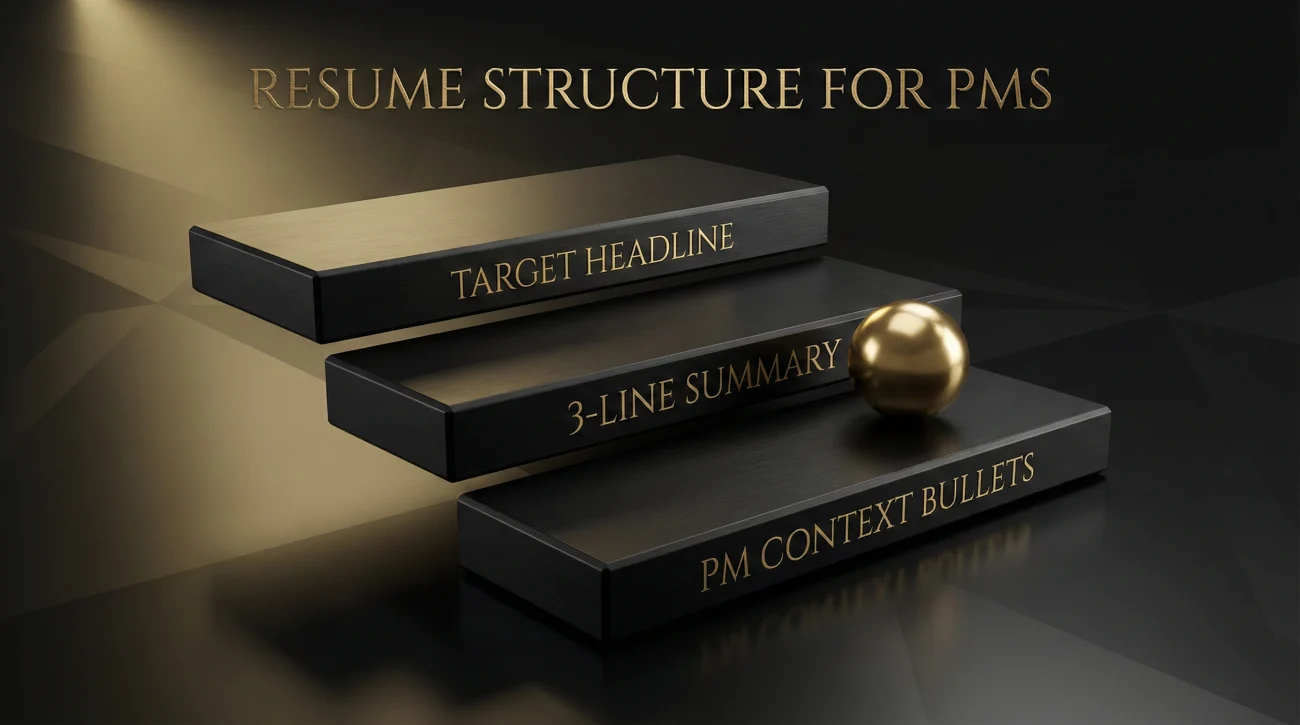
Step 1: Use A Headline That States The Target Role Clearly
Your top line should remove ambiguity. The resume’s first job is: “Is this person a fit for the role I am filling?” If the first thing they see is “Founder/CEO,” they start running a different evaluation in their head.
For this pivot, keep it simple: “Product Manager” or “Product Lead” as the functional identity, then let the experience prove it. If your background checks are strict, you can keep the company name and founder title in the company line while still describing the work in PM terms.
⚠️ Warning: Do not invent a title you never used in a way that creates a trust problem. You can frame your function as product management while keeping the legal reality intact in the company line.
Step 2: Add A 3 Line Summary That States Your Product “Lane”
Founders often write summaries that sound like pitching. PM summaries should sound like execution and judgment. The easiest structure is: Domain, product stage, and measurable outcomes.
That summary works because it describes product work, not entrepreneurship identity.
Step 3: Experience Section: One Line Context Then PM Bullets
This is the part most founders skip. Add one line that explains what the company did, in plain language, then get to bullets that show product decisions and outcomes.
What should the one line context look like?
Think: customer, problem, and scale. One sentence. No mythology. Example: “Built a workflow tool for independent clinics to reduce admin time and improve patient follow up.”
Then your bullets should follow a repeatable pattern: Insight, decision, shipped change, metric or proxy result.
10 Founder to PM Bullet Examples You Can Adapt Today
These bullets are designed for the “founder to PM” screen. They avoid founder language and show the signals a PM hiring manager expects. Use your real numbers when you have them. If you do not, use honest proxies: time saved, cycle time reduced, conversion rate movement, usage growth, or customer retention indicators.
Also, one keyword note for ATS. You only need to place the long tail phrases once naturally. For example, if you are aiming for a founder to product manager resume, the work has to read like product decisions, not like a company biography.
• Built a prioritization system (impact, effort, risk) and shipped the top 6 roadmap items over two quarters with a small engineering team.
• Defined success metrics for activation and retention, instrumented key events, and used funnel data to drive onboarding improvements.
• Partnered with design to redesign onboarding flow, reducing setup time and increasing first week activation.
• Led pricing and packaging experiments, tested two plans, and improved conversion from trial to paid while reducing support load.
Now a second set that leans more “PM in the wild,” the type of bullets that work well for a startup founder product manager resume when your scope was scrappy but real.
• Coordinated cross functional launch with marketing and sales, created messaging and enablement, and supported the first 50 customer onboardings.
• Built a lightweight roadmap cadence (weekly triage, monthly review), improved delivery predictability, and kept stakeholders aligned.
• Interviewed churned customers, identified the top cancellation drivers, and shipped fixes that reduced early churn indicators.
• Created a customer feedback loop (in app prompt, support tags, and interviews) and used it to drive a quarterly product plan.
If you want a sanity check: Read each bullet and ask, “Would this make sense if I remove the word Founder?” If yes, it is probably solid PM signal. That is what a good founder PM resume feels like.
Founder Resume Mistakes That Quietly Kill PM Credibility
I am not judging founder pride. I like founder energy. But hiring managers can misread it fast. When a resume sounds like a pitch deck, they assume you will bring pitch deck behavior into product meetings. That is not what most teams need.
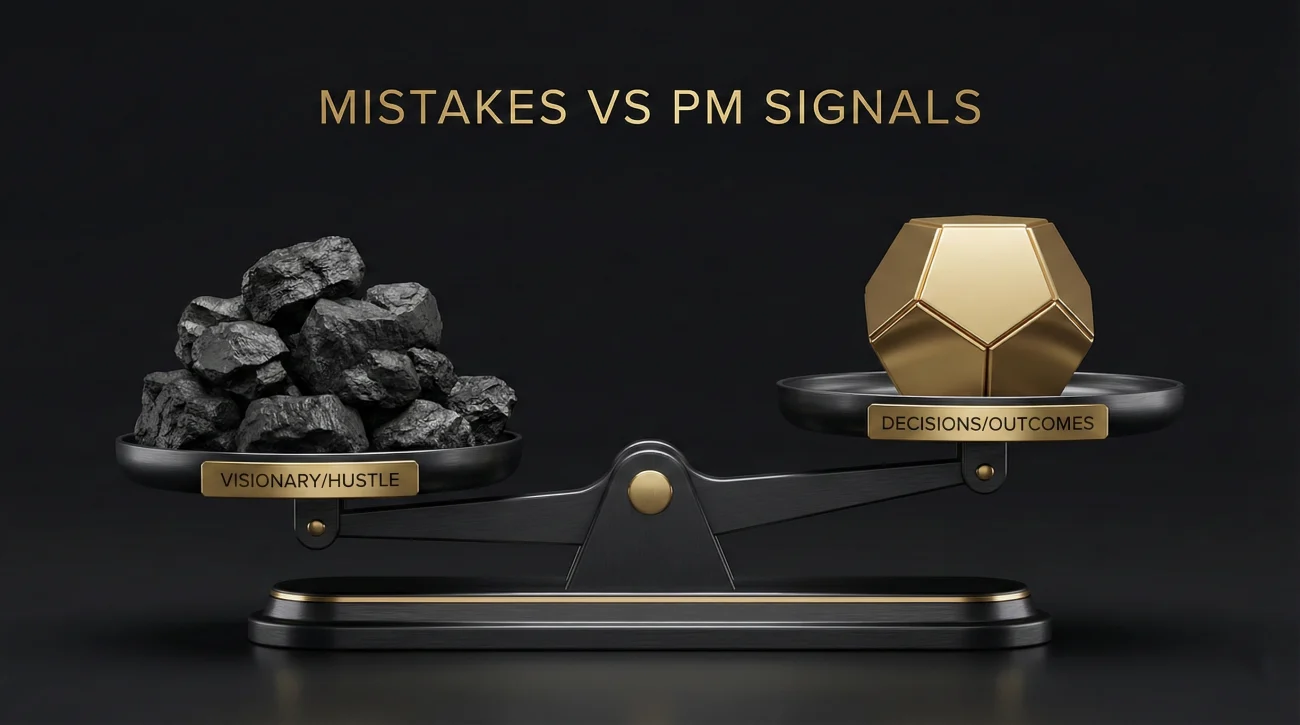
Four Before After Swaps That Fix The “Founder Vibe” Problem
These are small wording swaps that change the story from “I built a company” to “I made product decisions and delivered outcomes.”
Here is the second swap. Keep it specific and measurable, even if the product was small.
Third swap. This one matters because “vision” language can sound like ego if it is not paired with execution.
Fourth swap. Stop calling everything “successful” and let the numbers or decisions carry the point.
Handle The Two Awkward Questions: Why You Left, And Who Owned The Roadmap
Founders often avoid these topics on the resume. Then the recruiter asks in the first three minutes, and you end up sounding defensive. A better approach is to plan for it with one neutral sentence and a calm tone.
A Conversation Pattern That Does Not Sound Like Damage Control
One of my colleagues, Alfonso, used to lead product at a startup where the CEO was also the founder. When Alfonso later hired a former founder into a PM role, he told me something that stuck: “I am not scared of the founder story. I am scared of the ambiguity.” That is the mindset you are writing for.
“So, what happened with the company?”
“We took it through MVP and early adoption, then I decided to transition into a dedicated PM role where I can focus on discovery and delivery inside a larger team. The product work is what I want to keep doing, full time.”
That answer works because it signals closure and clarity. It does not overshare, and it does not ask the recruiter to comfort you.
Two One Sentence Options You Can Use On The Resume
You do not need a long explanation. You just need a line that prevents the hiring manager from imagining chaos.
- “Transitioned from founder role to pursue full time product management in a larger team environment.”
- “Closed the founder chapter after MVP and early adoption; now focused on PM roles in B2B SaaS.”
❌ Note: Avoid emotional reasons on the resume. Save nuance for interviews if you are asked and if it is relevant.
If You Lack Big Company PM Artifacts, Use These Proof Signals Instead
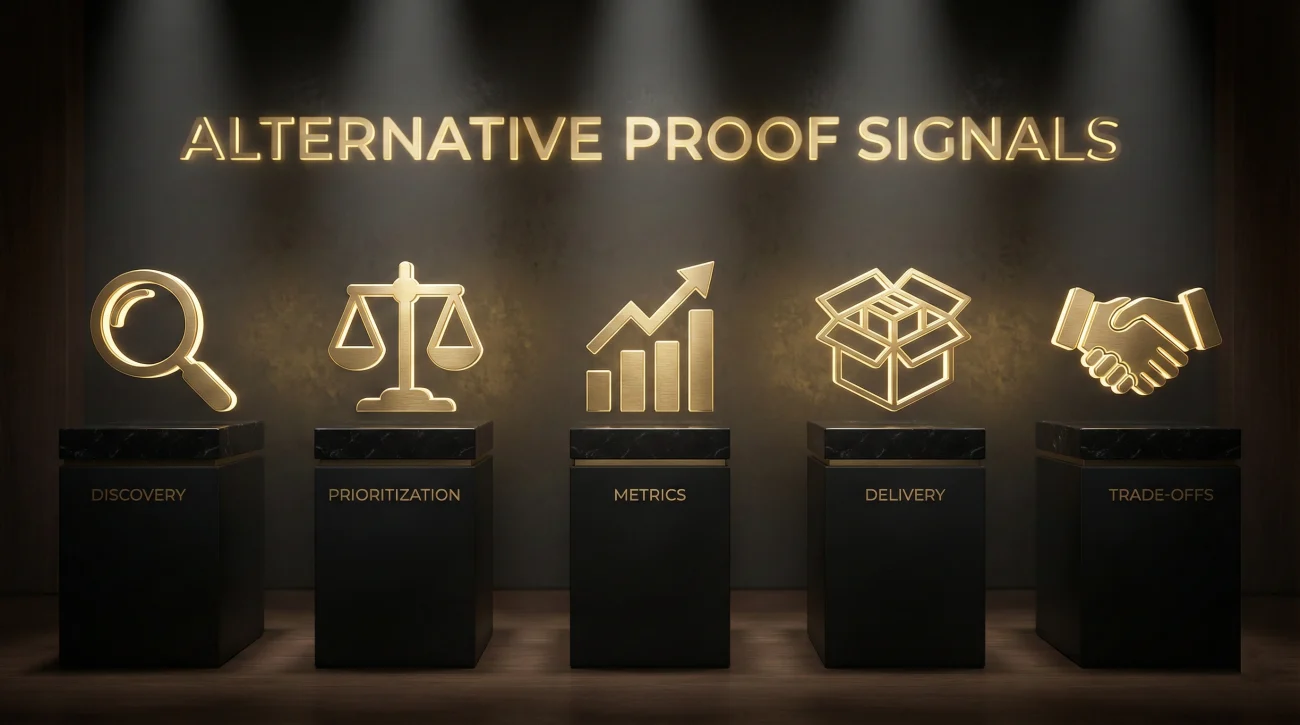
Founders sometimes panic because they do not have the classic corporate artifacts: a formal PRD process, a big roadmap tool, or “stakeholder buy in” meetings with ten directors. That is fine. Hiring managers are still looking for evidence of how you think and decide.
Practical Proof Points That Work Even In Small Startups
Here are proof signals that translate well and are easy to write without exaggeration. Use what you actually did.
- Customer discovery cadence: Weekly interviews, structured feedback loops, churn analysis.
- Prioritization method: Any consistent model you used, even if it was simple.
- Metrics literacy: Activation, retention, conversion, time to value, support load, NPS themes.
- Delivery discipline: Release cadence, scope control, acceptance criteria, and post launch iteration.
- Trade off clarity: What you explicitly did not build, and why.
Another real example. Silvia was a founder who built a marketplace product. Her first resume had a long “Company story” paragraph. We replaced it with a one sentence context line and three bullets that showed prioritization and metrics. She told me later: The interview questions changed immediately. Recruiters stopped asking “Why founder?” and started asking “How did you decide what to build next?” That is exactly the shift you want.
Final: Write Like A PM, Not Like A Pitch Deck
The cleanest way to think about this pivot is simple: You are not trying to convince someone you are impressive. You are trying to make your decision making readable. If your resume consistently shows discovery, prioritization, delivery, and outcomes, the founder label becomes context, not a barrier.
When you apply the framework for how to write a founder resume for product manager, your story stops sounding like “I started a thing” and starts sounding like “I ship the right things for the right reasons.” That is the moment the conversation becomes about fit, not about skepticism.
❓ FAQ
🧭 Should I keep “Founder” as my title if I am applying for PM roles?
You can keep Founder in the company line, but your bullets should read like PM work. If the first glance screams “CEO,” some teams will evaluate you for leadership roles instead of PM roles.
🔍 What if my startup did not grow or did not raise funding?
Growth and funding are not required to show PM signal. Focus on discovery quality, prioritization discipline, shipped improvements, and measurable product outcomes or honest proxies.
🧪 How do I show metrics if I did not track everything?
Use what you have: activation steps completed, onboarding time reduced, support tickets reduced, churn reasons, conversion changes, or cycle time improvements. Avoid making up numbers.
🧩 Should I list my startup under Experience or Projects?
If it was your primary work for a meaningful period, put it under Experience with a one line context statement. Projects works better when it was clearly part time or a short build.
🎯 What PM keywords matter most for founders?
Discovery, prioritization, roadmap, trade offs, cross functional, metrics, experimentation, launch, iteration. Use them only when they match real work you did.
🧠 How do I avoid sounding like I will resist direction?
Write bullets that show collaboration and constraints. Mention alignment, acceptance criteria, feedback loops, and iteration based on evidence. “I decided everything” is the vibe to avoid.
⚠️ Disclaimer: ResumeSolving provides resume, cover letter, job search communication, and career transition guidance for informational purposes only. Hiring practices vary by employer, role, location, industry, and individual circumstances. We do not guarantee interviews, job offers, ATS results, or other outcomes. Verify employer requirements directly and follow applicable laws and workplace policies. For sensitive situations, use only information you are comfortable disclosing and keep all statements accurate.