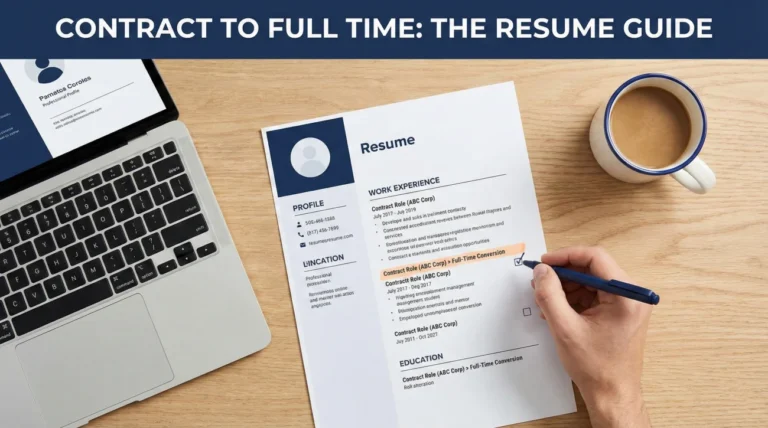
- If you are wondering how to list founder on resume, start by choosing one structure that makes your role look verifiable, not “everything-ish”.
- Recruiters do not reject founders for ambition. They reject ambiguity: Unclear employer, fuzzy scope, and no signal that the chapter is stable or closed.
- You only need two anchors: One proof marker (entity, dates, outcomes) and one stability marker (role mapping, team fit, or commitment signal).
Why Founder Experience Gets Misread On Paper
I have watched this happen in hiring debriefs more times than I can count. Someone opens a resume, sees “Founder”, and their brain fills in the blanks in five seconds.
Not because they hate entrepreneurship. Because they hate risk they cannot measure.
A founder role can trigger three quiet questions:
- Are you still emotionally or operationally tied to the business?
- Is this real work experience or a vague “life chapter”?
- Will you leave again the moment you get bored?
So instead of another “use action verbs” lecture, this is a translation guide for the one section that usually decides whether a founder gets a fair read: Experience.
The Real Problem Is Not “Founder”. It Is Missing Signals

One candidate I worked with, Young, built a small B2B SaaS with two engineers and a handful of paying customers. She was not trying to impress anyone. She just wrote the truth: “Built product, did sales, did marketing.”
In the debrief, a manager said: “I cannot tell what she actually did day to day. Also, is this still running?”
Same human, different writing. We rebuilt her Experience entry to include two signals recruiters trust:
- Closure or stability: A calm line that says the venture is closed, acquired, paused, or transitioned away from daily operations.
- Verifiability: Entity, dates, scope, and outcomes that can be checked without needing your life story.
💡 Pro Tip: You do not need to “justify” being a founder. You just need to remove the ambiguity that makes people assume the worst.
Pick One Of These 3 Structures For Founder Experience
Founders often jam everything into one entry, then wonder why it reads vague. The fix is choosing a structure that matches what the recruiter expects to see.
Here are three structures that work in real hiring loops. Pick one. Commit to it.
| Structure | Best When | What It Solves | Hidden Risk If Done Wrong |
|---|---|---|---|
| Company as Employer | You built an entity that existed as a company, even if small | Makes it look like a standard role with verifiable dates | Title inflation (CEO for a 2 person side project) |
| Consulting Umbrella | You did client work, services, agency, fractional, contracting | Stops the “random startup” assumption and clarifies deliverables | Looks like freelancing if you do not show scope and outcomes |
| Product Led Role Framing | You want to map founder work to a target function (PM, Sales, Ops) | Translates founder chaos into one job family | Sounds dishonest if your bullets do not match the role name |
Structure 1: Company As Employer (The “Normal Experience” Look)
Use this when you had a real entity and you can stand behind the dates. It makes your resume feel familiar to the reader.
Your job is to write it like employment, not like a biography. Keep it calm, specific, and checkable.
⚠️ Warning: If your “company” was a weekend side project with no customers, do not dress it up like a venture-backed startup. That is where trust breaks.
Structure 2: Consulting Umbrella (The “Client Work” Translation)
This is the cleanest option for agency owners, consultants, and founders whose work looked like projects, not product roadmaps.
It also helps when your business name is unknown. Recruiters understand client outcomes faster than they understand your brand story.
Structure 3: Product Led Role Framing (The “Map To Target Role” Move)
If you are applying for Product Manager roles, writing “Founder” can be a waste. The recruiter still needs to picture you doing the target job inside their system.
That structure keeps the company entry, but labels the role in a way that matches the job family, while still being truthful.
Example: “Product Lead (Founder)” instead of “CEO”. Same reality, clearer translation.
A Simple Verifiable Line That Stops The “Is This Real?” Doubt

Here’s the line I look for when I review founder resumes for hiring managers. It does not need to be long. It just needs to remove uncertainty.
[Role Label] | [Company or Consulting Brand] | [Dates] | [One Sentence Scope] | [Proof Marker]
Proof markers can be boring, and that is the point. “Boring” reads as stable.
- Registered entity or DBA name (if relevant)
- Paying customers, contract count, or revenue range (only if you can stand behind it)
- Team size or cross functional partners
- Distribution signal: users, trials, retention, pipeline, renewals
- Outcome signal: acquisition, shutdown, transition to advisory, handed off operations
💡 Pro Tip: If you cannot share a number, share a boundary. “Low six figures ARR” reads more credible than “scaled rapidly”.
Write Founder Bullets Like A Job, Not A Life Story
The fastest way to sound vague is writing founder bullets that are all identity and no work.
Weak bullets look like this: “Wore many hats. Built strategy. Managed everything.” They are not wrong. They are just unreadable.
So what should founder bullets look like?
They should read like a job description that already happened. Three parts:
- Scope: What system did you own (product, revenue, ops, partnerships)?
- Mechanism: What did you actually do (build, negotiate, hire, ship, redesign, sell)?
- Outcome: What changed because of it (customer growth, cost reduction, cycle time, retention)?
Key Point: Your bullets are not there to prove you are impressive. They are there to prove you are legible inside someone else’s org chart.
Six Founder Experience Examples You Can Adapt
These examples are not “perfect resumes”. They show how to translate founder work into readable experience entries without exaggeration.
Example 1: B2B SaaS Founder (Company As Employer)
Maisie’s first draft was honest but foggy. The entry below keeps it grounded and checkable.
Built and shipped a workflow tool for mid market operations teams (B2B SaaS).
Owned discovery, roadmap, and go to market for first paid cohort (8 customers).
Partnered with 2 engineers to ship MVP in 10 weeks, then iterated weekly based on support tickets.
Created sales pipeline, demos, onboarding, and retention loops; reached low six figures ARR.
Transitioned day to day operations after Oct 2024; product is maintained in light mode (support only).
⚠️ Warning: If you write “CEO” here, some readers will assume ego, not leadership. “Product Lead (Founder)” is often a cleaner mapping for product roles.
Example 2: Local Service Business Owner (Consulting Umbrella)
For business owner resume experience, the work is operational, customer-facing, and process-heavy. That means the entry should emphasize systems, cadence, and outcomes.
Ran daily operations for residential services business across scheduling, customer intake, and vendor management.
Built repeatable quoting process and service SOPs; reduced no show rate and improved review consistency.
Managed a small contractor network (5 to 8 active); handled hiring, training, and quality checks.
Transitioned business after Aug 2023 due to relocation; operations handed off to new operator.
Example 3: Agency Founder (Consulting Umbrella With Client Outcomes)
If you want to avoid “random projects”, anchor the work around deliverables and outcomes.
Led brand and content strategy engagements for B2B teams (positioning, messaging, launch assets).
Built repeatable intake system, briefs, and editorial workflows; improved delivery speed across projects.
Managed client relationships end to end: discovery, scope, pricing, delivery, and renewal.
Currently operating at a limited capacity while pursuing full time roles; no active hiring, no expansion plans.
That last line matters. It answers the question the reader is scared to ask: “Is this still your real job?”
Example 4: Startup Co Founder (Role Framing Toward Sales)
For founders targeting revenue roles, the trick is not claiming a fancy title. The trick is writing sales work like sales work.
Built outbound motion from scratch: ICP definition, messaging tests, sequence design, and follow up system.
Created pipeline from zero to consistent weekly demos; closed first 12 paying customers.
Partnered with product to translate objections into roadmap priorities; improved activation and onboarding clarity.
Stepped away from daily operations in Dec 2024 after co founder transition; retained as informal advisor only.
Example 5: Side Venture That Stayed Small (Honest Boundaries)
When the venture was real but not “big”, honesty plus structure beats hype every time.
Built a small e-commerce brand alongside full time work; handled supplier coordination, listings, and customer support.
Ran weekly ops cadence: inventory checks, fulfillment handoffs, and issue resolution.
Closed the brand in Nov 2023 after evaluating time tradeoffs; no ongoing sales or operations.
💡 Pro Tip: Saying “I closed it” is not a confession. It is a clarity signal.
Example 6: Product Founder Targeting Operations Roles (Role Framing Toward Ops)
For startup founder resume experience that is pivoting into operations, program management, or systems roles, show cadence, stakeholder flow, and execution discipline.
Built internal operating system across planning, vendor workflows, and customer communication for early stage product delivery.
Designed weekly cadence: intake, prioritization, execution tracking, and post-mortems; reduced avoidable rework.
Negotiated and managed external partners; created scorecards to measure reliability and turnaround time.
Transitioned responsibilities in Sep 2024; currently not operating the venture day to day.
Do Not Do List: The Mistakes That Make Founders Look Untrustworthy

These are the patterns that trigger skepticism fast, even when the candidate is strong.
- ❌ Writing a grand title with no matching scope (CEO, President, Chairman) for a tiny venture
- ❌ “Did everything” bullets with no owned system and no outcomes
- ❌ Metrics you cannot explain in a follow up (especially revenue claims)
- ❌ Fuzzy timelines (no months, overlapping dates, “2022 to 2024” with no context)
- ❌ Hiding the venture outcome when the reader can sense it (quiet shutdowns read like avoidance)
- ❌ Making the business sound like your identity instead of a role you can translate
One of my colleagues in HR, Daniel, says it bluntly: “I do not mind founders. I mind fog.” That line stuck with me because it is exactly what hiring teams are reacting to.
What A Recruiter Wants To Hear When They Ask About Your Founder Entry
Sometimes the resume is fine, but the recruiter still asks the question because they need one calm sentence of reassurance.
I see you were a founder. Are you still running this?
No. I transitioned day to day operations last fall. I kept it on my resume because the work maps directly to this role, especially the product delivery and customer facing execution.
What part of it is most relevant to what you want next?
The operating system side. Weekly planning, stakeholder alignment, and turning messy inputs into shipped outcomes. That is the work I want to do inside a larger team.
Notice what is not in that answer: defensiveness, drama, or a pitch deck. It is just clarity.
Final: A Founder Entry That Reads Stable, Verifiable, And Easy To Place
If you only take one idea, take this: the goal is not to “sell” your startup. The goal is to make your founder experience readable as work someone can hire.
Choose one structure, add a proof marker, and include a calm closure or stability line. That is the difference between “interesting but risky” and “clear and hireable”.
When people ask me how to list founder on resume, I tell them the same thing I told Maisie: Do not shrink your story, just remove the fog.
❓ FAQ
🧩 Should I write “Founder” or a functional title like Product Lead?
If you are applying into a specific job family, a functional label like “Product Lead (Founder)” often reads clearer than “Founder” alone. It keeps the truth while helping the recruiter place you inside their org chart. Just make sure your bullets match the function you claim.
🧾 Do I need to include the company as an employer even if it was small?
If it was a real entity and you can stand behind the dates, yes. “Company as employer” is the fastest way to look normal in an ATS scan and in a human skim. If it was closer to a side project with no traction, keep it honest and bounded.
🔎 What makes founder experience look “verifiable”?
Clear dates, a stable role label, and at least one proof marker: customers, team size, contract count, product distribution, or a clean venture outcome line. The point is not to overshare. The point is to make the entry checkable.
🧠 Is it bad to say the startup shut down?
No. Silence often reads worse than closure. A calm line like “Closed in Nov 2023 after evaluating time tradeoffs” is usually safer than leaving the reader guessing. Keep it factual and short.
📌 How many bullets should I use for founder experience?
Most founders do best with 4 to 6 bullets. Fewer can look thin, more can turn into a wall of chaos. Prioritize bullets that show owned systems, mechanisms, and outcomes.
🧭 What if I am still doing light work on the business?
Say it cleanly. “Operating at limited capacity” or “Support only” removes uncertainty. Recruiters mainly want to know whether you are available and whether the role will compete with the job you are applying for.
⚠️ Disclaimer: ResumeSolving provides resume, cover letter, job search communication, and career transition guidance for informational purposes only. Hiring practices vary by employer, role, location, industry, and individual circumstances. We do not guarantee interviews, job offers, ATS results, or other outcomes. Verify employer requirements directly and follow applicable laws and workplace policies. For sensitive situations, use only information you are comfortable disclosing and keep all statements accurate.