- If your summary quietly signals flight risk, pay risk, or ego risk, you often lose the screen before you can explain anything.
- A solid overqualified resume summary shows you accept the scope, you want the work, and you can contribute fast.
- Use one calming opening line, then add a single proof hook that sounds factual rather than emotional.
Why Overqualified Candidates Lose Interviews Before The First Call
I have watched this happen in real hiring rooms, especially when the role is a level down or a “simpler” version of what someone used to do. The resume looks strong. The candidate looks capable. And yet the first reaction is not excitement. It is caution.
That caution is rarely about skill. It is about prediction. A hiring manager is silently weighing: “Will this person leave as soon as something better shows up?” “Will they push hard on title or pay?” “Will they get annoyed doing the routine parts of the job?”
That is why your overqualified resume summary cannot read like a highlight reel. This space is not for proving you are senior. It is for showing you are safe to hire at this level.
A former colleague of mine, Jessa, put it plainly after a tense screening discussion: “I don’t doubt she can do it. I doubt she wants to do it.” That one sentence explains why summary wording matters so much when you are downleveling.
The Three Fears Your Summary Accidentally Triggers
A lot of advice online says “tone it down.” That is vague. What you actually need is to calm a specific worry quickly, because the summary is where the reader decides what story they will attach to your name.
| Fear | What They Think | What Your Summary Should Signal |
|---|---|---|
| Flight risk | You will leave quickly once you get a better role. | You chose this scope on purpose and you can name why it fits. |
| Pay risk | You will be expensive or resent the pay band. | You value stability, contribution, schedule, craft, or mission more than status. |
| Ego risk | You will undermine the manager or refuse routine work. | You respect the role, enjoy hands-on delivery, and work well in a defined lane. |
⚠️ Warning: If your summary opens with “15+ years” plus “strategic leadership” plus “executive,” it may land like: “I am passing through.” Even if you do not mean it.
One candidate I worked with, Wilson, kept leading with his biggest titles because he felt he had to justify why he was applying. The result was the opposite. The hiring manager read his summary like a warning label. Once we rewrote it to show scope acceptance and a calm reason, he started getting screens again.
Three Rules For A Summary That Sounds Intentional, Not Desperate

Rule 1: Choose One Lane And Name It
Do not try to keep every door open in your summary. Overqualified candidates who sound “open to anything” often come across as uncertain or short-term.
Pick the lane that matches the posting and name it in plain language. Examples that read grounded: “hands-on operations,” “front line customer support,” “project coordination,” “IC data analysis,” “day to day account management.”
Rule 2: Add One Proof Hook That Feels Like A Fact
Hiring teams trust a small, concrete detail more than a long explanation. Your proof hook can be a metric, a volume, a cadence, or a clear boundary on scope.
Three simple shapes:
[Scope] + [Cadence] + [Outcome]
[Environment] + [Constraint] + [Delivery Signal]
[Skill] + [Tool] + [Useful Result]
If the hook matches the role’s reality, the reader relaxes. It sounds like you know what the job actually feels like.
Rule 3: Do Not Fight The Label In The Summary
If you write “Not overqualified” or “Willing to take a step back,” you drag the reader straight back to the fear. Your goal is to replace the fear with a cleaner story.
Say what you want, show you accept the scope, then let one proof hook do the convincing. Keep it short enough that it reads like positioning, not pleading.
Should I explain the pay cut or downleveling inside the summary?
Usually no. A light motivation signal is enough. Save detailed pay framing for later unless the application explicitly asks for it.
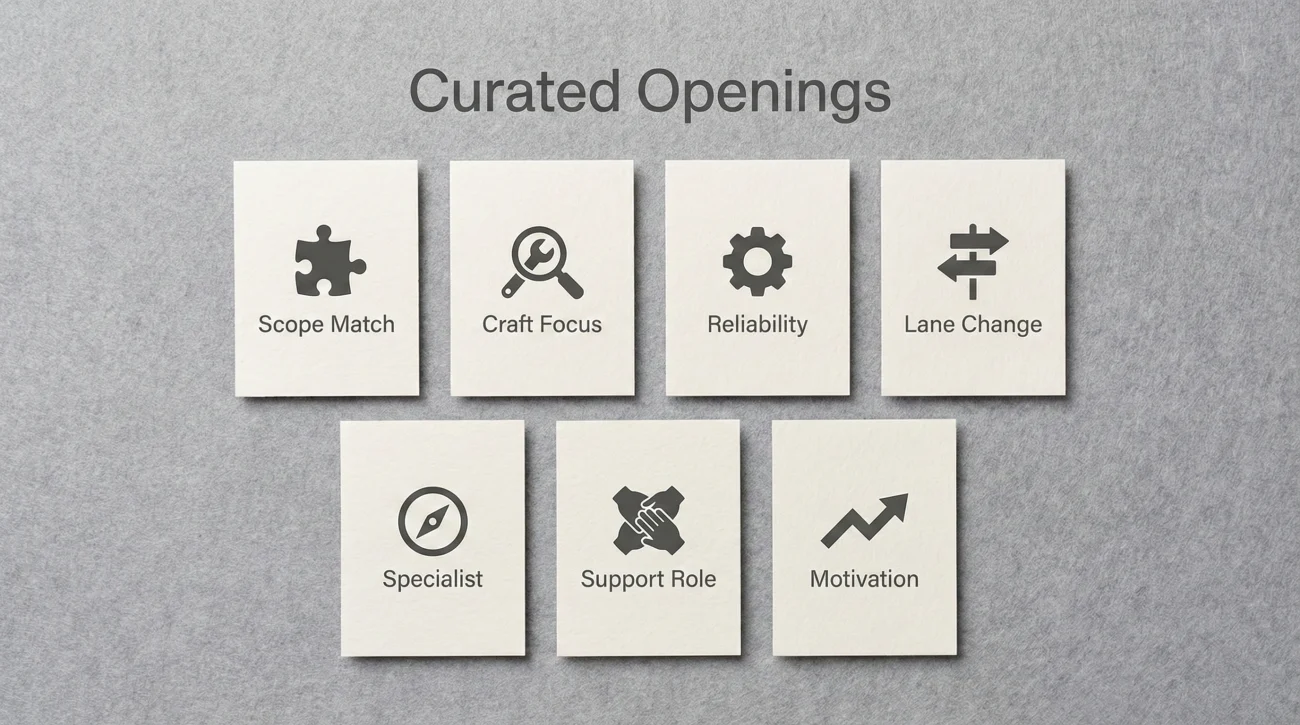
Seven Summary Openings That Make Hiring Managers Relax
These openings are built to calm one specific fear fast, then land one proof hook so it feels real. Keep the structure, swap the nouns for your field, and do not over-explain.
Opening 1: The Scope Acceptance Line
Best fit when: Your last title sits visibly above the job you want now. You are showing the level is a deliberate choice, not a temporary detour.
💡 Pro Tip: “Hands-on” lowers ego risk in one word without making you sound smaller.
Opening 2: The Craft Over Title Line
This one shines when: You are stepping from leadership-heavy work into an individual contributor lane. It signals you want the craft and the output, not the org chart.
Notice what is missing: Rank language. The hook is the weekly output, which reads practical and immediate.
Opening 3: The Reliability Line
Pick this if: You suspect the reader is thinking “they will leave.” The tone should feel steady, calm, and operational, like someone who will quietly handle the work.
One manager I know described summaries like this as “the opposite of drama.” In downlevel hiring, that is a real advantage.
Opening 4: The Defined Lane Line
Go with this when: The role is narrower than what you used to do and you want to show you will respect the lane. It reads like you understand the job’s boundaries and you are comfortable inside them.
⚠️ Warning: Avoid “I can do anything.” Instead, name what you can do repeatedly and well.
Opening 5: The Problem-Type Specialist Line
Use this to feel specific: You are overqualified on level, but unusually relevant to one painful problem type. It makes your application feel targeted instead of random.
This works because it reads like lived experience instead of ambition. It also suggests you are comfortable with operational reality.
Opening 6: The Supportive Senior Line
Choose this when: You have senior experience, but you want to remove the “threat” feeling for the manager. It signals maturity, teamwork, and accountability without competing for authority.
A candidate named Kamila used a version of this after being told she sounded “too senior.” The feedback shifted. They stopped calling her intimidating and started calling her steady.
Opening 7: The Short Motivation Line
This is for clean intent: You are making a visible priority shift and you want a simple signal that makes staying likely. Keep it short, professional, and non-personal.
Keep the reason simple. “Stable scope” plus “hands-on role” is enough. You do not need to explain your entire life change in the summary.
Quick Word Swaps That Quiet The Overqualified Signal
Generic advice says “sound less senior,” but it rarely shows the actual language moves. These swaps keep your credibility while lowering the “I will outgrow this” vibe.
| If Your Summary Says | It Can Sound Like | Try This Instead |
|---|---|---|
| Strategic leader driving transformation | I want senior scope | Hands-on operator improving day-to-day flow |
| Executive stakeholder management | I will be bored | Clear communication and dependable follow-through |
| Scaling organizations | I will demand growth | Improving consistency, quality, and turnaround |
| Building high-performing teams | I need to manage | Supporting teams through smooth coordination |
| Vision and strategy | I will challenge the lane | Execution, accuracy, and predictable delivery |
📌 Note: Overqualified summaries fail when they read like a negotiation. A summary is a preview of how you will show up on Tuesday morning.
How To Add A Proof Hook Without Sounding Like You Are Bragging
A proof hook is the small detail that makes your calm tone believable. Without it, the summary can feel like you are trying to talk someone into trusting you.
Three low-friction options that usually land well:
- Volume: “handling 40 to 60 tickets a day,” “supporting 12 to 15 client accounts,” “processing 200 invoices weekly.”
- Cadence: “weekly reporting,” “monthly close,” “daily dispatch coordination,” “end-of-shift handoff accuracy.”
- Constraint: “tight cutoffs,” “high compliance environment,” “limited resources,” “high turnover teams.”
When I review resumes for downlevel roles, I look for a hook that matches the job’s reality. If the work is repetitive, cadence is your friend. If the work is high pressure, a constraint hook shows you understand what you are walking into.
💡 Pro Tip: Keep it to one hook. Two can start to feel like a pitch. Three often reads like overcompensation.
Final The Summary That Gets Read Is The One That Feels Safe
Being overqualified is not automatically a deal-breaker. What blocks you is the unanswered question sitting in the reader’s head.
If you choose a lane, show scope acceptance, and add one believable proof hook, you stop sounding like someone passing through. You start sounding like someone who knows what they want and will do the work well.
That is the difference between an impressive background that gets filtered out and an overqualified resume summary that opens the door without creating a new argument.
❓ FAQ
🧩 Should I remove senior titles from my summary?
You usually do not need to remove truth. You need to remove emphasis. If your title alone creates ego risk, lead with your lane and delivery instead of your rank.
💰 Do I need to address salary expectations in the summary?
No. A short stability signal is enough. Save compensation details for the screen unless the application forces it.
🧠 What if I genuinely want less stress and less responsibility?
You can say that without sounding negative. Use language like “stable scope,” “hands-on work,” and “consistent responsibilities,” then back it with a proof hook that shows you like the day-to-day rhythm.
🎯 How long should an overqualified summary be?
Two lines is ideal, three lines max. If you need a fourth line, move that detail into your experience bullets.
🛠️ Can I use the same summary for every lower-level role?
Keep the structure, swap the lane. The fastest safe method is one stable template plus one role-specific phrase that matches the posting’s day-to-day work.
⚠️ Disclaimer: ResumeSolving provides resume, cover letter, job search communication, and career transition guidance for informational purposes only. Hiring practices vary by employer, role, location, industry, and individual circumstances. We do not guarantee interviews, job offers, ATS results, or other outcomes. Verify employer requirements directly and follow applicable laws and workplace policies. For sensitive situations, use only information you are comfortable disclosing and keep all statements accurate.