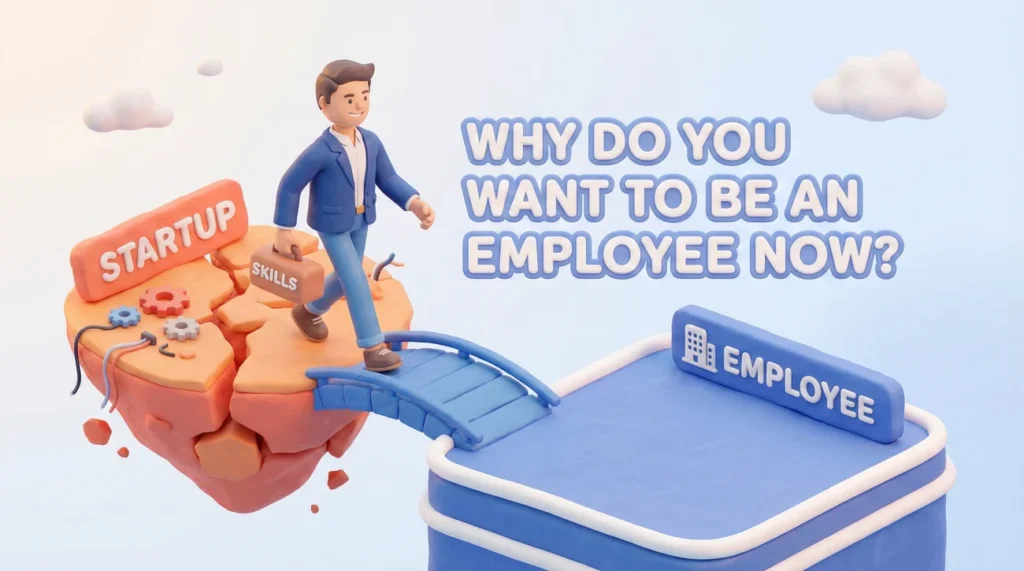
- This question is really about commitment and risk. Your answer has to close the “temporary employee” fear without sounding defensive.
- Use one simple structure: what you learned as a founder, what you want now, and one proof of boundaries or stability.
- Borrow a version that matches your founder outcome (sold, shutdown, consulting, burn out, cofounder split), then add one commitment cue that is true for you.
Why Do You Want to Be an Employee Now: A Founder Interview Answer That Sounds Committed
If you have ever been a founder, you have probably heard a version of this question. It can sound polite, but it is rarely small talk.
The interviewer is trying to understand something very specific: how to explain why you want to be an employee after being a founder without triggering the “flight risk” story in their head.
I have sat in debriefs where a candidate had great skills, great output, and still lost the offer because the room could not agree on one thing: “Will they stay, or will they quit the moment the next idea hits?”
This article gives you a practical structure you can reuse, six variations you can borrow, and the small “commitment cues” that make your answer land like a decision, not a detour.
What They Are Actually Asking When They Say: “Why Employee Now?”
Founders hear the question as: “Are you sure you are not giving up?” Interviewers hear it as: “What risk am I taking if I hire you?”
In practice, they are usually trying to rule out four fears:
| Fear in the room | What it sounds like in their head | What your answer must contain |
|---|---|---|
| Flight risk | You will join, get bored, and leave to start something again. | A boundary or time horizon that feels real. |
| Authority risk | You will struggle with having a manager or a slower decision process. | A line that shows respect for structure and collaboration. |
| Motivation risk | You want “stability” because you are burned out or desperate. | A positive pull toward the role, not just a push away from founding. |
| Confidentiality and conflict risk | You might learn our playbook and build a competitor. | A values-based statement about focus and ethics, not a legal argument. |
⚠️ Warning: If your answer only talks about paycheck, benefits, or “work life balance,” you may accidentally confirm the motivation risk, even if you are a top performer.
One founder I worked with, Madeline, answered with: “I’m tired of stress and I want something stable.” She meant: “I’m ready to focus and build deeply.” The panel heard: “She is recovering and might not last.” We did not change her story. We changed the signal.
The Core Structure That Works Across Roles and Industries
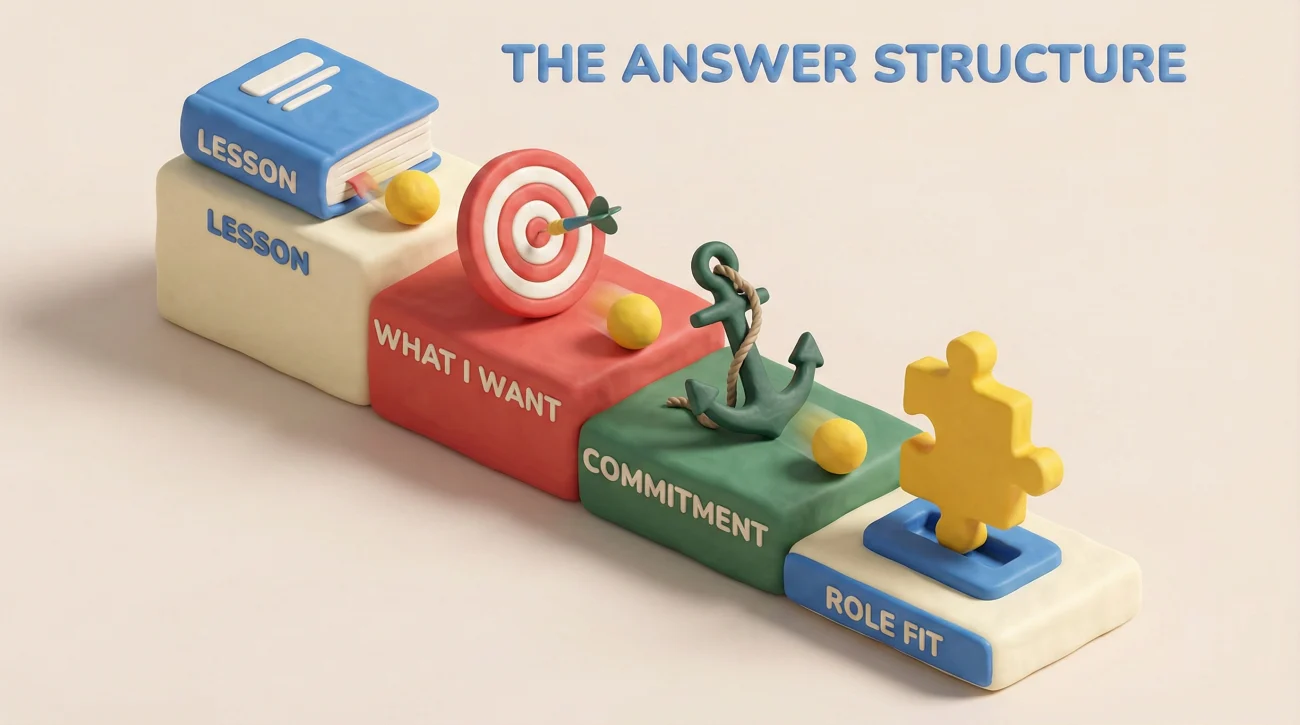
Your best answer is not a speech. It is a short chain of logic. I like to teach it as a four-part structure you can fit into 30 to 60 seconds:
[Founder Lesson] + [What I Want Now] + [Commitment Cue] + [Why This Role Here]
1) Founder Lesson: Show maturity, not nostalgia
Pick one lesson that makes you look more employable, not more restless. Good lessons sound like better decision making, sharper prioritization, and real accountability.
Bad lessons sound like: “I hate bosses,” “I hate corporate,” or “I finally learned that working for myself is hard.”
2) What I Want Now: Choose a “pull” reason that fits employment
Employment is not a downgrade. It is a different operating system. Strong “pull” reasons include:
- Wanting to build inside a larger roadmap and longer runway.
- Wanting to go deeper on one craft instead of wearing every hat.
- Wanting to lead with real cross-functional partners, not just vendors.
- Wanting to ship at scale with an established user base and constraints.
3) Commitment Cue: One concrete boundary that reduces risk
This is the missing piece most founders skip. A commitment cue can be a boundary, a timeline, a closure signal, or a focus statement that is true and specific.
It does not need to be dramatic. It needs to feel lived-in.
4) Why This Role Here: Make it about fit, not escape
End with one reason the role is a match for what you want now. This keeps your answer forward-facing and stops the interviewer from re-litigating your startup.
As one hiring manager told me after a loop: “I can handle any past. I need to trust the next 18 months.” That is the real job of this answer.
Eight Commitment Cues That Make Your Answer Sound Real

Commitment cues are small lines that turn your story from “temporary” to “intentional.” Use one, maybe two. More than that can feel rehearsed.
- ✅ A clear closure signal: You sold, shut down, or stepped away from operations with a defined handoff.
- ✅ A focus statement: You want to deepen one lane (product, growth, ops, design) instead of doing everything.
- ✅ A timeline that is not defensive: “I’m looking for a long-term team where I can compound.”
- ✅ A structure-positive line: You enjoy collaboration, feedback loops, and shared standards.
- ✅ A non-compete reassurance without legal talk: “I’m not here to build on your contacts. I’m here to build outcomes.”
- ✅ A responsibility style: You like being accountable to a roadmap and measurable goals.
- ✅ A learning motive that fits employment: You want to operate at scale and learn how mature orgs run.
- ✅ A personal boundary that is calm: “I’m not starting anything new on the side. My focus is this role.”
💡 Pro Tip: If you have a side project you truly will keep, do not hide it. Instead, describe it like a hobby with boundaries, not like a second company in stealth mode.
An old colleague of mine, Ben, hired a former agency owner into a senior marketing role. The turning point was one sentence: “I don’t want to run a business right now. I want to be excellent at the work again.” Simple. Believable. Commitment cue included.
A Realistic Dialogue Version That Calms the Room Fast
Sometimes the cleanest way to deliver this answer is in a short dialogue format, because it mirrors the actual moment. Here is the version I often coach founders toward when the interviewer is skeptical.
You have been a founder. Why do you want to be an employee now?
Founding taught me how to prioritize, how to make decisions with imperfect data, and how to take full ownership of results. What I want now is to go deeper in one lane and build inside a larger roadmap with a real runway.
Are you going to start something again in six months?
No. I closed that chapter intentionally. I am looking for a long-term team where I can compound, and I am choosing roles where the scope is big enough that I do not need to create a side mission to stay engaged.
Notice what it does:
- It treats employment as a choice, not a fallback.
- It includes a boundary without sounding defensive.
- It ends on fit and scope, which is what the interviewer can evaluate.
Six Answer Variations You Can Borrow
Use the variation that matches your founder outcome. Each one still uses the same core structure, but the commitment cue changes.
Variation 1: You sold the company and you are choosing the next chapter
This version works when the interviewer assumes you are only here because you are “between things.” Your job is to make the decision look intentional and specific.
“I built the company, grew it to a point where it made sense to exit, and completed the transition. What I want now is to focus on building inside a larger product and a longer roadmap. I miss having strong partners across engineering, design, and data, and I want to compound in one organization rather than reset every year. I am here because this role is exactly the lane I want to go deeper in, and I am looking for a long-term team.”
Variation 2: You shut it down and you learned what you needed to learn
Do not apologize. Do not over-explain. Show learning, closure, and forward fit. This is also a great spot to mention why leave entrepreneurship without sounding bitter.
“We shut the business down after we tested the market and the model did not reach viability. I learned a lot about customer discovery, prioritization, and running lean, and I am proud of the work we shipped. What I want now is to build inside a team with a clearer runway and scale, where I can focus on the parts I do best. I am not looking to start something again right now. I want to commit to a role where I can deliver outcomes over multiple cycles.”
Variation 3: You were successful, but you hated the “CEO plus janitor” reality
This is common with service founders and small SaaS founders. The risk is sounding like you dislike responsibility. You do not. You dislike context switching.
💡 Pro Tip: Say you want to reduce hats, not reduce ownership.
“I enjoyed building, but the reality of being responsible for everything meant I spent too much time on work that is not my best lane. What I want now is to go deeper and be accountable for a clear scope, with strong partners around me. I like structured goals, feedback loops, and shipping in a team. This role fits because it lets me focus on the craft and deliver measurable results, which is where I do my best work.”
Variation 4: You are coming from consulting or fractional work and want one team
This variation answers the hidden question: “Are you only here until the next client arrives?” Your commitment cue is focus.
“Consulting taught me speed and clarity, but I am ready to invest in one product and one team again. What I want now is to own outcomes over time, not just deliver a project and move on. I am not keeping a client pipeline on the side. I am choosing a role where I can build relationships, iterate, and compound performance.”
Variation 5: You had a cofounder split and you want stability without drama
Keep this calm. No blame. No therapy. The commitment cue is maturity and closure.
“The company ended after a cofounder change and a decision to step away from the model. I handled the transition professionally and closed out responsibilities. What I want now is to build in an environment with shared priorities and a stable roadmap. I like collaborating with a manager and a team, and I am looking for a long-term seat where I can deliver repeatedly.”
Variation 6: You want to be an intrapreneur, not a founder right now
This is the “builder inside the building” version. Use it when you are applying to scale-ups or innovation-focused teams. It pairs well with founder to employee interview answer phrasing that signals energy without chaos.
“Founding gave me a builder mindset. What I want now is to apply that inside a team with a bigger platform and a longer runway. I enjoy operating within clear priorities, aligning with stakeholders, and shipping improvements that scale. I am not looking to start something separate. I want to build here, with this team, and compound impact over time.”
What Not to Say: Phrases That Create More Doubt
Sometimes the problem is not your background. It is the wording. These lines tend to trigger the exact fears you are trying to reduce:
| Risky line | What they hear | Swap to a calmer signal |
|---|---|---|
| “I just want stability.” | You are recovering or desperate. | “I want to compound in one team and build over multiple cycles.” |
| “I miss having a boss tell me what to do.” | You cannot self-direct. | “I value clear priorities, feedback loops, and shared standards.” |
| “I am done with entrepreneurship forever.” | Overreaction, emotional residue. | “I am choosing employment now because this is the lane I want to deepen.” |
| “I need benefits.” | Motivation risk, short-term need. | “I want to commit to a long-term environment where I can deliver consistently.” |
When candidates get nervous, they often overcorrect. The goal is not to sound anti-founder or anti-corporate. The goal is to sound like an adult making a decision.
A Quick Rehearsal Plan: 20, 45, and 90 Seconds
If you only practice one version, practice the 45-second version. It is long enough to feel thoughtful and short enough to feel confident.
20-second version
“Founding taught me ownership and prioritization. What I want now is to build inside a larger roadmap with a real runway, go deeper in one lane, and compound impact with a team. I am choosing employment intentionally, and this role matches exactly what I want to focus on next.”
45-second version
“As a founder, I learned how to make decisions with imperfect data, stay close to customers, and take full responsibility for outcomes. What I want now is to go deeper in one lane and build inside a larger product and a longer roadmap, with strong partners across functions. I am not looking to start something on the side. I want to commit to one team and deliver repeatedly. This role fits because it is exactly the scope I want to own next.”
90-second version with one proof point
Add a proof point only if it is real and simple: a shipped product, a defined exit, a completed handoff, or a measurable outcome.
“As a founder, I learned how to prioritize, how to handle ambiguity, and how to stay accountable to outcomes. We shipped [one clear thing] and I handled the transition professionally. What I want now is to build inside a larger roadmap where I can go deeper in one lane, work with strong partners, and compound impact over time. I am choosing employment intentionally. I am focused on committing to one team, not collecting experience and moving on. This role is a match because it sits at the intersection of what I do best and what I want to invest in next.”
That last line matters. It is your bridge from “my past” to “your needs.”
Final: The Calm Way to Prove You Are Not Temporary
Interviewers do not need you to renounce entrepreneurship. They need to believe your next step is intentional and stable.
If you remember nothing else, remember this: the best founder to employee answers are built around clarity, boundaries, and fit. One founder lesson. One “pull” reason. One commitment cue. One role match.
And if you want the simplest anchor for your story, build your answer around how to explain why you want to be an employee after being a founder as a decision, not a retreat. That framing is what makes the room exhale.
When you sound calm, specific, and forward-facing, most panels stop worrying about your past and start picturing your output.
❓ FAQ
🧠 Should I admit I might start another company someday?
You do not need to predict your entire life. You only need to reduce short-term hiring risk. If you are not planning to start anything soon, say that clearly and keep it focused on commitment to this role.
🔒 What if they worry I will build a competitor?
Do not argue legally. Use a values-based line: you are here to build outcomes for the company, you respect confidentiality, and you are not using employment to harvest contacts.
🎯 What is the best “commitment cue” if my startup is still alive?
Use a boundary that is true: you are stepping away from operations, you have a defined role change, or you are not taking new clients. Then explain why this role is your focus now.
💬 How do I answer if the interviewer asks: “Will you be okay with having a manager?”
Say you value clear priorities, feedback loops, and shared standards. Then give one example of working well with stakeholders or partners. Make it about collaboration, not submission.
🧩 Is it okay to say I miss teamwork?
Yes, but make it concrete. Mention what kind of teamwork: cross-functional execution, reviews, feedback loops, shared planning, or building a roadmap together.
🛠️ What if I am asked this question in a screening call and I have 20 seconds?
Use the short structure: founder lesson, what you want now, and one commitment cue. Keep it calm and end with why the role fits.
⚠️ Disclaimer: ResumeSolving provides resume, cover letter, job search communication, and career transition guidance for informational purposes only. Hiring practices vary by employer, role, location, industry, and individual circumstances. We do not guarantee interviews, job offers, ATS results, or other outcomes. Verify employer requirements directly and follow applicable laws and workplace policies. For sensitive situations, use only information you are comfortable disclosing and keep all statements accurate.