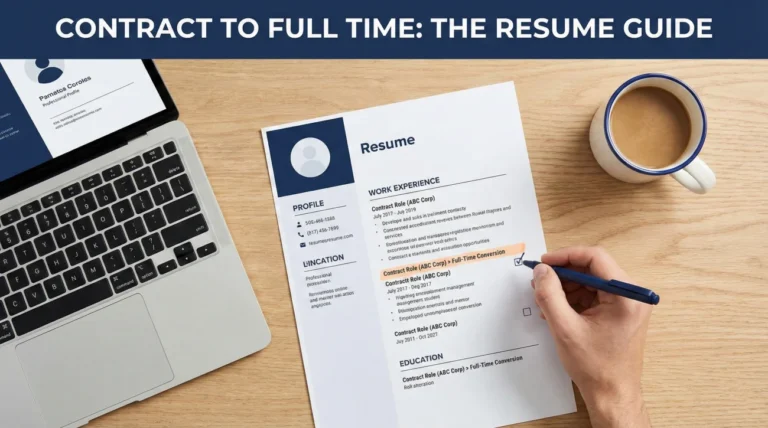
- If your summary starts with a target role and a proof hook, recruiters stop treating you like a “maybe later” candidate.
- Use one of the 7 openings below to bridge the title gap without sounding like you’re begging for a chance.
- Pick 1 proof hook (numbers, scope, tools, training, or a relevant project) and place it in line 2 so your pivot feels real.
Career Change Resume Summary: 7 Openings That Make Recruiters Read On
Most career-change summaries fail for a boring reason: They start with personality, not a position. A recruiter sees “hardworking professional” and mentally files you under “Nice, but not clearly aligned.”
So this guide is intentionally narrow. It answers one question: how to write a career change resume summary that feels stable, specific, and evidence-backed in the first two lines.
I’m writing this as someone who’s screened and interviewed career switchers for years. Not every pivot is the same, and a single “universal template” usually produces a summary that sounds like everyone else’s.
🗝️ Key Point: Your summary is not where you “explain your journey.” It is where you prove you can do the next job.
One candidate I worked with, Alena, was moving from operations into customer success. Her first draft opened with: “Motivated professional seeking a new challenge.” Nothing was technically wrong, but it read like a request, not a qualification. We changed the first 18 words and added one proof hook. The rest of her resume suddenly made more sense because the summary gave it a target.
The 3 Rules That Keep Your Summary From Sounding Like a Wish

Rule 1: Lead with the target role, even if your last title does not match
Your last job title is already visible. If your summary starts with it again, you’ve wasted the only real estate that can re-frame the story.
Instead, name the role you are applying for, then immediately give a bridge: One line that makes the pivot feel like continuity, not a leap.
Rule 2: Put a proof hook in line 2, not line 5
Career changers often say “transferable skills” and then list soft skills. Recruiters need a reason to believe your skills are operational, not theoretical.
A proof hook can be: A quantified outcome, the scope you owned, a tool stack, a credential in progress, or a relevant project with a real deliverable.
Rule 3: Motivation belongs in one phrase, not a paragraph
Yes, you can hint at why you’re switching. But if the summary turns into a personal essay, it triggers doubt: “Are they convincing me, or themselves?”
Keep motivation short and employer-facing. Think “pull toward the work” instead of “escape from the old path.”
6 Proof Hooks You Can Steal Without Making Things Up
If you’re stuck, it’s usually because you’re trying to “sound qualified” instead of showing evidence. These proof hooks are safe because they are based on things you can actually point to on the resume.
| Proof hook type | What it signals | Example fragment you can paste |
|---|---|---|
| Outcome number | You’ve delivered impact, not just tasks | “Backed by results like reducing cycle time by 22%.” |
| Scope and stakeholders | You can operate at the level of the new role | “Partnered with Sales, Ops, and Product on weekly priorities.” |
| Tool or method | You’re not starting from zero | “Hands-on with SQL basics, dashboards, and experiment readouts.” |
| Relevant project | You already do the work in smaller form | “Built a portfolio project: Customer onboarding flow redesign.” |
| Training in progress | You’re serious and structured | “Completing a certificate in data analytics (2026).” |
| Domain advantage | You bring context others lack | “Deep knowledge of healthcare workflows and compliance constraints.” |
💡 Pro Tip: Pick one proof hook for the summary, then support it again in bullets. When the same signal appears twice, the pivot feels less risky.
7 Copy Ready Openings For Career Changers
You do not need all seven. Choose the one that matches your situation, then customize the bracketed parts. Each opening is written to reduce “fit anxiety” fast.
Also, you’ll notice these do not start with “I” and they rarely use “seeking.” That’s deliberate. Recruiters read summaries like headlines.

Opening 1: Same function, new industry
Best when your day-to-day work stays similar, but the domain changes. This is where your domain advantage can do real work.
Example story: Sebastien moved from B2B SaaS support into fintech customer success. We kept the function consistent, then used the domain shift as a positive: He was already used to regulated customers and high-stakes tickets.
Opening 2: New function, same industry
This is the “internal pivot” shape. Recruiters like it because you keep domain context while changing the type of work.
If you want to naturally include professional summary career change language, this opening does it without sounding like a confession. It reads like a progression, not a restart.
Opening 3: Portfolio or project-led pivot
Use this when you built real artifacts: Case studies, dashboards, process redesigns, prototypes, or volunteer deliverables. This is one of the most persuasive shapes for switchers with limited direct titles.
Elena’s pivot worked because her “projects” were not pretend. She rebuilt an onboarding flow for a nonprofit using real customer feedback notes and a measurable retention metric. The summary referenced that artifact, so the pivot felt earned.
Opening 4: Credential plus proof, not credential alone
Certificates help, but they rarely close the gap by themselves. Pair the credential with proof of application.
⚠️ Warning: If your summary is 80% “coursework,” recruiters assume you are still at the beginning. Make the credential the supporting actor.
Opening 5: Leadership pivot without sounding like “too senior”
Some pivots are not junior moves, but they can read like downleveling if you phrase them poorly. This opening keeps authority while showing you can still execute.
This is especially useful when you want a career change resume summary that reads calm and intentional, not like you are running from management.
Opening 6: “Bridge role” narrative for non-linear paths
If your background looks like a patchwork, you can still create a clean line by naming the bridge: The repeating thread across roles that matches the target.
One colleague of mine, Sam, had titles that looked messy: analyst, ops coordinator, then community manager. The bridge theme was “customer insight to process decisions.” Once we named that, the summary made the path feel designed.
Opening 7: The “problem-first” opener
This is the sharpest option when you know the employer’s pain. You start with the problem you solve, then you attach yourself to it with proof.
If you’re collecting career change summary examples and everything feels bland, this is the pattern that tends to read like a real candidate, not a template.
A Simple Build Process: Choose, Hook, Tighten

Here’s how I usually assemble a strong summary for switchers in under 20 minutes, without turning it into a rewriting marathon.
Step 1: Choose the opening that matches your pivot type
Pick one of the seven openings above. Do not mix them. When people blend patterns, the summary becomes longer and less confident.
Step 2: Add one proof hook and delete one vague adjective
If you have “detail-oriented,” “hardworking,” or “motivated,” swap it for a proof hook. A recruiter can argue with adjectives. They cannot argue with scope, tools, and outcomes.
Step 3: Tighten the motivation into one employer-facing phrase
Examples that stay safe:
- “Now focused on roles where [target lever] drives results.”
- “Leaning into [target work] after repeated success owning [bridge tasks].”
- “Shifting toward [target function] because it has been the consistent thread in my best work.”
❌ Note: Avoid “I have always dreamed of…” in a resume summary. It can work in a conversation, but on paper it reads unverified.
Final: The Summary That Wins Attention Is the One That Sounds Like It Belongs
A career change summary is not supposed to erase your past. It’s supposed to make your past feel useful to the next employer, quickly, with evidence.
If you keep one rule, keep this one: Name the target role, add one bridge, then prove it with a hook. That structure is the cleanest answer to how to write a career change resume summary without sounding like you’re asking for permission.
When your opening reads like you already operate in the new lane, the rest of the resume stops feeling like a justification. It starts feeling like support.
❓ FAQ
🎯 Should I mention I am changing careers in the summary?
You can, but you do not have to. If the opening already shows the target role and proof, the pivot becomes obvious without the announcement. If you do mention it, keep it to one short phrase and follow it with evidence.
🧩 What if I have no direct experience in the new role?
Use a project-led opener or a credential-plus-proof opener. Recruiters do not need a perfect title match, but they do need to see that you have already practiced the core tasks in some form.
🔍 How long should a career change resume summary be?
Two to three lines is the sweet spot for most roles. If you go longer, it usually means you are explaining instead of proving. Keep it tight and let the bullets carry detail.
💼 Do I need to add tools and keywords for ATS in the summary?
Include only the tools that you can back up elsewhere on the resume. The summary is not a keyword dump. One relevant tool phrase is enough if your bullets reinforce it.
🧠 What is the biggest red flag in career change summaries?
The biggest red flag is a summary that reads like a request: “seeking,” “hoping,” “looking for an opportunity,” followed by vague soft skills. Replace that with a role-first opener and a proof hook.
⚠️ Disclaimer: ResumeSolving provides resume, cover letter, job search communication, and career transition guidance for informational purposes only. Hiring practices vary by employer, role, location, industry, and individual circumstances. We do not guarantee interviews, job offers, ATS results, or other outcomes. Verify employer requirements directly and follow applicable laws and workplace policies. For sensitive situations, use only information you are comfortable disclosing and keep all statements accurate.