- Founder bullets fail when they read like a job list or a pitch deck. You need proof that matches the role you want next.
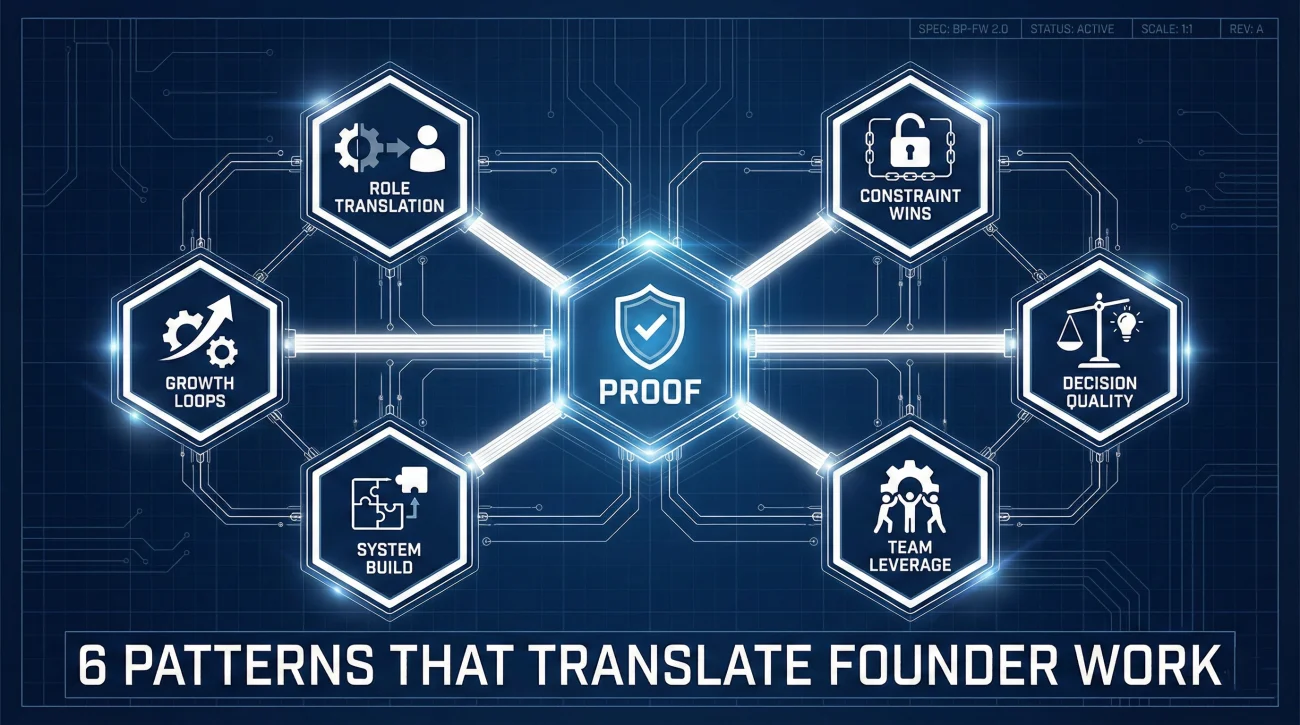
- Use 6 founder-specific patterns: Role Translation, Constraint Wins, Growth Loops, Decision Quality, System Build, Team Leverage.
- Steal from the 20 examples, then swap in your numbers, scope, and constraints without oversharing or sounding unavailable.
Why Founder Bullets Get Judged Harder
I have reviewed a lot of founder resumes over the years, and the pattern is weirdly consistent. The person is often capable, fast, and resilient, but the bullets read like chaos. Or worse: They read like self-praise.
That is why resume bullet points for founders need a different approach than a standard employee role. You are not “describing a job.” You are translating a messy, multi-hat reality into proof a hiring manager can trust.
One candidate I worked with, Mason, had built a small B2B product and wore every hat for two years. His first draft had 14 bullets under one role. Every bullet was true, and every bullet made him look less hireable. Once we changed the bullets from “everything I did” to “proof that I can do this job,” the resume stopped feeling like a founder diary and started feeling like a professional track record.
Key Point: Founder bullets are not a history lesson. They are evidence. Evidence is always selective, role-shaped, and anchored to outcomes.
The Two Founder Signals Recruiters Scan For
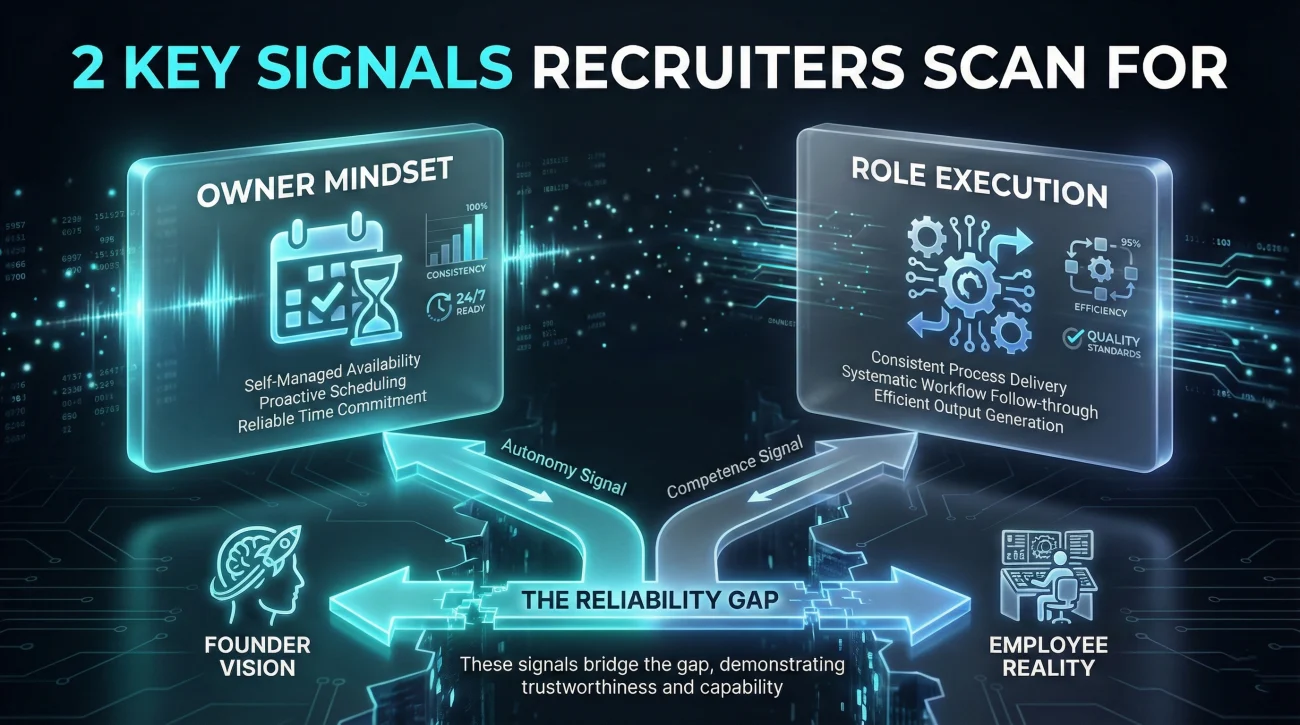
Signal One: Are You Still Operating Like An Owner
Recruiters do not dislike founders. They dislike uncertainty. A bullet like “Building my startup” sounds ongoing. A bullet like “Raised funds” without context sounds like a pitch. A bullet like “Overseeing all operations” sounds like you might struggle in a defined role.
So the first scan is simple. Are you available, scoped, and able to work inside a team structure?
Signal Two: Can You Do The Job They Are Hiring For
The second scan is even more practical. Hiring managers want proof you can do the role now. Not “you could learn it,” not “you have grit,” and not “you once built something.” They want proof of repeatable behaviors: shipping, closing, scaling, aligning stakeholders, building systems, making tradeoffs, and learning fast.
| What Your Bullet Says | What They Hear | What To Make Them Hear Instead |
|---|---|---|
| “Led marketing and sales.” | Generalist. No proof. | One loop with an outcome: pipeline, conversion, retention, or cycle time. |
| “Built the product.” | Unclear scope. Unclear role. | What you shipped, why it mattered, and how users changed behavior. |
| “Managed operations.” | Sounds like busywork. | System built: process, tool, SLA, dashboard, or cost control method. |
| “Raised funding.” | Pitch energy. Not role fit. | Decision quality: what you validated, negotiated, and executed afterward. |
Six Bullet Patterns That Translate Founder Work Into Proof
You can write founder bullets without stuffing numbers or sounding like a headline from a pitch deck. The trick is using patterns that naturally produce credibility. Here are the six I use most when a founder wants to look hireable fast.
Pattern 1: Role Translation
Founder work is vague. Role work is specific. Your bullet should quietly answer: “Which function did you operate as?”
[Function Title] + [Deliverable] + [Stakeholder] + [Outcome Signal]
💡 Pro Tip: Pick the function that matches the job you are applying for, not the function you spent the most hours on.
Pattern 2: Constraint Wins
Founders rarely have perfect conditions. That is a feature, not a flaw, if you frame it as problem-solving under constraints.
[Constraint] + [Decision] + [Execution] + [Result Or Tradeoff]
Pattern 3: Growth Loop, Not Vanity Metric
Instead of shouting “growth,” show the loop you built: acquisition channel, activation moment, retention lever, or sales cycle improvement. This works even when you cannot share exact revenue.
[Lever] + [Experiment Or System] + [Behavior Change] + [Business Impact Proxy]
Pattern 4: Decision Quality Under Uncertainty
A lot of founder work is tradeoffs. Hiring managers respect tradeoffs when you show how you chose and what you learned.
[Choice] + [Data Signal] + [What You Cut] + [What Improved]
Pattern 5: System Built That Outlives You
Founder credibility spikes when you show you built a repeatable system, not just worked hard. Systems are easier to trust than “hustle.”
[System] + [Process Or Tooling] + [Cadence] + [Reliability Outcome]
Pattern 6: Team Leverage Without Ego
Many founders write leadership bullets like a CEO bio. Instead, write leadership as leverage: hiring decisions, delegation, operating rhythm, and outcomes the team delivered.
[Team] + [Operating Method] + [Execution] + [Impact]
My colleague Yoshie (also HR, and very blunt in a helpful way) says she trusts founder bullets only when she can see the operating rhythm. Not inspiration. Not vision. Rhythm: what shipped, what changed, what improved, and how often.
Twenty Founder Bullet Examples You Can Adapt
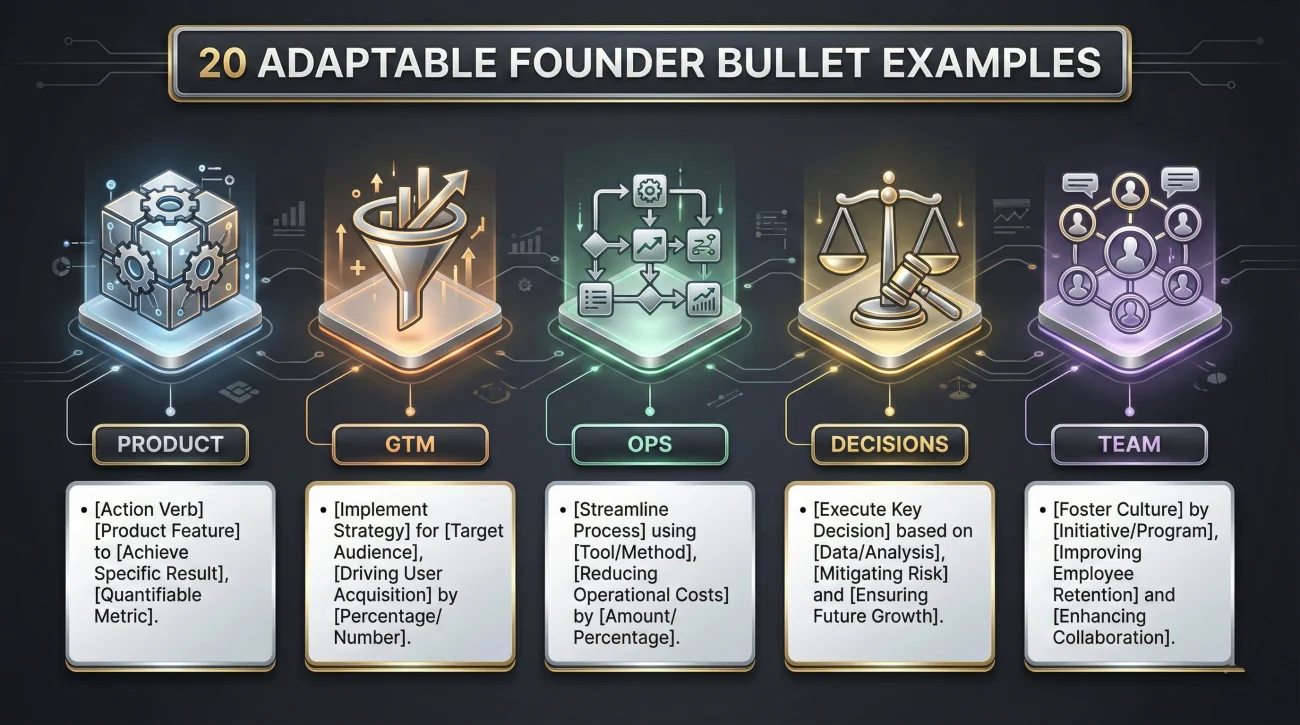
These are written to feel credible in a normal hiring process. They avoid founder bravado, but they still show ambition and ownership. If you are tempted to make them “bigger,” pause and make them clearer instead.
Product Outcomes (Role Translation):
• Defined MVP scope, ran weekly user interviews, and delivered two releases that improved activation for the core use case
• Built a simple feature intake and prioritization system, aligning engineering and customer feedback into one roadmap
• Rewrote pricing page and packaging narrative after user testing, improving qualified demo requests without changing ad spend
Go-To-Market Proof (Growth Loop):
• Launched partner channel with two integrations, creating a repeatable referral path instead of one-off intros
• Ran weekly funnel experiments across landing page, email, and demo flow, improving conversion at the activation step
• Repositioned target segment after churn analysis, improving retention by focusing on users with a clear recurring need
Operations And Systems (System Built):
• Built customer support playbook and escalation rules, keeping response quality consistent as volume increased
• Set up KPI dashboard for weekly review, turning “gut feel” decisions into measurable priorities
• Standardized contractor workflow with checklists and QA steps, reducing rework and missed deadlines
Decision Quality (Tradeoffs That Read Mature):
• Chose to pause a new market launch after early signals showed weak fit, protecting runway and focusing on core demand
• Simplified the product from three tiers to one core package, improving buyer clarity and reducing friction in demos
• Changed onboarding from “feature tour” to “first value in 10 minutes,” improving early adoption for new accounts
Team Leverage (Leadership Without Ego):
• Delegated customer onboarding to a trained specialist, freeing product time while improving consistency for new clients
• Built a lightweight hiring scorecard, improving interview consistency and reducing costly mis-hires
• Introduced sprint retrospectives and post-launch reviews, improving execution quality and catching issues earlier
Constraint Wins (Proof Without Sensitive Metrics):
• Rebuilt the onboarding flow under strict timeline constraints, improving adoption through clearer first-use guidance
• Negotiated vendor terms to protect cash flow, keeping operations stable during a tight runway period
• Created a customer feedback loop that prioritized retention fixes first, reducing churn signals without sharing private numbers
⚠️ Warning: If every bullet sounds like “I did everything,” the reader assumes you did nothing deeply. Pick the three to five bullets that prove the job you want next.
One more real moment. Elena, a founder applying for a Product Ops role, insisted she needed to list fundraising, legal, and “company strategy” because it was “the biggest work.” The hiring manager did not care. Once we replaced those with operating rhythm bullets, she started getting interviews. The truth did not change. The proof got sharper.
Do-Not-Do List For Founder Bullets
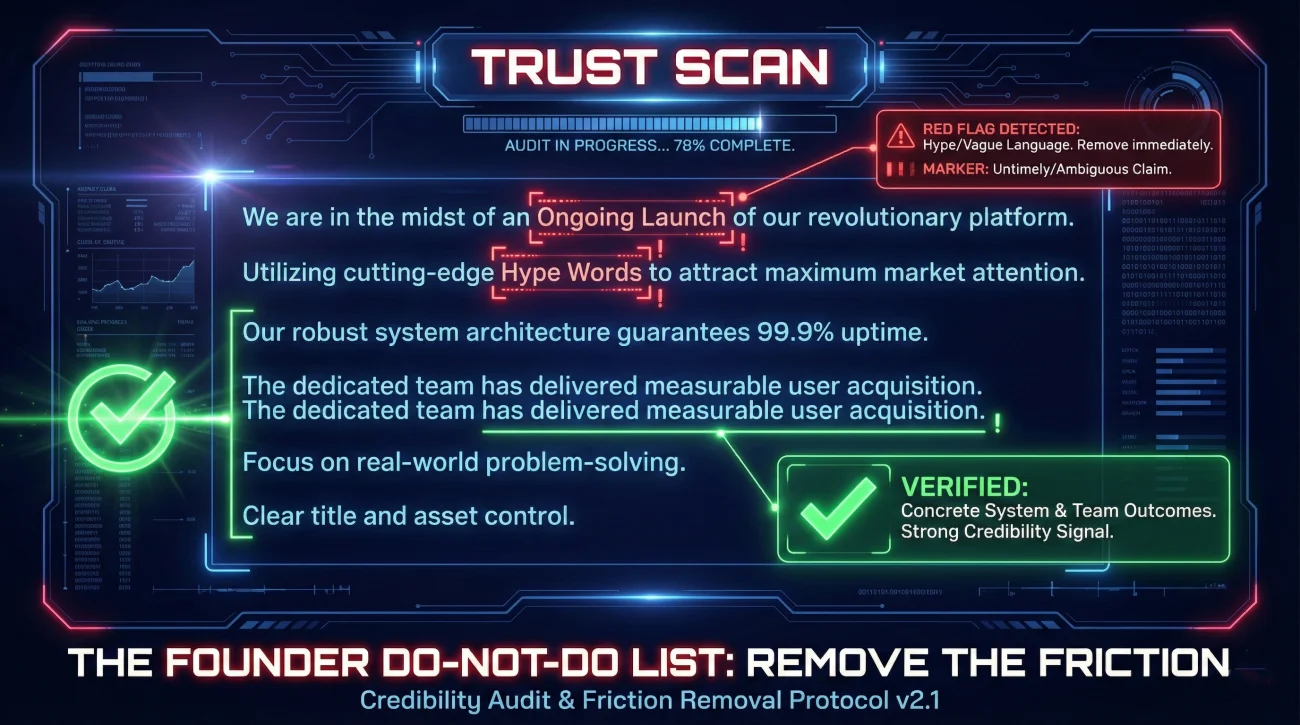
This is the part most templates never say out loud. Founder bullets can trigger specific recruiter doubts. Avoid these patterns and you remove friction before it starts.
❌ Note: These are not “writing style preferences.” These are trust killers.
- Do not write bullets that sound ongoing: “Building,” “Currently launching,” “In the process of.”
- Do not stack vague verbs: “Oversaw,” “Handled,” “Worked on,” unless the next phrase is concrete proof.
- Do not write vanity claims without mechanism: “Grew fast,” “Scaled rapidly,” “Exploded growth.”
- Do not make every bullet about you: Show systems, team outcomes, and customer behavior changes.
- Do not dump every hat you wore: Pick the hats that match the target role.
- Do not write like a pitch deck: Avoid hype words that belong in fundraising, not hiring.
Founder Wording Swaps That Make You Sound Hireable
Founder language is usually “ownership language.” Hiring language is “execution language.” The swap is not about shrinking your work. It is about making it legible.
| Avoid This | Use This Instead | Why It Works |
|---|---|---|
| “Built a startup from scratch.” | “Launched a product and built repeatable delivery across product, GTM, and ops.” | Turns identity into operating proof. |
| “Wore many hats.” | “Operated as [target function] while building supporting systems.” | Signals focus instead of chaos. |
| “Responsible for all company strategy.” | “Set quarterly priorities and shipped weekly improvements tied to customer outcomes.” | Shows rhythm and execution. |
| “Drove growth.” | “Built and iterated a growth loop across acquisition, activation, and retention.” | Mechanism beats bragging. |
| “Managed a team.” | “Built hiring criteria, delegation model, and delivery cadence that improved consistency.” | Leadership as leverage, not status. |
If you want a simple check: Read your bullets and ask, “Would this sound normal if it were written by an employee?” If the answer is no, it is probably too founder-coded.
Final
Founder experience is not the problem. The problem is how it reads at speed. When your bullets look like a task list, you sound unfocused. When they look like a pitch, you sound risky. The fix is writing bullets as evidence: role-shaped, outcome-anchored, and operationally specific.
If you take nothing else: Pick one target role, choose two to three proof loops that match it, and write your startup work through those loops. That is how resume bullet points for founders stop sounding like “founder energy” and start sounding like “hireable track record.”
❓ FAQ
🎯 How many bullets should a founder list under the startup role?
Most founders do best with 3 to 5 bullets, not 10+. Pick the bullets that prove the job you want next, not the full story of the company.
🧩 What if I cannot share revenue, users, or exact numbers?
You can still show proof by describing mechanisms and proxies: cycle time improvements, adoption behaviors, funnel conversion steps, process reliability, or operational cadence. The goal is credible specificity, not public metrics.
🛠️ Should I write “Founder” or a functional title in my bullets?
Use “Founder” as the role label if needed, but write bullets as functional proof aligned to the target job. Your bullets should read like a Product, Growth, Ops, or Sales professional who happened to do it in a startup context.
📌 How do I avoid sounding like I am still running the startup?
Avoid ongoing verbs and present-tense framing. Use completed language, clear time boundaries, and outcome-based bullets that feel closed and professional.
💬 Are “I” statements okay inside resume bullets for founders?
No. Keep bullets in standard resume style with strong verbs and clear objects. The credibility comes from specificity and outcomes, not first-person voice.
🔍 What is the fastest way to tailor founder bullets for a specific job?
Choose 2 to 3 requirements from the job description and rewrite your bullets using the six patterns, focusing on the closest matching loop: system, growth mechanism, decision tradeoff, or team execution.
⚠️ Disclaimer: ResumeSolving provides resume, cover letter, job search communication, and career transition guidance for informational purposes only. Hiring practices vary by employer, role, location, industry, and individual circumstances. We do not guarantee interviews, job offers, ATS results, or other outcomes. Verify employer requirements directly and follow applicable laws and workplace policies. For sensitive situations, use only information you are comfortable disclosing and keep all statements accurate.