- If your contract timeline looks chaotic, recruiters assume your work was chaotic too. Your job is to make the time story feel intentional.
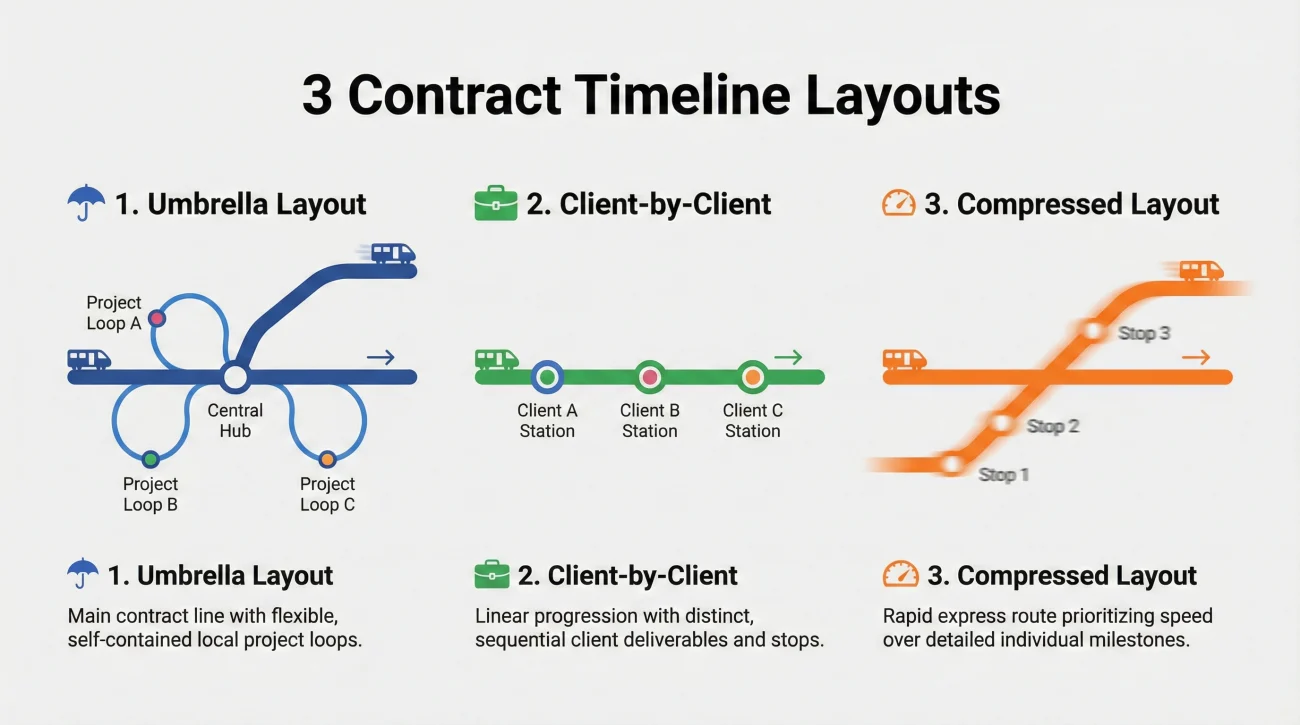
- Pick one of 3 layouts: Umbrella role with projects, Client-by-client entries, or One client with renewals compressed.
- Use month and year, label the relationship clearly, and keep the format consistent so short contracts do not read as instability.
Contract dates are not a detail. They are the story.
I have seen strong contractors lose interviews for one boring reason: Their timeline looked like a series of accidents. Nothing about their work was messy, but the dates made it feel that way.
This guide is about how to list contract work dates on resume so a recruiter reads your experience as continuity, not chaos. You are not hiding anything. You are choosing the cleanest timeline structure for how contract work actually functions.
Your goal is not to prove you were “busy.” Your goal is to prove you were “reliable,” and reliability is a timeline feeling.
Choose one timeline layout. Do not mix three.
Most weak resumes do not have a date problem. They have a structure problem. Contract work can be presented in multiple truthful ways, but you should commit to one layout so the reader does not have to decode you.
| Layout | Best when | What it signals |
|---|---|---|
| Umbrella role + selected projects | You had many short gigs, overlapping clients, or repeat work under one “independent” identity | Continuity and control |
| Client-by-client entries | You had a few meaningful contracts where each client matters to the target role | Clear progression and relevance |
| One client + renewals compressed | You worked with the same client across multiple renewals or agencies | Stability, long-term trust |
Layout 1: Umbrella role plus projects
This is the cleanest answer when your calendar was busy but your story is simple: You operated as a contractor and delivered outcomes for multiple clients. Put the continuity at the top, then list projects underneath with dates.
It is also the safest way to show multiple client contract resume work without making it look like you changed jobs every 10 weeks.
Layout 2: Client-by-client entries
Use this when your clients are recognizable, the scope was substantial, and you want each contract to stand as a role. The risk is visual instability, so keep formatting tight and only include contracts that support the target job.
Layout 3: One client, renewals compressed
I had a candidate, Mel, who kept getting hired back by the same fintech but through different staffing vendors. Her resume listed three “different employers” in two years, and recruiters assumed she was bouncing around. We rewrote it as one continuous client engagement with a short line explaining the vendor changes. Same truth, better read.
Rules that keep contract dates from looking unstable
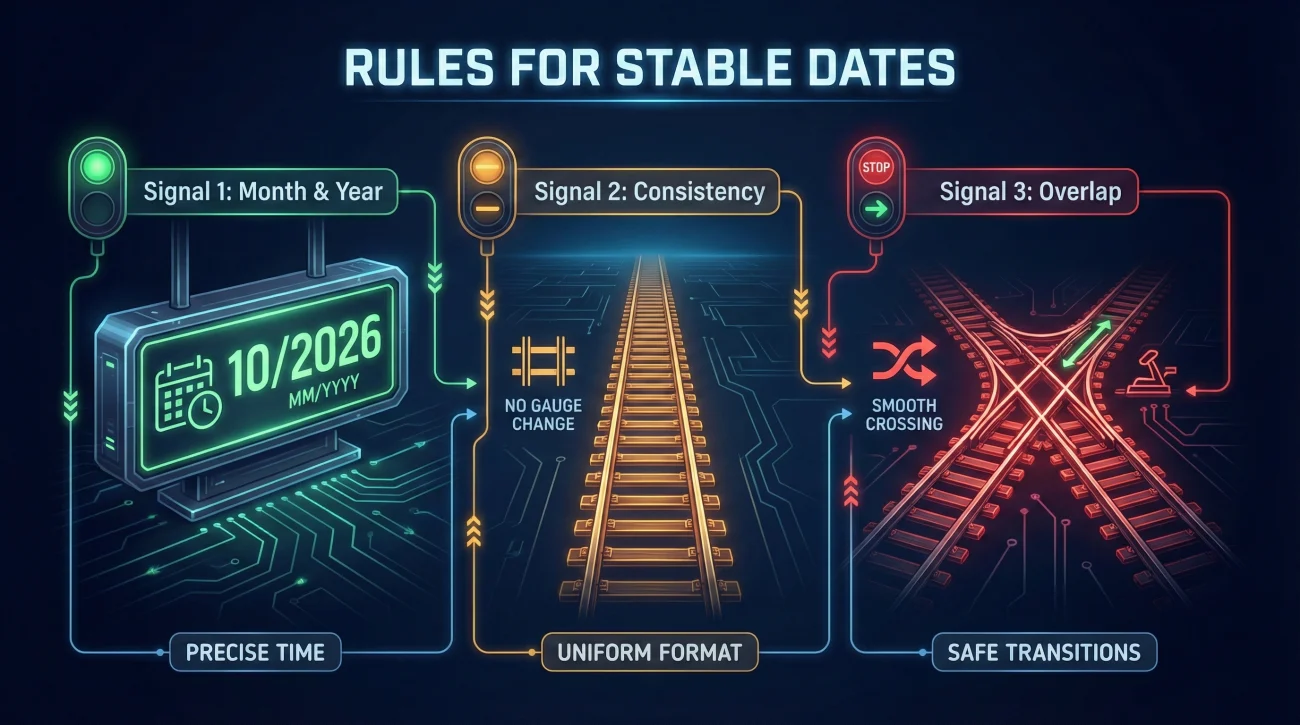
These rules are boring, which is exactly why they work. Your date formatting should disappear so the reader focuses on results.
Rule 1: Use month and year, not exact days
Exact days usually add noise. Month and year gives clarity without drawing attention to short gaps between projects.
If you are dealing with contract dates resume entries that are 6 to 10 weeks long, month and year is the difference between “normal contracting” and “why is this person leaving so fast.”
Rule 2: Keep one date style across the whole resume
Do not format your employee roles one way and your contract roles another way. Consistency is what makes contract work feel like part of a career, not a separate category.
Rule 3: If contracts overlap, do not pretend they did not
Overlap is normal in consulting, freelancing, fractional work, and project delivery. The mistake is listing them as if they were sequential, which creates impossible timelines. Use an umbrella role with projects, or show that the contracts were part-time.
Key Point: Recruiters do not panic because you did contract work. They panic when the dates force them to guess what actually happened.
Labeling options: Client, agency, or “independent”
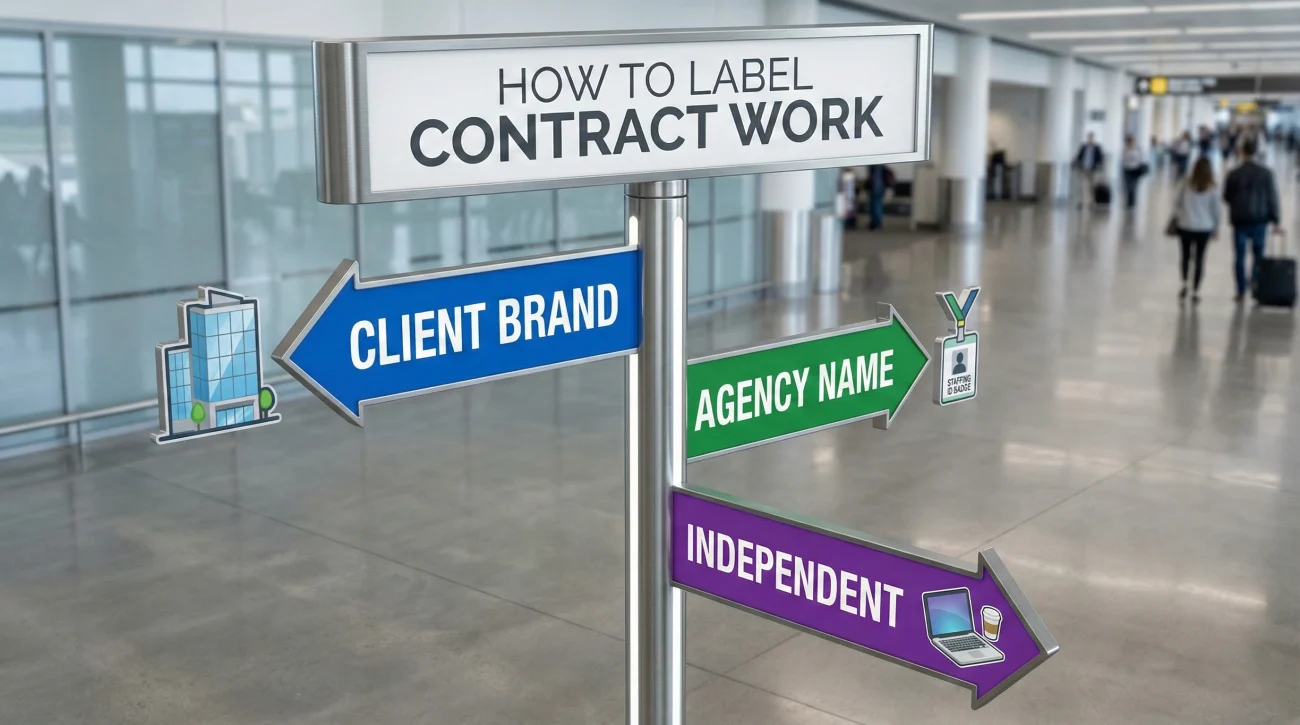
The biggest confusion is what name to put on the line. Here is a practical rule: Use the name that makes the reader understand the work, then add the other party as a clarifier when needed.
| What you write | When it works | Small clarifier to add |
|---|---|---|
| Client as the company name | Your work was directed by the client and that brand matters | “Contract via [Agency]” |
| Agency as the company name | The agency was the true employer and the client brand is not essential | “Assigned to [Client]” |
| Independent Consultant as the company name | You had many clients or your work was self-sourced | List clients as projects with dates |
| Confidential client | NDA or sensitive work | “Confidential enterprise client” with scope and outcome |
⚠️ Warning: Do not invent a company name that sounds like a real firm if you did not have one. If you want an umbrella entry, “Independent Consultant” or “Freelance [Role]” is clean and honest.
Six examples you can copy, depending on your situation
Below are six different “date stories.” Pick the one that matches how your work actually happened, then match the formatting everywhere else.
Example 1 (Single contract, simple):
– Built pricing model used by 12 category managers, reducing weekly pricing review time by 30%
– Partnered with Finance and Merchandising to validate margin assumptions and rollout rules
Example 2 (Client name first, agency noted):
– Migrated reporting pipelines to a new warehouse, cutting query times from minutes to seconds
– Created monitoring alerts that reduced incident triage time by 40%
Example 3 (Same client, renewals compressed):
– Renewed across multiple vendor transitions; continuous engagement supporting operations scale-up
– Led vendor onboarding playbook that shortened launch timelines by 3 weeks per region
Example 4 (Umbrella role with projects):
Clients and projects:
– Fintech onboarding rewrite | Aug 2024 – Nov 2024: Improved activation by 12% through clearer step copy
– Healthcare portal microcopy audit | Feb 2024 – Apr 2024: Reduced support tickets by 18% for top flows
– Ecommerce checkout testing | Oct 2023 – Dec 2023: Increased checkout completion by 7%
Example 5 (Overlapping part-time contracts made explicit):
– Standardized lifecycle reporting and attribution, improving MQL to SQL visibility across 3 segments
Marketing Analytics Consultant (Contract, Part-time) | Redwood SaaS | Mar 2024 – Aug 2024
– Built dashboards for pipeline velocity and retention, used in weekly exec reviews
Example 6 (Confidential client, project-first framing):
– Supported incident response readiness and access review cleanup across a 2,000+ user environment
– Documented remediation workflows that improved handoffs between IT and Security teams
If your reader is confused after the first two lines, the issue is not your experience. It is your layout. That is why the format matters as much as the bullets.
Also, when you are writing freelance dates resume entries, the umbrella format is often the simplest way to show a real timeline without creating 10 tiny “jobs.”
Common red flags and the clean fixes
Contract resumes get punished for patterns that are normal. The fix is almost always labeling and compression, not hiding.
- 🚩 Too many one-line contracts with no context: Use an umbrella role and list projects underneath.
- 🚩 Same client appears multiple times under different agencies: Compress into one client timeline and add a one-line note about vendor transitions.
- 🚩 Gaps between gigs look like unemployment: Use month and year, keep the narrative in bullets outcome-focused, and do not over-explain.
- 🚩 Projects look like hobbies: Tie each project to business outcomes and role-relevant tools, especially for project dates on resume entries.
I once reviewed a contractor resume where every line screamed activity, but none of it screamed trust. After we simplified the dates and anchored the story around one umbrella engagement, the resume finally read like a professional timeline, not a gig ledger.
Final
The cleanest contract resume is the one that makes your dates feel predictable. Not long. Predictable. When your timeline layout matches how contract work actually happens, the reader stops doing math and starts reading your impact.
If you remember one thing, let it be this: how to list contract work dates on resume is really about choosing a structure that makes your work look continuous, even when the projects were not.
❓ FAQ
🧭 Should I list contract work as one job or multiple jobs?
If you had many small gigs or overlapping clients, one umbrella entry with projects underneath is usually clearer. If you had a few major contracts that map directly to the target role, separate entries can work. The best choice is the one that a recruiter can understand in five seconds.
🧾 Do I have to list the staffing agency name?
Not always. If the client brand matters more and your day-to-day was directed by the client, list the client and add a small “Contract via [Agency]” note. If the agency was the real employer and the client is not essential, list the agency and add “Assigned to [Client].”
🧩 What if I had contract gaps between projects?
Small gaps are normal. Use month and year, keep the timeline consistent, and do not draw attention to the gaps with extra explanation. If the gap was longer and you did training or meaningful work, add it as its own entry so the timeline stays honest and readable.
🕵️ How do I handle confidential clients under NDA?
Use a neutral label like “Confidential enterprise client,” then describe the scope in a way that proves credibility: industry, scale, systems, and outcomes. Keep it specific enough to feel real, but not specific enough to violate confidentiality.
📅 Can I show only years instead of months for contract work?
You can, but it is a tradeoff. Year-only reduces the appearance of short stints, but it also reduces clarity. For most contractors, month and year is the sweet spot because it is readable and still normalizes short engagements.
⚠️ Disclaimer: ResumeSolving provides resume, cover letter, job search communication, and career transition guidance for informational purposes only. Hiring practices vary by employer, role, location, industry, and individual circumstances. We do not guarantee interviews, job offers, ATS results, or other outcomes. Verify employer requirements directly and follow applicable laws and workplace policies. For sensitive situations, use only information you are comfortable disclosing and keep all statements accurate.